Jardin des Plantes: Paris's Ancient Botanical Garden Worth Half a Day
Founded in 1626 as a royal medicinal herb garden, the Jardin des Plantes is France's principal botanical garden and one of Paris's most underrated green spaces. Free to enter and open every day of the year, it combines formal flowerbeds, towering greenhouse pavilions, a zoo, and four natural history museums inside a single 28-hectare site on the left bank of the Seine.
Quick Facts
- Location
- 57 rue Cuvier, 75005 Paris (5th arrondissement)
- Getting There
- Métro Line 7: Place Monge or Censier-Daubenton; RER C: Gare d'Austerlitz
- Time Needed
- 2–4 hours for gardens; full day if including museums and zoo
- Cost
- Gardens: free. Zoo and museum galleries: paid separately (prices vary)
- Best for
- Families, botany lovers, history enthusiasts, quiet morning walks
- Official website
- www.jardindesplantesdeparis.fr/en
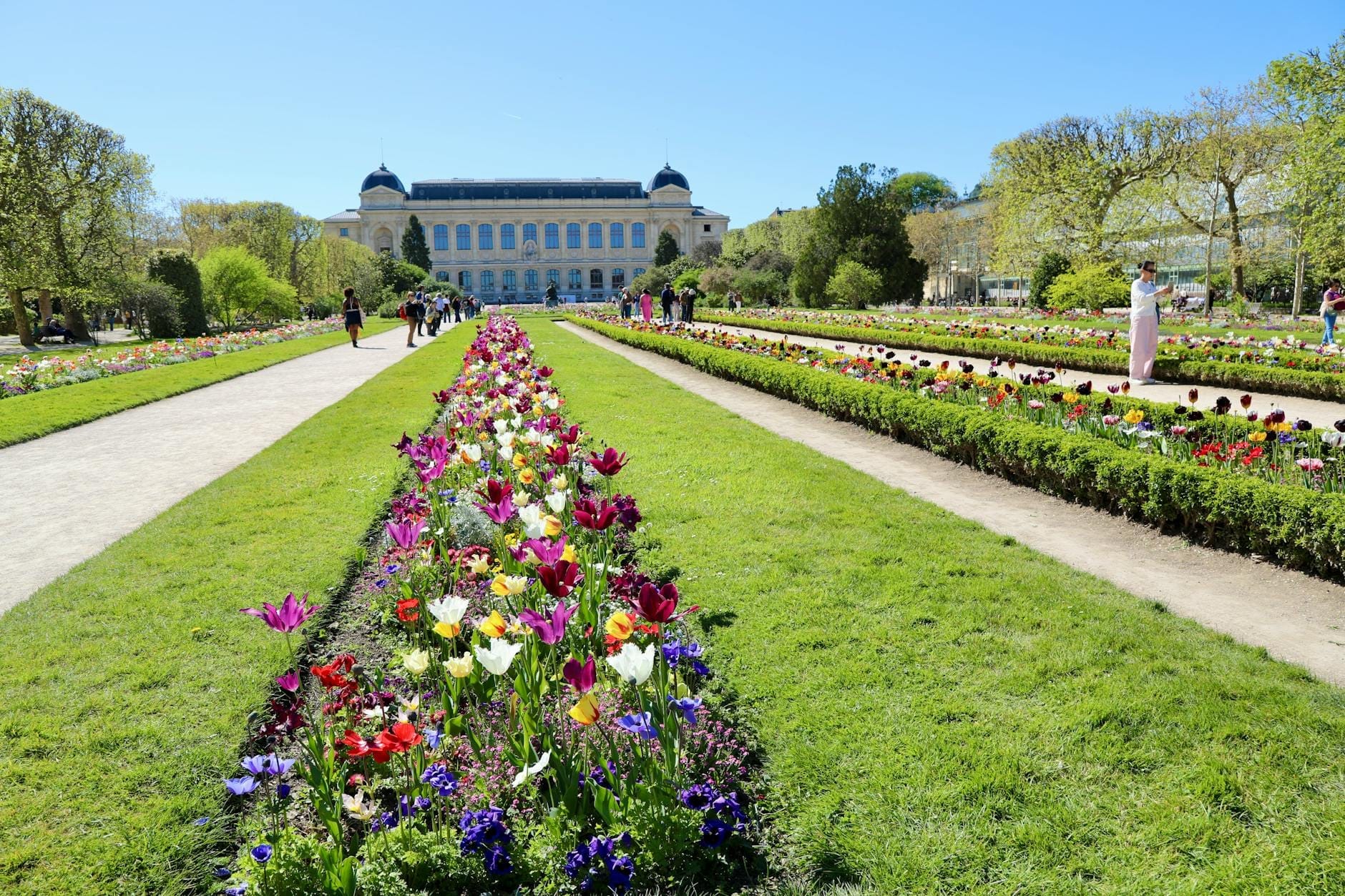
What the Jardin des Plantes Actually Is
The Jardin des Plantes is not simply a park. It is France's main botanical garden, a working scientific institution run by the Muséum National d'Histoire Naturelle, spread across roughly 28 hectares on the left bank of the Seine. It contains formal gardens, research greenhouses, a zoo (the Ménagerie), an alpine garden, an iris and perennial garden, an ecological garden, and four museums. Garden entry is free; the museums and zoo charge their own admission. Its full historical name, the Jardin Royal des Plantes Médicinales, explains its origins: created in 1626 under Louis XIII to grow medicinal plants for royal physicians, it was opened to the public in 1640, making it one of the oldest continuously public green spaces in Europe.
ℹ️ Good to know
The garden is open every day of the year. Summer hours run approximately 7:30 a.m. to 8 p.m.; winter hours are shorter, around 8 a.m. to 5:30 p.m. The Alpine Garden closes annually from early November through late February. Always check the official site before visiting, as times can shift seasonally.
The Garden at Different Hours
Early morning, before 9 a.m., the main allée is almost entirely still. The scent of damp earth and cut grass carries from the central flowerbeds. Elderly Parisians walk the gravel paths at a measured pace. The light, filtered through rows of plane trees, falls in long cool strips across the ground. By midday the character shifts: students eat lunch on the lawns, families cluster near the Ménagerie entrance, and a low hum of city noise spills over the walls. The garden is large enough that a quieter corner is always findable; the rue Geoffroy Saint-Hilaire side draws fewer visitors even at peak hours.
Late afternoon in spring and summer is when color is most concentrated. The iris beds in May produce a faintly sweet smell that drifts across the central paths; the perennial borders shift from violet to gold as the light drops. The garden empties steadily after 6 p.m., and the last thirty minutes before closing deliver a near-empty version of the formal allée that few visitors see.
Tickets & tours
Hand-picked options from our booking partner. Prices are indicative; availability and final rates are confirmed when you complete your booking.
Investigative visit, The Prisoner of the Bastille
From 14 €Instant confirmationFree cancellationPastry and chocolate tour in Saint-Germain-des-Pres neighborhood
From 109 €Instant confirmationFree cancellationWalking tour of Saint-Germain-des-Pres neighborhood
From 104 €Instant confirmationFree cancellationGuided tour of Les Invalides with Tomb of Napoleon
From 89 €Instant confirmation
The Grand Allée and Formal Gardens
The spine of the garden is the Grand Allée, a long central axis running from the rue Cuvier entrance toward the greenhouses and galleries at the far end. Designed in the French formal style, it has symmetrical flowerbeds and clipped borders framed by mature plane trees, replanted seasonally from tulips in early spring to dahlias in late summer. At the northern end, the labyrinth, a small wooded hill with a spiral path, offers the only elevation in the grounds. An octagonal 18th-century gazebo sits at the summit; the climb takes two minutes and delivers a clear view over the tree canopy. The hill's peak also marks the site of the garden's oldest tree, a false acacia (Robinia pseudoacacia) planted around 1636.
The Greenhouses and Specialized Gardens
The 19th-century greenhouse complex along the western edge is the most architecturally striking part of the site. The Grande Serre, an iron and glass pavilion, houses tropical and arid-zone plants; inside, the temperature and humidity shift abruptly from the Paris air outside, and the smell is damp and organic, closer to a forest floor than a conservatory. The winter greenhouse holds succulents and cacti; the tropical greenhouse grows species that would not survive a Paris winter outdoors. The Alpine Garden, near the rue Buffon boundary, is open only from March through October and contains mountain plants from Europe and Asia: small, densely packed, and easy to overlook, but one of the more serious botanical collections in the institution.
💡 Local tip
If you visit in May, the Iris Garden is at peak bloom and arguably the single most photogenic part of the garden. Arrive in the morning for soft directional light and no crowds. For photography advice on Paris green spaces more broadly, see our guide to the best photo spots in Paris.
The Museums and the Ménagerie
Four museums operated by the Muséum National d'Histoire Naturelle sit within the garden boundary. The Grande Galerie de l'Évolution is the most visited: a soaring 19th-century hall that was restored in 1994 and now contains an enormous parade of taxidermied animals arranged to suggest a migration across the nave. It is genuinely impressive as architecture and as display, and the children's section on the lower level is well-designed enough to hold attention for an hour. The Paris with kids guide covers it in more detail alongside other family-friendly options across the city.
The other three galleries — Minéralogie et de Géologie, Paléontologie et d'Anatomie Comparée, and Botanique — are quieter and reward curiosity. The paleontology gallery, with its long rows of chronologically arranged skeletons, has an austere grandeur that more theatrical natural history museums lack. Each museum charges separate admission; a combined ticket is available.
The Ménagerie du Jardin des Plantes is the oldest public zoo in France, established in 1794. It is a compact urban zoo, not suited to large savanna animals, but it maintains notable collections of reptiles, invertebrates, and microzoology that larger zoos rarely prioritize, with species tied to active MNHN research programs. Budget at least 90 minutes here with children. See the best parks and gardens in Paris guide for how it compares to other green spaces.
Getting There and Getting Around
The most practical Métro stops are Place Monge and Censier-Daubenton (both Line 7), each about a 5-minute walk to the rue Cuvier entrance. RER C stops at Gare d'Austerlitz, which borders the southeastern edge and gives direct access through the back gate — ideal if you plan the museums first. The garden slots naturally into a day covering the Latin Quarter and the wider 5th arrondissement. The rue Geoffroy Saint-Hilaire entrance leads more directly to the zoo and southern greenhouses. Most paths are flat gravel; the labyrinth hill is unpaved. Wheelchair loans are available by calling +33 (0)1 40 79 54 79.
⚠️ What to skip
Evacuation of the garden begins 15 minutes before official closing time. Visitors still inside at that point will be directed to exit. Last admission to the museums is also 15 minutes before their listed closing time. In cases of severe weather, parts of the site may close without prior notice.
Historical and Scientific Context
The garden's scientific pedigree is considerable. Georges-Louis Leclerc de Buffon, who directed the garden from 1739 to 1788, transformed it from a medicinal herb plot into a serious research institution. Jean-Baptiste Lamarck and Georges Cuvier both worked here, and the museum's collections fed directly into 19th-century debates about evolution and extinction. After the Revolution, seized royal menageries were consolidated here, establishing the zoo in 1794. The garden sits in a historically academic neighborhood: the Sorbonne is less than 15 minutes west on foot, the Musée de Cluny with its medieval Roman baths is within easy walking distance, and the whole area rewards a full left-bank intellectual itinerary.
Honest Assessment: Who Should Adjust Expectations
Visitors expecting a showpiece in the style of the Jardin du Luxembourg will find the Jardin des Plantes more functional and academic. The flowerbeds are well kept, but the emphasis is on scientific collections rather than theatrical display. The zoo is historically significant but compact by modern standards. Paths near the Ménagerie can crowd on weekend afternoons during school holidays. If you have only one afternoon and want maximum visual impact, the Luxembourg is the more concentrated choice. But if you want a place where the plant labels actually mean something, where the museums carry scientific weight, and where the history is not merely decorative, the Jardin des Plantes is the more interesting destination.
Insider Tips
- The labyrinth hill closes earlier than the rest of the garden in some seasons — check the access board at the main entrance. The view from the summit over the tree canopy is worth the short climb and is almost never mentioned in standard guides.
- The Galerie de Paléontologie et d'Anatomie Comparée is far less crowded than the Grande Galerie de l'Évolution and arguably more atmospheric: the 19th-century display cases and skeleton arrangements have barely changed in a century.
- The garden's ecological enclosure has restricted access — contact the garden in advance if you want to visit this section, as it is not part of the general free-access area.
- Come on a weekday morning between September and October for the calmest visit: summer crowds have thinned, temperatures are comfortable, and the perennial borders are still in late color before the winter cutback.
- The RER C entrance via Gare d'Austerlitz deposits you at the least-used gate, directly beside the ecology garden and a five-minute walk from the paleontology museum — a better starting point if you plan to do museums first and gardens after.
Who Is Jardin des Plantes For?
- Families with children, thanks to the Ménagerie and the interactive Grande Galerie de l'Évolution
- Botany and natural history enthusiasts who want scientific depth rather than pure aesthetics
- Travelers following a left-bank intellectual itinerary covering the Latin Quarter and Saint-Germain
- Photographers, particularly in May for the iris and alpine gardens, or in autumn for the plane-tree allée
- Budget travelers: the garden grounds, including the Grand Allée and most outdoor areas, are entirely free
Nearby Attractions
Other things to see while in Saint-Germain-des-Prés & the Latin Quarter:
- Catacombs of Paris
Twenty metres underground, the Catacombs of Paris hold the remains of more than six million people in a network of former limestone quarries beneath the 14th arrondissement. It is one of the most unusual historical sites in Europe, and one of the most crowded. Here is what visiting actually looks like.
- Jardin du Luxembourg
Spread across 25.72 hectares in the heart of the 6th arrondissement, Jardin du Luxembourg is Paris's most refined public garden. Created in 1612 by Marie de Médicis, it blends French formal geometry with wilder English-style landscaping, 102 statues, a working orchard, and the grand Luxembourg Palace. Entry is free and the atmosphere shifts completely depending on the hour.
- Latin Quarter (Saint-Michel)
The Latin Quarter is Paris's most historically layered neighborhood, stretching across the 5th and 6th arrondissements on the Left Bank. From the monumental Saint-Michel Fountain to streets that follow paths worn by Roman Lutetia, this is a district where two thousand years of intellectual and political life are woven into the stone. Entry is free, and it rewards exploration at any hour.
- Musée de Cluny (Medieval Museum)
The Musée de Cluny — officially the Musée national du Moyen Âge — holds one of the world's most complete collections of medieval art inside a 15th-century mansion built over 1st-century Roman baths. Its crown jewel, the Lady and the Unicorn tapestry cycle, is alone worth the admission.