The Catacombs of Paris: What to Know Before You Descend
Twenty metres underground, the Catacombs of Paris hold the remains of more than six million people in a network of former limestone quarries beneath the 14th arrondissement. It is one of the most unusual historical sites in Europe, and one of the most crowded. Here is what visiting actually looks like.
Quick Facts
- Location
- 1 avenue du Colonel Henri Rol-Tanguy, 75014 Paris (Place Denfert-Rochereau)
- Getting There
- Denfert-Rochereau (Métro lines 4, 6, RER B)
- Time Needed
- 1.5 to 2 hours for the main circuit (1.5 km)
- Cost
- €31 full price, €25 reduced (audio guide included). Online booking strongly recommended.
- Best for
- History lovers, those drawn to unusual or macabre sites, teenagers, and curious first-timers with a steady knee
- Official website
- www.catacombes.paris.fr/en
What the Catacombs of Paris Actually Are
The Catacombs of Paris, officially Les Catacombes de Paris, are not simply a burial tunnel. They are the ossuary section of a far larger subterranean network: roughly 300 kilometres of former limestone quarries carved beneath the city from the Middle Ages onward. The stone extracted here built Notre-Dame, the Louvre, and much of historical Paris. What visitors descend into on avenue du Colonel Henri Rol-Tanguy is a curated, consecrated slice of that underground world.
The ossuary was consecrated on April 7, 1786, when city authorities faced a public health crisis: the Saints-Innocents cemetery had been in use for ten centuries and was contaminating nearby wells. Between 1787 and 1814, the remains of over six million Parisians were transferred underground and, from 1810 onward, arranged into the stacked walls and decorative patterns visitors see today under the supervision of Paris mine inspector Louis-Étienne Héricart de Thury. The site opened to the public in 1809.
ℹ️ Good to know
The Catacombs reopened in April 2025 following a major renovation project. Visiting now means encountering restored areas that had been inaccessible or degraded for years. Book tickets online in advance — the maximum capacity is around 200 visitors at a time and slots sell out days or weeks ahead.
Descending: The Physical Experience
The entry point is a modest green kiosk on Place Denfert-Rochereau, with nothing above ground to signal what lies below. You descend 131 steps down a tight spiral staircase to a depth of 20 metres (65 feet). The air stabilises at around 14°C (57°F) year-round: welcome relief in August heat, but cold enough in winter to justify a light layer regardless of the temperature above ground.
Before reaching the ossuary, you walk through roughly 800 metres of dark quarry passages. The ceiling is low in sections, the floor uneven, and humidity coats the stone walls in a visible sheen. Information panels in English describe the quarry's geological and civic history. Most visitors press forward quickly, which means this section is often quieter. Take your time: the lutetian limestone here, deposited during the Eocene epoch, is part of the same stone that built Notre-Dame and the Louvre above ground.
⚠️ What to skip
Wear shoes with grip and a closed toe. The floor is wet in places and uneven throughout. The exit requires climbing 112 steps up a separate staircase with no alternative route. This site is not accessible for wheelchair users or visitors with significant mobility limitations.
Tickets & tours
Hand-picked options from our booking partner. Prices are indicative; availability and final rates are confirmed when you complete your booking.
Paris Catacombs skip-the-line guided tour with restricted area access
From 135 €Instant confirmationParis Catacombs Tour with Access to Secret Rooms
From 149 €Instant confirmationFree cancellationCatacombs guided tour with skip-the-line ticket and access to restricted areas
From 139 €Instant confirmationFree cancellationParis Essential dinner cruise at 6.15pm
From 99 €Instant confirmationFree cancellation
The Ossuary: What You Will See
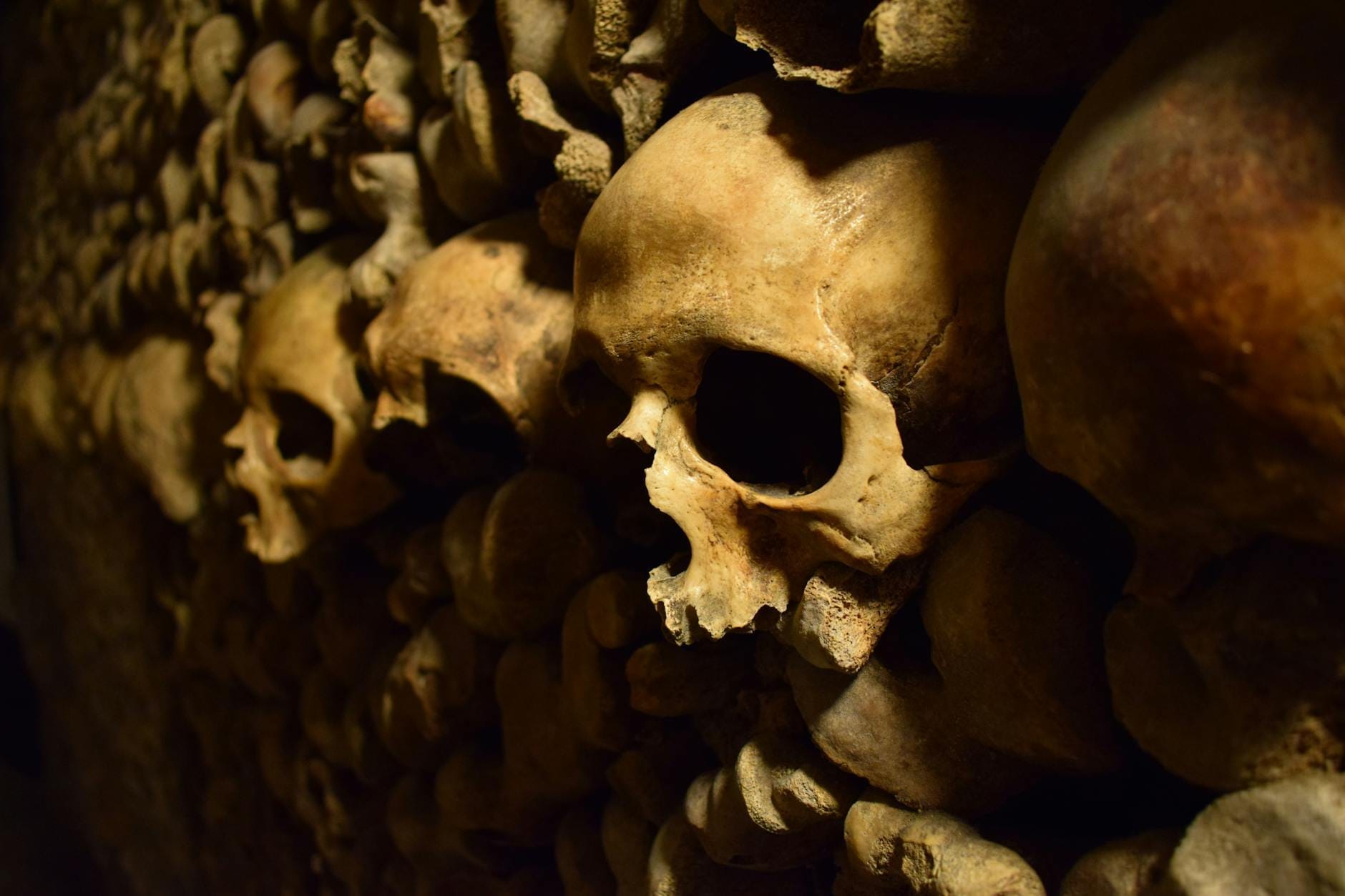
The ossuary entrance is marked by the inscription: "Arrête! C'est ici l'empire de la Mort" (Stop! This is the empire of Death), added by Héricart de Thury to give the space a formal, contemplative register. Beyond the threshold, femurs and tibias are stacked in rows to chest height, interspersed with neat bands of skulls. The effect reads less as horror and more as a strange order imposed on the scale of mortality.
The ossuary circuit covers approximately 700 metres through chambers each associated with a former Parisian cemetery: Les Innocents, Saint-Nicolas-des-Champs, Saint-Étienne-du-Mont. Sculpted features appear at intervals, including a miniature limestone structure called the Barrel Vault and a heart-shaped arrangement of skulls. The remains represent Parisians from the medieval period through the French Revolution, including victims of the Black Death and the Wars of Religion.
Audio guides are included in the ticket price, and they matter here. Without context, you are looking at bones arranged on stone shelves. With context, the same sight becomes a compressed history of Paris from the medieval period to the late 18th century. The guided commentary is available in multiple languages.
When to Visit and How Crowds Behave
The Catacombs open Tuesday to Sunday, 9:45 to 20:30 (last admission 19:30), and are closed Mondays, January 1, May 1, and December 25. Summer (June to August) is the busiest period, with queues forming before the doors open and the constant 14°C underground temperature functioning as a selling point in its own right. October through May, excluding the December holiday window, reliably brings shorter waits. Wednesday through Friday morning slots are the low-water mark for crowds.
At peak times, the ossuary can feel processional rather than contemplative, with visitors shuffling through in a continuous stream. Arriving 10 to 15 minutes before your timed slot and letting a small gap open between you and the group ahead changes the experience noticeably.
💡 Local tip
Book your timed-entry ticket directly on the official website (catacombes.paris.fr) rather than through resellers. If you qualify for a free ticket (under-18, disabled visitors, certain card holders), these cannot be reserved online and must be collected at the entrance on the day, but you are guaranteed entry even if the online slots show as fully booked.
Historical and Cultural Weight
By the 18th century, centuries of limestone extraction had created an unstable honeycomb beneath the city's southern quarters: streets and buildings were collapsing. The General Inspectorate of Quarries, founded in 1777, was created to map and reinforce the tunnels, and the 1786 ossuary project gave civic purpose to the infrastructure already in place. The tunnels carry later history too: the French Resistance used the quarry network for clandestine meetings during the Second World War.
The visitor circuit covers a small, curated fraction of the full quarry network. Unofficial exploration of the off-limits sections — known locally as "cataphilie" — has been illegal since 1955. The Musée Carnavalet in Le Marais is a natural complement for anyone wanting broader context on Paris's physical and social history.
Getting There and Practical Logistics
The entrance at Place Denfert-Rochereau is served by Metro lines 4 and 6 and RER B, making it about 15 to 20 minutes from central Paris. Note that the exit deposits you on a different street (rue Rémy Dumoncel), and the surrounding neighbourhood is residential with no cluster of cafés immediately at hand. Plan your onward route before you descend.
Denfert-Rochereau sits at the edge of the Saint-Germain-des-Prés area, placing it within comfortable reach of the Latin Quarter to the northeast and the leafy Parc Montsouris to the south. If you are combining attractions in the area, the Jardin du Luxembourg is about a 25-minute walk north and makes a logical decompression point after the underground circuit.
Is It Worth the Ticket Price?
If you are genuinely drawn to the history of Paris, Enlightenment-era urban planning, or the social history of death, the Catacombs are worth the €31 ticket. The post-renovation presentation is strong, and the included audio guide provides essential context. If your main motivation is something "cool and creepy," the ossuary takes about 45 minutes and can feel rushed at peak times: a free visit to Père-Lachaise Cemetery may satisfy the same impulse at no cost.
Teenagers tend to find it genuinely engaging. Visitors with claustrophobia, or families with very young children, will find the tight passages and relentless visual content a poor fit.
Paris has extraordinary depth as a city of museums. If you are working through the major sites, the Paris Museum Pass does not cover the Catacombs — it is managed separately by the City of Paris — which is worth knowing before you budget. For a broader look at what Paris offers underground and out of the way, the hidden gems guide for Paris covers several less-crowded alternatives.
Insider Tips
- The exit staircase deposits you on a different street from the entrance. Before you descend, note your exit location (rue Rémy Dumoncel) on a map so you are not disoriented when you emerge.
- Midweek morning slots (Wednesday to Friday, 9:45 or 10:00 entry) see the thinnest crowds. The ossuary feels qualitatively different when you are not shuffling in a line.
- The temperature underground is 14°C year-round. On a warm summer day, that feels ideal. On a cold January day, it feels colder than outside. Bring a light layer regardless of forecast.
- Free tickets for eligible visitors (under-18, disabled, certain card holders) cannot be reserved online. Go directly to the front desk on the day with documentation. You will be guaranteed entry even if the website shows the session as fully booked.
- The quarry section before the ossuary is often underappreciated. Slow down here, read the panels, and look at the ceiling: the geological strata visible in the stone is a record of a prehistoric sea bed.
Who Is Catacombs of Paris For?
- History and urban heritage enthusiasts who want context beyond the visual spectacle
- Teenagers and curious older children who are comfortable with mortality as a subject
- Visitors on a second or third Paris trip who have covered the major surface-level monuments
- Photographers working with low-light techniques who want an unusual subject
- Anyone visiting Paris in summer who wants a reliable escape from the heat
Nearby Attractions
Other things to see while in Saint-Germain-des-Prés & the Latin Quarter:
- Jardin des Plantes
Founded in 1626 as a royal medicinal herb garden, the Jardin des Plantes is France's principal botanical garden and one of Paris's most underrated green spaces. Free to enter and open every day of the year, it combines formal flowerbeds, towering greenhouse pavilions, a zoo, and four natural history museums inside a single 28-hectare site on the left bank of the Seine.
- Jardin du Luxembourg
Spread across 25.72 hectares in the heart of the 6th arrondissement, Jardin du Luxembourg is Paris's most refined public garden. Created in 1612 by Marie de Médicis, it blends French formal geometry with wilder English-style landscaping, 102 statues, a working orchard, and the grand Luxembourg Palace. Entry is free and the atmosphere shifts completely depending on the hour.
- Latin Quarter (Saint-Michel)
The Latin Quarter is Paris's most historically layered neighborhood, stretching across the 5th and 6th arrondissements on the Left Bank. From the monumental Saint-Michel Fountain to streets that follow paths worn by Roman Lutetia, this is a district where two thousand years of intellectual and political life are woven into the stone. Entry is free, and it rewards exploration at any hour.
- Musée de Cluny (Medieval Museum)
The Musée de Cluny — officially the Musée national du Moyen Âge — holds one of the world's most complete collections of medieval art inside a 15th-century mansion built over 1st-century Roman baths. Its crown jewel, the Lady and the Unicorn tapestry cycle, is alone worth the admission.