Père Lachaise Cemetery: Paris's City of the Immortals
The Cimetière du Père-Lachaise is the world's most visited cemetery and Paris's largest green space in the east of the city. Free to enter and spanning 44 hectares of sloping paths, sculpted tombs, and ancient chestnut trees, it rewards visitors who treat it as both an open-air museum and a place of genuine contemplation.
Quick Facts
- Location
- 16 Rue du Repos, 75020 Paris (20th arrondissement)
- Getting There
- Philippe Auguste (Line 2, main entrance) or Gambetta (Line 3, upper entrance)
- Time Needed
- 2–4 hours for a focused visit; half a day if you explore thoroughly
- Cost
- Free entry
- Best for
- History lovers, art and architecture enthusiasts, solo wanderers, photography
- Official website
- www.paris.fr/pages/le-cimetiere-du-pere-lachaise-1843
What Is Père Lachaise, Really?
The Cimetière du Père-Lachaise is not a conventional tourist attraction. It is an active cemetery, a park, an open-air museum of funerary sculpture, and one of the most atmospheric places in Paris, all at once. Opened in 1804 on a forested hillside in what was then the eastern outskirts of the city, it was designed by architect Alexandre-Théodore Brongniart on the former estate of Père François de la Chaise, confessor to King Louis XIV. Today it covers 44 hectares, contains around 70,000 plots, and receives more visitors annually than any other cemetery in the world.
That statistic can give the wrong impression. On most weekday mornings, especially between November and February, the cemetery is genuinely quiet. You will hear pigeons, the crunch of gravel, and the distant hum of eastern Paris traffic. You will not hear tour group commentary unless you seek it out. Père Lachaise has that rare quality among Paris landmarks: it absorbs crowds without feeling crowded, largely because 44 hectares is simply a lot of space.
💡 Local tip
Pick up a free paper map at the main entrance on Boulevard de Ménilmontant or at the Porte des Amandiers (April to October). Without one, navigating the 5,000-plus pathways is genuinely disorienting, even with a smartphone.
Opening Hours and How to Enter
The cemetery has two seasonal schedules. From March 16 through November 5, it opens at 8:00 am on weekdays, 8:30 am on Saturdays, and 9:00 am on Sundays and public holidays, closing at 6:00 pm throughout the season. The last entry is at 5:15 pm. From November 6 through March 15, opening remains the same but closing is at 5:30 pm on weekdays and Saturdays, and 5:00 pm on Sundays and public holidays. Admission is free at all times.
There are several entrances. The main gate on Boulevard de Ménilmontant (opposite number 21) is the most used and is served by the Philippe Auguste stop on Métro Line 2. The Gambetta entrance, higher up the hill on the northeast side, is useful if you are arriving from that direction or want to begin near the newer sections. The Porte des Amandiers, near Père Lachaise Métro station (Line 2 and Line 3), also works. Each entrance delivers you to a different part of the cemetery, so your choice of gate genuinely affects your route.
⚠️ What to skip
If you arrive and see a hearse or a small gathering near a tomb, give the group a wide berth. Père Lachaise is still an active burial site, and funerals take place regularly. Silence and discretion are expected, not just politely requested.
Tickets & tours
Hand-picked options from our booking partner. Prices are indicative; availability and final rates are confirmed when you complete your booking.
Guided tour of famous graves at Pere Lachaise
From 21 €Instant confirmationFree cancellationPere-Lachaise Cemetery self-guided audio tour app
From 7 €Instant confirmationFree cancellationPere Lachaise Cemetery 2-hour private walking tour
From 56 €Instant confirmationPere Lachaise Cemetery audio tour on mobile app
From 12 €Instant confirmation
The Landscape: More Than a Graveyard
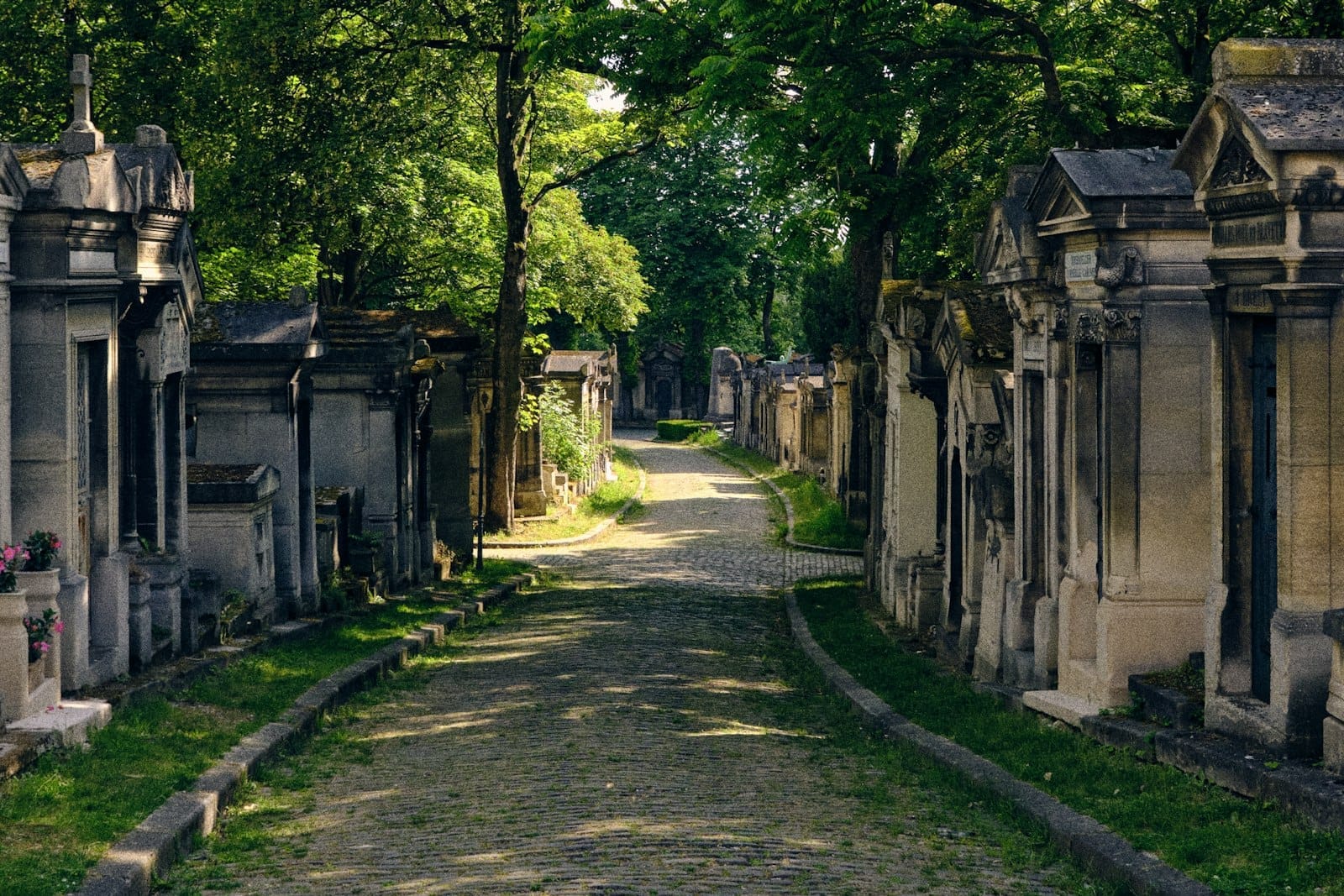
Brongniart's original design blended the English garden tradition with a French understanding of civic grandeur. The result is a cemetery that feels like a small town built on a slope, complete with named avenues, crossroads, and distinct quarters that have their own visual character. The oldest section, sometimes called the Romantic Section, sits in the southwest and contains the original sixteen acres from 1804. The tombs here are among the most theatrical in the world: Gothic Revival spires, Egyptian obelisks, Haussmann-era vaults with iron gates, and modernist slabs sit side by side with no obvious logic except the passage of time.
The terrain is genuinely hilly. The central section around Divisions 36 to 49 involves some of the steepest gradients on site, and the paths vary from wide, paved allées to narrow gravel tracks between tightly packed tombs. Wear shoes with grip. In autumn, fallen leaves make the slopes slippery; in wet weather, some of the unpaved paths turn muddy. The trees, mostly chestnut and lime, provide shade in summer and a skeleton-like canopy in winter that adds considerable atmosphere.
For visitors interested in the broader context of Paris's outdoor spaces, the cemetery pairs well with a walk through Parc des Buttes-Chaumont, a landscaped park in the same northeastern arc of the city that shows a different face of 19th-century Parisian design.
Who Is Buried Here: The Most Visited Graves
The original marketing campaign for the cemetery is one of the more unusual chapters in Parisian commercial history. When Père Lachaise first opened, Parisians were reluctant to bury their dead so far from the city center. The administrators responded by transferring the remains of Molière, La Fontaine, Héloïse, and Abelard to the grounds, instantly conferring prestige. It worked. Within decades, burial here became a mark of cultural achievement, and the list of interments grew into an informal canon of French intellectual and artistic life.
The graves most visitors seek include Frédéric Chopin (Division 11), whose tomb is regularly decorated with flowers left by Polish visitors; Marcel Proust (Division 85); Honoré de Balzac (Division 48); Guillaume Apollinaire (Division 86); and Colette (Division 4). Oscar Wilde's tomb in Division 89, designed by Jacob Epstein in 1914, is one of the most photographed objects in the cemetery. For decades, visitors covered it in lipstick kisses; a glass barrier was installed in 2011 to prevent further damage to the stone.
Jim Morrison's grave in Division 6 remains the single most visited plot. It sits in a modest section of the older part of the cemetery, surrounded by unassuming French tombs, and the contrast is part of what makes it interesting. There is usually a small crowd regardless of season. Earlier in the morning, around 8:30, you can often visit in relative quiet.
ℹ️ Good to know
Division numbers on the free map are your navigation tool. Learn to cross-reference the map's division grid with the numbered markers on the stone posts at path intersections. It takes about ten minutes to get the hang of it.
Historical and Cultural Significance
Père Lachaise is not only significant for its famous residents. In May 1871, the last stand of the Paris Commune ended here. The surviving Communards were cornered in the cemetery and shot against what is now known as the Mur des Fédérés, the Federalists' Wall, in Division 76. More than a hundred bodies were buried in a mass grave at the foot of the wall. The site became a pilgrimage point for the French left throughout the 20th century and remains a place of political memory.
The funerary sculpture across the cemetery constitutes one of the most comprehensive open-air collections of 19th and early 20th-century monumental art in Europe. You will find work ranging from neo-classical portrait busts to Art Nouveau iron reliefs to stripped-down modernist markers. Some of the most compelling pieces are on tombs of people whose names mean nothing to a foreign visitor, which is an argument for wandering without a fixed itinerary at least for part of your visit.
If the sculpture at Père Lachaise sparks an interest in Paris's tradition of monumental art, the Musée Bourdelle and the Musée Rodin offer fuller context, though they are located in different parts of the city.
How the Experience Changes by Time of Day and Season
Early morning, from opening until around 10:00, is the most atmospheric time to visit. The light arrives at a low angle through the trees, particularly beautiful in autumn when the leaves are gold and orange. You will share the paths mostly with joggers, dog walkers, and the occasional groundskeeper raking leaves. The smell is of damp stone and earth, occasionally cut through by the scent of fresh flowers left at a tomb.
Midday brings the main tourist influx. Groups tend to arrive between 10:30 and 14:00, clustering around the dozen or so famous graves. If you are visiting in spring or summer and care about photographs without crowds in them, arrive early or after 15:30 when many tour groups have moved on. On weekends in May and June, the main allées near the Molière, Chopin, and Morrison tombs can feel genuinely congested.
Winter visits have their own logic. Between November and February, the cemetery is cold and often grey, but the absence of foliage means you can see the architecture of the tombs more clearly, and the atmosphere shifts from picturesque to something quieter and more austere. Bring layers. The wind moves freely across the upper sections of the hill.
Père Lachaise sits in the 20th arrondissement, on the edge of the Canal Saint-Martin and Belleville neighborhood. After your visit, the streets around Belleville and Ménilmontant have some of the most interesting independent cafés and restaurants in eastern Paris, which makes for a natural end to the day.
Practical Notes for Your Visit
Eating and drinking inside the cemetery is not permitted. There are toilets near the main entrances, but bring your own paper. The terrain makes the cemetery challenging for wheelchair users and anyone with significant mobility limitations: some flat pathways near the main entrances are manageable, but the majority of the site involves steps, slopes, and uneven gravel. Benches are limited, so factor that in if you plan a long visit.
Photography is welcome throughout, and the cemetery is one of the better free photography locations in Paris. The combination of light, shadow, architecture, and natural texture produces results that are difficult to achieve elsewhere in the city. Early morning in autumn, or after light rain when the stone is wet and dark, produces particularly strong images.
For more on photography locations across Paris, the best photo spots in Paris guide covers a range of locations that complement a visit here.
If you are planning a broader itinerary that balances landmark sites with less obvious places, the 3-day Paris itinerary integrates Père Lachaise alongside other areas of the city in a logical sequence.
Insider Tips
- The Gambetta entrance on the northeast side drops you near Divisions 70–97, where you will find Proust, Apollinaire, and the Mur des Fédérés with far less foot traffic than the main boulevard entrance.
- Jim Morrison's grave is always visited, but the adjacent Division 6 contains some of the most beautiful Belle Époque tombs in the entire cemetery. Look up from the famous graves and explore the surrounding plots.
- Free maps are available at entrances including Porte des Amandiers (April to October). Staff provide free maps and can answer navigation questions in French.
- The Mur des Fédérés in Division 76 is historically the most significant spot in the cemetery that most visitors miss. It is a plain brick wall with a small plaque, located in the southeastern corner. The contrast between its modesty and its history is striking.
- If you visit in late October or early November around All Saints' Day (Toussaint), the cemetery fills with fresh chrysanthemums left by families at family plots. The transformation is remarkable and unlike any other time of year.
Who Is Père Lachaise Cemetery For?
- History and literature enthusiasts who want to encounter the physical traces of French cultural life across three centuries
- Architecture and art lovers drawn to funerary sculpture ranging from Romantic-era monuments to early modernist design
- Photographers looking for a free, atmospheric location with strong natural and architectural subjects at any season
- Solo travelers who prefer wandering without a fixed agenda over queue-dependent tourist sites
- Visitors with half a day free who want something genuinely different from the standard Paris monument circuit
Nearby Attractions
Other things to see while in Canal Saint-Martin & Belleville:
- Atelier des Lumières
Housed in a 3,300 m² cast-iron foundry dating to 1835, Atelier des Lumières projects monumental digital exhibitions across every surface. It is one of Paris's most distinctive cultural venues, combining industrial architecture with cutting-edge visual storytelling.
- Belleville
At 108 metres above sea level, Parc de Belleville is the highest public park in Paris and one of the few places where you can watch the sun set behind the Eiffel Tower for free. Opened in 1988 on the historic Belleville hill, the park combines sweeping city panoramas, a 100-metre cascading waterfall, working Pinot Meunier vines, and a genuinely local atmosphere that the tourist-track parks of central Paris rarely deliver.
- Canal Saint-Martin
Stretching 4.6 kilometres through the 10th arrondissement, Canal Saint-Martin offers iron footbridges, plane-tree avenues, and a neighbourhood that balances old Parisian working-class grit with a modern creative scene. Whether you stroll its quays on a Sunday afternoon or join a boat cruise through its nine locks, this is one of the city's most rewarding free experiences.
- Parc des Buttes-Chaumont
Built on the bones of a limestone quarry and a former execution ground, Parc des Buttes-Chaumont is a 25-hectare landscape of cliffs, grottos, and a lake-island temple that most tourists never find. Free to enter, beloved by locals, and genuinely unlike any other park in the city.