Parc des Buttes-Chaumont: Paris's Most Dramatic Park (and Its Best-Kept Secret)
Built on the bones of a limestone quarry and a former execution ground, Parc des Buttes-Chaumont is a 25-hectare landscape of cliffs, grottos, and a lake-island temple that most tourists never find. Free to enter, beloved by locals, and genuinely unlike any other park in the city.
Quick Facts
- Location
- 1-7 rue Botzaris, 75019 Paris (19th arrondissement)
- Getting There
- Buttes-Chaumont or Botzaris (line 7bis); Laumière (line 5)
- Time Needed
- 1.5 to 3 hours
- Cost
- Free entry
- Best for
- Families, joggers, photographers, picnickers, local-life seekers
- Official website
- www.paris.fr/equipements/parc-des-buttes-chaumont-1757
What Is Parc des Buttes-Chaumont?
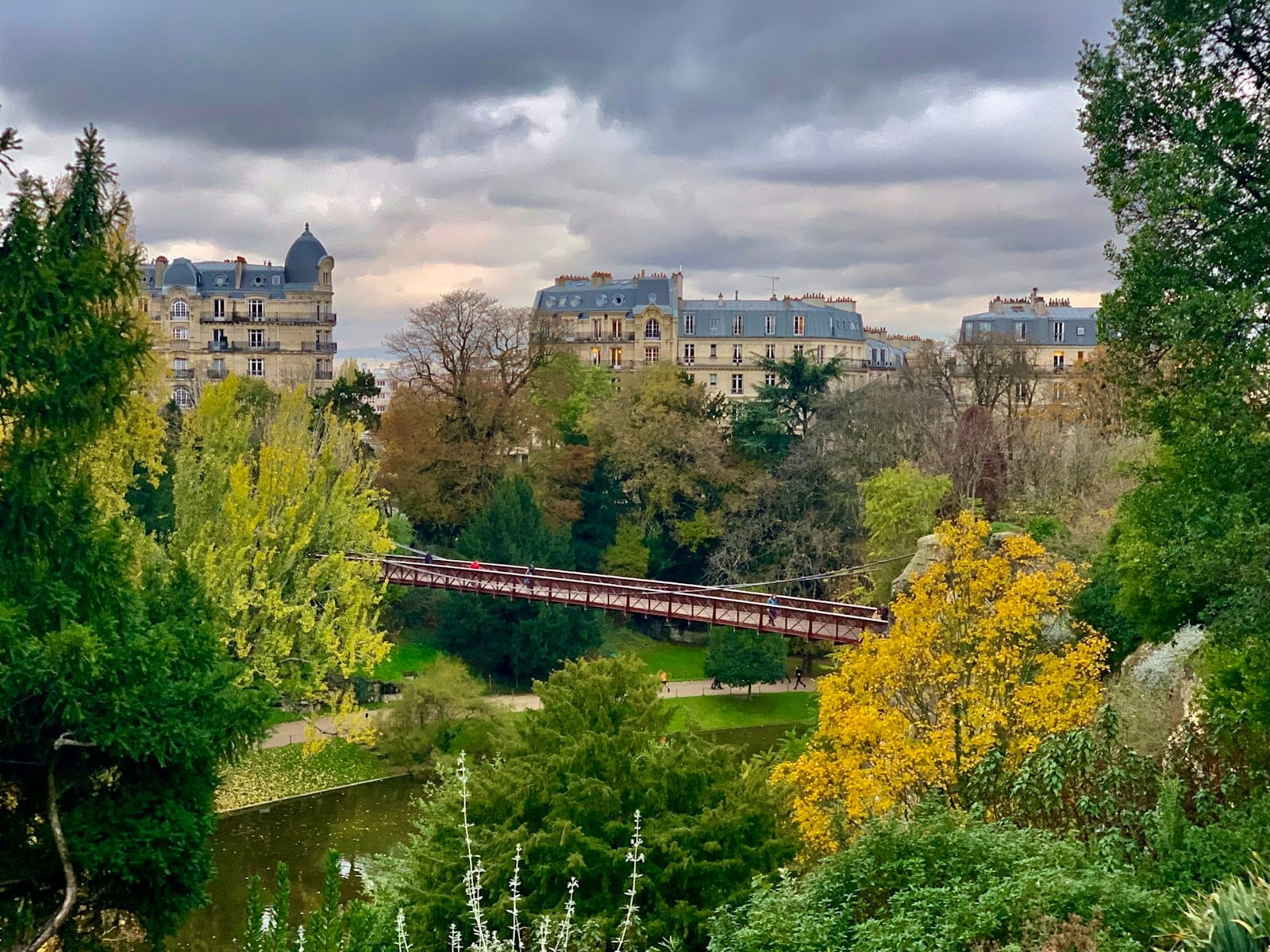
Parc des Buttes-Chaumont is the fifth-largest park in Paris, covering 25 hectares (62 acres) in the 19th arrondissement. It is also the most topographically unusual: the landscape rises and drops by over 40 metres, producing genuine cliffs, a 50-metre rocky peak, a grotto with artificial stalactites, and a waterfall, all carved out of what was once an industrial wasteland. Most visitors arriving for the first time are surprised by how wild it feels within the city limits.
Unlike the manicured symmetry of the Jardin des Tuileries or the formal geometry of the Jardin du Luxembourg, Buttes-Chaumont was designed as a romantic English-style landscape garden, full of winding paths, sudden viewpoints, and deliberate surprises. The park is open every day of the year, free of charge, and draws an almost entirely local crowd.
ℹ️ Good to know
Opening hours vary by season: roughly 7:00 am to 8:00 pm in winter and up to 10:00 pm in summer. Verify current hours at paris.fr before visiting.
A Place Built on Dark Ground: The History
Before Haussmann's transformation of Paris in the 1860s, this corner of the 19th arrondissement served successively as an execution ground, a gypsum quarry, a dumping site, and a carcass-rendering operation. Emperor Napoleon III commissioned its redesign to give working-class Parisians a large public green space comparable to London's parks. Baron Haussmann oversaw the project and assigned the landscape design to Jean-Charles Adolphe Alphand, who was responsible for all of Paris's major Second Empire parks. Construction ran from 1864 to 1867, with workers excavating the lake by hand and constructing the cliffs from quarried stone. The park opened on April 1, 1867, timed to coincide with the Exposition Universelle.
The Temple de la Sibylle, a small circular colonnade modelled on the Temple of Vesta in Tivoli, Italy, was added in 1869 at the island's summit. At 50 metres above the lake surface, it remains the park's most recognisable feature and its highest point.
Tickets & tours
Hand-picked options from our booking partner. Prices are indicative; availability and final rates are confirmed when you complete your booking.
Pastry and chocolate tour in Saint-Germain-des-Pres neighborhood
From 109 €Instant confirmationFree cancellationWalking tour of Saint-Germain-des-Pres neighborhood
From 104 €Instant confirmationFree cancellationGuided tour of Les Invalides with Tomb of Napoleon
From 89 €Instant confirmationGluten-free and organic dessert cooking class
From 129 €Instant confirmationFree cancellation
What You Actually See: A Walkthrough
Entering from the Buttes-Chaumont metro stop, you arrive in the lower northern section: wide lawns used for picnicking from the first warm day of spring through October, a Guignol puppet theater, and a small pony circuit. The smell in the early morning is of damp grass and cut leaves; the gardening teams start at dawn, and joggers are already completing circuits around the lake.
The artificial lake covers about 1.5 hectares at the park's center. The Belvedere Island rises from the water and is reachable by two bridges: a stone arch and a narrow iron suspension bridge that sways underfoot. From the island base, 173 steps climb the rock face to the Temple de la Sibylle, where the view takes in Montmartre and the dome of Sacré-Cœur to the northwest. Late afternoon, with western light on the temple colonnade, is when this viewpoint earns its reputation.
💡 Local tip
Wear proper walking shoes. The island's upper paths are steep and can be slippery after rain. The sandal-and-cobblestones combination that works elsewhere in Paris is a liability here.
Below the main promontory on the southern shore is the park's grotto: a low cave with artificial stalactites and a small interior waterfall, dim and cool even in summer. It is one of the details many first-time visitors miss entirely.
How the Experience Changes Through the Day
Early mornings before 9:00 am belong to joggers and dog walkers. The paths are quiet, the light is low and angled, and the lake reflects the cliffs without mid-morning visual noise. This is the best window for photography. By midday on a sunny weekend, the lawns fill with families, groups of friends, and open bottles of wine. The park is large enough to absorb a crowd without feeling compressed.
Late afternoon brings the park's most photogenic quality: golden light on the cliff faces and the lake surface. It is also when Rosa Bonheur, the park's guinguette (open-air bar and dance venue), begins to fill. Established in 2008 and run under a government mandate from the Mairie of the 19th, it is one of the more unusual hospitality setups in Paris.
Getting There and Moving Around
The most direct access is Buttes-Chaumont station on metro line 7bis, two minutes from the northern entrance. Botzaris (also line 7bis) serves the eastern side; Laumière on line 5 covers the northwest corner. The park has 5.5 km of roads and 2.2 km of paths.
Buttes-Chaumont sits within the Canal Saint-Martin and Belleville corridor of northeast Paris. It combines naturally with a walk along the Canal de l'Ourcq or an afternoon at Parc de la Villette to the north.
⚠️ What to skip
Bicycles, scooters, and electric vehicles are not permitted inside the park for anyone over 8 years old. Vélib' racks are available at the park entrances.
Honest Assessment: Who This Is (and Isn't) For
Buttes-Chaumont rewards visitors who want to see Paris functioning as a living city. There is no famous collection here, no ticketed experience, and no queue. If your trip is structured entirely around landmark sightseeing, this park may feel like time that could be spent elsewhere. But if you want to understand how Parisians actually use public space: where they picnic, run, drink, and spend Saturday afternoons. The park answers that question better than anywhere else in the city.
Visitors with mobility limitations should know that the dramatic viewpoints all require significant climbing. The lakeside paths are more accessible, but the island summit is not. For a flatter, fully accessible green space, the Jardin des Plantes is the more practical alternative. Rain significantly reduces the experience: the steep paths become slick and the social energy of the lawns disappears quickly.
Cultural Footnotes
Éric Rohmer shot sequences of his 1981 film La Femme de l'aviateur here, and Jean Gabin walked the suspension bridge in Jean Grémillon's 1937 film Gueule d'amour. Each September, the park hosts the Silhouette Short Film Festival, a week of free outdoor screenings that remain one of the quieter pleasures of the Parisian autumn calendar.
The name is often misread: 'Buttes' refers to the raised terrain; 'Chaumont' derives from the old French 'chaux mont', meaning chalk or lime hill, a direct reference to the gypsum extraction that defined the site for centuries. For context on how the park fits among Paris's other green spaces, see the guide to the best parks and gardens in Paris.
Insider Tips
- Rosa Bonheur, the guinguette bar in the park's northeast corner, runs on a government mandate from the Mairie of the 19th and has outdoor seating, cold drinks, and weekend dancing. Arrive before 6:00 pm in summer to secure a table.
- The Temple de la Sibylle faces northwest directly toward Sacré-Cœur. Come late afternoon with the sun behind you for one of Paris's better Montmartre sightlines, typically without other tourists in frame.
- The grotto on the southern cliff face at lake level is easy to walk past. It is the most atmospheric corner of the park and is almost always empty. Look for it beneath the main promontory.
- Weekday mornings before 9:00 am are the quietest the park gets. Photographers and serious picnickers use this window; the weekend crowd builds quickly after 11:00 am.
- The Silhouette Short Film Festival runs each September with free outdoor screenings after dark inside the park. Check dates if you are in Paris during that period.
Who Is Parc des Buttes-Chaumont For?
- Local-style picnickers who want open grass, space, and a corkscrew rather than a café terrace
- Photographers looking for non-postcard Paris views and landscapes off the tourist circuit
- Families with young children: Guignol theater, ducks, pony rides, playgrounds, and wide lawns
- Joggers and walkers who want topographic variety rather than a flat city-park circuit
- Curious travelers who want to understand how Parisians actually spend a Saturday afternoon
Nearby Attractions
Other things to see while in Canal Saint-Martin & Belleville:
- Atelier des Lumières
Housed in a 3,300 m² cast-iron foundry dating to 1835, Atelier des Lumières projects monumental digital exhibitions across every surface. It is one of Paris's most distinctive cultural venues, combining industrial architecture with cutting-edge visual storytelling.
- Belleville
At 108 metres above sea level, Parc de Belleville is the highest public park in Paris and one of the few places where you can watch the sun set behind the Eiffel Tower for free. Opened in 1988 on the historic Belleville hill, the park combines sweeping city panoramas, a 100-metre cascading waterfall, working Pinot Meunier vines, and a genuinely local atmosphere that the tourist-track parks of central Paris rarely deliver.
- Canal Saint-Martin
Stretching 4.6 kilometres through the 10th arrondissement, Canal Saint-Martin offers iron footbridges, plane-tree avenues, and a neighbourhood that balances old Parisian working-class grit with a modern creative scene. Whether you stroll its quays on a Sunday afternoon or join a boat cruise through its nine locks, this is one of the city's most rewarding free experiences.
- Père Lachaise Cemetery
The Cimetière du Père-Lachaise is the world's most visited cemetery and Paris's largest green space in the east of the city. Free to enter and spanning 44 hectares of sloping paths, sculpted tombs, and ancient chestnut trees, it rewards visitors who treat it as both an open-air museum and a place of genuine contemplation.