Canal de l'Ourcq: Paris's Most Lived-In Waterway
Stretching 108 km from the Bassin de la Villette into the Seine-et-Marne countryside, Canal de l'Ourcq is where Parisians actually spend their weekends. This is not a postcard canal. It is a working waterway with a genuine neighbourhood feel, electric boat rentals, seasonal festivals, and some of the city's most unhurried people-watching.
Quick Facts
- Location
- Bassin de la Villette, 75019 Paris (La Villette / 19th arrondissement)
- Getting There
- Métro Line 5: Ourcq; Métro Line 7: Corentin Cariou; Métro Lines 2/5/7bis: Stalingrad (Bassin de la Villette)
- Time Needed
- 1 to 4 hours depending on whether you walk, cycle, or take a boat
- Cost
- Free (walking/cycling); electric boat rentals from approx. €13 per person for a 2-hour trip
- Best for
- Picnics, cycling, self-drive boat trips, weekend markets, photography away from tourist crowds
- Official website
- parisjetaime.com/eng/transport/canal-de-l-ourcq-p1872
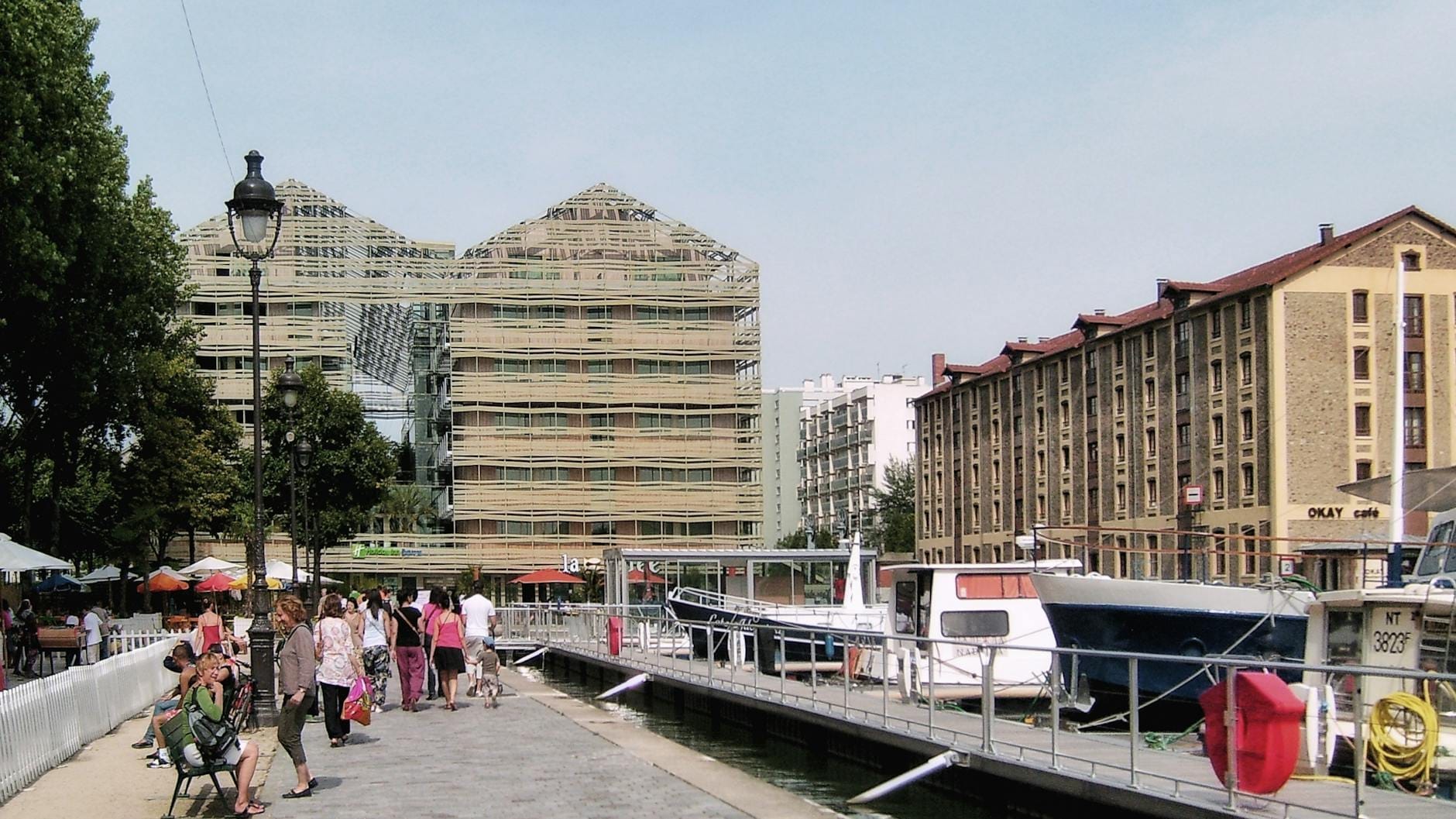
What Is Canal de l'Ourcq?
Canal de l'Ourcq is a 108-kilometre waterway linking the Bassin de la Villette in the 19th arrondissement of Paris to the Ourcq River in the Seine-et-Marne département, making it the longest of Paris's three main canals. Commissioned by Napoleon Bonaparte in 1802 and opened in 1822, its original purpose was entirely practical: to bring fresh water into a city struggling with supply, and to allow freight barges to reach the capital's heart. Today the Paris section has been reimagined as one of the city's great outdoor corridors, though commercial traffic still uses parts of the route.
Unlike the Canal Saint-Martin, which attracts a younger, trend-conscious crowd and lines its banks with fashionable cafés, Canal de l'Ourcq has a broader, more community-oriented character. The quays are wider, the atmosphere more relaxed, and on a warm Saturday you'll find families grilling on portable barbecues, teenagers fishing, retirees playing pétanque, and cyclists sharing the tow-path in both directions. It tells you more about how Parisians actually live than a trip to the Seine ever could.
💡 Local tip
Start at the Bassin de la Villette end (Métro Stalingrad or Jaurès) for the widest quays, the most activity, and the easiest access to boat rentals. From there you can walk or cycle northeast along the canal at whatever pace suits you.
How the Canal Changes Through the Day
Early mornings, before 9am, the canal belongs to joggers and dog-walkers. The water is dark green and still, the plane trees cast long shadows across the tow-path, and the only sounds are bicycle tyres on tarmac and the occasional thrum of a barge engine. The Pont de Crimée, a rare hydraulic lift bridge dating to 1885, often lets a commercial vessel pass at this hour. It is the best time to photograph the canal without crowds.
By midday on weekends from April through September, the banks fill rapidly. Blankets appear on the grass strips, cooler bags and baguettes come out, and the electric boat rental kiosks at the Bassin start launching small flat-bottomed boats in a steady stream. Late afternoon brings golden light over the water, particularly looking west, as the plane trees along the quai de la Marne catch the sun. By early evening in summer, food trucks and pop-up bars sometimes appear near the Parc de la Villette end, and groups gather on the low walls with plastic cups of wine.
Tickets & tours
Hand-picked options from our booking partner. Prices are indicative; availability and final rates are confirmed when you complete your booking.
Cruise on Canal Saint-Martin and Seine River from La Villette Park
From 25 €Instant confirmationFree cancellationCruise on the Seine River and Canal Saint-Martin from Orsay Museum
From 25 €Instant confirmationFree cancellationNormandy D-Day beaches with Juno Beach, bunkers and Canadian cemetery from Paris
From 220 €Instant confirmationFree cancellationParis Essential dinner cruise at 6.15pm
From 99 €Instant confirmationFree cancellation
Walking and Cycling the Route
The pedestrian and cycle path runs continuously from the Bassin de la Villette northeast through the 19th arrondissement and into the Seine-Saint-Denis suburbs. For most visitors, the stretch from the Bassin to the Parc de la Villette boundary and a short distance beyond, roughly 3 to 4 km, covers the liveliest section. The tow-path surface is smooth enough for road bike tyres, though it narrows slightly under the lower bridges.
If you want to extend the day, continue northeast to Pantin, where the old Magasins Généraux warehouse complex has been converted into a creative campus with street art, studios, and a well-regarded rooftop café with canal views. Cyclists who keep going reach Bobigny and then the quieter, greener stretches where the canal cuts through suburban parks and allotment gardens. The full 108-km route to Mareuil-sur-Ourcq is a multi-day touring option popular in summer. Paris's Vélib' bike-share network has docking stations near the Bassin de la Villette, making it easy to pick up a bicycle and return it anywhere in the city via the city's public transport network.
ℹ️ Good to know
The Pont de Crimée hydraulic lift bridge, built in 1885, is still in daily use. If you see a barge approaching, stop and wait: the central span rises slowly to let the vessel through in a ten-minute operation that is genuinely worth watching.
Boating on Canal de l'Ourcq
The most distinctive activity on the canal is renting a small electric boat, no licence required, from operators based at the Bassin de la Villette. Companies such as Marin d'Eau Douce offer self-drive flat-bottomed boats for groups of up to 11 people, with prices starting at around €13 per person for a two-hour trip (rates vary by group size and season; confirm directly before visiting). The boats are quiet and stable enough that a picnic on board is entirely practical: a bottle of wine, a baguette, and a wedge of cheese, and you have one of the more memorable lunch experiences Paris offers at a modest price.
Guided cruises are available through operators like Canauxrama, which runs scheduled departures linking Canal de l'Ourcq to the Canal Saint-Martin and the Seine. These suit visitors who want narrated historical context without self-navigation. In summer, the Mairie de Paris occasionally runs a subsidised shuttle boat as part of the Paris Plages programme. Worth checking paris.fr event listings closer to your travel date. Navigation on the Paris section is straightforward: there are no locks in the first 20 km from the city, so the water is flat and the current minimal. Barges always have right of way.
The La Villette Neighbourhood
The canal flows into the Bassin de la Villette, a rectangular urban lake framed by 19th-century warehouse architecture and connecting south to the Canal Saint-Martin via two locks. At its northern end, the canal passes through the La Villette cultural campus, which houses the Cité des Sciences et de l'Industrie and the Philharmonie de Paris. This makes the canal walk a natural extension of a Villette day rather than a standalone trip.
The surrounding 19th arrondissement is one of Paris's most ethnically diverse districts. Halal butchers and West African grocery stores sit alongside craft beer bars and design studios. There is no pretension here: this is one of the few parts of central Paris where the tourist infrastructure doesn't dominate, and where you can sit at a café terrace and hear more French than English at the surrounding tables.
When to Visit, What to Wear, and Who Might Not Enjoy It
Spring (April to June) and early autumn (September to October) are the best seasons: temperatures are comfortable for walking, the plane trees are in full leaf, and the canal is active without being overwhelmed. July and August can be hot along the sun-exposed sections, where shade is limited; bring water and sunscreen. Winter visits are entirely possible: the canal empties of leisure traffic, the bare branches reflect in dark water, and the cafés along the route feel cosy by contrast. A wet day flattens the light and offers limited shelter, so check the forecast before committing to a long walk.
⚠️ What to skip
The canal banks get very crowded on summer weekend afternoons near the Bassin de la Villette. Arrive before 11am or walk 1.5 km further northeast for a noticeably quieter experience.
Visitors with a single day in Paris and a checklist of major monuments will find the canal a poor trade-off against the Louvre or Musée d'Orsay. The canal's appeal is atmosphere and pace, not iconic sights. It rewards slow travel: the visitor who is happy to sit on a low wall watching a barge negotiate the Pont de Crimée lift will get far more from it than someone ticking boxes. For a full picture of the best ways to spend time outdoors in the city, the best parks and gardens in Paris guide is a useful companion.
Photography and Accessibility
The canal offers strong material at both ends of the day. Morning light rakes across the water's surface and catches the ironwork of the bridges; the Pont de Crimée is the most architecturally interesting span on the Paris section. The Magasins Généraux building in Pantin, visible from the water, has a dramatic painted mural façade that photographs well from a boat. For a broader collection of the city's best camera angles, the best photo spots in Paris guide covers several lesser-known waterway locations.
Accessibility along the main tow-path is reasonable: the surface is flat and paved for most of the Paris section. Some bridges require steps to cross between banks, but it is generally possible to stay on the same side for the full length of the walk. Wheelchair users and pushchair parents will find the first 2 km from the Bassin the most straightforward stretch. Boat rental accessibility varies by operator, so contact companies in advance if this is a consideration.
Insider Tips
- The Pont de Crimée hydraulic lift operates when barges need to pass. If you see one approaching from either direction, stop and wait: the full lift takes about ten minutes and is one of the more unusual free spectacles in Paris.
- Sundays between April and October are peak social day on the canal banks. For the same easy-going atmosphere at half the density, come on a Saturday morning before 11am.
- The Magasins Généraux complex in Pantin, roughly 2 km northeast of the Bassin, has a rooftop café with a canal view and is worth a stop on a cycling day. It sits just outside the Paris city boundary, so most guidebooks miss it entirely.
- For a free lunch spot with good afternoon sun, sit on the low wall along the quai de la Seine on the Bassin's western bank. The Franprix on avenue de Flandre, two minutes' walk away, has all the picnic provisions you need.
- In July and August, the Paris Plages festival sometimes extends an animation programme to the canal banks, including outdoor film screenings and free activities for children. Check paris.fr in the weeks before your visit.
Who Is Canal de l'Ourcq For?
- Repeat visitors to Paris who have already covered the major monuments and want to see where residents actually spend their free time
- Families looking for a relaxed half-day that combines a self-drive boat trip with a picnic and open space for children to move around
- Cyclists who want a flat, scenic route out of the city centre with a destination at either end
- Photographers seeking water reflections, industrial architecture, and street-level Parisian life away from postcard angles
- Budget travellers: the canal offers a full half-day of varied experience at zero or very low cost
Nearby Attractions
Other things to see while in La Villette & Northeast Paris:
- Parc de la Villette
Parc de la Villette is a 55.5-hectare post-industrial landscape in northeast Paris where a former slaughterhouse became one of Europe's most inventive public spaces. Designed by architect Bernard Tschumi, it combines serious cultural institutions with free open-air lawns, canal paths, children's playgrounds, and a summer cinema. Entry to the park itself is free, making it one of the best-value days out in the city.
- Philharmonie de Paris
Opened in 2015 and designed by Jean Nouvel, the Philharmonie de Paris is one of Europe's great concert halls, combining extraordinary acoustics with bold architecture. Set inside Parc de la Villette, it hosts around 500 concerts a season alongside music exhibitions, family programs, and a rooftop terrace with panoramic city views.