Louvre Museum: How to Visit the World's Largest Art Museum Without the Overwhelm
The Musée du Louvre holds over 35,000 works across 60,600 square metres of gallery space in a palace that was already centuries old when the French Revolution began. Knowing what to prioritise, when to arrive, and which entrance to use makes the difference between a memorable morning and an exhausting afternoon. This guide covers everything you need before you go.
Quick Facts
- Location
- Rue de Rivoli, 75001 Paris (1st arrondissement, Right Bank)
- Getting There
- Métro Line 1 or 7: Palais Royal – Musée du Louvre
- Time Needed
- 3–5 hours minimum; a full day for serious explorers
- Cost
- €22 for EEA residents / €32 for non-EEA visitors (2026); free for under-18s and EEA residents under 26. Verify current pricing on louvre.fr.
- Best for
- Art lovers, history enthusiasts, architecture fans, first-time Paris visitors
- Official website
- www.louvre.fr/en
What the Louvre Actually Is (and Why That Matters)
The Musée du Louvre is, by floor area, the largest art museum on earth. That single fact shapes every practical decision you make as a visitor. With over 35,000 objects on display across roughly 60,600 square metres of gallery space — spread across three wings and multiple floors of a palace that dates back to a late 12th-century fortress built under King Philip II — this is not a place you see in two hours. It is a place you plan for.
The museum opened to the public on August 10, 1793, under the name Muséum Central des Arts, just four years after the Revolution that ended the monarchy whose residence it had been. What was once a fortress, then a royal palace, became a democratic institution — a deliberate political act as much as a cultural one. That layering of purpose is still visible in the architecture if you know to look for it.
The collection spans antiquity to the mid-19th century: ancient Egyptian, Greek, Roman, Near Eastern, and Islamic art, plus European paintings, sculptures, and decorative objects. If Impressionist or modern art is your priority, the Louvre is the wrong museum — head to the Musée d'Orsay instead. The Louvre covers the ancient and classical worlds through Romanticism, and nothing later.
The Building Itself: A Palace Worth Noticing
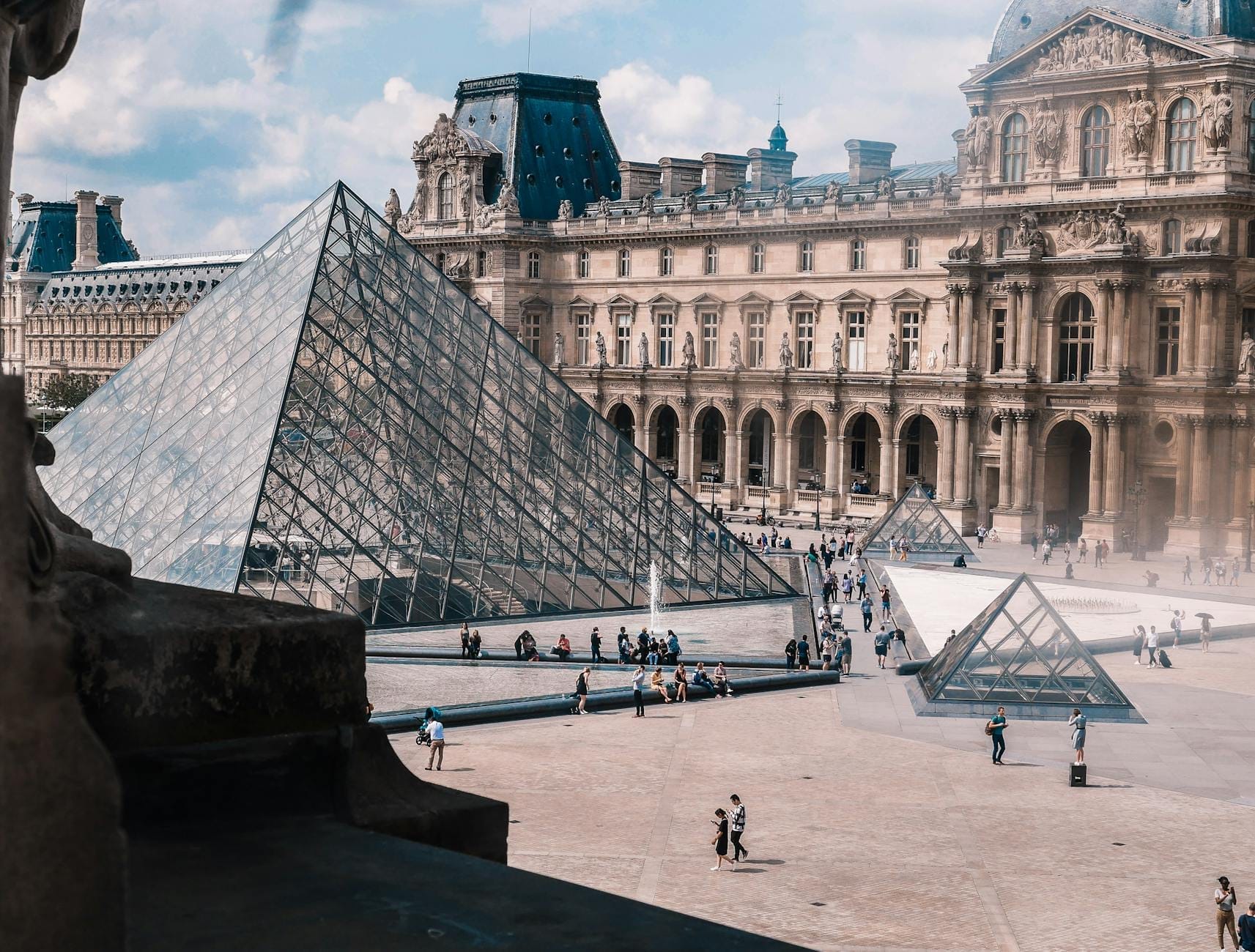
Most visitors rush through the Cour Napoléon without stopping to register what they are standing in: a courtyard framed by Renaissance and classical French architecture built over four centuries, from Francis I to Napoleon III. At its centre sits I.M. Pei's glass-and-steel Pyramid, completed in 1989. What reads as jarring contrast in photographs feels oddly harmonious in person.
The Pyramid entrance leads underground to the Hall Napoléon, the main orientation hub with ticket desks, cloakrooms, toilets, and entrances to all three wings: Denon, Sully, and Richelieu. Getting comfortable with this map before you descend saves real time. The three wings are not interchangeable — each has a distinct character and different collection strengths.
💡 Local tip
Download the official Louvre app or pick up a paper map at the information desk beneath the Pyramid as soon as you arrive. Room numbering inside the museum is logical once you understand it, but confusing until you do. The app's real-time navigation function is genuinely useful.
Tickets & tours
Hand-picked options from our booking partner. Prices are indicative; availability and final rates are confirmed when you complete your booking.
Luggage storage at the Louvre Museum in Paris
From 6 €Instant confirmationFree cancellationSemi-private Louvre tour with Mona Lisa and Royal Palace
From 94 €Instant confirmationFree cancellationSmall group tour of top Paris attractions with a local
From 61 €Instant confirmationFree cancellationLouvre guided tour with priority entry and audio guide
From 76 €Instant confirmationFree cancellation
How the Visit Feels at Different Times of Day
Opening time — 9:00 AM on days the museum is open — is significantly calmer than mid-morning. The first 45 minutes after doors open is when you have the best chance of standing in front of the Venus de Milo or the Winged Victory of Samothrace without being absorbed into a crowd. Both are large sculptures in open gallery spaces, so they never feel truly intimate, but the difference between viewing them at 9:15 AM and 11:00 AM is substantial.
By 10:30 AM on any day between April and October, all three wings feel genuinely crowded. The Denon Wing, which houses the Mona Lisa, the Italian paintings, and the grande galerie of French Neo-classical work, becomes the most congested corridor in Paris. Tour groups synchronise around the same 12 or 15 masterpieces, and queues to photograph the Mona Lisa can stretch back 10 to 15 rows from the barrier. Budget this into your expectations.
Wednesday and Friday evenings offer a separate rhythm. The Louvre stays open until 9:00 PM, and attendance drops sharply after 6:00 PM. Lighting shifts as natural light fades — this actually flatters the Dutch and Flemish collections in the Richelieu Wing, where warm gallery light makes the textures in Vermeer and Rembrandt read more clearly. Arriving around 4:30 PM on a Wednesday or Friday is the single best use of a limited Paris schedule.
ℹ️ Good to know
The Louvre is closed every Tuesday, and on January 1, May 1, and December 25. It remains open on most other public holidays. On the first Friday of each month (except July and August), entry is free after 6:00 PM for all visitors.
What to Actually See: A Realistic Prioritisation
A more satisfying strategy: pick one or two departments and go deep. The Egyptian Antiquities collection is one of the finest outside Cairo. The Seated Scribe, the sphinx of Tanis, and the funerary objects cases reward slow, careful attention — and these rooms see far fewer visitors than the Italian paintings galleries.
The Denon Wing's ground floor contains the museum's sculpture collections, including Michelangelo's Slaves, originally intended for the tomb of Pope Julius II. These are large, powerful works that most people walk past in a rush toward the paintings upstairs — they reward ten minutes of careful attention, and the gallery is rarely crowded before 11:00 AM.
The Louvre's Islamic Art galleries, opened in 2012 beneath a spectacular undulating glass-and-steel roof designed by Mario Bellini and Rudy Ricciotti in the Cour Visconti, hold around 18,000 objects and are among the museum's most undervisited spaces. For context on how Paris has engaged with art from the wider world, the collection complements what you might see at the Musée Guimet, which focuses specifically on Asian civilisations.
Getting There and Getting In
The museum sits in the 1st arrondissement on the Right Bank of the Seine, flanked by the Jardin des Tuileries to the west and the Rue de Rivoli to the north. The closest Métro stop is Palais Royal – Musée du Louvre, served by Lines 1 and 7. From there, you are a 3-minute walk from the Pyramid entrance. Line 1 connects directly from Champs-Élysées stations to the east and from La Défense to the west, making it straightforward from most parts of central Paris.
The Pyramid is the main entrance and where queues form. At peak times, the Carrousel du Louvre entrance (via 99 Rue de Rivoli) and the Porte des Lions entrance on the Seine side often have shorter lines. Time-slot bookings are strongly recommended and available through the official website. The Louvre is covered by the Paris Museum Pass — see our guide on whether the Paris Museum Pass is worth it to see if it suits your itinerary.
⚠️ What to skip
Ticket fraud around the Louvre is a genuine problem. Do not buy tickets from street vendors near the Pyramid — they are either invalid or overpriced. Book only through louvre.fr or authorised resellers. Mirror websites mimicking the official site have increased; double-check the URL before entering payment details.
Photography, Accessibility, and Practical Logistics
Photography is permitted in most permanent collection galleries without flash. The Mona Lisa is smaller than most visitors expect (77 cm × 53 cm), hung high behind thick protective glass and typically photographed from 6 to 8 metres away. Manage expectations: close visual engagement with the painting is difficult at peak hours.
Accessibility is well-considered: lifts connect all main levels, wheelchairs are available free at the information desk, and visitors with disabilities (plus one companion) are admitted free. Some historic staircases and secondary galleries remain challenging — check the official site for current details on which areas are fully accessible.
Coat check (vestiaire) is free and located in the Hall Napoléon. Using it is worth doing: bag searches on entry are thorough, and a lighter bag makes the visit considerably more comfortable. There are several cafes and a restaurant inside the Cour Napoléon. For a meal with proper context, the Jardin des Tuileries immediately to the west has terrace cafes and open lawns where you can decompress between gallery sessions.
Honest Assessment: Is It Overhyped?
For visitors who arrive expecting a calm, contemplative museum experience, parts of the Louvre — specifically the Italian paintings section of the Denon Wing in peak season — will feel disappointing. The Mona Lisa room on a July Saturday is not an art experience; it is a crowd management exercise. The painting is watched more on phone screens than with eyes.
But the Louvre is not overhyped as a building, an institution, or a collection. Ninety percent of what it contains is extraordinary and seen, on most days, in reasonable calm. The problem is visitor concentration around a small number of marquee works. The solution: go to the less-photographed galleries first, then return to the Mona Lisa around 4:00 PM when tour groups have typically left.
Visitors who find the scale exhausting or who prefer intimacy in their museum experience may find the Musée de l'Orangerie — a 10-minute walk away at the west end of the Tuileries — a better use of an afternoon. Its two oval rooms of Monet's Water Lilies panels offer something the Louvre rarely does: silence, and a single sustained visual experience.
Insider Tips
- The Carrousel du Louvre entrance (via 99 Rue de Rivoli or the underground mall) is consistently less crowded than the Pyramid. On busy days this alone can save 30 to 45 minutes.
- Free evenings occur select nights monthly (check louvre.fr for schedule). Arrive by 5:30 PM to collect your ticket before the rush hits.
- The Richelieu Wing's first-floor decorative arts galleries — covering French royal furniture from the ancien régime — are among the finest displays of their kind anywhere, and see a fraction of Denon's foot traffic. The Apollo Gallery is particularly spectacular.
- Leave the Mona Lisa for last. Spend the first two hours in the Egyptian antiquities or sculpture collections, then circle back to Denon late in the day when guided tour groups have departed.
- The Cour Napoléon opens from 7:30 AM, before the museum itself. Early risers can photograph the Pyramid in near-empty conditions — the light at 8:00 AM on a clear morning is excellent.
Who Is Louvre Museum For?
- First-time visitors to Paris who want to engage with the city's full cultural weight
- Art historians and students interested in European painting from the Renaissance through Romanticism
- Lovers of ancient civilisations: Egypt, Greece, Rome, and the ancient Near East are all exceptionally well-represented
- Architecture enthusiasts who want to walk through the evolution of French palatial building from the 16th to 19th centuries
- Families with older children (10+) who can handle multi-hour visits — the Egyptian mummies and suits of armour in the decorative arts section tend to engage younger visitors
Nearby Attractions
Other things to see while in Champs-Élysées & Trocadéro:
- Arc de Triomphe
Standing 49.5 metres above Place Charles de Gaulle, the Arc de Triomphe de l'Étoile anchors the grandest axis in Paris. Its rooftop terrace delivers one of the city's great panoramas, while the base houses the Tomb of the Unknown Soldier — a living memorial renewed by flame every evening.
- Champs-Élysées
Stretching 1.91 km from Place de la Concorde to the Arc de Triomphe, the Avenue des Champs-Élysées is at once Paris's grandest promenade and its most debated street. Here is what to expect, when to go, and how to make the most of it.
- Crazy Horse Paris
Crazy Horse Paris has staged its distinctive blend of dance, light, and visual design on Avenue George V since 1951. The current show, 'Totally Crazy!', runs approximately 90 minutes and draws a mix of curious first-timers and loyal returning guests who appreciate its position between cabaret tradition and contemporary performance art.
- Grand Palais
Built for the 1900 Universal Exhibition and freshly reopened after a landmark renovation, the Grand Palais is one of the most spectacular public buildings in Europe. Its iron-and-glass nave stretches 240 metres and shelters world-class art exhibitions, cultural events, and the Palais de la Découverte science museum beneath a single soaring roof.