Grand Palais: Inside Paris's Grandest Exhibition Palace
Built for the 1900 Universal Exhibition and freshly reopened after a landmark renovation, the Grand Palais is one of the most spectacular public buildings in Europe. Its iron-and-glass nave stretches 240 metres and shelters world-class art exhibitions, cultural events, and the Palais de la Découverte science museum beneath a single soaring roof.
Quick Facts
- Location
- 3 Avenue du Général Eisenhower, 75008 Paris (8th arrondissement)
- Getting There
- Champs-Élysées-Clemenceau (lines 1 & 13) or Franklin D. Roosevelt (lines 1 & 9)
- Time Needed
- 1.5 to 3 hours depending on exhibition
- Cost
- Approx. €10 full / €8 reduced for Galeries nationales exhibitions; Nave events priced separately. Check grandpalais.fr for current shows.
- Best for
- Architecture lovers, art enthusiasts, design fans, Paris first-timers
- Official website
- www.grandpalais.fr/en
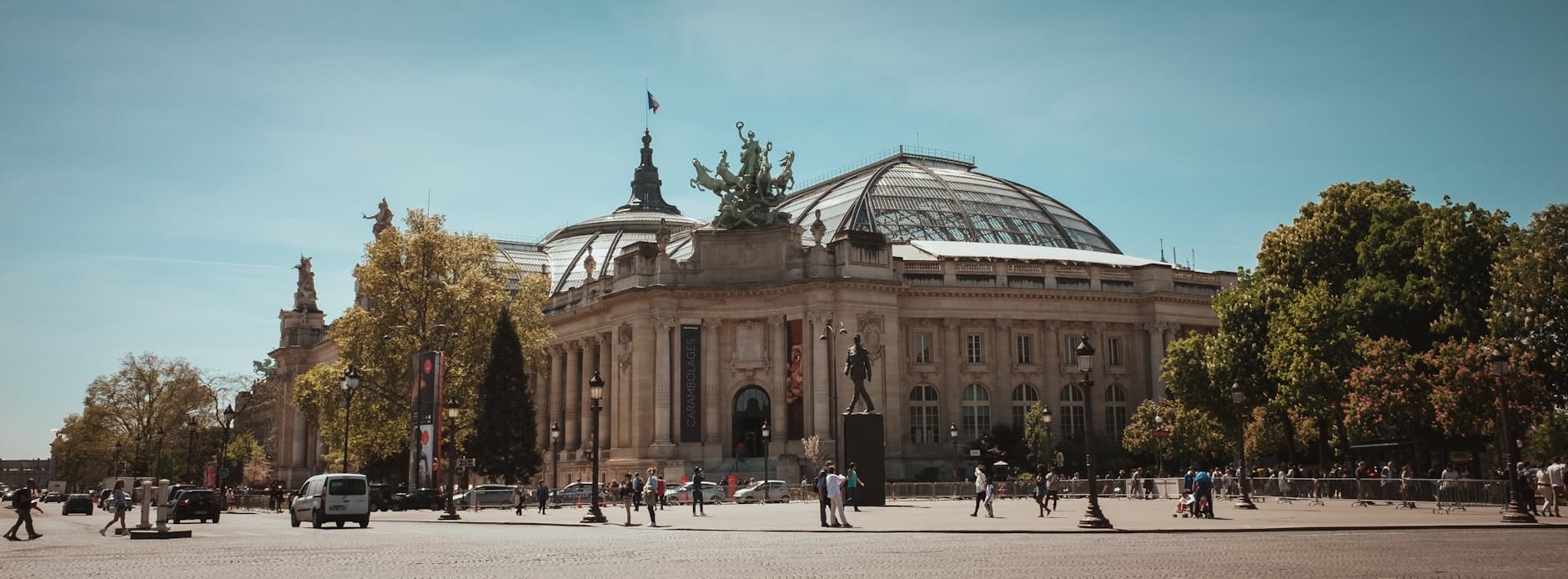
What Is the Grand Palais?
The Grand Palais is a monumental exhibition hall in the heart of Paris, sitting between the Seine and the Champs-Élysées in the 8th arrondissement. Built between 1897 and 1900 for the Universal Exhibition, it was designed as a celebration of French art, industry, and ambition at the turn of the twentieth century. Today, managed by the Réunion des musées nationaux (RMN-Grand Palais), it functions as one of the most versatile cultural venues in Europe.
The building is not a single museum with a permanent collection. It is three distinct spaces under one Beaux-Arts shell: the Nave, a cathedral-like iron-and-glass hall used for large-scale events; the Galeries nationales, which host major temporary art exhibitions on loan from institutions around the world; and the Palais de la Découverte, a science museum and cultural centre. Understanding this from the start saves confusion at the ticket desk.
ℹ️ Good to know
The Grand Palais fully reopened in spring 2025 after a major renovation and briefly hosted fencing and taekwondo events during the Paris 2024 Olympics. Expect the interior to look cleaner and brighter than older photos suggest.
Architecture: What Makes the Building Exceptional
From the outside, the Grand Palais reads as a classical stone palace: Ionic colonnades, carved friezes, bronze quadriga sculptures crowning each corner wing. Walk around to the Avenue Winston Churchill side and look up at the vast glass barrel vault catching the light above the stone facade, and the building's real personality reveals itself. It belongs to neither style entirely, which is precisely what makes it remarkable.
The Nave alone covers 13,500 square metres under what remains the largest glass roof in Europe, built using iron framing, light steel, and early reinforced concrete. The latticed ironwork, the arching ribs, the pale natural light pouring through 15,000 square metres of glass: the effect on a clear morning is closer to a Gothic cathedral than an exhibition hall. The building was designated a Historic Monument in November 2000.
Unlike the Eiffel Tower, which was always meant to be temporary, or the Louvre, which accreted over centuries, the Grand Palais was conceived as a complete and permanent civic statement. Every surface was calculated. The four mosaic friezes along the roof line read, in French: 'Dedicated by the Republic to the glory of French art.' That is still the building's operating principle.
For context on the wider architectural ambition of this part of Paris, the Pont Alexandre III was built at the same time, to the same aesthetic brief, and sits at the southern end of Avenue Winston Churchill connecting the Grand Palais directly to the Invalides esplanade.
Tickets & tours
Hand-picked options from our booking partner. Prices are indicative; availability and final rates are confirmed when you complete your booking.
World War II in Paris private walking tour
From 26 €Instant confirmationFree cancellationPalais Royal and the Covered Galleries: walking audio tour
From 9 €Instant confirmationGuided walking tour of the Covered Passages of Paris
From 125 €Instant confirmationFree cancellationPrivate tour of the Opera Garnier and the Covered Passages
From 187 €Instant confirmationFree cancellation
The Galeries Nationales: Major Temporary Exhibitions
The Galeries nationales are where the Grand Palais earns its international reputation. Over the decades, the rooms have housed retrospectives of Picasso, Matisse, Renoir, Monet, and Degas, alongside design surveys, fashion history, and cross-cultural shows that would fill a dedicated museum for a year. Attendance regularly exceeds two million visitors annually, which tells you something about both the quality and the demand.
Exhibitions typically run for three to four months and require a separate timed ticket. Admission for Galeries nationales shows runs approximately €10 for full price and €8 for reduced rate, though this varies by exhibition. Book online in advance. On-site ticket availability cannot be guaranteed, especially on weekends and public holidays. The Friday late opening until 10:30 p.m. is one of the smartest times to visit: crowd density drops noticeably after 7 p.m., and the artificial lighting inside the galleries shifts the atmosphere entirely.
💡 Local tip
Check the program on grandpalais.fr before you go. If no major exhibition is running in the Galeries nationales during your visit, the Nave may still be open for a ticketed event or the Palais de la Découverte will be running independently. Never assume the building is closed simply because one wing isn't hosting a show.
Serious art museum visitors in Paris should also consider the Musée d'Orsay and the Musée de l'Orangerie, both within walking distance. Together, these three institutions form a triangular loop of French impressionist and modern art that can occupy a full day.
The Nave: Europe's Largest Glass-Roofed Hall
Even visitors who have seen photographs are not fully prepared for the Nave. The space is 240 metres long and open to the full height of the glass vault above. When sunlight comes through on a clear morning, the iron framework throws long geometric shadows across the floor and the air has a pale amber quality, warmed by the glass above. On overcast days, the diffused grey light makes the space feel vast and slightly otherworldly.
The Nave has hosted horse shows, car salons, fashion weeks, fencing tournaments, and electronic music events. During the Paris 2024 Olympics, it was the site of fencing and taekwondo competitions watched by a global audience. That range says something important about the building: it is not precious about its programming. It treats spectacle as a legitimate purpose, which is, after all, what it was built for.
Access to the Nave is ticketed separately from Galeries exhibitions and depends entirely on what is scheduled. Check the program for 'After Nef' evening events and temporary installations, some of which are among the more unusual cultural experiences available in Paris.
How the Experience Changes Through the Day
Arriving at opening time at 9:30 a.m. on a Tuesday or Wednesday gives you the Galeries nationales largely to yourself for the first hour. The stone floors still hold a slight morning chill, the ticket hall is quiet, and the exhibition rooms feel proportionally grander without crowds in them. By 11 a.m. school groups begin to fill the atrium. By early afternoon on weekends, the queues outside stretch along the colonnade, and the interiors become genuinely crowded.
The Friday late opening is worth planning around even if it means reorganising your day. Most tourists have left by 7 p.m. and the light inside the Galeries changes to warm artificial sources that can actually suit impressionist and post-impressionist paintings better than the cooler midday light through the glass above. Bring a layer: the stone building retains cold well, and the temperature inside can be lower than outdoors in summer.
⚠️ What to skip
The Grand Palais is closed on Mondays, December 25, May 1, and July 14 (Bastille Day). Check official hours for December 24 and 31. Always verify specific event dates and hours on the official website before your visit, as programming and access vary by week.
Getting There and Getting Around
The Grand Palais sits on the axis between the Place de la Concorde and the Rond-Point des Champs-Élysées, flanked by Avenue du Général Eisenhower to the north and Avenue Winston Churchill to the south. The main exhibition entrance is at 3 Avenue du Général Eisenhower (Square Jean Perrin), while the Nave entrance faces Avenue Winston Churchill. They are not the same door, and if you arrive at the wrong one, you will need to walk around.
By metro, Champs-Élysées-Clemenceau (lines 1 and 13) is the closest station, a three-minute walk. Franklin D. Roosevelt (lines 1 and 9) adds perhaps two minutes. Bus lines 28, 42, 72, 73, 80, 83, and 93 stop on the Champs-Élysées or along the river. Parking is available at the George V lot at 5 Avenue des Champs-Élysées, though driving here on busy days is not recommended.
The Grand Palais sits within easy walking distance of the Champs-Élysées to the north and the Jardin des Tuileries to the east. A riverside walk along the Cours la Reine connects it westward to the Eiffel Tower quarter in about 20 minutes on foot.
Photography and What to Focus On
The exterior is best photographed from across the road on Avenue Winston Churchill, where you can frame the glass vault against the sky with the stone columns in the foreground. Early morning light from the east hits the south-facing colonnade first; late afternoon turns the bronze quadrigas gold. The Pont Alexandre III in the background adds depth if you shoot from the river side.
Inside the Nave, photography rules vary by event, but the architecture itself is generally fair game. The geometric ironwork against the glass ceiling is the primary subject; a wide-angle lens or phone panorama will not do it justice. Look for the riveted joints and the painted decorative panels between the ribs, where the industrial and the ornamental meet in a way that is unmistakably Belle Époque.
For a broader survey of Paris photography opportunities, the best photo spots in Paris guide covers the full city, including several spots near the Grand Palais.
Is It Worth Your Time?
That depends almost entirely on what is showing during your visit. The Grand Palais with a major exhibition in the Galeries nationales is one of the best art-going experiences in Paris, combining world-class content with one of the most architecturally significant rooms in Europe. The Grand Palais between exhibitions, or when only the Nave is open for a commercial event, is interesting architecturally but offers less depth for the casual visitor.
Visitors who come expecting a permanent collection will be disappointed. There is no resident art to fall back on in the Galeries if the temporary show does not interest you. The Palais de la Découverte operates independently and is well suited to families and anyone with an interest in science, but it is a separate ticket and a separate experience. Do not conflate the two.
Visitors who simply want to see the building can walk along Avenue Winston Churchill and view the glass vault exterior and the colonnades for free. On days when the Nave doors are open for a free event, stepping inside briefly to experience the scale costs nothing and takes fifteen minutes. That alone is worth including in a walk between the Tuileries and the Eiffel Tower.
Insider Tips
- Book Galeries nationales tickets online as soon as your travel dates are confirmed. Popular retrospectives sell out weeks in advance, and on-site availability is not guaranteed.
- The Friday late opening until 10:30 p.m. is the single best time to visit an active exhibition: crowds thin dramatically after 7 p.m. and the galleries feel closer to their intended scale.
- The GrandPalais Pass offers unlimited access to exhibitions for a full year, plus reduced rates at 15 national partner museums across France. If you are spending more than a week in Paris or plan to return, the maths can work in your favour.
- Arrive from the south side (Avenue Winston Churchill) for the best first impression of the glass vault. The north entrance on Avenue du Général Eisenhower is the official exhibition entry but offers a less dramatic arrival.
- The building retains cold in winter and can be surprisingly chilly even when outdoor temperatures are mild. In summer, the glass roof makes the Nave warm. A light layer is useful year-round.
Who Is Grand Palais For?
- Architecture enthusiasts who want to study Beaux-Arts and Belle Époque ironwork in a working building
- Art lovers visiting Paris for a blockbuster retrospective at the Galeries nationales
- First-time visitors to Paris looking to combine a cultural highlight with the Champs-Élysées and Pont Alexandre III walk
- Families with the Palais de la Découverte science museum as the primary destination
- Evening visitors who want a world-class art experience without daytime crowds, using the Friday late opening
Nearby Attractions
Other things to see while in Champs-Élysées & Trocadéro:
- Arc de Triomphe
Standing 49.5 metres above Place Charles de Gaulle, the Arc de Triomphe de l'Étoile anchors the grandest axis in Paris. Its rooftop terrace delivers one of the city's great panoramas, while the base houses the Tomb of the Unknown Soldier — a living memorial renewed by flame every evening.
- Champs-Élysées
Stretching 1.91 km from Place de la Concorde to the Arc de Triomphe, the Avenue des Champs-Élysées is at once Paris's grandest promenade and its most debated street. Here is what to expect, when to go, and how to make the most of it.
- Crazy Horse Paris
Crazy Horse Paris has staged its distinctive blend of dance, light, and visual design on Avenue George V since 1951. The current show, 'Totally Crazy!', runs approximately 90 minutes and draws a mix of curious first-timers and loyal returning guests who appreciate its position between cabaret tradition and contemporary performance art.
- Jardin des Tuileries
Stretching approximately 800 metres between the Louvre and Place de la Concorde, the Jardin des Tuileries is one of the oldest and most significant public gardens in France. Designed by André Le Nôtre in 1664 and free to enter year-round, it offers formal French geometry, open terraces, historic sculptures, and a rare patch of calm in the middle of central Paris.