Arc de Triomphe: Paris's Monumental Gateway, From Stone to Skyline
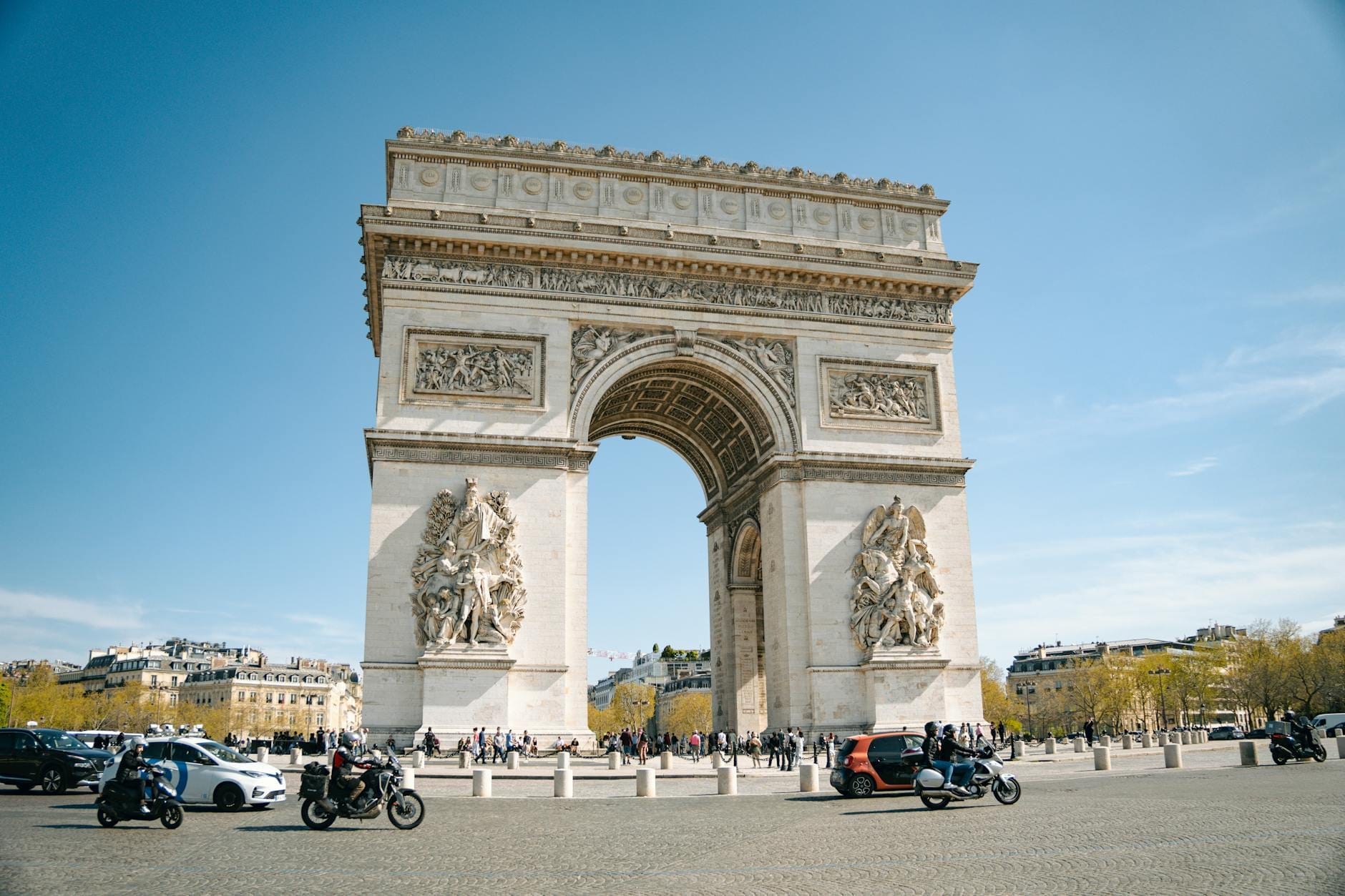
Standing 49.5 metres above Place Charles de Gaulle, the Arc de Triomphe de l'Étoile anchors the grandest axis in Paris. Its rooftop terrace delivers one of the city's great panoramas, while the base houses the Tomb of the Unknown Soldier — a living memorial renewed by flame every evening.
Quick Facts
- Location
- Place Charles de Gaulle (Place de l'Étoile), 8th arrondissement, Paris
- Getting There
- Métro Line 1, 2 or 6 — Charles de Gaulle–Étoile station
- Time Needed
- 1 to 1.5 hours (monument + terrace)
- Cost
- €16 winter / €22 summer (€16 on Wednesdays in summer). Free for under-18s and EU residents aged 18–25. First Sunday of each month (Nov–Mar) free for all. Paris Museum Pass accepted. (2026 rates)
- Best for
- Panoramic city views, French history, photography at sunset, and architecture lovers
- Official website
- www.paris-arc-de-triomphe.fr/en
What You're Actually Looking At
The Arc de Triomphe de l'Étoile is not simply a large arch. At 49.5 metres tall and 45 metres wide, it is one of the world's most celebrated triumphal arches, and the centrepiece of a deliberate urban geometry: twelve radiating avenues fan outward from the circular Place Charles de Gaulle, a layout that is only truly legible from above. The arch stands at the western end of the historical axis that runs from the Louvre, through the Jardin des Tuileries, along the Champs-Élysées, and continues to the Grande Arche de La Défense several kilometres west.
Commissioned by Napoleon Bonaparte in 1806 following his victory at Austerlitz, the structure was designed by architect Jean-François Thérèse Chalgrin. Construction was interrupted by political upheaval, and the arch was not completed until 1836, under King Louis-Philippe — 15 years after Napoleon's death. The emperor never walked beneath it, though his funeral cortège was ceremonially passed beneath the arch in 1840.
The four main piers carry sculptural reliefs, none more famous than François Rude's 'La Marseillaise' on the eastern face. On the interior walls, 660 names of Napoleonic generals and battles are engraved — those who died in combat are underlined. For deeper context on Napoleon's Paris, pair this visit with Les Invalides, where his tomb lies a short taxi ride away.
The Tomb of the Unknown Soldier
Beneath the central vault, since 11 November 1920, the Tomb of the Unknown Soldier has honoured the unidentified dead of the First World War. The eternal flame is rekindled every evening at 6:30 PM (5:30 PM in winter), a ceremony that has continued without interruption since 1923. Even on the most tourist-heavy afternoons, this corner of the arch retains genuine gravity — visitors lower their voices without being asked.
💡 Local tip
The 6:30 PM flame ceremony is free and requires no ticket. Arrive a few minutes early and stand to the side of the arch for an unobstructed view. On 11 November (Armistice Day), it becomes a major national commemoration; note the monument is partially closed that morning.
The tomb is accessible without a ticket from street level at all hours. The ground-level visit alone — studying the reliefs and reading the battle names on the inner walls — can occupy a thoughtful 20 minutes and costs nothing.
Tickets & tours
Hand-picked options from our booking partner. Prices are indicative; availability and final rates are confirmed when you complete your booking.
Best of Paris guided bike tour
From 45 €Instant confirmationFree cancellationBig Bus tour of Paris
From 0 €Instant confirmationFree cancellationBig Bus tour of Paris
From 0 €Instant confirmationFree cancellationDiscovering Paris: Walking audio tour along the Seine river
From 11 €Instant confirmation
Climbing to the Terrace
The rooftop terrace is the main reason most visitors buy a ticket, and it earns its price. From 50 metres up, the geometry of Paris resolves in a way that no other viewpoint quite replicates. The Champs-Élysées stretches east toward the Louvre in a straight line; the Eiffel Tower fills the southern sky; Montmartre and its white dome sit on the northern horizon.
There are 284 steps to the top. An elevator runs to the attic level, an intermediate room housing a small museum on the arch's construction and its role in events including the 1944 Liberation. The final 46 steps to the open terrace must be climbed on foot. If you want to compare city panoramas, the Montparnasse Tower offers a broader southward view that includes the Arc de Triomphe itself.
⚠️ What to skip
Accessibility: the terrace requires climbing more than 40 steps above the elevator landing and cannot be reached by wheelchair users. The museum area is accessible via elevator, though three steps precede it. Pushchairs are not permitted inside the monument. A drop-off zone is available directly on the roundabout for visitors who cannot use the underpass.
When to Visit: Time of Day Changes Everything
Mid-morning on a weekday sees the lowest crowds. By 11 AM in summer, tour groups arrive in earnest. The monument opens at 10 AM daily (11 AM on Tuesdays year-round), so arriving at opening is the simplest crowd-avoidance strategy.
Dusk is the most photographically rewarding time. As the light drops, the Champs-Élysées fills with headlights streaming toward you, and the city transitions from golden-hour warmth to blue-hour electric glow. The monument stays open until 11 PM (April–September) and 10:30 PM (October–March), making a post-dinner ascent in summer entirely practical. The terrace at 9 PM in July, with the Eiffel Tower sparkling on the hour below, delivers exactly what it promises.
ℹ️ Good to know
Opening hours: April 1–September 30, daily 10:00–23:00 (Tuesdays from 11:00). October 1–March 31, daily 10:00–22:30 (Tuesdays from 11:00). Last admission 45 minutes before closing. Closed morning of 1 May, 8 May, and 11 November for official ceremonies. Verify exceptional closures on the official site.
Spring (April–June) and early autumn (September–October) offer the best combination of mild weather and manageable crowds. Paris summers can bring haze that softens long-distance views. For a fuller picture of timing your trip, the best time to visit Paris guide covers seasonal trade-offs in detail.
Getting There and Buying Tickets
Do not try to cross to the arch via the road — the roundabout is one of Paris's most dangerous traffic circles. Use the pedestrian underpass beneath the north side of the Champs-Élysées, near Avenue de Friedland. The entrance is clearly signposted from the Métro exits.
By Métro, take Line 1, 2, or 6 to Charles de Gaulle–Étoile; RER A stops here as well. The station is a major interchange reachable from virtually anywhere in central Paris. For a broader look at navigating the city, the getting around Paris guide covers all transit options and fare structures.
Book tickets online in advance, particularly June through September. The 2026 fare is €16 in low season (Oct–Mar) and €22 in high season (Apr–Sep), reduced to €16 on Wednesdays in summer. The Paris Museum Pass covers entry. Free-admission days (first Sunday of the month, November–March) are popular; the monument can still feel crowded even without a ticket cost.
Photography Tips and Honest Assessment
The classic shot of the arch framing the Champs-Élysées is taken from street level looking west along the avenue. For the overhead star pattern of the twelve avenues, you need the terrace: position yourself on the eastern parapet and shoot straight down toward the Louvre. At night, long-exposure shots of car light trails converging from all directions are among the most technically satisfying compositions in Paris.
For a curated list of Paris's best photography locations, the best photo spots in Paris guide is worth reviewing before you arrive. And for the full pedestrian experience of the avenue itself, the Champs-Élysées walk from Place de la Concorde to the arch base takes about 30 minutes at a leisurely pace.
For a first-time visitor, the Arc de Triomphe is worth both the time and the ticket. The rooftop view shows the city's urban design rather than just its skyline, and the Tomb of the Unknown Soldier gives the visit a layer of substance that pure viewpoint attractions rarely have. Visitors who prioritise art over panoramas may reasonably skip the paid ascent and spend the same time and budget at a major museum — but as a condensed encounter with French national identity, the arch covers a lot of ground in 90 minutes.
Insider Tips
- Book your ticket online at least 24 hours in advance in summer. The box office queue can add 30–40 minutes even with a reserved ticket; the online pre-purchase lane moves significantly faster.
- The attic-level museum midway up the stairs is easy to rush past, but pause for the scale model of the arch and the exhibition on the 1944 Liberation parade — both add genuine context to what you're standing inside.
- On the terrace, walk the full perimeter rather than just facing the Champs-Élysées. The western view toward La Défense shows Paris's 20th-century architectural ambitions, and the northern panorama reveals Montmartre in a way few visitors expect.
- On the first Sunday of every month from November through March, admission is free for all visitors with no conditions. Arrive right at opening (10 AM) to avoid the crowds that free days inevitably attract.
- The flame rekindling at 6:30 PM is brief, about five minutes, and entirely free. Arrive a few minutes before from the underpass entrance. Wednesday and Thursday evenings see the lowest attendance at this ceremony.
Who Is Arc de Triomphe For?
- First-time visitors to Paris wanting a single spot that encapsulates the city's scale and grandeur
- History enthusiasts with an interest in Napoleonic France or the World Wars
- Photographers seeking the Champs-Élysées light-trail shot or golden-hour rooftop panoramas
- Travellers with the Paris Museum Pass looking to maximise their coverage in the 8th arrondissement
- Evening visitors who want a late-night city view without the Eiffel Tower crowds
Nearby Attractions
Other things to see while in Champs-Élysées & Trocadéro:
- Champs-Élysées
Stretching 1.91 km from Place de la Concorde to the Arc de Triomphe, the Avenue des Champs-Élysées is at once Paris's grandest promenade and its most debated street. Here is what to expect, when to go, and how to make the most of it.
- Crazy Horse Paris
Crazy Horse Paris has staged its distinctive blend of dance, light, and visual design on Avenue George V since 1951. The current show, 'Totally Crazy!', runs approximately 90 minutes and draws a mix of curious first-timers and loyal returning guests who appreciate its position between cabaret tradition and contemporary performance art.
- Grand Palais
Built for the 1900 Universal Exhibition and freshly reopened after a landmark renovation, the Grand Palais is one of the most spectacular public buildings in Europe. Its iron-and-glass nave stretches 240 metres and shelters world-class art exhibitions, cultural events, and the Palais de la Découverte science museum beneath a single soaring roof.
- Jardin des Tuileries
Stretching approximately 800 metres between the Louvre and Place de la Concorde, the Jardin des Tuileries is one of the oldest and most significant public gardens in France. Designed by André Le Nôtre in 1664 and free to enter year-round, it offers formal French geometry, open terraces, historic sculptures, and a rare patch of calm in the middle of central Paris.