Les Invalides: The Golden Dome, Napoleon's Tomb, and One of Paris's Most Rewarding Museum Complexes
L'Hôtel National des Invalides is far more than a single monument. Spread across a 15-courtyard complex in the 7th arrondissement, it combines Napoleon's tomb beneath a 110-metre gilded dome, the vast Musée de l'Armée, and a working veterans' institution that has stood since Louis XIV commissioned it in 1670.
Quick Facts
- Location
- 129 Rue de Grenelle, 75007 Paris (7th arrondissement)
- Getting There
- Métro lines 8 or 13 (La Tour-Maubourg or Varenne); RER C (Invalides); Bus 69, 87
- Time Needed
- 2 to 4 hours (half day for the full museum)
- Cost
- €17 full price; €12 discounted; free for under-18s and EU residents under 26. Paris Museum Pass accepted.
- Best for
- History lovers, military history enthusiasts, architecture admirers, first-time visitors to Paris
- Official website
- www.musee-armee.fr/en/home.html
What Is Les Invalides, Exactly?
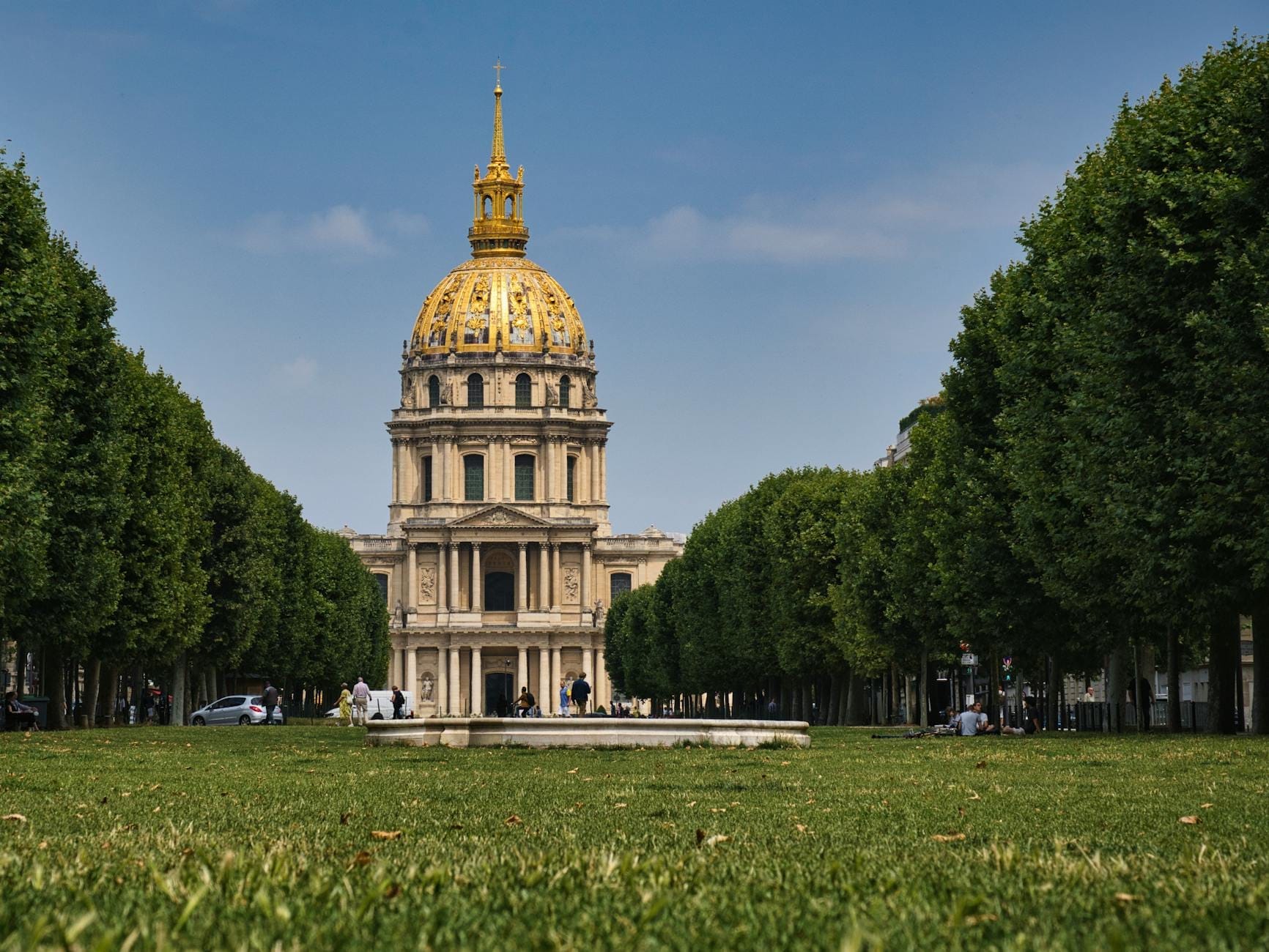
L'Hôtel National des Invalides is one of the most architecturally imposing complexes in Paris, and also one of the most misunderstood. Many visitors arrive expecting to see a single building. What they find instead is a self-contained world: 15 courtyards, a 196-metre-long baroque facade, a church split into two halves by a wall of glass (one for soldiers, one for kings), and one of the largest military museums in the world. Then there is the gilded dome, rising 110 metres above the surrounding rooftops and visible from across the city.
Louis XIV commissioned the complex in 1670 to house wounded soldiers returning from France's wars. Libéral Bruant designed the main structure between 1671 and 1676; Jules Hardouin-Mansart added the Dôme des Invalides between 1679 and 1706. At its peak over 4,000 veterans lived here, and today the site still functions as a retirement home and medical centre for veterans, giving it an unusual dual identity: working institution and historic monument at once.
ℹ️ Good to know
Opening hours: daily 10am to 6:30pm (April to September) and 10am to 5pm (October to March). Closed on the 1st Monday of each month. The first Friday of every month features a late-night opening from 6pm to 10pm at a reduced €10 entry fee.
The Esplanade and First Impressions
Approaching from the north, across the Esplanade des Invalides, the scale of the place starts to register gradually. The esplanade stretches roughly 450 metres by 250 metres, framed by rows of plane trees whose canopy casts dappled shade in spring and summer. On a clear day, the golden dome catches the light from far down the Seine, competing visually with the Eiffel Tower to the west. If you are walking from the river, you pass the Pont Alexandre III, one of Paris's most ornate bridges, which lines up almost perfectly with the dome's axis.
In the early morning before 10am, the esplanade is quiet enough to photograph without interference from the crowds that arrive later. Runners use it, dog walkers cross it diagonally, and the long shadows from the plane trees stretch across the gravel in a way that photographs well. The main entrance gate opens onto the Cour d'Honneur, the grandest of the 15 courtyards, which has served as a parade ground since the 17th century. It was here that Napoleon reportedly reviewed his troops. If you are interested in the broader landscape of landmarks in this part of the city, the Eiffel Tower and Invalides neighbourhood concentrates an extraordinary density of monuments within walking distance.
Tickets & tours
Live prices and dates from our booking partner. If you book, we may earn a commission at no extra cost to you.
Guided tour of Les Invalides with Tomb of Napoleon
From 89 €Instant confirmationLes Invalides and Army Museum priority tickets with audio tour on mobile app
From 29 €Instant confirmationPrivate guided tour Napoleon and Les Invalides
From 88 €Instant confirmationBike tour of Versailles Palace with skip-the-line tickets
From 109 €Instant confirmationFree cancellation
Napoleon's Tomb: The Emotional Core of the Visit
Whatever you think of Napoleon Bonaparte as a historical figure, his tomb is an extraordinary thing to stand in front of. His remains were returned from Saint Helena in 1840 and placed beneath the Dôme des Invalides in a red quartzite sarcophagus that rests on a base of green Vosges granite. The whole structure sits in a circular sunken crypt, so visitors look down on it from a surrounding gallery. The geometry is deliberate: you are always looking down at the emperor, which subtly undercuts the grandeur the tomb was designed to project. Around the crypt, the names of Napoleon's major campaigns are inscribed on the floor.
The dome itself, seen from the interior, is more theatrical than you expect. The painted ceiling draws the eye upward through successive concentric rings, and the gilded details glow with reflected light even on overcast days. The church is shared between the Soldiers' Church (Église Saint-Louis des Invalides, open to visitors and still used for military funerals) and the Royal Church beneath the dome. Stand at the glass partition between the two to see how dramatically different they feel in scale and atmosphere.
💡 Local tip
Visit the tomb between 10am and 11:30am on weekdays. Tourist groups tend to arrive en masse from around noon, and the circular gallery above the crypt becomes shoulder-to-shoulder. The early window gives you room to pause and read the inscriptions without rushing.
The Musée de l'Armée: More Than Cannons and Uniforms
The Army Museum spread across the wings of the complex is one of the largest and most comprehensive military history collections in the world. The full ticket (€17 adult) covers access to all permanent galleries, the temporary exhibition, the Musée de l'Ordre de la Libération, and the Musée des Plans-Reliefs, in addition to the dome and tomb. Ticket holders also get queue-cutting access to the nearby Musée Rodin, which is a genuinely useful perk given how close it is.
The collection spans medieval armour through to France's 20th-century conflicts. The armour gallery, in a long vaulted hall, is a highlight: full suits of armour for men and horses displayed in formation, lit from above, with enough density that even visitors with passing interest tend to slow down. The World War I and II sections rank among the most carefully curated in Europe, covering not just French perspectives but the broader allied and strategic context.
The Musée des Plans-Reliefs, on the upper floor, deserves more attention than it usually gets. It holds a collection of large-scale 3D models of French fortified towns, commissioned by Louis XIV as planning tools for military campaigns. Some models span several metres and the detail is extraordinary. The gallery is almost always calm compared to the floors below.
For those with a particular interest in French military history from a different angle, the Musée de Cluny in the Latin Quarter covers the medieval period in depth, with artefacts that complement what you see in Les Invalides' armour collection.
How the Experience Changes Through the Day
The complex reads differently depending on what time you arrive. Early mornings are for the exterior: the esplanade, the facade, the courtyard. The light hits the dome from the east in the morning and swings to the south by midday, but the gold leaf catches whatever is available. In overcast weather, the dome loses some of its luminosity, but the symmetry of the baroque facade is actually clearer without harsh shadows.
Inside, the museum galleries are manageable in the first two hours of opening. By early afternoon on weekdays, and from opening time on weekends and school holidays, the main rooms fill up with school groups and coach parties. The tomb in particular gets crowded. Midweek mornings in October or March are the closest thing to an uncrowded visit. The monthly late-night Friday opening (6pm to 10pm, €10 entry) is a genuinely different experience: the dome interior takes on a different quality under artificial lighting, and attendance is markedly lower than daytime.
⚠️ What to skip
The complex is closed on the 1st Monday of each month. Check the official site before visiting, particularly around French public holidays, when some sections may close or reduce hours.
Practical Walkthrough: Getting There and Getting Around
Les Invalides sits in the 7th arrondissement, on the Left Bank, roughly midway between the Eiffel Tower and Saint-Germain-des-Prés. The most straightforward Metro options are line 13 to Varenne (exit directly onto Boulevard des Invalides, a two-minute walk from the south entrance) or line 8 to La Tour-Maubourg (slightly longer walk along Rue de Grenelle). RER C stops at Invalides station, which puts you on the north side of the building near the Seine. The difference is directional: the north approach shows you the esplanade and dome first; the south approach brings you straight to the museum entrance.
Walking from the Eiffel Tower takes around 15 to 20 minutes through pleasant residential streets. From the Musée Rodin, it is a four-minute walk, and the combined ticket is now officially bundled: your Les Invalides ticket includes queue-cutting access to the Rodin, making a logical half-day pairing. The Pont Alexandre III is less than ten minutes on foot to the north and is worth including on any route through this part of the city.
Photography inside the dome and the main museum halls is permitted without flash. The courtyard and esplanade are freely accessible without a ticket during museum opening hours. Wheelchair access is available in the main areas, though the complex's age means some sections have uneven surfaces or limited lift access; confirm specifics with the museum before visiting if this is a concern.
Who Should Skip This, and What to Temper Your Expectations On
Les Invalides is not for visitors who want Paris in condensed, photogenic form. If you have one day and want to check off the city's most iconic images, the Eiffel Tower and Notre-Dame Cathedral will deliver that more efficiently. Les Invalides rewards curiosity and patience. You need at minimum two hours to move through the main sections without feeling rushed, and the museum's full depth only emerges if you spend a proper half day.
Young children may find the museum sections heavy going, though the courtyard and the visual spectacle of the dome interior tend to hold their attention. The armour hall is usually a hit with kids interested in knights and medieval history. The extensive World War II galleries, while important, are not designed with young children as the primary audience.
If you are travelling on a tight budget, note that under-18s and EU residents under 26 enter for free, as do holders of the Paris Museum Pass. Check whether the Pass makes financial sense for your itinerary using this overview of the Paris Museum Pass.
Insider Tips
- The first Friday of each month offers late-night access from 6pm to 10pm for just €10. The dome takes on a different atmosphere under evening lighting, and the crowds are a fraction of daytime levels.
- Enter from the south side on Boulevard des Invalides (via Métro Varenne) rather than the northern esplanade entrance if you want to head straight to the tomb and dome. The south entrance drops you directly into the museum wing, bypassing the longest courtyard walk.
- The Musée des Plans-Reliefs on the upper floor is consistently overlooked. The enormous scale models of French fortified towns, made to Louis XIV's orders, are some of the most detailed historical objects in the entire complex and the gallery is usually uncrowded.
- Your Les Invalides museum ticket includes queue-cutting access to the Musée Rodin, located just a short walk away on Rue de Varenne. If you plan to visit both in a day, do Les Invalides first when your energy is highest, then walk to the Rodin garden for a calmer afternoon.
- For exterior photography, mid-morning light from the east illuminates the golden dome most directly. The best angles of the dome against an open sky are from the centre of the esplanade or from the Pont Alexandre III to the north, where the dome frames cleanly against the skyline.
Who Is Les Invalides For?
- History enthusiasts with a particular interest in European military history from the medieval period to the 20th century
- Architecture admirers drawn to French baroque at its most ambitious
- Napoleon followers wanting to see the actual tomb and original artefacts connected to his campaigns
- Museum Pass holders looking to get significant value from a half-day visit that covers multiple collections under one roof
- Visitors pairing Les Invalides with a walk to the Eiffel Tower, Pont Alexandre III, and the Musée Rodin in a single Left Bank loop
Nearby Attractions
Other things to see while in Eiffel Tower & Les Invalides:
- Eiffel Tower
Standing 330 metres above the 7th arrondissement, the Eiffel Tower is the world's most visited paid monument. This guide covers everything you need to know before you go: ticket tiers, best visiting times, transit options, and honest advice on what the experience actually delivers.
- Musée d'Orsay
Housed in a converted 1900 railway station on the Seine's left bank, the Musée d'Orsay holds the world's most comprehensive collection of Impressionist and Post-Impressionist art. From Monet's water lilies studies to Van Gogh's self-portraits, the building itself competes with its contents for your attention.
- Musée Rodin
Housed in the 18th-century Hôtel Biron near Les Invalides, the Musée Rodin brings together more than 6,800 sculptures and a three-hectare garden where The Thinker, The Burghers of Calais, and The Gates of Hell stand in open air. It is one of the most rewarding museum visits in Paris, combining world-class art with one of the city's finest historic gardens.
- Pont Alexandre III
Pont Alexandre III is the most elaborately decorated bridge in Paris, a single-arch steel span dripping in gilded statues, winged horses, and Belle Époque lampposts. Free to cross at any hour, it doubles as an open-air sculpture museum with some of the finest views of the Eiffel Tower and Invalides along the Seine.
Planning a trip? Discover personalized activities with the Nomado app.