Pont Alexandre III: The Bridge That Outdressed Every Monument Around It
Pont Alexandre III is the most elaborately decorated bridge in Paris, a single-arch steel span dripping in gilded statues, winged horses, and Belle Époque lampposts. Free to cross at any hour, it doubles as an open-air sculpture museum with some of the finest views of the Eiffel Tower and Invalides along the Seine.
Quick Facts
- Location
- Cours la Reine / Quai d'Orsay, 75008 Paris (connecting 7th and 8th arrondissements)
- Getting There
- Invalides (Métro lines 8 & 13, RER C); Champs-Élysées–Clemenceau (Métro lines 1 & 13)
- Time Needed
- 20–40 minutes to stroll and photograph; longer if you pause at each sculptural group
- Cost
- Free – open public bridge, no ticket required
- Best for
- Architecture lovers, photographers, romantic evening walks, and Seine-side promenading
What Pont Alexandre III Actually Is
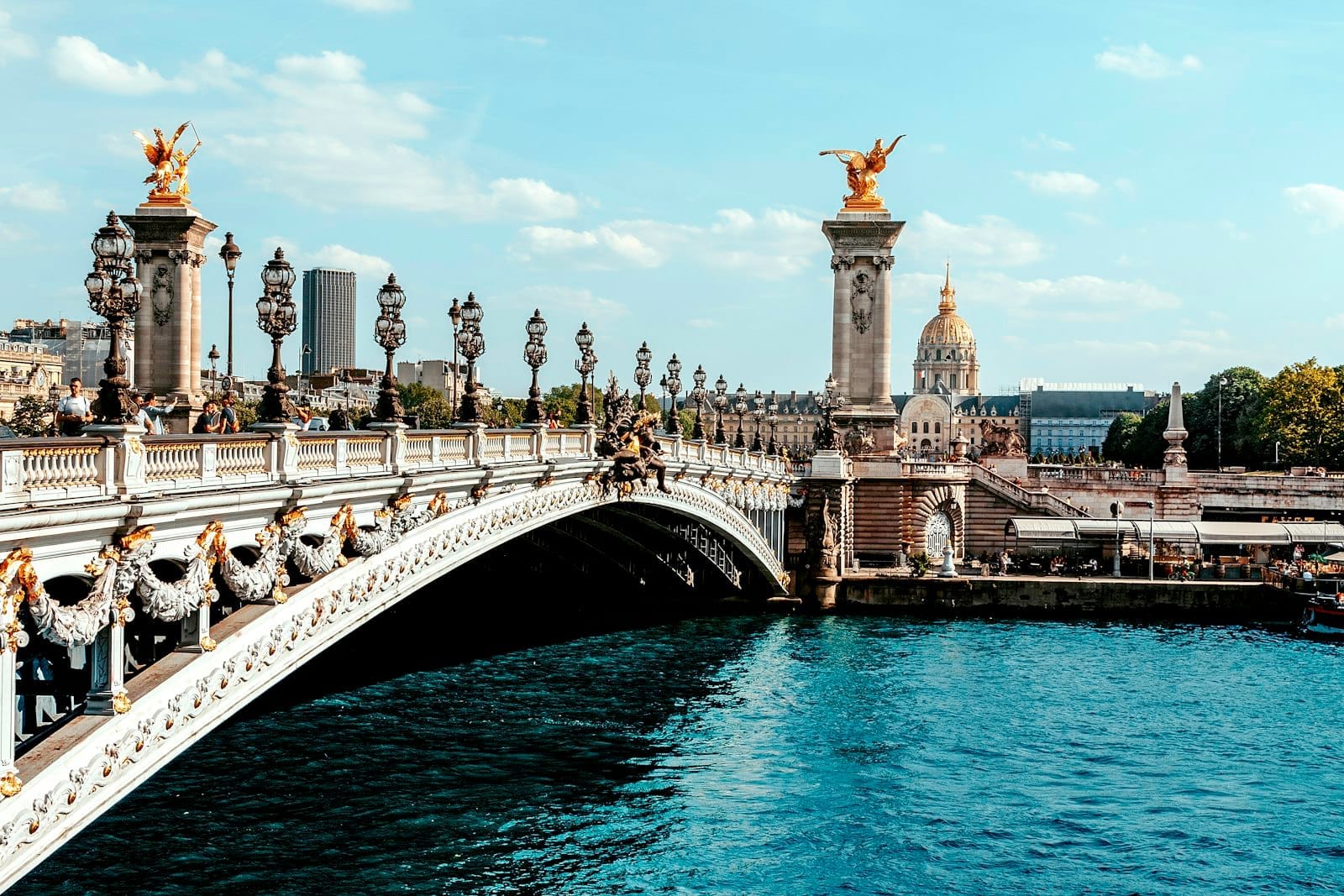
Pont Alexandre III is a classified French monument historique spanning the Seine between the 7th and 8th arrondissements of Paris. At 154 metres long and 45 metres wide, it is the widest and lowest bridge in the city, its single steel arch rising just 6 metres above the waterline. That deliberately flattened profile was an engineering choice, not a compromise: the bridge had to stay low enough to preserve sightlines to the Invalides and the Grand Palais on either side.
What most visitors notice immediately is not the engineering but the decoration. The bridge carries work by 13 different sculptors, four towering 17-metre stone pylons topped with gilded bronze Pegasus figures, ornate Belle Époque lampposts, marble sculptural groups at the pylon bases, copper keystone reliefs, and rows of lion sentinels at each entrance. It functions, in effect, as an open-air museum that also carries traffic.
ℹ️ Good to know
The bridge is open 24 hours a day, 365 days a year, with no admission charge. It carries both pedestrians and vehicles, so keep to the broad sidewalks on either side.
History: A Bridge as Diplomatic Symbol
The bridge was conceived as a physical embodiment of the Franco-Russian Alliance. Tsar Nicholas II laid the foundation stone in October 1896, and the bridge was inaugurated in April 1900 for the Exposition Universelle. It was named after Alexander III, Nicholas II's father and the Russian tsar who had signed the original 1892 alliance with France. The two copper keystone reliefs by sculptor Georges Récipon make the symbolism concrete: the upstream keystone shows nymphs of the River Seine alongside the coat of arms of the City of Paris; the downstream keystone shows nymphs of the River Neva alongside the imperial arms of Russia.
The designers were engineers Jean Résal and Amédée Alby, with architects Joseph Cassien-Bernard and Gaston Cousin overseeing the ornamental programme. The bridge was completed in three years, an impressive feat for a structure that involved pouring stone foundations while managing Seine river traffic. Its classification as a monument historique came in 1975, formally protecting both the structure and its sculptural decoration.
For context on the neighbourhood it anchors, the bridge sits at the heart of the Eiffel Tower and Invalides district, one of the most ceremonially planned stretches of Paris.
Tickets & tours
Hand-picked options from our booking partner. Prices are indicative; availability and final rates are confirmed when you complete your booking.
Paris Essential dinner cruise at 6.15pm
From 99 €Instant confirmationFree cancellationEiffel Tower reserved elevator entrance to 2nd floor with walking tour and Seine cruise
From 94 €Instant confirmationFree cancellationBest of Paris city tour with Eiffel Tower lunch and Seine cruise
From 144 €Instant confirmationFree cancellationBike tour of Versailles Palace with skip-the-line tickets
From 109 €Instant confirmationFree cancellation
The Sculptures: What to Look For
Most people cross Pont Alexandre III without realising the sculptural programme follows a deliberate iconographic scheme. The four pylons each carry a different gilded bronze Pegasus at the summit, while their marble bases are carved with four episodes from French history: La France Contemporaine by Gustave Michel, La France de Charlemagne by Alfred Lenoir, La France de la Renaissance by Jules Coutan, and La France de Louis XIV by Laurent Marqueste. Together they trace a visual history of French civilisation from the Carolingian era to the Belle Époque.
At the bridge entrances, bronze lions sculpted by Jules Dalou crouch on stone pedestals. The iron railings between the lampposts carry nymph reliefs representing the Seine and the Neva, the rivers of the two allied nations. The lampposts themselves, decorated with cherubs and foliage in cast iron, are among the most photographed details on the bridge. Count them as you walk: there are 32 lampposts in total.
💡 Local tip
Walk the downstream (south-facing) pavement rather than the upstream side. You get a cleaner view toward the Eiffel Tower, and the morning sun falls on the gilded pylons from that angle.
How the Experience Changes by Time of Day
Early morning is the bridge at its quietest. Between 7 and 9 a.m. the pedestrian sidewalks are mostly empty, the golden Pegasus figures catch the low eastern light, and the Seine below runs a deep slate colour. Photographers who want the gilded statues against a blue sky with minimal tourists in frame should aim for 7:30 a.m. in summer, a little later in winter. The only noise is passing traffic and the occasional river barge.
Midday brings tour groups, joggers, and cyclists. The bridge is wide enough that it never feels dangerously crowded, but selfie bottlenecks form around the pylon bases. If you are visiting primarily for atmosphere rather than photography, midday is actually fine because the sculptural detail is uniformly lit and easy to read. Street vendors sometimes set up near the ramps.
After sunset, Pont Alexandre III transforms. The bridge's period lampposts illuminate the deck in warm amber, the gilded horses glow above the dark water, and the Eiffel Tower's light show fires every hour on the hour until 1 a.m. Standing at the centre of the bridge at 10 p.m. on a clear night, with the tower sparkling to the south-west and the dome of the Invalides lit behind you, is one of the more quietly spectacular moments Paris offers without requiring a reservation.
For a broader itinerary built around views like this, see the guide to the best photo spots in Paris.
Getting There and Moving On
The most direct Métro approach is Invalides station (lines 8 and 13, plus RER C), a five-minute walk along the quai from the eastern end of the bridge. From the 8th arrondissement side, Champs-Élysées–Clemenceau (lines 1 and 13) puts you near the Grand Palais, a four-minute walk to the western ramp. There is no dedicated parking at the bridge, and cycling is possible since the bridge is shared-road.
The bridge sits at a natural walking junction. The Invalides complex is less than 400 metres east along the Quai d'Orsay. The Grand Palais is directly north across the Cours la Reine. A short walk along the riverbank southwest leads toward the Eiffel Tower. Most visitors combine the bridge with all three in a single half-day loop.
💡 Local tip
The RER C stops at Pont de l'Alma, about 600 metres west, which is useful if you are coming from the Eiffel Tower direction. Both stops are roughly equidistant from the bridge depending on which end you approach.
Practical Notes: Weather, Photography, and Accessibility
The bridge is fully wheelchair accessible: both approach ramps are gently graded with no steps. The broad pedestrian walkways are comfortable even with a pushchair or mobility aid. There are no facilities on the bridge itself (no toilets, no cafés), but options exist at the Invalides esplanade and near the Grand Palais within five minutes' walk.
Rain changes the experience meaningfully. The lampposts reflect in the wet deck surface, which is photogenic, but the gilded statues lose some of their warmth under grey skies. The bridge is exposed with no shelter, so bring a waterproof layer in any season except high summer. In winter, low sun angles from roughly 10 a.m. to 2 p.m. are the only time the gilded bronze picks up warm light.
For photography, a wide-angle lens or standard phone camera works well for the full pylon groups. If you want detail shots of the keystone copper reliefs, those are best viewed from a river boat passing underneath. Several Seine cruise companies pass directly beneath the arch.
A Seine river cruise offers the only angle from which you can properly see the copper keystone sculptures under the arch, which are invisible from the bridge deck itself.
Is It Worth Your Time?
Pont Alexandre III rewards a slow crossing rather than a quick glance. The sculptural detail is dense enough that a purposeful 20-minute walk, pausing at each pylon base and reading the allegorical figures, gives you a genuine encounter with late-19th-century French monumental art at its most extravagant. At its worst, the bridge is simply an impressive backdrop. At its best, especially at dusk or early morning, it is one of the most atmospheric stretches of Paris.
Travellers who are primarily interested in interiors, art collections, or historical narratives may find the bridge slightly thin as a standalone destination. It earns its time as part of a wider walk rather than a dedicated pilgrimage. That said, it costs nothing, takes no advance planning, and is one of the few Paris landmarks that is genuinely better in person than in photographs.
Insider Tips
- Walk to the exact centre of the bridge at 10 p.m. during summer to watch the Eiffel Tower light show with the gilded Pegasus in the foreground. No viewpoint in Paris combines these two landmarks at this angle.
- The downstream pavement (south side) gets the better morning light on the gilded pylons and also gives you unobstructed westward views toward the Eiffel Tower. Most tourists default to the upstream side.
- The copper keystone reliefs under the arch, depicting the nymphs of the Seine and the Neva, are essentially invisible from the deck. Booking a river cruise or renting a kayak is the only way to see this detail properly.
- RER C stops at Invalides station, making this bridge very fast to reach from the Eiffel Tower or Musée d'Orsay without changing trains. The journey from Eiffel Tower (Champ-de-Mars) is two stops.
- Early October and late April offer the sharpest balance of good light, moderate visitor numbers, and mild temperatures for a long riverside walk between the bridge and the Invalides esplanade.
Who Is Pont Alexandre III For?
- Architecture and Beaux-Arts enthusiasts who want to study Belle Époque ornamental sculpture in detail
- Photographers targeting golden-hour shots that combine the bridge, the Seine, and the Eiffel Tower in one frame
- Couples and romantic evening walkers looking for the most atmospheric stretch of the Seine after dark
- First-time visitors building a half-day loop through the 7th and 8th arrondissements
- Travellers with limited mobility, since the bridge is flat, fully accessible, and free with no queuing
Nearby Attractions
Other things to see while in Eiffel Tower & Les Invalides:
- Eiffel Tower
Standing 330 metres above the 7th arrondissement, the Eiffel Tower is the world's most visited paid monument. This guide covers everything you need to know before you go: ticket tiers, best visiting times, transit options, and honest advice on what the experience actually delivers.
- Les Invalides
L'Hôtel National des Invalides is far more than a single monument. Spread across a 15-courtyard complex in the 7th arrondissement, it combines Napoleon's tomb beneath a 110-metre gilded dome, the vast Musée de l'Armée, and a working veterans' institution that has stood since Louis XIV commissioned it in 1670.
- Musée d'Orsay
Housed in a converted 1900 railway station on the Seine's left bank, the Musée d'Orsay holds the world's most comprehensive collection of Impressionist and Post-Impressionist art. From Monet's water lilies studies to Van Gogh's self-portraits, the building itself competes with its contents for your attention.
- Musée Rodin
Housed in the 18th-century Hôtel Biron near Les Invalides, the Musée Rodin brings together more than 6,800 sculptures and a three-hectare garden where The Thinker, The Burghers of Calais, and The Gates of Hell stand in open air. It is one of the most rewarding museum visits in Paris, combining world-class art with one of the city's finest historic gardens.