Musée d'Orsay: Inside the World's Greatest Impressionist Museum
Housed in a converted 1900 railway station on the Seine's left bank, the Musée d'Orsay holds the world's most comprehensive collection of Impressionist and Post-Impressionist art. From Monet's water lilies studies to Van Gogh's self-portraits, the building itself competes with its contents for your attention.
Quick Facts
- Location
- Esplanade Valéry Giscard d'Estaing, 75007 Paris (7th arrondissement, left bank of the Seine)
- Getting There
- RER C: Musée d'Orsay station (direct, 2-min walk); Métro Line 12: Solférino (5-min walk); Bus 63, 68, 73, 83, 84, 94
- Time Needed
- 2.5–4 hours for a focused visit; a full day if exploring every floor
- Cost
- Full price €16 online / €14 on-site; reduced €13 (Thursday late nights); free for under-18s and EU residents under 26. First Sunday of each month: free for all (reservation required)
- Best for
- Art lovers, architecture enthusiasts, Impressionism fans, photography buffs
- Official website
- www.musee-orsay.fr/en
What the Musée d'Orsay Actually Is
The Musée d'Orsay is not simply a museum with great paintings. It is, by most measures, the single greatest concentration of Impressionist and Post-Impressionist art on the planet, housed inside one of Paris's most theatrical architectural spaces. The collection spans 1848 to 1914, bridging the academic salons of the mid-19th century and the early modernist experiments that followed. Works by Monet, Renoir, Degas, Manet, Cézanne, Van Gogh, Gauguin, Seurat, and Toulouse-Lautrec hang here, not as isolated highlights in a general collection, but as the museum's entire reason for being. For context on how it fits into the city's broader cultural map, see our guide to the best museums in Paris.
The museum opened on 9 December 1986 inside the former Gare d'Orsay, a Beaux-Arts railway terminus built for the 1900 Paris Universal Exposition. By the 1960s the station had become obsolete for mainline rail — its platforms were too short for modern trains — and the building sat underused, even serving briefly as a set for Orson Welles's 1962 film adaptation of Kafka's The Trial. Demolition plans were drawn up more than once. The official decision to convert it into a museum was taken on 20 October 1977, a move that saved not just a building but an entire urban landscape on the Seine's left bank.
ℹ️ Good to know
Since 2021, the museum's official administrative address is 'Esplanade Valéry Giscard d'Estaing', renamed in honor of the French president who championed the museum project. The institution itself continues to operate under the name Musée d'Orsay.
The Building: A Station That Became a Cathedral of Art
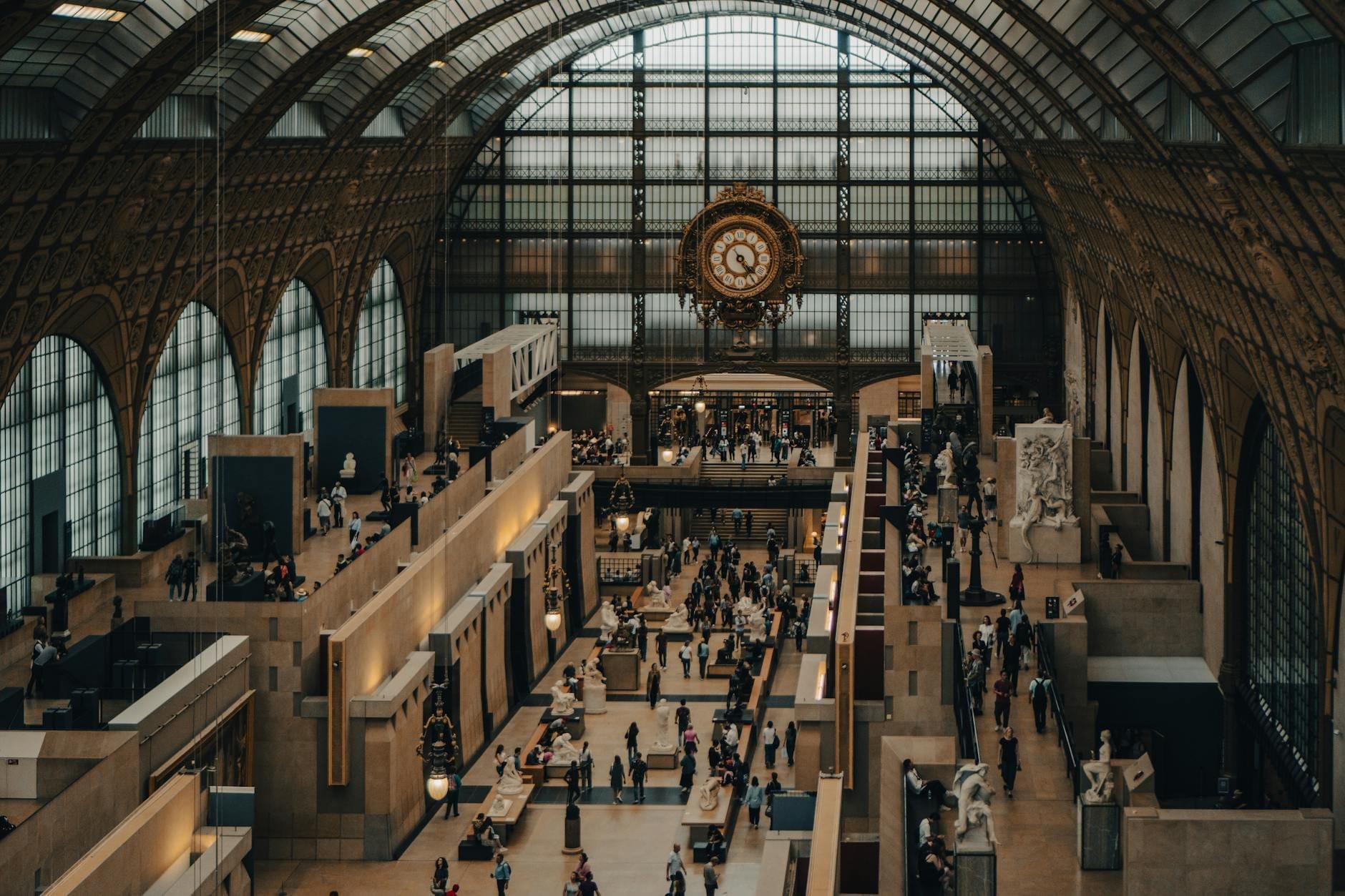
Walking into the Musée d'Orsay for the first time, the instinct is to look up. The central nave — formerly the station's main hall — rises 32 metres beneath an arching iron-and-glass vault that floods the space with diffuse natural light. The ornate gilded clocks set into the façade and the interior end walls are original station features, and they give the entire space a quality of suspended time that no deliberately designed museum hall could replicate.
The Beaux-Arts exterior, designed by architect Victor Laloux, was built to harmonize with the nearby Louvre and Tuileries across the river. From the outside, the building reads as a grand stone palace, not a functional transit hub. Inside, Italian architect Gae Aulenti led the 1980s conversion, inserting galleries within the nave's flanking wings while preserving the sweeping volume of the central hall. The tension between the industrial skeleton and the classical ornamentation is something you feel physically as you move through the space.
If you want to understand how this building sits within the broader Seine riverfront, it's worth combining a visit with a Seine river cruise, which passes directly in front of the museum's façade and offers the best exterior view of the building's full scale.
Tickets & tours
Hand-picked options from our booking partner. Prices are indicative; availability and final rates are confirmed when you complete your booking.
Musee d'Orsay Skip-the-Line Tickets and Guided Tour
From 59 €Instant confirmationFree cancellationSkip-the line guided tour of Musee Rodin
From 89 €Instant confirmationMusee d'Orsay entrance ticket with Seine river cruise
From 45 €Instant confirmationParis Musee d'Orsay tickets and in-app audio tour
From 35 €Instant confirmation
The Collection: What You'll Actually See
The permanent collection is organized across three levels. The ground floor (level 0) covers the academic and realist painting and sculpture of the 1850s–1870s, including large-scale Salon works that were the dominant aesthetic of the era. These rooms are often less crowded than the upper floors and reward visitors willing to slow down: the contrast between the official art world of Ingres and Cabanel and the rebellious experiments beginning just a few rooms away is one of the museum's most instructive juxtapositions.
The upper level (level 5) is where the museum's international reputation lives. The Impressionist and Post-Impressionist galleries are dense with works that most art lovers have spent a lifetime seeing only in reproduction. Monet's series paintings, Renoir's sun-drenched social scenes, Degas's bronze dancers and backstage ballet compositions, Pissarro's Paris boulevards, and Sisley's river landscapes occupy room after room. The light in these galleries, especially in morning hours when the crowd is thinner and the natural illumination from the roof windows is at its clearest, is genuinely affecting.
Van Gogh's room is inevitably the most crowded point in the museum. His Self-Portrait (1889), painted at the Saint-Paul-de-Mausole asylum, and The Church at Auvers-sur-Oise draw tight rings of visitors throughout the day. Arriving at opening time (9:00am) on a Tuesday or Wednesday gives the best chance of seeing these works without a crowd pressing behind you. By 11:30am on weekends, the upper galleries are genuinely packed. The middle level (level 2) covers Art Nouveau decorative arts, Symbolism, and early 20th-century works, and tends to be less trafficked — a good retreat when the top floor reaches capacity.
💡 Local tip
The giant clocks on the upper level are one of Paris's most photographed interior spots. For clean shots without strangers in frame, position yourself there before 10:00am on a weekday. The glass faces look out over the Seine and the Sacré-Cœur on the hill beyond — a genuinely surprising view.
How the Experience Changes Through the Day
Arriving just after opening at 9:00am on a Tuesday, Wednesday, or Friday puts you ahead of tour groups, school parties, and the main wave of day-trippers. The central nave echoes with footsteps rather than voices, and the light through the glass roof has a cool, almost silver quality in the early morning. Staff are attentive and the café on the middle level is nearly empty — a good moment to claim a seat and orient yourself with the floor plan before committing to a route.
By midday the museum reaches a different register. The nave fills with the ambient sound of dozens of audio guides playing simultaneously, and queues form at the main café. If you're arriving in the early afternoon, consider heading directly to the upper Impressionist galleries before the post-lunch surge from nearby hotels reaches them. The lower ground floor sculpture rooms and the Art Nouveau galleries on level 2 remain comparatively calm throughout the day and are worth saving for the middle hours.
Thursday evenings are a separate experience entirely. The extended opening until 9:45pm draws a different crowd: Parisians who have finished work, couples on dates, and serious art visitors who want space and quiet. The gallery lighting shifts slightly as natural light fades and the artificial illumination takes over — some visitors find the atmosphere more intimate; others prefer the clarity of daytime viewing. The Thursday night ticket is also cheaper at €13, making it the best-value entry point for adults.
Getting There and Practical Logistics
The most convenient access is via RER C, which stops at Musée d'Orsay station directly below the museum — a two-minute walk from platform to entrance. From the Métro, Line 12 to Solférino is a five-minute walk. Buses 63, 68, 73, 83, 84, and 94 all stop nearby. From the Eiffel Tower, the museum is approximately 15 minutes on foot along the riverbank, passing through the gardens of the Champ de Mars and crossing at the Pont de l'Alma — a pleasant walk in good weather.
Driving to the museum is possible but parking along the Seine embankments is limited and frequently unavailable on weekdays. The museum is within easy walking distance of other major 7th arrondissement sites; the Hôtel des Invalides is about 12 minutes on foot to the south, and the Musée Rodin is a 15-minute walk, making a combined visit to both museums a full but manageable day.
Timed-entry tickets are strongly recommended and available through the official website. Walk-up queues, especially on weekends and in peak summer months (June–August), can run 30–60 minutes. The museum participates in the Paris Museum Pass, which allows holders to enter without queuing at the general ticket line — a significant practical advantage. The first Sunday of each month is free for all visitors, but requires an advance reservation and attracts notably higher visitor numbers.
⚠️ What to skip
The museum is closed every Monday. This is one of the most common planning mistakes visitors make, particularly those arriving after a weekend in Paris and assuming museums follow consistent schedules. Double-check your visit day before traveling to the 7th arrondissement.
Photography, Accessibility, and What to Bring
Photography is permitted throughout the permanent collection without flash. Tripods are not allowed inside the galleries. The large clock windows on the upper level and the view down the central nave from the top-floor terrace are the most rewarding architectural shots. For the paintings themselves, the Degas ballet compositions and Renoir's Le Bal du moulin de la Galette are among the most recognizable works — though practically any stretch of wall on level 5 will produce an exceptional photograph.
The museum is wheelchair accessible, with lifts connecting all levels. Audio guides are available in multiple languages. The museum's on-site restaurant, set in the former station's ornate dining room, is worth at least a coffee stop for the gilded ceiling alone, even if the food prices reflect the location. For a deeper look at what Paris's museum circuit offers, the Paris Museum Pass guide breaks down whether the combined pass makes financial sense for your specific itinerary.
Wear comfortable shoes. The museum covers a significant floor area and the stone floors throughout the nave and galleries offer no forgiveness over a three-hour visit. Bag storage is available at the cloakroom near the entrance. Large backpacks may need to be checked; security at entry is thorough.
Honest Assessment: Who This Museum Is For, and Who Might Leave Disappointed
The Musée d'Orsay has a well-deserved reputation, and in this case the reputation is accurate. The density of significant works in the Impressionist galleries is genuinely unmatched anywhere in the world. If you care about 19th- and early 20th-century European art at all, this museum will exceed expectations.
That said: visitors expecting the encyclopedic scope of the Louvre will find the Orsay focused and relatively bounded. The collection ends at 1914. There is no ancient art, no Egyptian antiquities, no Renaissance painting. If your primary interest is medieval art, the Musée de Cluny or Sainte-Chapelle will be more relevant. And if you are traveling with young children who have no prior exposure to 19th-century painting, the Orsay's format — rooms of paintings requiring sustained attention — may test their patience more than a visit to the Cité des Sciences or a park would.
The crowds at peak times are real, and the Van Gogh and Monet rooms in summer can feel genuinely overwhelming. If you are sensitive to crowded enclosed spaces, a Thursday evening visit or an early Tuesday morning is not just a preference — it is the difference between a meaningful encounter with the art and a stressful jostle through famous rooms.
Insider Tips
- Thursday evenings (open until 9:45pm) offer the museum at its most peaceful and the ticket costs only €13 for adults — the best combination of value and experience available.
- The restaurant on the middle level occupies the original station dining room, with a painted ceiling and chandelier that most visitors walk past entirely. Even if you don't eat, step inside for sixty seconds.
- The giant clock faces on the upper level frame a view north over the Seine toward the Tuileries and beyond. Few visitors know they can walk directly up to the glass — arrive before 10:00am for an unobstructed photograph.
- The ground-floor sculpture gallery along the central nave is often overlooked in the rush to reach the Impressionist galleries upstairs. The academic bronzes and marbles here provide essential context for understanding what the Impressionists were reacting against.
- EU residents under 26 enter free on any day. Reduced rates apply for the Thursday late-night opening (currently around €13). All visitors still need a timed-entry reservation — this is separate from the ticket price.
Who Is Musée d'Orsay For?
- Art lovers with a specific interest in Impressionism, Post-Impressionism, or 19th-century European painting
- Architecture enthusiasts drawn to Beaux-Arts design and adaptive reuse of historic structures
- Photographers seeking iconic interior spaces with natural light and world-famous works
- Travelers on a second or third Paris visit who have already covered the Louvre and want deeper focus
- Couples and solo visitors looking for a full half-day cultural experience with a compelling café stop
Nearby Attractions
Other things to see while in Eiffel Tower & Les Invalides:
- Eiffel Tower
Standing 330 metres above the 7th arrondissement, the Eiffel Tower is the world's most visited paid monument. This guide covers everything you need to know before you go: ticket tiers, best visiting times, transit options, and honest advice on what the experience actually delivers.
- Les Invalides
L'Hôtel National des Invalides is far more than a single monument. Spread across a 15-courtyard complex in the 7th arrondissement, it combines Napoleon's tomb beneath a 110-metre gilded dome, the vast Musée de l'Armée, and a working veterans' institution that has stood since Louis XIV commissioned it in 1670.
- Musée Rodin
Housed in the 18th-century Hôtel Biron near Les Invalides, the Musée Rodin brings together more than 6,800 sculptures and a three-hectare garden where The Thinker, The Burghers of Calais, and The Gates of Hell stand in open air. It is one of the most rewarding museum visits in Paris, combining world-class art with one of the city's finest historic gardens.
- Pont Alexandre III
Pont Alexandre III is the most elaborately decorated bridge in Paris, a single-arch steel span dripping in gilded statues, winged horses, and Belle Époque lampposts. Free to cross at any hour, it doubles as an open-air sculpture museum with some of the finest views of the Eiffel Tower and Invalides along the Seine.