Notre-Dame Cathedral: The Complete Guide to Paris's Gothic Heart
Cathédrale Notre-Dame de Paris reopened in December 2024 after five years of post-fire restoration. Standing on the Île de la Cité since 1163, this Gothic masterpiece is one of the most visited monuments in the world — and entry to the cathedral itself is free.
Quick Facts
- Location
- 6 Parvis Notre-Dame – Pl. Jean-Paul II, 75004 Paris (Île de la Cité)
- Getting There
- Métro lines 4 (Cité), 10 (Maubert-Mutualité), 11 (Hôtel de Ville); RER B/C (Saint-Michel Notre-Dame)
- Time Needed
- 45–90 min for the cathedral; add 30 min for the Treasury and 45–60 min for the towers
- Cost
- Cathedral: Free (timed reservation recommended). Treasury: €12 adults / €6 reduced. Towers: from €16
- Best for
- Architecture lovers, history enthusiasts, first-time visitors to Paris
- Official website
- www.notredamedeparis.fr/en
What Notre-Dame Actually Is — and Why It Still Matters
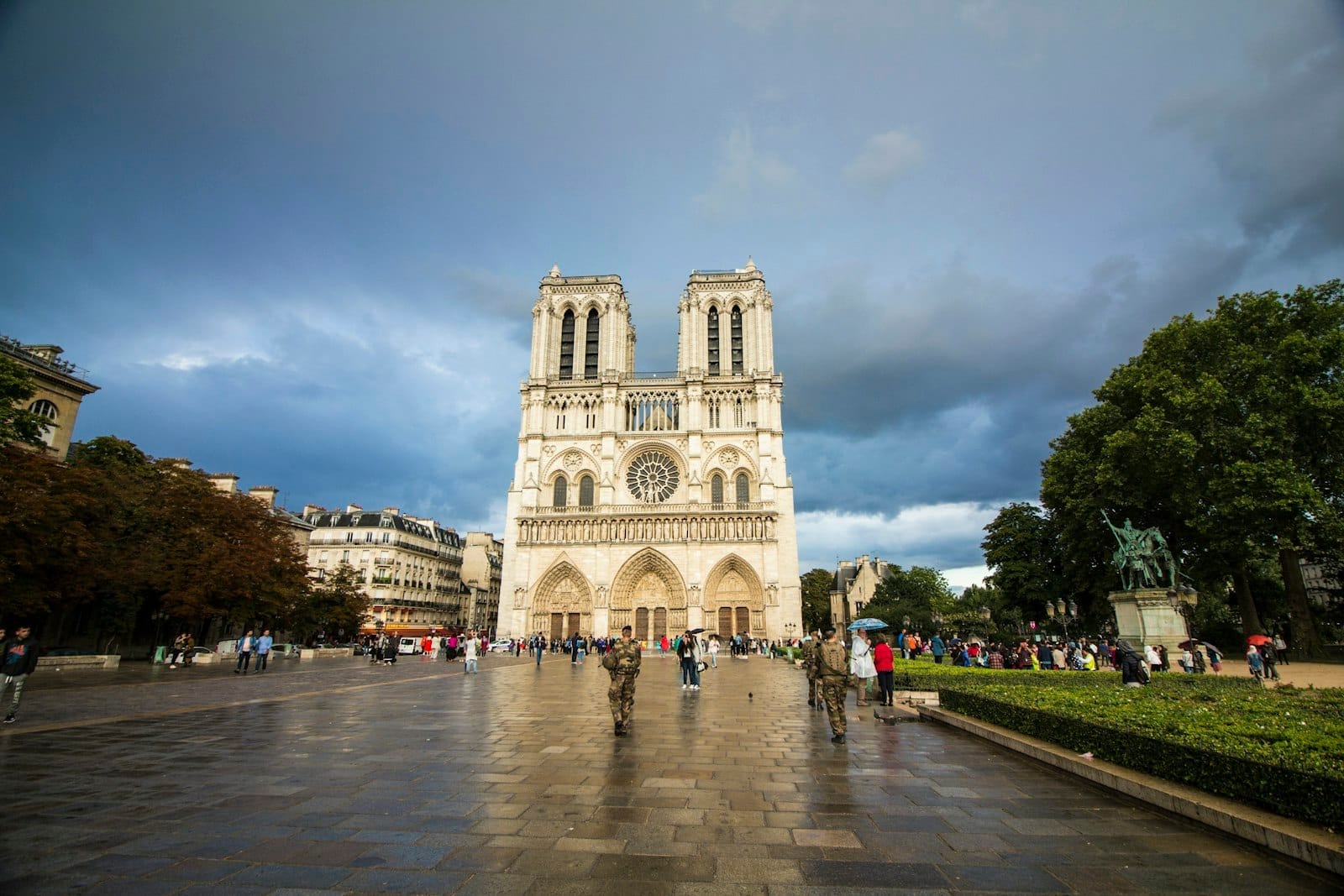
Cathédrale Notre-Dame de Paris is the benchmark against which almost all French Gothic architecture is measured. Construction began in 1163, with the foundation stone laid by Pope Alexander III himself, and the building reached its largely finished form around 1345. In that time, it helped define the visual grammar of Gothic design: pointed arches that redirect weight outward, flying buttresses that free the walls to soar, and enormous rose windows that flood stone interiors with coloured light. The nave rises 35 metres overhead; the two square towers reach 69 metres. Nothing about these numbers feels abstract when you're standing beneath the vault.
For centuries, Notre-Dame was not just a church but the symbolic centre of France. Napoleon's self-coronation as Emperor took place here in 1804; a liberation thanksgiving Mass was celebrated in 1944 under these same vaults. The bronze star set into the parvis pavement in front of the western façade marks Kilometre Zero — the point from which all road distances in France are officially measured. The cathedral also sits at the literal birthplace of Paris: the Île de la Cité was the original settlement of the Parisii tribe long before any of the city's famous boulevards existed.
On 15 April 2019, fire consumed the medieval oak roof framework and toppled the 19th-century spire designed by Eugène Viollet-le-Duc. After five years of restoration, the cathedral reopened on 8 December 2024 — the Feast of the Immaculate Conception. The cleaned stone and re-gilded details make the interior noticeably brighter and more legible than before the fire. For the wider context of this island, the Île de la Cité neighbourhood guide covers the Sainte-Chapelle, the Conciergerie, and the riverbanks that frame the cathedral.
The Exterior: Read the Stone Before You Go In
Spend ten minutes on the parvis before entering. The western façade divides into three horizontal registers. At ground level, the three portals carry deeply carved biblical narratives — the Portal of the Last Judgement at the centre is the most elaborate, with a tympanum depicting souls being weighed and judged in expressive, hierarchical detail. Above the portals, the Gallery of Kings displays 28 statues representing the kings of Judah and Israel; the originals were beheaded during the Revolution by crowds who mistook them for French monarchs. The actual medieval heads were discovered buried in 1977 and are now displayed at the nearby Musée de Cluny.
💡 Local tip
For the best full-façade photograph, cross to the Left Bank and walk east along Quai de Montebello. This angle — the southern flank and chevet above the Seine — appears in the majority of serious architectural photographs of Notre-Dame and takes only five minutes from the entrance.
Walk the full exterior circuit: the south transept façade is considered by many architects to be the most refined of the three, and the eastern chevet shows the flying buttresses of the apse fanning outward like ribs above the garden between the cathedral and the river. The best photo spots in Paris guide maps several lesser-known angles around the island that most visitors overlook.
Tickets & tours
Hand-picked options from our booking partner. Prices are indicative; availability and final rates are confirmed when you complete your booking.
Inside Notre Dame tour with small group city stroll
From 74 €Instant confirmationFree cancellationElectric bike tour of Paris
From 65 €Instant confirmationFree cancellationNotre Dame Cathedral reserved access with guided island tour
From 39 €Instant confirmationFree cancellationNotre-Dame de Paris exterior guided tour and interior audio tour
From 0 €Instant confirmationFree cancellation
Inside the Cathedral: What You Will See
Entry is free, but timed reservations are strongly recommended between April and October. The main batch of slots opens at midnight Paris time for dates up to two days in advance, with additional drops released progressively throughout the day. Reservations are made via resa.notredamedeparis.fr or the official Notre-Dame de Paris mobile app. Walk-ins are possible but expect longer queues during peak periods. Last entry is 30 minutes before closing.
ℹ️ Good to know
Opening hours: Monday–Friday 7:45 am–7:00 pm (until 10:00 pm on Thursdays). Saturday–Sunday 8:15 am–7:30 pm. Treasury: Monday–Saturday 9:30 am–6:00 pm (until 9:00 pm Thursday), Sunday 1:00 pm–5:30 pm. Hours may vary for religious services — always check notredamedeparis.fr before visiting.
Through the central portal, the nave opens at 35 metres overhead. The proportions are engineered to create a particular sensation: the verticality directs both eye and attention upward. The nave is flanked by double aisles on each side — an unusual feature that gives Notre-Dame more breadth than most comparable Gothic cathedrals. Post-restoration cleaning has brought the stone to a pale honey-cream, a notable change for anyone who visited before 2019. The three rose windows are the interior's defining feature: the north rose (c. 1250, 13 metres diameter) glows blue and purple on clear mornings; the south rose fills with warm golds in the afternoon. The great organ, with over 8,000 pipes, has been fully restored and is played at Sunday masses and periodic concerts.
The Treasury: Is It Worth the Extra Ticket?
The Treasury (€12 adults, €6 reduced) occupies the sacristy on the south side of the choir. It houses the Crown of Thorns relic, sacred vessels, liturgical garments, and illuminated manuscripts. The space is well-curated and rarely as crowded as the nave. For most visitors, it is an optional addition rather than an essential stop. Those with a deeper interest in medieval religious art will find equally rewarding material at the Musée de Cluny, a ten-minute walk away, which holds the original decapitated Gallery of Kings heads alongside its extraordinary tapestry collection.
When to Go: How the Cathedral Changes by Hour
Weekday mornings before 9:30 am are the most atmospheric. The north rose window catches early light at its most intense, the smell of cold stone and candle wax lingers before the air warms, and the crowd noise is minimal. Mass is celebrated at 8:00 am on weekdays; attending briefly gives a genuine sense of the building as a place of active worship rather than a sightseeing stop. Midday to 3:00 pm is peak traffic — workable, but crowded.
Thursday evenings are the single best time slot for serious visitors. The extended 10:00 pm closing means you can enter after 7:00 pm, when crowds thin dramatically, artificial lighting brings out different qualities in the stone, and the organ may be in rehearsal. The exterior is also worth revisiting after dark: the western façade is lit from below, and the Île de la Cité seen from the nearby bridges at dusk is a quietly different experience from the daytime.
Getting There, What to Wear, and Practical Notes
The closest Métro stop is Cité (line 4), a two-minute walk across the island. RER B and C stop at Saint-Michel Notre-Dame on the Left Bank, a five-minute walk via the Petit Pont. Cycling is practical: Vélib' bike-share stations sit on both river banks nearby. Shoulders must be covered on entry — a scarf or light layer is enough. Photography is permitted inside, but flash and tripods are generally restricted. Speak quietly near active prayer areas and during any services in progress.
Accessibility details for the post-restoration building are still being updated — contact the cathedral via the official website for current wheelchair and mobility provisions. The parvis is fully accessible. The bell towers reopened to visitors in September 2025 with a redesigned route that includes a new double-revolution oak staircase woven through the timber framework; tickets start from €16, must be booked online with a fixed time slot, and the climb of 424 steps through narrow passages is not recommended for anyone with vertigo, heart conditions, or limited mobility. For a wider comparison of elevated Paris viewpoints, the best views in Paris covers alternatives from the Eiffel Tower to Montparnasse.
Notre-Dame is a natural starting point for exploring the Île de la Cité. The Sainte-Chapelle is a ten-minute walk west and offers what many consider an even more extraordinary stained-glass interior — the 15-metre upper chapel windows are unmatched in Gothic architecture. Combining both in a half-day is entirely manageable.
Who Should Adjust Their Expectations
Notre-Dame is, without qualification, one of the great buildings of European civilisation. It is also one of the most visited sites in the world, and at peak times that shows. The timed-entry system has improved flow since the 2024 reopening, but midday summer crowds make the nave feel pressured. If solitude or a meditative atmosphere is the priority, an early weekday slot or Thursday evening will deliver it. If the gargoyle-level view from the towers is your primary reason for visiting, book the tower ticket in advance and budget separately for the climb — slots sell out days ahead in summer.
Insider Tips
- Book your free timed entry via resa.notredamedeparis.fr or the official Notre-Dame app. The main batch of slots opens at midnight Paris time for dates up to two days out — joining the virtual waiting room around 11:50 pm gives you the best shot at a prime morning window. Smaller drops are released throughout the day as capacity allows, so a quick refresh a few hours before the session you want often surfaces openings that weren't there overnight.
- The Kilometre Zero bronze star is embedded in the parvis pavement directly in front of the central portal. Almost every visitor walks over it without noticing. It marks the official point from which all road distances in France are measured.
- Attend a Thursday evening visit after 7:00 pm. The cathedral's 10:00 pm Thursday closing is largely unknown to casual tourists, which means far lower crowd levels and a completely different sonic atmosphere — especially if the restored 8,000-pipe organ is being rehearsed.
- Walk the full exterior circuit before entering. Most visitors arrive at the façade and go straight in; the chevet and south transept seen from the garden on the river side give a much stronger sense of the building's structural logic and sheer scale.
- The Archaeological Crypt beneath the parvis is ticketed separately and chronically undervisited. It traces the island's layered history from Gallo-Roman foundations through medieval Paris with actual preserved remains underfoot — an excellent addition for visitors with children or anyone interested in urban archaeology.
Who Is Notre-Dame Cathedral For?
- First-time visitors to Paris who want to understand the city's architectural and historical foundations
- Architecture and art history enthusiasts studying French Gothic structure and ornament
- Travellers who visited before 2019 and want to see the restored cathedral and compare it with memory
- Those interested in attending an active Catholic mass in a historic, living place of worship
- Families with older children who can engage with medieval history, the 2019 fire story, and the restoration effort
Nearby Attractions
Other things to see while in Île de la Cité & Île Saint-Louis:
- Île Saint-Louis
An 11-hectare island in the heart of Paris, Île Saint-Louis feels like a separate city from the one surrounding it. With 17th-century mansions lining the quays, a single main street of independent shops and cafés, and no metro station by design, it offers a rare pocket of unhurried Paris just steps from Notre-Dame.
- Place Dauphine
Tucked into the western tip of Île de la Cité, Place Dauphine is a triangular 17th-century royal square where Parisians eat lunch under plane trees and time moves a little slower. Free to enter, largely off the tourist trail, and loaded with architectural and historical depth, it rewards anyone willing to stray five minutes from Notre-Dame.
- Pont Neuf
Completed in 1607, Pont Neuf is the oldest surviving bridge in Paris, stretching 232 metres across the Seine at the western tip of the Île de la Cité. Free, open at all hours, and layered with royal history and architectural detail, it rewards those who slow down and actually look.
- Sainte-Chapelle
Completed in 1248 for King Louis IX, Sainte-Chapelle is the finest example of Rayonnant Gothic architecture in France. Its upper chapel is essentially a skeleton of stone holding 15-metre walls of 13th-century stained glass that transform sunlight into cascading colour. No other medieval interior in Paris comes close.