Pont Neuf: Paris's Oldest Bridge, and Still Its Most Cinematic
Completed in 1607, Pont Neuf is the oldest surviving bridge in Paris, stretching 232 metres across the Seine at the western tip of the Île de la Cité. Free, open at all hours, and layered with royal history and architectural detail, it rewards those who slow down and actually look.
Quick Facts
- Location
- Quai de la Mégisserie / Quai des Grands Augustins, 75001 Paris (western tip of Île de la Cité)
- Getting There
- Métro Line 7: Pont Neuf station (2-min walk); also Châtelet–Les Halles (10 min on foot). Bus lines 21, 27, 58, 67, 69, 70, 72, 74, 75, 85.
- Time Needed
- 20–40 minutes for a thoughtful crossing; 1–2 hours if you sit by the river or explore the Île de la Cité
- Cost
- Free — no ticket, no reservation required. Open 24 hours, 7 days a week.
- Best for
- Architecture lovers, photographers, romantic walks, history seekers, and anyone looking to connect the Right Bank to Saint-Germain on foot
Why Pont Neuf Still Matters
The name means 'New Bridge,' yet Pont Neuf is the oldest bridge standing in Paris today. That contradiction is the first thing worth understanding. When construction began in 1578 under King Henri III and finished in 1607 under Henri IV, it was genuinely revolutionary: the first bridge in the city built without houses lining its sides, and the first to feature raised pedestrian pavements separating walkers from horse traffic. For 17th-century Parisians, this was a civic breakthrough.
Listed as a Monument Historique since 1889 and inscribed as part of the UNESCO World Heritage Site 'Banks of the Seine' in 1991, the bridge has outlasted dozens of its successors. It was fully restored by the City of Paris in 2007, so the stonework you see today is clean and structurally sound, without the patched-together quality of some older civic monuments.
💡 Local tip
Walk the full length of the bridge and stop at one of the 12 semicircular balconies that project out over the river above each pier. These alcoves give you an unobstructed view upstream and downstream without standing in foot traffic — they were designed for exactly this purpose.
What the Bridge Actually Looks Like
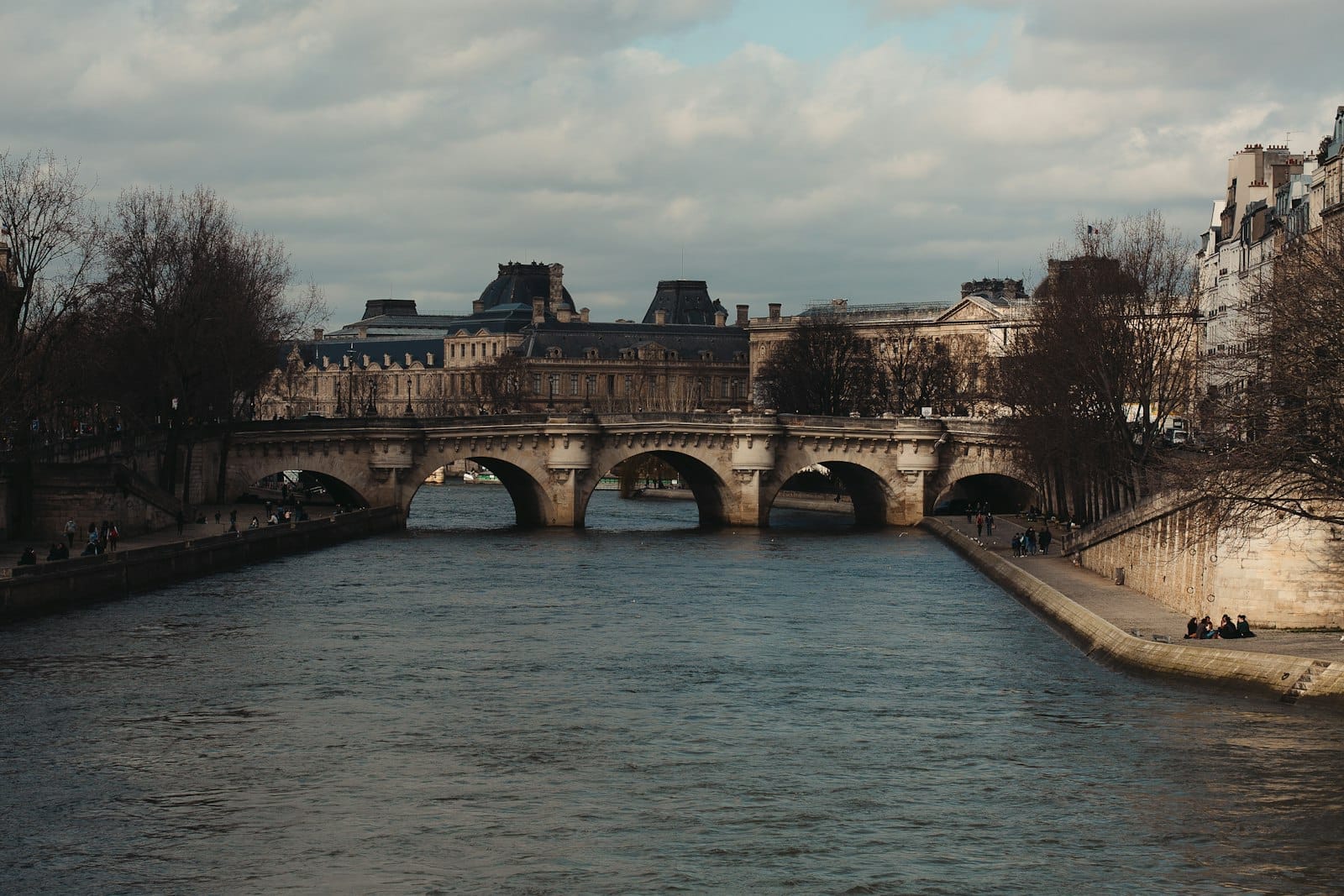
Pont Neuf is not a single straight span. It crosses the Seine in two sections, meeting at the western tip of the Île de la Cité: seven arches on the longer Right Bank side, five arches on the Left Bank side. Total length is 232 metres; width is 20.5 metres, with 4.5-metre pavements on each side of an 11.5-metre central causeway. By the standards of its era, this was enormous.
What catches most visitors off guard are the mascarons: 381 carved grotesque faces, each different, running along the cornices above the arches. Human, animal, and hybrid in expression, they stare down at the water with an eeriness that contrasts with the bridge's otherwise civic solemnity. No one knows with certainty who all the faces represent, though theories range from caricatures of courtiers to generic mythological figures. Run your eye along the parapet slowly and you will spot them.
At the midpoint on the Right Bank span stands the equestrian statue of Henri IV, the king who saw the bridge to completion. The original bronze was melted down during the Revolution; the current statue dates from the Bourbon Restoration in 1818. It is the oldest equestrian royal monument in Paris, which gives the bridge a quietly layered historical symbolism: a modern replica of a lost original, on a bridge that is both the oldest and was once the newest.
Tickets & tours
Hand-picked options from our booking partner. Prices are indicative; availability and final rates are confirmed when you complete your booking.
Paris Essential dinner cruise at 6.15pm
From 99 €Instant confirmationFree cancellationEiffel Tower reserved elevator entrance to 2nd floor with walking tour and Seine cruise
From 94 €Instant confirmationFree cancellationBest of Paris city tour with Eiffel Tower lunch and Seine cruise
From 144 €Instant confirmationFree cancellationBike tour of Versailles Palace with skip-the-line tickets
From 109 €Instant confirmationFree cancellation
How the Bridge Changes by Time of Day
Early morning, before 8am, is the version of Pont Neuf closest to what a 17th-century Parisian might have experienced as a moment of quiet on a public thoroughfare. The light from the east falls flat across the water, catching the pale limestone of the arches. Joggers pass in both directions, and the Seine is glassy. The smell of river water is present but not unpleasant. This is the best hour for photography: no lens flare, no crowds, and the mascarons in raking light.
By midday, the bridge carries steady foot traffic between the Louvre area and Saint-Germain-des-Prés. Tour groups cross in both directions, and the semicircular balconies fill with people pausing to photograph Notre-Dame's towers downstream. The bridge is wide enough that it never feels claustrophobic, but the balconies can get congested. If you want one to yourself, walk to the far end away from the Île de la Cité access stairs.
At dusk and into the evening, Pont Neuf becomes one of the better vantage points in central Paris for watching the sky shift over the river. The Eiffel Tower's light show, which begins at nightfall, is faintly visible to the southwest. The bridge itself is lit by warm lantern-style lamps. On warm evenings, people sit along the riverside steps at the tip of the Île de la Cité directly beneath the bridge, and the sound of conversation drifts upward. This lower terrace, known as the Square du Vert-Galant, is worth descending to.
ℹ️ Good to know
The Square du Vert-Galant, at the very western tip of the Île de la Cité directly below the bridge, is accessible via stairs from the bridge itself. It is a narrow, tree-lined park at river level, with some of the most intimate Seine views in Paris. On weekend afternoons it draws Parisians with bottles of wine and books.
Historical Context: Why This Bridge Changed Paris
Before Pont Neuf, medieval bridges in Paris were commercial streets: densely built with timber-framed houses, shops, and mills, often so overloaded they collapsed. The Grand Pont and Petit Pont on the Île de la Cité were essentially covered markets. Pont Neuf was a deliberate break from that tradition, conceived as infrastructure rather than real estate. Henri III laid the first stone in 1578, but wars of religion halted construction; Henri IV resumed it and the bridge opened in its complete form in 1607.
Its open sides immediately transformed how the city used public space. Street performers, tooth-pullers, booksellers, and quacks gathered on its wide pavements. In the 17th and 18th centuries, Pont Neuf was effectively Paris's town square, the most democratic space in the city, where any social class might rub shoulders. That character, a public stage rather than a private thoroughfare, is still faintly legible in how people use it today.
The bridge sits at the meeting point of the 1st and 6th arrondissements, and crossing it connects two of the city's most important historic cores. To the northeast is the Louvre Museum, a 10-minute walk. To the south, Rue Dauphine leads into the heart of Saint-Germain-des-Prés. The bridge is less a destination than a connector, but the connective tissue in Paris often carries as much interest as the nodes it joins.
Photography on Pont Neuf
Pont Neuf offers three distinct types of shot. First, the structural portrait: position yourself at the downstream balcony on the Right Bank span, look east, and you get the double curve of the bridge's arches receding toward the Île de la Cité, with the spires of Sainte-Chapelle and the towers of Notre-Dame in the background. This is the classic composition, and it works best in morning or golden-hour light when shadows define the stonework.
Second, the river-level shot: descend to the Square du Vert-Galant and look back up at the underside of the arches. The framing of the stone against sky and water produces an entirely different image from anything taken from the bridge deck. Third, from a Seine cruise passing beneath the arches: the scale of the individual spans only becomes apparent from the water, and the mascarons are clearly visible at that angle.
If photography is a central interest, the area around Pont Neuf fits naturally into a broader circuit of Paris's most photogenic points. The official best photo spots in Paris guide covers several angles that pair well with the bridge, including the view from the Vert-Galant toward the Île de la Cité.
Getting There and Practical Walkthrough
Métro Line 7 stops directly at Pont Neuf station, a three-minute walk to the bridge's Right Bank entrance. The Châtelet–Les Halles interchange is about ten minutes on foot and useful if you are arriving from the RER network or other Métro lines. Multiple bus lines serve the quays on both banks; the stop named 'Pont Neuf' on Quai de la Mégisserie (Right Bank) is the most direct.
The bridge is 20.5 metres wide and flat, with no steps on the main deck. Both pedestrian pavements (4.5 metres each) are smooth stone, manageable for wheelchairs and pushchairs, though the descending stairs to the Square du Vert-Galant are not accessible by wheelchair. The surface can be slick in rain; flat-soled shoes are advisable in wet weather.
A sensible route from the bridge extends naturally into the Île de la Cité. Sainte-Chapelle is a five-minute walk east along the island, and Notre-Dame Cathedral is ten minutes further. Combining Pont Neuf with both sites makes for a coherent half-day on the island without backtracking.
⚠️ What to skip
Pont Neuf is a working road bridge, not a pedestrianised promenade. Vehicles, cyclists, and scooters share the central causeway. The pavements are wide and clearly separated, but keep children close to the barriers and stay alert when crossing the road access points at each end.
Who Should Consider Skipping It
Pont Neuf is not an attraction in the conventional sense: there is no interior to enter, no collection to see, and no experience curated for visitors. Travellers who measure value by exhibits, guided narratives, or air-conditioned comfort will find it underwhelming as a standalone destination. In wet, grey weather, a stone bridge over a grey river offers limited drama, and the mascarons are easy to miss if you are walking quickly to get out of the rain.
For those who want structured historical depth rather than an atmospheric crossing, the Musée Carnavalet in the Marais contains paintings and artifacts documenting Pont Neuf's social life in the 17th and 18th centuries, providing context that standing on the bridge itself cannot fully deliver.
Insider Tips
- The semicircular balconies on the downstream side of the bridge (facing west, toward the Eiffel Tower direction) give you a clean, unobstructed view along the Seine with no pavement clutter in the frame. Most visitors use the upstream balconies for Notre-Dame shots and miss these entirely.
- Descend to the Square du Vert-Galant via the stairs at the western tip of the Île de la Cité. The park sits at water level, below the bridge, and on weekdays before noon you can often find a bench with an uninterrupted river view and almost no other visitors.
- Each of the 381 mascarons along the cornice is unique. If you stop and examine a 10-metre stretch carefully, you will find faces that are clearly human, others that are animal-hybrid, and a few that seem to grimace in what might be comic exaggeration. They reward close attention that most walkers never give them.
- The best view of the bridge's full silhouette is not from the bridge itself but from the Quai du Louvre on the Right Bank, looking southwest. From here you can see both spans and how they meet at the island's tip, which is impossible to appreciate when you are standing on the deck.
- Evening Seine cruises pass directly beneath the arches of Pont Neuf, and from the water the scale of the individual spans — and the mascarons peering down — is far more legible than from street level. A cruise also positions the bridge correctly in relation to the rest of the riverbank.
Who Is Pont Neuf For?
- Architecture enthusiasts who want to read a building's history in its physical details rather than a museum label
- Photographers looking for structured river compositions, especially in early morning or golden-hour light
- Travellers building a walking route between the Louvre area and Saint-Germain-des-Prés who want a historically resonant path rather than the most direct one
- Couples on an evening walk, particularly after dark when the bridge is lit and foot traffic thins out
- Visitors with limited mobility who want a significant historic site that requires no tickets, stairs, or queuing
Nearby Attractions
Other things to see while in Île de la Cité & Île Saint-Louis:
- Île Saint-Louis
An 11-hectare island in the heart of Paris, Île Saint-Louis feels like a separate city from the one surrounding it. With 17th-century mansions lining the quays, a single main street of independent shops and cafés, and no metro station by design, it offers a rare pocket of unhurried Paris just steps from Notre-Dame.
- Notre-Dame Cathedral
Cathédrale Notre-Dame de Paris reopened in December 2024 after five years of post-fire restoration. Standing on the Île de la Cité since 1163, this Gothic masterpiece is one of the most visited monuments in the world — and entry to the cathedral itself is free.
- Place Dauphine
Tucked into the western tip of Île de la Cité, Place Dauphine is a triangular 17th-century royal square where Parisians eat lunch under plane trees and time moves a little slower. Free to enter, largely off the tourist trail, and loaded with architectural and historical depth, it rewards anyone willing to stray five minutes from Notre-Dame.
- Sainte-Chapelle
Completed in 1248 for King Louis IX, Sainte-Chapelle is the finest example of Rayonnant Gothic architecture in France. Its upper chapel is essentially a skeleton of stone holding 15-metre walls of 13th-century stained glass that transform sunlight into cascading colour. No other medieval interior in Paris comes close.