Place Dauphine: Paris's Most Quietly Magnificent Square
Tucked into the western tip of Île de la Cité, Place Dauphine is a triangular 17th-century royal square where Parisians eat lunch under plane trees and time moves a little slower. Free to enter, largely off the tourist trail, and loaded with architectural and historical depth, it rewards anyone willing to stray five minutes from Notre-Dame.
Quick Facts
- Location
- Western tip of Île de la Cité, 75001 Paris (1st arrondissement)
- Getting There
- Pont Neuf (Métro Lines 7 and 14) — 3-min walk; Cité (Line 4) — 5-min walk
- Time Needed
- 20–45 minutes to absorb the square; longer if you sit at a café or restaurant
- Cost
- Free entry; open 24/7 year-round
- Best for
- Architecture lovers, slow travellers, couples, Île de la Cité walkers
- Official website
- parisjetaime.com/transport/place-dauphine-p1873
What Is Place Dauphine?
Place Dauphine is one of Paris's original royal squares, commissioned by King Henry IV in 1607 and substantially complete by 1616. It sits at the far western point of Île de la Cité, the island in the Seine that is, in many ways, the geographic and historic origin of Paris itself. The square is triangular, a shape dictated by the narrowing tip of the island, and it opens at its widest end onto the interior of the island while its pointed end meets Pont Neuf, marked by a grand equestrian statue of Henry IV.
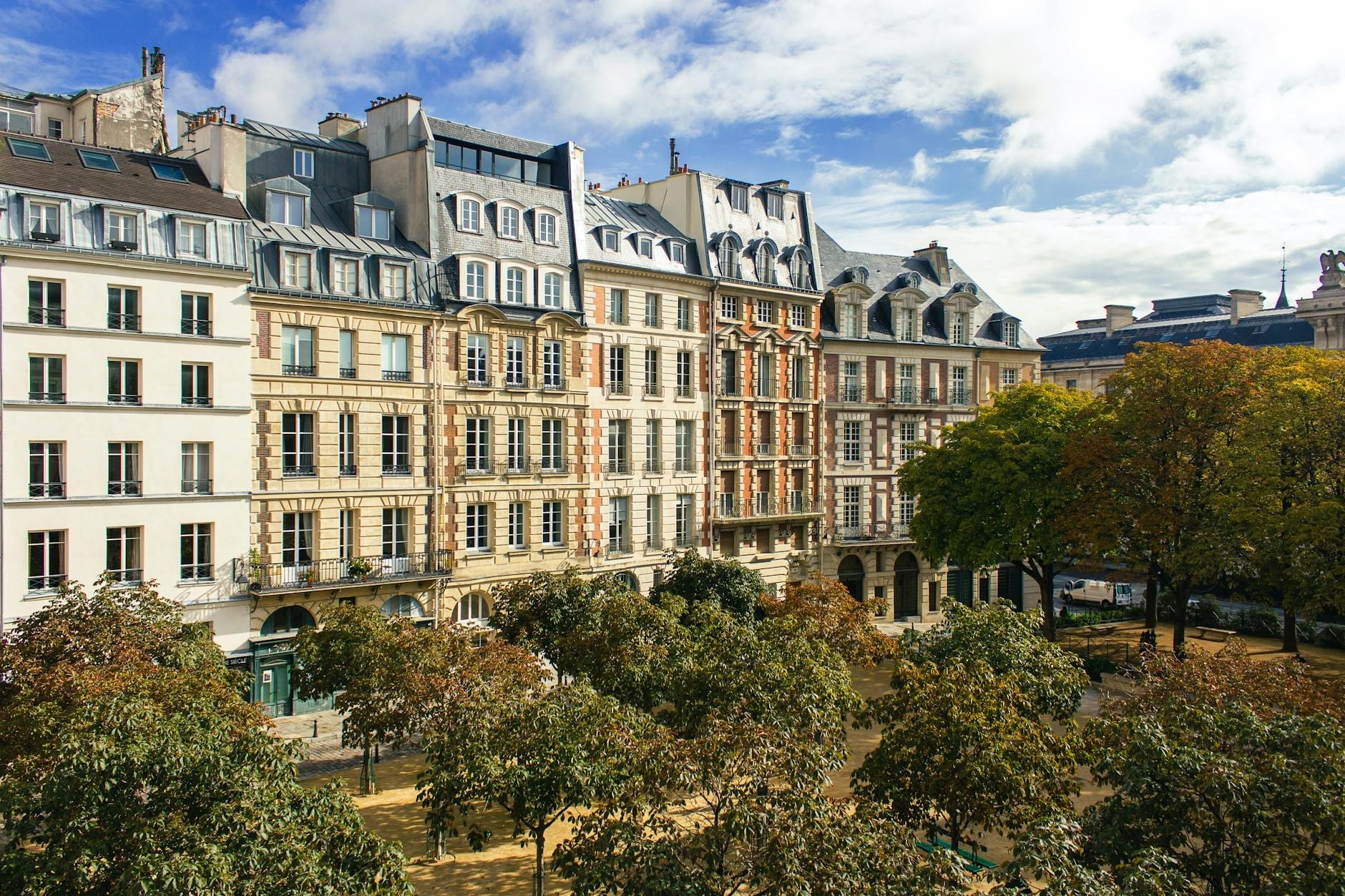
What distinguishes Place Dauphine from the city's more theatrical spaces is its deliberate restraint. There are no fountains, no grand monuments facing inward, and no admission gates. The square is lined on two sides by rows of 17th-century buildings in pale stone and red brick, shaded by mature plane trees, and furnished with benches and a patch of gravel where locals play pétanque in the afternoon. It is a place that rewards presence over spectacle.
💡 Local tip
The most scenic approach is from Pont Neuf Métro (Lines 7 and 14). Walk across Pont Neuf bridge and take Rue Henri Robert directly into the square. This route gives you the Henry IV equestrian statue at your back and the full triangular geometry of the place opening up in front of you.
Four Centuries of History in One Triangle
Henry IV had already reshaped Paris's urban fabric with Place des Vosges (then Place Royale) in the Marais, completed in 1612. Place Dauphine was his follow-up, named in honour of his heir, the Dauphin Louis XIII. The two squares were conceived as a pair, bookending the king's ambition to give Paris rational, beautiful public spaces where commerce and civic life could unfold together.
A crucial distinction separates Place Dauphine from Place des Vosges: while the Marais square was built for the aristocracy and court, Place Dauphine was constructed for merchants and commoners. The buildings, originally 32 in number, were let to goldsmiths, clockmakers, and traders who lived above their workshops. That civic, working character has never entirely left the square, which today is flanked by lawyers from the adjacent Palais de Justice rather than jewellers.
The square has not emerged from history entirely intact. Several of the original 17th-century buildings were demolished in the 19th century to accommodate the expansion of the Palais de Justice, which now forms the third side of the triangle (the square's base). What remains is a partial but remarkably evocative survivor. For full context on the island's layered history, the Île de la Cité neighbourhood guide covers the arc from Roman Lutetia to the present day.
Tickets & tours
Hand-picked options from our booking partner. Prices are indicative; availability and final rates are confirmed when you complete your booking.
Paris Essential dinner cruise at 6.15pm
From 99 €Instant confirmationFree cancellationEiffel Tower reserved elevator entrance to 2nd floor with walking tour and Seine cruise
From 94 €Instant confirmationFree cancellationBest of Paris city tour with Eiffel Tower lunch and Seine cruise
From 144 €Instant confirmationFree cancellationBike tour of Versailles Palace with skip-the-line tickets
From 109 €Instant confirmationFree cancellation
The Square at Different Hours
Arrive early on a weekday morning and Place Dauphine belongs almost entirely to the neighbourhood. A few lawyers cross the gravel in dark suits, café chairs are being unfolded, and the light falls at a low angle through the plane trees, striping the pale stone facades in long shadows. The air carries coffee from the terraces and, on damp mornings, the faint mineral smell of wet stone that characterises so much of central Paris.
Midday transforms the square into an informal dining room. The restaurants and cafés that line both flanks fill quickly with workers from the Palais de Justice and the nearby Préfecture de Police. Tables spill onto the gravel, and the sound of conversation and cutlery replaces the morning quiet. This is genuinely the best time to eat here: the lunch crowd is local, the portions are generous, and the prices reflect a working-neighbourhood clientele rather than tourist surcharges.
By late afternoon the square settles again. In warm months, the pétanque pitch near the centre of the gravel area sees regular use, and benches fill with people who have finished work or who have deliberately built a rest stop into an afternoon on Île de la Cité. At dusk, the facades catch the last western light before the square falls into a quiet that feels disproportionately calm given how close you are to one of the world's most visited tourist corridors.
ℹ️ Good to know
Place Dauphine is open 24 hours a day, every day of the year, with no admission charge. It is a public square in the full sense: there are no barriers, no ticket booths, and no guided-tour infrastructure.
Architecture and Sense of Place
The surviving buildings along the two residential flanks of the triangle date to the early 17th century, though many have been altered at ground level and in their upper stories over the centuries. The characteristic vocabulary is Henry IV's preferred style: pale cream-coloured stone for the lower storeys, warm red brick above, slate roofs with dormer windows, and regular arched arcades at street level. The rhythm is calm and unhurried, the kind of architecture designed to frame outdoor life rather than demand attention for itself.
Photography here is more rewarding in diffuse light than in direct sun. The narrow proportions of the square mean that facades face each other at close range, and harsh midday light produces deep, unflattering shadows in the arcades. Overcast days, or the soft light of an hour after sunrise, render the stonework in its most accurate warm-grey tones. Wide-angle lenses capture the full triangular shape; a longer focal length compresses the depth and isolates individual facade details.
The equestrian statue of Henry IV at the Pont Neuf entrance, visible from the square's apex, was originally installed in 1614. The current bronze is a 19th-century replacement of the original, which was melted down during the Revolution. It serves as a useful anchor point: standing at the statue and looking into the square, you see the entire triangular composition as Henry IV's planners intended. Pont Neuf itself, the oldest standing bridge in Paris, is steps away and worth a few minutes on its own. The Pont Neuf connects Île de la Cité to both banks of the Seine and offers unobstructed river views in both directions.
Getting There and Getting Around
The most direct approach is via Pont Neuf station on Métro Line 7. From exit 1, walk south across the bridge and turn into Rue Henri Robert on your right: the square opens ahead of you within three minutes. From Cité station (Line 4), walk west along the Boulevard du Palais past the Palais de Justice; the square entrance is at the base of the triangle on your left, taking around five minutes.
Place Dauphine sits at the logical midpoint of an Île de la Cité walking circuit. From the square, Sainte-Chapelle is a four-minute walk east. Notre-Dame is roughly ten minutes on foot to the east. The Notre-Dame Cathedral is currently being phased back into full visitor access following the 2019 fire — check current opening status before planning your visit. For those arriving from the Left Bank, the Rue Dauphine on the south side of the river leads directly to Pont Neuf and the square.
Cobblestone surfaces cover most of the square and the surrounding streets, which makes navigation with wheeled luggage or pushchairs more demanding than on typical Paris pavements. There are no steps to navigate to enter the square itself, but the uneven gravel and stone can be challenging for anyone using a mobility aid.
⚠️ What to skip
If you are combining Place Dauphine with Sainte-Chapelle, book your Sainte-Chapelle tickets online in advance. Walk-up queues at the entrance on the Boulevard du Palais can be long, and the booking system is separate from the Paris Museum Pass.
Eating and Sitting at Place Dauphine
Several restaurants occupy the ground-floor arcades along both flanks of the triangle. Restaurant Paul and Le Caveau du Palais are among the longest-established, both offering traditional French bistro menus with terrace seating directly on the gravel. Lunch here is an institution for the Palais de Justice legal community, which means quality standards are maintained by a demanding regular clientele rather than by tourist volumes alone.
If you are not eating, the benches under the plane trees provide good resting points. There are no kiosks or food vendors within the square itself. Bring water in summer: the square gets warm in July and August as the dense canopy, while providing shade, also traps heat. The nearest public drinking fountain is on the Pont Neuf bridge approach.
For a broader dining context across Île de la Cité and the surrounding arrondissements, the where to eat in Paris guide covers neighbourhood-by-neighbourhood options at different price points.
Honest Assessment: What This Square Is and Isn't
Place Dauphine is not a destination that generates strong reactions. It will not appear in your photographs as a landmark that non-travellers will immediately recognise, and it offers nothing in the way of exhibitions, audio guides, or interactive experiences. If you are measuring a day in Paris by the number of iconic sights processed, this square will feel like dead time.
What it does offer, and does so reliably, is a quality of stillness that is genuinely rare in the centre of Paris. The square sits within walking distance of Notre-Dame, Sainte-Chapelle, the Conciergerie, and Pont Neuf, yet it draws a fraction of their visitor numbers. Its value is relational: it works best as a deliberate pause built into a morning or afternoon on the island, a place to sit and understand why Parisians are protective of their squares and slow hours, rather than as a standalone destination.
Travellers on a tight schedule who are trying to cover Paris in three days may reasonably choose to walk through briefly rather than linger. First-time visitors to the city whose priority is major monuments would be better served spending the same 30 minutes inside Sainte-Chapelle or crossing Pont Neuf at leisure.
Insider Tips
- Come on a weekday between noon and 2pm to see the square at its most authentically Parisian. The restaurant terraces fill with lawyers and civil servants, and the atmosphere is entirely local rather than touristic.
- The pétanque area near the centre of the square occasionally sees informal games on weekday afternoons and weekend mornings. Watching a round of boules here, with 17th-century facades as the backdrop, is one of those Paris moments that no itinerary can manufacture.
- For the best architectural photographs, come in overcast conditions or within the first hour after sunrise. Direct midday sun creates harsh shadows across the arcade recesses and washes out the warm tones of the brick and stonework.
- The square's triangular apex, where it meets Pont Neuf, is the least-visited part of the space and provides the clearest sightline back into the full depth of the triangle. Stand here to see the composition as its 17th-century planners intended.
- If you want to eat at Le Caveau du Palais or Restaurant Paul on a weekday lunchtime, arrive by 12:15pm or after 1:45pm. The midday rush is fast and the tables turn quickly, but the 20-minute window at peak is genuinely competitive.
Who Is Place Dauphine For?
- Architecture and urban history enthusiasts who want to read a city beyond its famous monuments
- Couples looking for a calm, unhurried moment away from high-traffic tourist corridors
- Slow travellers building a walking circuit across Île de la Cité who need a natural rest point
- Food travellers seeking a genuinely local lunch setting close to the island's major sights
- Photographers interested in 17th-century French urban architecture in authentic, unthemed surroundings
Nearby Attractions
Other things to see while in Île de la Cité & Île Saint-Louis:
- Île Saint-Louis
An 11-hectare island in the heart of Paris, Île Saint-Louis feels like a separate city from the one surrounding it. With 17th-century mansions lining the quays, a single main street of independent shops and cafés, and no metro station by design, it offers a rare pocket of unhurried Paris just steps from Notre-Dame.
- Notre-Dame Cathedral
Cathédrale Notre-Dame de Paris reopened in December 2024 after five years of post-fire restoration. Standing on the Île de la Cité since 1163, this Gothic masterpiece is one of the most visited monuments in the world — and entry to the cathedral itself is free.
- Pont Neuf
Completed in 1607, Pont Neuf is the oldest surviving bridge in Paris, stretching 232 metres across the Seine at the western tip of the Île de la Cité. Free, open at all hours, and layered with royal history and architectural detail, it rewards those who slow down and actually look.
- Sainte-Chapelle
Completed in 1248 for King Louis IX, Sainte-Chapelle is the finest example of Rayonnant Gothic architecture in France. Its upper chapel is essentially a skeleton of stone holding 15-metre walls of 13th-century stained glass that transform sunlight into cascading colour. No other medieval interior in Paris comes close.