Sainte-Chapelle: Paris's Cathedral of Light
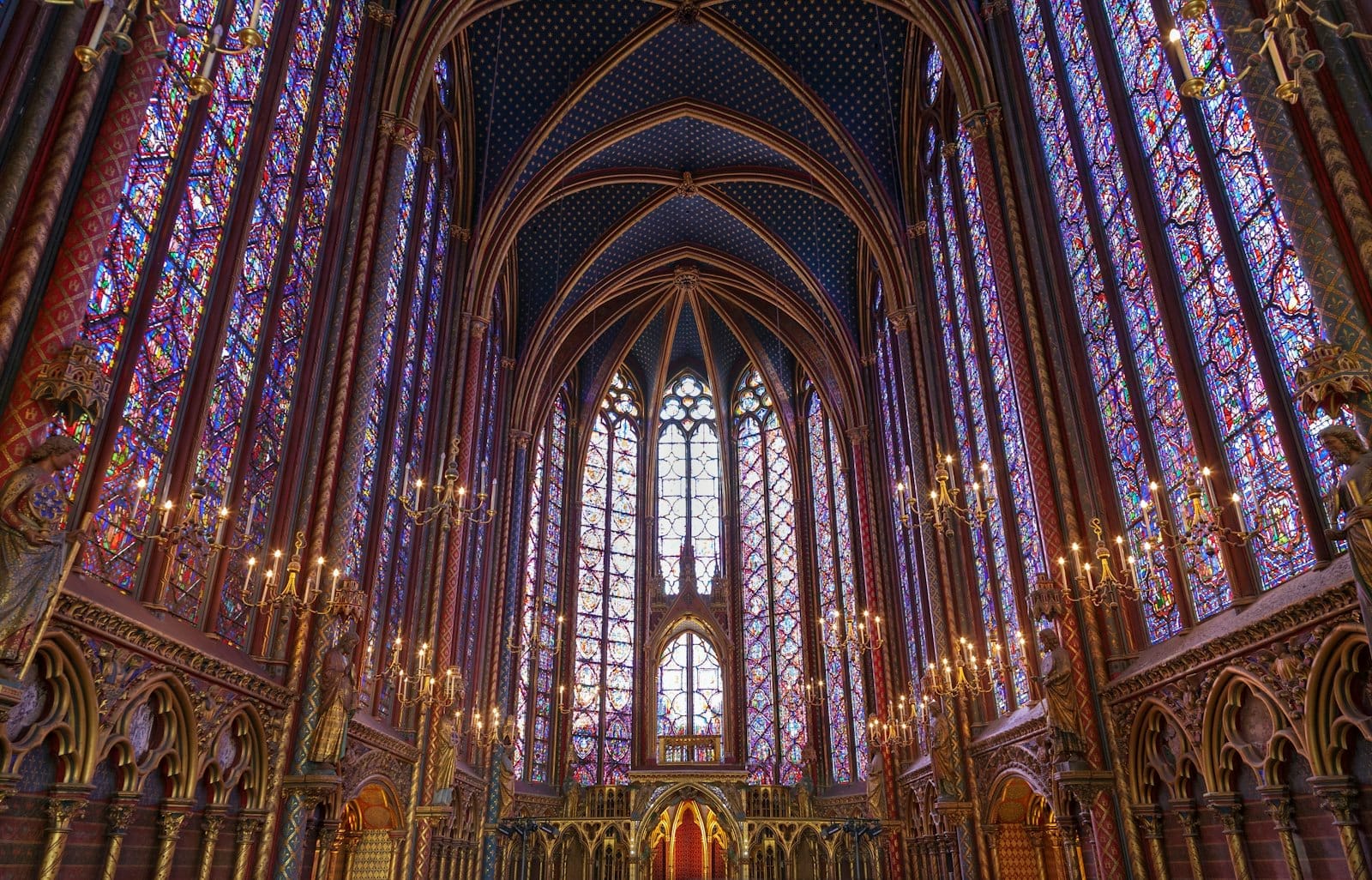
Completed in 1248 for King Louis IX, Sainte-Chapelle is the finest example of Rayonnant Gothic architecture in France. Its upper chapel is essentially a skeleton of stone holding 15-metre walls of 13th-century stained glass that transform sunlight into cascading colour. No other medieval interior in Paris comes close.
Quick Facts
- Location
- 10 Boulevard du Palais, Île de la Cité, 1st arrondissement, Paris
- Getting There
- Métro Cité (line 4), or Châtelet / Saint-Michel Notre-Dame (RER B/C)
- Time Needed
- 45–90 minutes
- Cost
- €22 individual; €23 combined with Conciergerie; free for under-18s and EU residents aged 18–25
- Best for
- Architecture lovers, medieval history, photography, quiet contemplation
- Official website
- www.sainte-chapelle.fr/en
What Sainte-Chapelle Actually Is
Sainte-Chapelle is a royal Gothic chapel completed in 1248 on the Île de la Cité, Paris's ancient island at the heart of the Seine. King Louis IX — later canonised as Saint Louis — built it to house Christianity's most prized relics: the Crown of Thorns and a fragment of the True Cross, purchased from the Latin Emperor of Constantinople in 1239 for a sum that reportedly exceeded the cost of constructing the chapel itself. The building sits inside the compound of the former Palais de la Cité, today enclosed by the Palais de Justice and the Conciergerie.
The chapel operates on two levels. The lower chapel, with its low vaulted ceilings and columns painted in alternating blue and red, was used by palace servants. The upper chapel is the reason visitors come. At 42.5 metres tall and only 33 metres long, its walls are almost entirely dissolved into 1,113 scenes of medieval stained glass, held in place by the thinnest possible stone ribs. This was the central ambition of the Rayonnant Gothic style: replace solid wall with glass, and make a room feel less like a building and more like a scaled-up reliquary.
💡 Local tip
Book a timed entry slot online before you visit. Sainte-Chapelle uses 30-minute entry windows, and tickets sell out on busy days. Security screening at the Palais de Justice entrance adds 10–15 minutes — factor that in.
The Upper Chapel: A Room Made of Light
Nothing in Paris quite prepares you for the top of the staircase. You walk up a tight stone spiral, push through a low doorway, and suddenly the walls are gone. Fifteen windows, each roughly 15 metres tall, rise on either side, saturated with reds, blues, and gold. On a clear morning with the sun coming from the east, the south-facing windows blaze and cast shifting colour patches across the pale stone floor. The acoustics absorb sound almost completely, so even a crowded chapel feels oddly still.
The 15 lancet windows date from the 13th century, and roughly two-thirds of the glass is original. The narrative reads like an illustrated Bible: the north wall begins with Genesis and the major figures of the Old Testament, the south wall moves through the kings of Israel and the prophets, and the last bay of the south wall depicts King Louis IX himself receiving the relics — placing himself within a biblical lineage of sacred kingship.
The rose window at the western end was added in the late 15th century in the Flamboyant Gothic style. Nine metres in diameter, composed of 89 panels depicting the Apocalypse, its flame-like tracery used a then-new technique called silver stain, which allowed craftsmen to paint directly onto glass with enamel and fuse it in a kiln. In late afternoon, when the lancets dim, the western light fills this circular frame and it becomes the room's focal point.
Tickets & tours
Hand-picked options from our booking partner. Prices are indicative; availability and final rates are confirmed when you complete your booking.
Notre Dame Island with Entrance to Sainte Chapelle
From 34 €Instant confirmationFree cancellationParis off-the-beaten-path bike tour
From 45 €Instant confirmationFree cancellationEntrance tickets for the Sainte Chapelle and Conciergerie
From 25 €Instant confirmationEntrance tickets for the Conciergerie
From 13 €Instant confirmation
The Lower Chapel: Often Overlooked, Worth Your Time
Most visitors hurry past the lower chapel on their way upstairs. The ceiling is low, the vaulted arches are painted in alternating red and blue with gold fleurs-de-lis, and slender gilded columns divide the space. It reads as almost cave-like compared to the luminosity above, which is partly the point: all that structural mass at ground level was engineered deliberately so that the upper chapel walls could afford to be nearly weightless. Spending five minutes down here makes the upper level feel even more implausible when you emerge.
A Building That Has Survived Everything
Construction began sometime after 1238 and the chapel was consecrated on 26 April 1248. Its architect is not recorded in any surviving document. During the French Revolution, royal emblems on the exterior were smashed, the original spire was torn down, and the building was converted into a grain warehouse. Between 1803 and 1837 it stored legal archives for the adjacent Palais de Justice. A 19th-century restoration campaign, guided by detailed watercolour records made in 1847 by architect Félix Duban, rebuilt much of what had been lost. The current spire, the fifth since the original construction, rises 75 metres above street level. During World War II, the stained glass was removed and stored for safety; its survival rate remains extraordinary.
The Crown of Thorns is no longer here. It was moved to Notre-Dame Cathedral, where it survived the 2019 fire. After your visit to Sainte-Chapelle, the rest of the Île de la Cité repays exploration on foot: the flower market, Place Dauphine, and the riverbank all sit within a five-minute walk.
Tickets, Hours, and Getting There
Sainte-Chapelle is open daily: 9 am to 7 pm from April 1 through September 30, and 9 am to 5 pm from October 1 through March 31. Last admission is 30 minutes before closing. The chapel closes on January 1, May 1, and December 25. Entry is by timed ticket with a 30-minute entry window, booked in advance through the Centre des Monuments Nationaux website.
As of 2026, individual admission is €16 for EEA nationals/residents and €22 for non-EEA visitors. The combined ticket for Sainte-Chapelle and the Conciergerie costs €23 (EEA) or €30 (non-EEA) — barely more than the individual Sainte-Chapelle ticket, and worth buying even if the Conciergerie is a secondary interest. Children under 18, EU residents aged 18–25, and disabled visitors with a companion enter free. On the first Sunday of each month between November and March, and during European Heritage Days (third weekend of September), admission is free for all.
ℹ️ Good to know
The Paris Museum Pass is NOT valid at Sainte-Chapelle. It is managed by the Centre des Monuments Nationaux, not the city museum network. Budget the ticket separately.
The entrance is on Boulevard du Palais within the Palais de Justice complex. The closest Métro stop is Cité on line 4, a short walk across the island. Châtelet connects to RER lines B and C, making it useful if you are arriving from Charles de Gaulle airport or the Rive Gauche. For help structuring a full day around nearby monuments, the 3-day Paris itinerary covers efficient routing through the historic core.
Best Time to Visit and Photography
The upper chapel is at its most spectacular on a clear morning in late spring or early autumn, when sunlight enters from east and south simultaneously and both banks of windows are lit from outside. Overcast days mute the glass considerably: the blues deepen, the reds go almost black, and the gold details vanish. The chapel retains its spatial drama in any weather, but grey skies shift the experience from overwhelming to merely impressive.
Crowds peak between 11 am and 2 pm in summer. Arriving at 9 am, or in the final 90 minutes before closing, gives noticeably more space. Late afternoon produces the best light through the rose window. For photography, a wide-angle lens handles the full height of the lancets; individual panels reward a moderate zoom. Flash is unnecessary — the light coming through the glass is adequate in good conditions.
⚠️ What to skip
Evening concerts are held in the upper chapel regularly and require separate tickets. These events book out weeks in advance in peak season. Check the official website for the current programme.
Who Will Love This, and Who Might Not
Sainte-Chapelle is genuinely extraordinary for anyone drawn to medieval architecture, Gothic art, or the craft of stained glass. It also works for visitors with no specialist knowledge — the visual impact of the upper chapel is immediate. Families with older children (10 and up) who can manage a slower, quieter attraction will find it memorable. It pairs naturally with Notre-Dame and a walk across the Pont Neuf for a complete half-day on the Île de la Cité.
The chapel is compact: the upper level is a single room roughly 33 metres long. Visitors who are indifferent to religious art, or travelling with young children who need space to move, may find 45 minutes sufficient. There are no rotating exhibitions, no interactive displays, and limited English interpretive signage. The monument makes its case through presence alone.
Accessibility note: the upper chapel is reached by a narrow stone spiral staircase with no lift access. The lower chapel is at ground level and fully accessible. Disabled visitors and companions enter free with valid documentation. For broader planning, the Paris for first-timers guide includes practical notes on navigating the city's historic monuments.
Insider Tips
- Arrive at 9 am on a sunny weekday in April, May, or September. Low crowds and direct eastern light through the lancet windows produce conditions that midday in July cannot match.
- The combined Sainte-Chapelle and Conciergerie ticket is excellent value: €23 (EEA rate) or €30 (non-EEA), versus €16/€22 for Sainte-Chapelle alone — worth buying regardless of whether you spend much time next door.
- Stand against the far west wall of the upper chapel and look toward the apse. From this position you see both banks of windows simultaneously, with the rose window at your back — the processional view the space was designed around.
- The lower chapel stays cool year-round. In summer it provides a genuine respite before or after your time upstairs, and it is significantly less crowded.
- Evening concerts — usually chamber music or choral works — are held inside the upper chapel throughout the year. Hearing baroque or medieval music performed within a 13th-century stained-glass interior is a categorically different experience from the daytime visit. Book at least three weeks ahead in peak season.
Who Is Sainte-Chapelle For?
- Architecture and art history enthusiasts wanting to see the pinnacle of Rayonnant Gothic craft
- Photographers seeking the most extraordinary interior light in Paris
- First-time Paris visitors pairing it with Notre-Dame for a half-day on the Île de la Cité
- Travellers interested in medieval history and the political symbolism of sacred kingship
- Classical music lovers attending one of the regular evening concerts inside the chapel
Nearby Attractions
Other things to see while in Île de la Cité & Île Saint-Louis:
- Île Saint-Louis
An 11-hectare island in the heart of Paris, Île Saint-Louis feels like a separate city from the one surrounding it. With 17th-century mansions lining the quays, a single main street of independent shops and cafés, and no metro station by design, it offers a rare pocket of unhurried Paris just steps from Notre-Dame.
- Notre-Dame Cathedral
Cathédrale Notre-Dame de Paris reopened in December 2024 after five years of post-fire restoration. Standing on the Île de la Cité since 1163, this Gothic masterpiece is one of the most visited monuments in the world — and entry to the cathedral itself is free.
- Place Dauphine
Tucked into the western tip of Île de la Cité, Place Dauphine is a triangular 17th-century royal square where Parisians eat lunch under plane trees and time moves a little slower. Free to enter, largely off the tourist trail, and loaded with architectural and historical depth, it rewards anyone willing to stray five minutes from Notre-Dame.
- Pont Neuf
Completed in 1607, Pont Neuf is the oldest surviving bridge in Paris, stretching 232 metres across the Seine at the western tip of the Île de la Cité. Free, open at all hours, and layered with royal history and architectural detail, it rewards those who slow down and actually look.