Tour Montparnasse: The View That Includes the Eiffel Tower
At 210 metres, Tour Montparnasse is home to Paris's highest open-air observation terrace. Unlike any other viewpoint in the city, it places the Eiffel Tower in the middle of the panorama rather than beneath your feet. This guide covers what to expect floor by floor, the best time to go, and exactly how to plan your visit.
Quick Facts
- Location
- 33 Avenue du Maine, 15th arrondissement, Paris
- Getting There
- Métro Montparnasse-Bienvenüe (Lines 4, 6, 12, 13); Gare Montparnasse (SNCF)
- Time Needed
- 1–1.5 hours
- Cost
- Adults ~€19; Youth (12–17) ~€13.50; Children (4–11) ~€9.50; Under 4 free. Check the official site for current rates.
- Best for
- Photography, sunset views, first-time visitors wanting an Eiffel Tower panorama
- Official website
- www.tourmontparnasse56.com
Why This Tower Deserves a Second Look
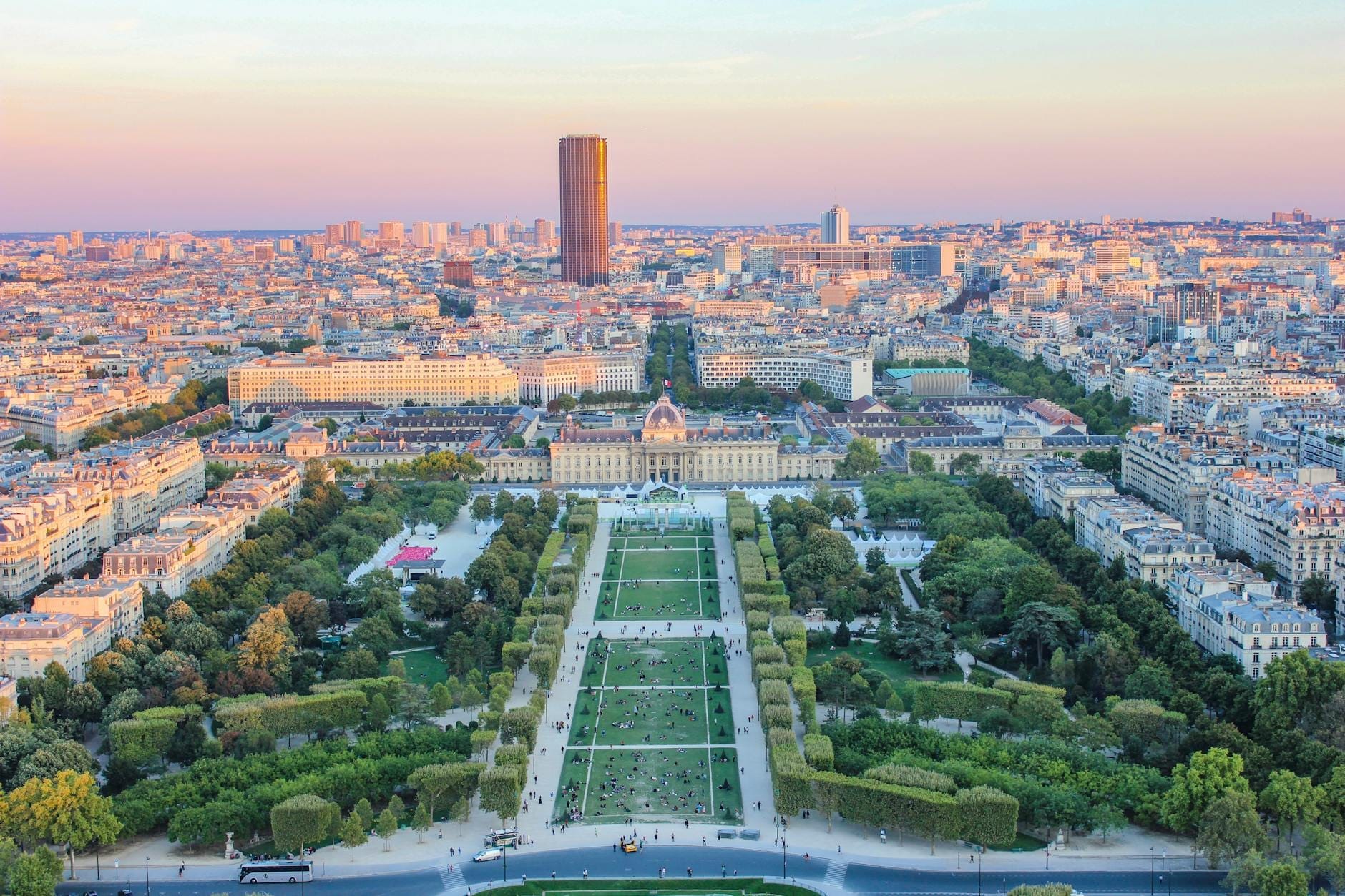
Tour Montparnasse is one of Paris's most polarising buildings. Locals have long complained about its profile on the skyline, and that reputation has arguably made it one of the most underrated viewpoints in any major European city. Here's the thing guidebooks rarely say plainly: if you want a photograph of the Eiffel Tower sitting inside the Paris skyline rather than a photo taken from it, this is the only place to do it. From the open-air roof terrace on the 59th floor, the Eiffel Tower appears at eye level, surrounded by Haussmann rooftops, the Seine's curves, and the hills of Montmartre in the distance.
The tower sits in the 15th arrondissement, one of Paris's most residential and least-touristed districts, which means the crowds here are a fraction of what you'll find at the Eiffel Tower or Sacré-Cœur. Even on a busy summer afternoon, queues move quickly. The lift ride alone, one of the fastest in Europe, is a small spectacle.
⚠️ What to skip
Important: Tour Montparnasse underwent renovation in 2024; verify the current operational status on the official website before planning your visit.
Architecture and History: A Building Paris Grew to Regret
Construction ran from 1969 to 1973, and Tour Montparnasse was inaugurated on June 18, 1973. Rising 210 metres (689 feet), it stood as France's tallest building for nearly four decades, losing that title only in 2011. The tower is the centrepiece of the Maine-Montparnasse development project, a postwar urban renewal scheme that dramatically reshaped the 14th and 15th arrondissements. For planners, it was a statement of modernist ambition. For many Parisians, it was a lesson in what the city should never build again: within a year of its completion, Paris enacted sweeping height restrictions that effectively banned skyscrapers from the central city, a rule that still defines the low, horizontal skyline visitors see today.
That irony gives the tower an unexpected cultural weight. The very building that Parisians most resent is also the reason the rest of Paris looks the way it does. Standing on its roof, looking out at an uninterrupted sea of six-storey limestone buildings, you are partly looking at the consequence of this tower's own existence.
The surrounding Montparnasse quarter has its own creative history stretching back to the 1920s, when artists and writers from Picasso to Hemingway gathered in its cafés. That layered neighbourhood story is worth exploring on foot before or after your visit. For more architectural and cultural context across the city, the Paris city guide offers a useful broader frame.
Tickets & tours
Hand-picked options from our booking partner. Prices are indicative; availability and final rates are confirmed when you complete your booking.
Go City | Paris Pass
From 99 €Instant confirmationFree cancellationGo City | Paris Pass Plus
From 179 €Instant confirmationFree cancellationEiffel Tower reserved elevator entrance to 2nd floor with walking tour and Seine cruise
From 94 €Instant confirmationFree cancellationBest of Paris city tour with Eiffel Tower lunch and Seine cruise
From 144 €Instant confirmationFree cancellation
The 56th Floor: Enclosed Deck and What You'll Actually See
The high-speed lift deposits you on the 56th floor, an enclosed observation deck with floor-to-ceiling windows running the full perimeter. Large information panels identify each landmark as it appears across the glass, which is particularly useful if you're still orienting yourself to Paris's geography. On clear days, visibility reaches 40 kilometres (25 miles). The Eiffel Tower dominates the western view; swing north and you'll pick out the white dome of Sacré-Cœur above Montmartre, the Louvre's glass pyramid, and the green spine of the Tuileries gardens. Look east toward La Défense and the glass towers marking the business district create an interesting visual contrast with the 19th-century city in the foreground.
The 56th floor also houses the 360 Café, where you can order a drink and sit with a view. It's not a gourmet experience, but a coffee with that backdrop is an easy way to slow down and actually absorb what you're looking at rather than just photographing it.
The 59th Floor: Open-Air Rooftop, the Real Reason to Come
A final staircase from the 56th floor takes you to the open-air terrace at the summit, over 200 metres above street level. The difference between the two decks is considerable. Up here, there is no glass between you and the panorama. Wind is a constant presence, even in summer; in winter, it can be fierce. Bring a layer regardless of the season. The terrace surface is textured metal underfoot, and the low perimeter barrier is solid enough to feel secure, though anyone with a genuine fear of heights may find it confronting.
The Eiffel Tower, with its latticed ironwork fully visible and at near-eye level, is the obvious focal point, but the view has texture in every direction. At dusk, the city shifts from golden to blue-grey in about twenty minutes, and the Eiffel Tower's light show begins at nightfall, lighting up every full hour. Photographers who want that shot need to be in position before sundown, because the terrace can get crowded around the light show window.
💡 Local tip
Photography tip: For the Eiffel Tower light show (runs for 5 minutes every hour after dark), arrive at least 30 minutes early and position yourself on the northwest corner of the rooftop terrace for the clearest sightline.
Best Time to Visit: Morning, Sunset, or Night?
Morning visits (opening until around 11am) offer the cleanest visibility and smallest crowds. The light is soft, especially in spring and autumn, and haze has not yet built up over the city. Serious landscape photographers often prefer this window. Midday, particularly in summer, brings both crowds and atmospheric haze that can flatten the view.
Sunset is the most popular window, and for good reason: the quality of light is extraordinary. The Eiffel Tower turns amber in the last hour before sunset, and the city's rooftops catch colours that no other time of day produces. Expect the largest crowds between 6pm and 9pm in summer. If you plan to visit at sunset, buying tickets online in advance is advisable, not just to save time but to guarantee entry without queuing during the peak window.
Night visits deliver Paris fully illuminated, with the Eiffel Tower's sparkle sequence the visual centrepiece. The city looks compact and ordered from above at night, with the major boulevards tracing lit lines across the dark. This is arguably the most atmospheric experience, though the rooftop terrace can feel cold after 10pm even in summer.
Practical Details: Getting There, Hours, and Tickets
Tour Montparnasse stands at 33 Avenue du Maine in the 15th arrondissement. The Montparnasse-Bienvenüe Métro station, served by Lines 4, 6, 12, and 13, is a two-minute walk. This is one of Paris's largest interchange stations, making it straightforward to reach from virtually any part of the city. Gare Montparnasse, one of the six main SNCF mainline stations, is immediately adjacent for those arriving by train from Brittany, the Loire Valley, or the TGV network.
Opening hours vary by season. From April 1 through September 30 the tower is open daily from 9:30am to 11:30pm. From October 1 through March 31, hours are 9:30am to 10:30pm Sunday through Thursday, and until 11:00pm on Fridays, Saturdays, and the eve of public holidays. Last admission is 30 minutes before closing. The tower opens on major French public holidays including Bastille Day and Christmas. Always confirm current hours on the official site before visiting, especially in shoulder seasons. For general advice on timing your Paris trip, see the best time to visit Paris guide.
Adult tickets are priced at approximately €19, youth (ages 12–17) at around €13.50, and children aged 4 to 11 at approximately €9.50. Children under 4 enter free. Discounted or free admission may be available for younger visitors; check the official website for current rates and any included passes. Booking online in advance avoids the ticket desk queue and often qualifies for a small discount.
ℹ️ Good to know
Accessibility: Lifts serve the 56th-floor enclosed deck. Note that the open-air 59th-floor terrace is only reachable by stairs from the 56th floor, and may not be accessible for all visitors. Contact the tower in advance if this is a concern.
Weather and Conditions: What Affects the Experience
Paris's oceanic climate means overcast days are common year-round, with October through December seeing the highest rainfall. A cloudy day does not necessarily ruin the view from the 56th floor, since the enclosed deck is well above ground-level haze and the city panorama can still be striking under grey skies. The open-air 59th floor, however, is exposed and uncomfortable in rain or strong wind. Check the forecast before you go and dress accordingly.
Winter visits (December through February) bring cold temperatures on the rooftop, often dropping well below the street-level readings due to wind chill. That said, Paris in winter has its own atmosphere, and the view from above on a clear December night, with Christmas lights tracing the city's main axes, is genuinely beautiful. For the full picture of seasonal conditions across the city, the seasonal Paris guide gives month-by-month detail.
Who Should Skip This Attraction
If you have already climbed the Eiffel Tower or the Arc de Triomphe on the same trip, a third high viewpoint may feel redundant unless photography is a specific priority. Visitors primarily interested in art, history, or neighbourhood life will likely find more value in places like Musée d'Orsay or Musée Rodin within the same southern Paris circuit. Anyone with a serious fear of heights should be aware that the open-air 59th-floor terrace has a very exposed feel, and even the enclosed 56th floor has large floor-to-ceiling windows that some find unsettling.
Budget travellers prioritising the Paris Museum Pass should note that Tour Montparnasse is not included in that pass, so the full ticket cost applies on top of any pass purchase. For those weighing viewpoint options, the best views in Paris guide gives a direct comparison of each major observation point.
Insider Tips
- Buy tickets online: the online booking discount is modest but the time saved avoiding the ground-floor ticket queue is real, especially during peak summer evenings.
- The northwest corner of the 59th-floor terrace gives the cleanest Eiffel Tower sightline with minimal crowd obstruction. Stake out a position there before the light show window.
- The 360 Café on the 56th floor serves coffee and light bites. A window seat here lets you study the panorama at a slower pace than the rooftop terrace allows, and it's far less windy.
- Arriving in the last 90 minutes before closing means significantly thinner crowds and, if you time it right, a transition from daylight to city lights within a single visit.
- Gare Montparnasse is directly adjacent to the tower, making this a logical first or last stop on a day trip to Versailles, the Loire, or Chartres, as all those trains depart from here.
Who Is Tour Montparnasse For?
- First-time visitors who want to photograph the Eiffel Tower as part of the Paris skyline
- Photography enthusiasts prioritising the golden-hour and night-sky window
- Families with children who find the fast lift and open rooftop more engaging than a museum interior
- Travellers arriving or departing from Gare Montparnasse who want to maximise a short layover
- Anyone who has already visited the Eiffel Tower and wants a complementary perspective of the city
Nearby Attractions
Combine your visit with:
- Bois de Vincennes
Covering nearly 1,000 hectares on the eastern edge of Paris, the Bois de Vincennes is the city's largest green space, combining ancient woodland, three lakes, a botanical garden, a world-class zoo, and a medieval royal castle. It rewards both casual afternoon strollers and full-day explorers.
- Château de Fontainebleau
Older than Versailles and used by more French monarchs, the Château de Fontainebleau is a UNESCO World Heritage palace 55 km southeast of Paris. With over 1,900 rooms, free formal gardens, and a manageable crowd count compared to other royal sites, it rewards visitors who make the 40-minute train trip from Paris.
- Château de Vaux-le-Vicomte
Built between 1656 and 1661 for finance minister Nicolas Fouquet, Château de Vaux-le-Vicomte is the largest privately owned château in France. Its formal gardens, gilded state rooms, and extraordinary backstory make it one of the most rewarding half-day trips from Paris.
- Château de Vincennes
Rising at the eastern edge of Paris, Château de Vincennes is one of the most complete medieval royal fortresses in Europe. Home to France's tallest medieval keep and a stunning Gothic chapel, it rewards visitors who venture beyond the tourist centre with centuries of largely undisturbed royal history.