Château de Vaux-le-Vicomte: The Estate That Inspired Versailles
Built between 1656 and 1661 for finance minister Nicolas Fouquet, Château de Vaux-le-Vicomte is the largest privately owned château in France. Its formal gardens, gilded state rooms, and extraordinary backstory make it one of the most rewarding half-day trips from Paris.
Quick Facts
- Location
- Maincy, Seine-et-Marne, 55 km southeast of Paris (near Melun)
- Getting There
- RER D to Melun, then shuttle bus or taxi to the château (approx. 1hr 15min from central Paris)
- Time Needed
- 3–5 hours for the full estate; allow a full day if attending a candlelit evening
- Cost
- Day tickets from €17/person; check official site for current rates and seasonal events
- Best for
- Architecture lovers, garden enthusiasts, history buffs, families, and day-trippers from Paris
- Official website
- vaux-le-vicomte.com/en
What Is Château de Vaux-le-Vicomte?
Château de Vaux-le-Vicomte is not simply a pretty country house. It is the building that effectively invented the French classical style and, in doing so, signed its creator's death warrant. When finance minister Nicolas Fouquet inaugurated the completed estate on August 17, 1661 with a lavish fete attended by Louis XIV himself, the king was so overwhelmed by its splendor that he ordered Fouquet's arrest on charges of embezzlement three weeks later. The entire creative team, architect Louis Le Vau, garden designer André Le Nôtre, and painter-decorator Charles Le Brun, was immediately commandeered to build something even bigger: the Palace of Versailles.
That origin story is the key to understanding why Vaux-le-Vicomte deserves your time. Versailles is, in many ways, Vaux scaled up and politically weaponized. Coming here first gives you the original prototype in a far more intimate setting, without the crowds, without the audio-guide queues, and without the sense that you are shuffling through a state monument rather than a living estate.
ℹ️ Good to know
Always confirm current opening dates and hours on the official site before planning your visit, as seasonal schedules vary significantly.
The Architecture: Le Vau's Masterpiece
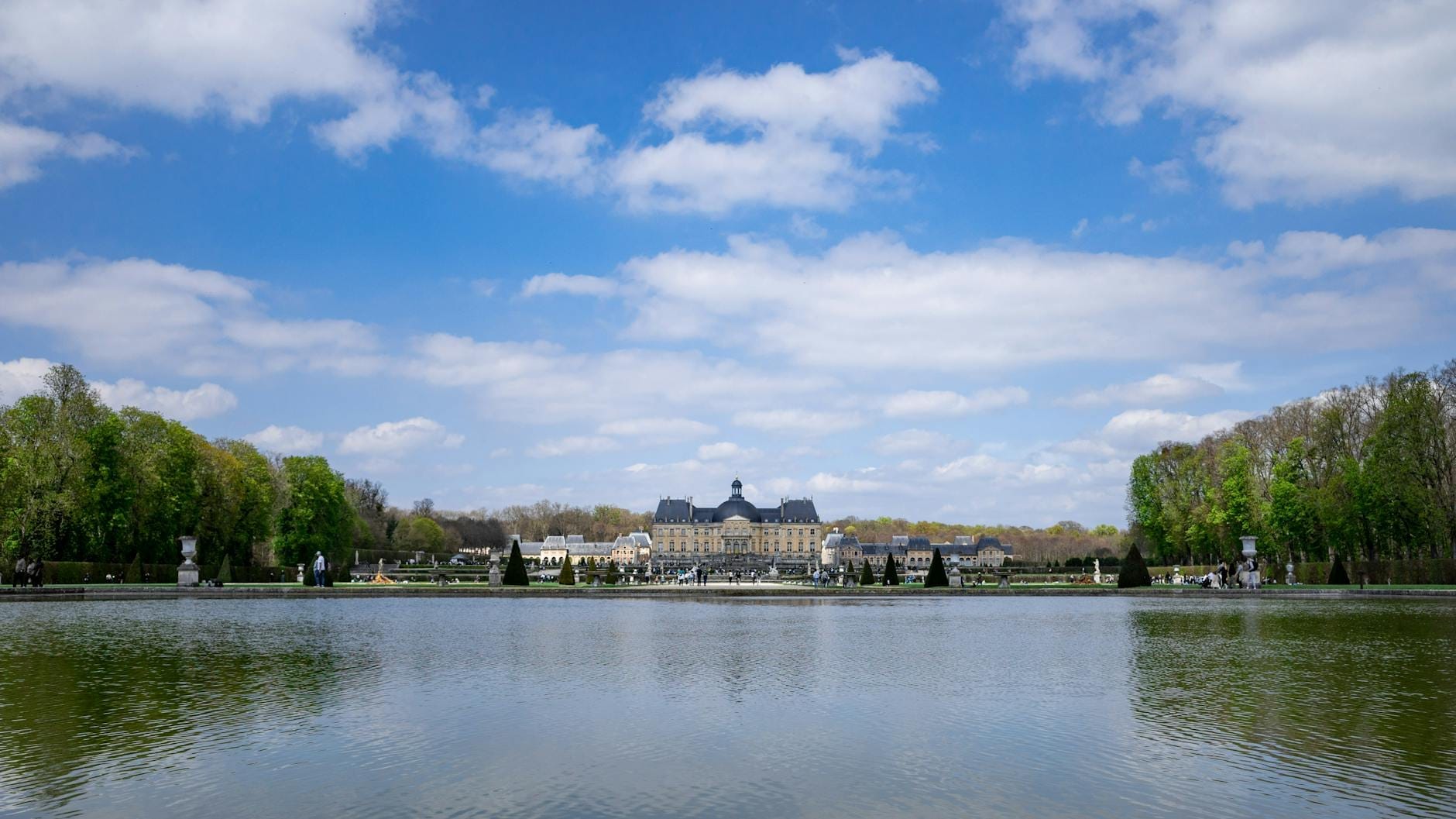
The château sits at the center of a perfectly symmetrical composition: moat, formal forecourt, main building, terrace, and then a cascade of geometric parterres descending to a grand canal. Le Vau's design introduced the oval central salon as its dramatic core, a domed space that punches through the full height of the piano nobile and opens onto the garden terrace. Standing in it, you understand immediately why Louis XIV coveted the concept: the room commands attention in a way that no rectangular hall can.
The exterior is built in pale limestone, and on a clear afternoon the stone catches the low sun and turns almost gold. The roofline is steep French baroque, punctuated by dormer windows and slate that darkens to near-black when rain passes through. From the parapet walk, more than 25 metres above ground level, the full symmetry of Le Nôtre's garden design becomes apparent in a way that is impossible from the ground: clipped parterres, circular pools, long grass allées, and the distant glint of the grand canal stretching to the horizon.
The building represents a transition point in French architecture, arriving just before the full flowering of Louis XIV's absolutist aesthetic at the Palace of Versailles. Visiting both in sequence, if your schedule allows, reveals exactly how the language of royal grandeur was developed and then amplified.
Tickets & tours
Hand-picked options from our booking partner. Prices are indicative; availability and final rates are confirmed when you complete your booking.
Audioguided visit of Fontainebleau and Vaux le Vicomte
From 105 €Instant confirmationFree cancellationPrivate day trip to Vaux-le-Vicomte and Fontainebleau from Paris
From 1.380 €Instant confirmationFree cancellationFontainebleau and Vaux-Le-Vicomte Castle small-group day trip from Paris
From 189 €Instant confirmationFree cancellation2-Day Excursion to Mont Saint-Michel, Loire Valley Chateaux and Wine Tasting from Paris
From 475 €Instant confirmationFree cancellation
The Gardens: Le Nôtre at His Most Inventive
André Le Nôtre designed the gardens at Vaux-le-Vicomte before he ever set foot at Versailles, and many landscape historians argue they are his finest work. The 33 hectares of formal French garden that surround the château unfold in an extended visual trick: the beds and pools and statuary appear to be arranged on a flat plane, but the site is subtly graded so that the far end of the garden actually sits at a higher elevation than it appears from the terrace. Walk the full length to the Hercules statue at the top of the hill and turn around: the château seems to have risen, as if on a stage set.
In spring, the parterres de broderie, clipped box hedging in interlocking scroll patterns, are freshly trimmed and a vivid green against the pale gravel paths. By midsummer, the borders flanking the allées soften with perennial planting. In autumn, the tree canopies along the outer bosquets turn amber and ochre, and the lower angle of the sun creates long shadows that dramatize every hedge line. Winter closes the estate entirely, which is worth knowing before you travel.
💡 Local tip
Rent a golf cart at the entrance if mobility is a concern or if you have young children. The estate's formal gardens cover 33 hectares, and the formal garden alone requires a walk of roughly 2 km end to end on compacted gravel paths.
For context on how Vaux fits into Paris's broader landscape tradition, the guide to the best parks and gardens in Paris covers Le Nôtre's other surviving work across the city and region.
The Interiors: Fouquet's Unfinished Dream
The state rooms on the piano nobile were lavishly decorated by Charles Le Brun, whose ceiling paintings in the Grand Salon and the Chambre du Roi are among the finest examples of French baroque painting outside of Versailles. Fouquet's private apartments on the upper floors are preserved in a more intimate register: tiled floors, painted wooden panelling, and furniture that gives a sense of how a very wealthy 17th-century administrator actually lived, rather than how a king performed power.
The basement level holds a Carriage Museum, an often-overlooked collection of 19th-century horse-drawn vehicles that belonged to the Sommier family, who rescued the estate from ruin after 1875. The carriages are beautifully maintained and give a different angle on the estate's long post-Fouquet history. The wine cellars, also accessible, still have their original stone vaulting.
One notable recent addition in the Grand Salon is a video projection onto the ceiling dome that reconstructs Le Brun's never-completed painting scheme using surviving sketches and studies. It runs silently during the day and adds genuine depth to understanding what Fouquet originally envisioned before his arrest cut the project short.
Candlelit Evenings: A Completely Different Visit
Every Saturday evening from June through late September, Vaux-le-Vicomte stages its celebrated chandelier evenings, when more than 2,000 candles are lit throughout the château's state rooms and along the garden paths. The effect is not theatrical in a forced way: the candlelight strips away the clarity of electric lighting and returns the rooms to something close to how they appeared in Fouquet's time. Shadows deepen in the ceiling vaults, gilding glows warmly, and the garden outside moves between pools of light and darkness in a way that no daytime visit replicates.
These evenings sell out well in advance, particularly in July and August. Book tickets directly through the official website at least two to three weeks ahead. Evening sessions typically run from around 8 PM to 11 PM, which means you can combine a daytime garden visit with the evening illumination on the same day, though that makes for a long excursion from Paris.
⚠️ What to skip
The last shuttle from the château back to Melun station on candlelit Saturday evenings runs late. Confirm the return shuttle schedule at the welcome desk on arrival, or arrange a taxi in advance. Missing the last shuttle means a costly cab ride back to Paris.
Getting There and Practical Details
Vaux-le-Vicomte sits 55 km southeast of Paris, near the town of Melun in Seine-et-Marne. The most straightforward public transport route is the RER D from Gare de Lyon to Melun, a journey of around 40 minutes. From Melun station, a shuttle bus runs directly to the château during the open season; a taxi is the alternative outside shuttle hours. By car, the estate is roughly 55 minutes from central Paris via the A6 autoroute, and parking on site is free.
Wear comfortable shoes with grip. The garden paths are compacted gravel, uneven in places, and the interior stone staircases are steep with low handrails in the older sections. Pushchairs and wheelchairs can access most of the ground floor and the garden, but the upper floors of the château involve staircases with no lift alternative.
The Château de Vaux-le-Vicomte pairs naturally with the nearby Château de Fontainebleau, about 20 km further southeast. If you are planning a longer excursion, the day trips from Paris guide covers how to combine both sites efficiently.
Photography is permitted throughout the estate. The best light on the château facade falls in the late afternoon, when the sun is behind the visitor and the pale limestone turns golden. For broader inspiration on Paris-region photography, the best photo spots in Paris guide includes context on the region's most photogenic day-trip destinations.
Who Should Skip Vaux-le-Vicomte
If your Paris time is genuinely limited to two or three days and you have not yet seen the Louvre, Musée d'Orsay, or Notre-Dame, prioritize the city first. The round trip to Vaux-le-Vicomte takes at least six hours including transit, which is a significant portion of a short city break. Travelers with limited mobility should note that the estate's gravel paths and interior staircases are not well suited to wheelchairs or pushchairs beyond the ground level and main garden paths.
Visitors who find highly manicured, formal landscapes cold or lifeless may prefer the wilder English-style parks within Paris itself. The Parc des Buttes-Chaumont offers dramatic landscaping with far less travel time.
Insider Tips
- Arrive at opening time (10:00 AM on most days) to have the château interior to yourself. Tour groups typically arrive after 11:30 AM, and the state rooms feel entirely different when you can stand still in them without shuffling.
- The view that makes the best photograph of the château is not from the front forecourt but from the far end of the garden, at the Hercules statue hilltop, looking back. You get the full garden composition with the château at the end of the central axis.
- Pick up the estate map at the entrance and note the location of the 'Grille d'Eau' water parterre near the canal. Most visitors walk straight down the central axis and miss the side basins entirely.
- The on-site café serves decent lunches at reasonable prices. Bringing a picnic is also permitted on the garden lawns outside the formal parterre areas, saving you a rush back to Melun for food.
- If you are visiting in summer, check the official site for 'Les Fêtes de Nuit' dates, occasional costumed theatrical evenings with fireworks. These are considerably more elaborate than the standard candlelit Saturdays and require booking months in advance.
Who Is Château de Vaux-le-Vicomte For?
- Architecture and design enthusiasts who want to understand the origins of French classical style before visiting Versailles
- Couples looking for a genuinely romantic evening outing, particularly on candlelit Saturday nights in summer
- Families with children who respond well to open space, outdoor exploration, and the Carriage Museum
- Garden lovers wanting to experience André Le Nôtre's work in its original, pre-Versailles form
- Repeat Paris visitors who have covered the main city sites and are ready for a deeper regional excursion
Nearby Attractions
Combine your visit with:
- Bois de Vincennes
Covering nearly 1,000 hectares on the eastern edge of Paris, the Bois de Vincennes is the city's largest green space, combining ancient woodland, three lakes, a botanical garden, a world-class zoo, and a medieval royal castle. It rewards both casual afternoon strollers and full-day explorers.
- Château de Fontainebleau
Older than Versailles and used by more French monarchs, the Château de Fontainebleau is a UNESCO World Heritage palace 55 km southeast of Paris. With over 1,900 rooms, free formal gardens, and a manageable crowd count compared to other royal sites, it rewards visitors who make the 40-minute train trip from Paris.
- Château de Vincennes
Rising at the eastern edge of Paris, Château de Vincennes is one of the most complete medieval royal fortresses in Europe. Home to France's tallest medieval keep and a stunning Gothic chapel, it rewards visitors who venture beyond the tourist centre with centuries of largely undisturbed royal history.
- Cité des Sciences et de l'Industrie
France's largest science and technology museum sits inside a landmark glass-and-steel building at the northern edge of Parc de la Villette. With interactive permanent galleries, a digital planetarium, an Argonaute submarine, and dedicated children's spaces, it rewards a solid half-day and punches well above the expectations of a typical museum visit.