Château de Fontainebleau: The Palace That Shaped Eight Centuries of French History
Older than Versailles and used by more French monarchs, the Château de Fontainebleau is a UNESCO World Heritage palace 55 km southeast of Paris. With over 1,900 rooms, free formal gardens, and a manageable crowd count compared to other royal sites, it rewards visitors who make the 40-minute train trip from Paris.
Quick Facts
- Location
- Place du Général de Gaulle, 77300 Fontainebleau, approximately 60 km southeast of Paris
- Getting There
- Transilien Line R from Paris Gare de Lyon (~40 min) to Fontainebleau-Avon station, then Bus 1 to the château
- Time Needed
- Half day minimum; full day recommended if exploring the gardens and surrounding forest
- Cost
- Palace admission varies by source; gardens and courtyards free. Closed Tuesdays. Check official website for current pricing and holiday closures.
- Best for
- History lovers, architecture enthusiasts, day-trippers from Paris, and anyone who finds Versailles too crowded
- Official website
- www.chateaudefontainebleau.fr/en
Why Fontainebleau Deserves More Attention Than It Gets
The Château de Fontainebleau does not have the global name recognition of the Palace of Versailles, and that is precisely what makes it worth visiting. Where Versailles can feel overwhelming at peak season, Fontainebleau still functions as a genuine encounter with French royal history on a human scale, in a setting where you can move freely through the rooms.
The palace began as a 12th-century royal hunting lodge and was transformed into a full Renaissance palace under François I from 1528 onward. Every major French monarch from François I to Napoleon III left architectural or decorative fingerprints here, making it a layered record of French taste across eight centuries rather than a single king's vision. UNESCO recognised it as a World Heritage Site for its testimony to the evolution of French art and architecture.
💡 Local tip
Buy your château entrance ticket online in advance to skip the ticket queue on busy weekends. The gardens and all exterior courtyards are free and need no booking.
Arriving at the Cour du Cheval Blanc
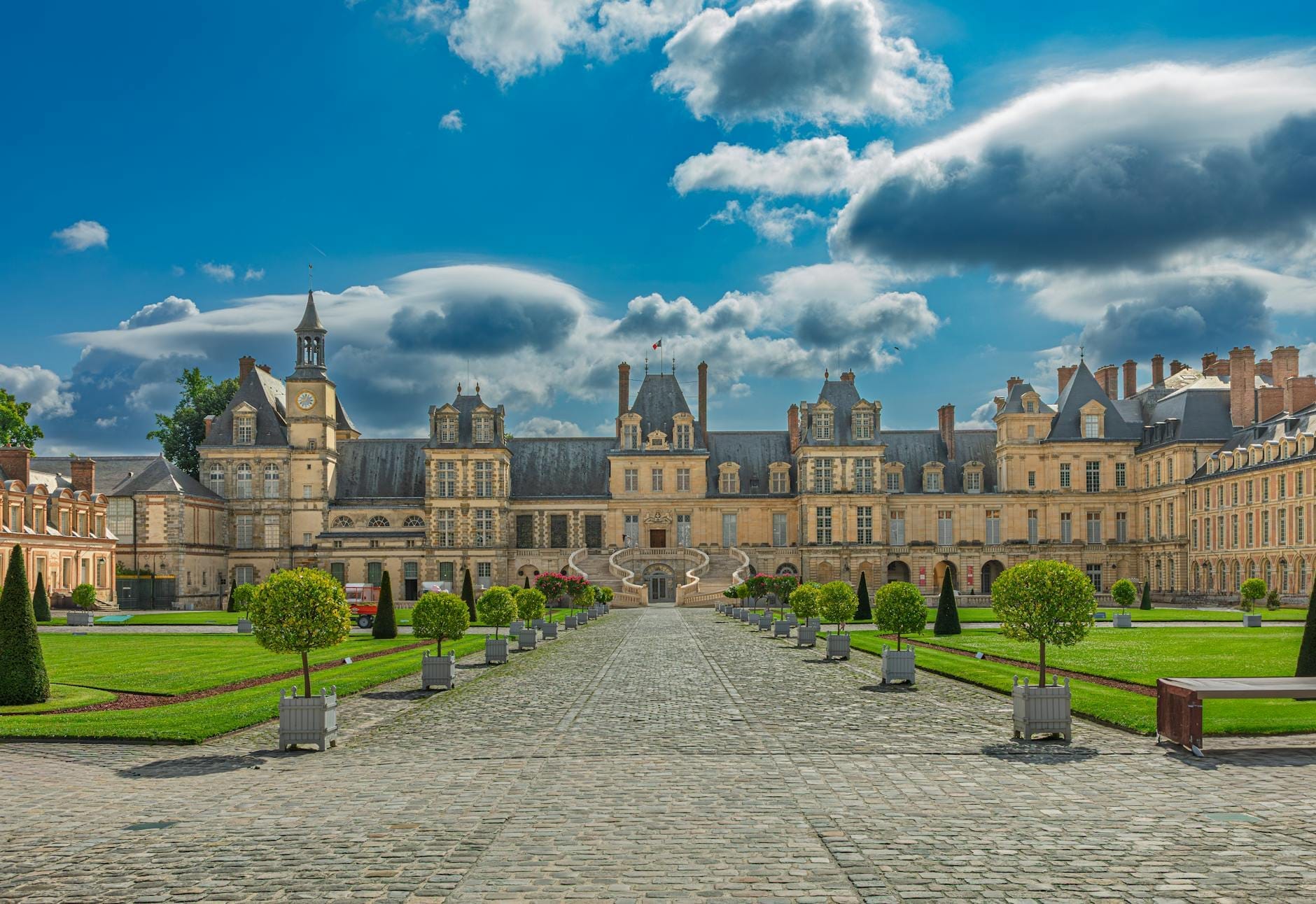
The main approach is through the Cour du Cheval Blanc, a vast horseshoe-shaped forecourt entered directly from Place du Général de Gaulle. The façade is more restrained than many visitors expect: pale stone, dormered roofs, and a central horseshoe staircase curving down to the cobblestones. This is the staircase where Napoleon Bonaparte bid farewell to his Imperial Guard in April 1814 before his abdication and exile to Elba.
On weekday mornings the courtyard is almost empty. The gravel is raked, the stone glows pale gold in low light, and the quiet after the Paris commute feels earned. By early afternoon, tour groups fill the space. If your schedule allows flexibility, arriving at opening time on a weekday produces a meaningfully different experience.
Tickets & tours
Hand-picked options from our booking partner. Prices are indicative; availability and final rates are confirmed when you complete your booking.
Audioguided visit of Fontainebleau and Vaux le Vicomte
From 105 €Instant confirmationFree cancellationPrivate day trip to Vaux-le-Vicomte and Fontainebleau from Paris
From 1.380 €Instant confirmationFree cancellationFontainebleau and Vaux-Le-Vicomte Castle small-group day trip from Paris
From 189 €Instant confirmationFree cancellation2-Day Excursion to Mont Saint-Michel, Loire Valley Chateaux and Wine Tasting from Paris
From 475 €Instant confirmationFree cancellation
Inside the Palace: The Grands Appartements and Napoleon's Rooms
Your admission ticket covers two sections: the Grands Appartements and the Napoleon I Museum. Allow roughly two hours for a self-guided tour, though the decorative detail can fill three for those who slow down.
The highlight is the Galerie François I, a long corridor decorated in the 1530s with frescoes and carved walnut paneling that effectively introduced Italian Mannerist style to France. The scale of individual rooms is more intimate than Versailles, which makes the craftsmanship easier to absorb: carved chimney pieces, coffered ceilings with mythological scenes, and marquetry floors that click underfoot.
The Napoleon I Museum occupies rooms where the emperor actually lived and worked. Unlike many Napoleonic sites in Paris, the furnishings are largely original. His personal library, the throne room, and the bedroom where he signed the abdication document are all included. The connection between physical space and historical event is tangible in a way that reconstructed museum rooms rarely achieve.
Visitors interested in related French history can find complementary perspectives at Les Invalides, which contains Napoleon's Tomb, and the Musée Carnavalet, which covers Parisian history across several centuries.
ℹ️ Good to know
Opening hours: 9:30 am–5 pm (October to March) and 9:30 am–6 pm (April to September). Closed every Tuesday, January 1st, May 1st, and December 25th. Last admission is 45 minutes before closing.
The Gardens: Free, Formal, and Far Less Visited
Entry to the gardens and exterior courtyards is free, making them one of the best-value outdoor spaces within easy reach of Paris. The formal Jardin à la Française features geometric parterres framing a long ornamental canal. On a clear morning the reflections are sharp enough to photograph without a filter, and foot traffic is light before 11 am.
The Jardin de Diane, near the north wing, centers on a bronze fountain of Diana the huntress surrounded by old trees whose roots have buckled some of the paving. The English-style Jardin Anglais at the far end takes a looser, more romantic approach with winding paths. Both close 30 to 60 minutes before the main garden closure time depending on the season.
Beyond the formal gardens, the Forêt de Fontainebleau stretches across 25,000 hectares surrounding the town and palace. This forest of oak, pine, and birch was the original reason French kings kept a hunting lodge here. In autumn, the forest floor turns amber and copper, and the contrast with the pale palace stone is one of the more underrated visual combinations in the Île-de-France region.
Travellers who enjoy combining architecture with exceptional outdoor scenery might also consider Parc de Sceaux and Monet's Gardens at Giverny, both accessible as day trips with quite different characters.
How the Experience Changes by Season
Spring and early autumn are the strongest seasons. April and May bring the gardens into bloom with favorable morning light; September and October deliver the forest at its most photogenic without the school-holiday density of July and August. Summer weekends are the one period when Fontainebleau's crowd advantage over Versailles begins to narrow. Weekday mornings in summer are considerably more relaxed.
Winter visits are underrated. From November through February the palace interiors feel more atmospheric in lower light, and the forest takes on a particular stillness in winter fog that regular visitors to the region come specifically to experience.
⚠️ What to skip
The palace closes every Tuesday. Always check the official website for additional closure dates before making the trip, especially around public holidays.
Getting There and Practical Notes
The standard route from Paris is Transilien Line R from Gare de Lyon, around 40 minutes to Fontainebleau-Avon station, then Bus 1 to the palace gates. By car via the A6 motorway, expect 45 to 60 minutes in normal traffic. Fontainebleau is one of the most satisfying day trips from Paris: straightforward logistics, a palace that justifies a full half-day, and a town with good cafes for a post-visit lunch.
Photography is permitted inside without a tripod. Wear comfortable shoes: cobbled courtyards and gravel paths are hard on thin soles. A café operates in the Fountain Courtyard; a restaurant is open for lunch daily. Ground-floor rooms are largely accessible for wheelchair users; audioguides are available in multiple languages. Pushchairs with metal frames must be left at the free deposit desk near the entrance.
The Paris Museum Pass is not accepted at Fontainebleau. EU residents under 26 and children under 18 enter free. For a breakdown of which Paris sites the pass covers, the Paris Museum Pass guide explains the calculation in detail.
Who Should Think Twice
Visitors on a single day in Paris who have not yet seen the Louvre or the Eiffel Tower should save Fontainebleau for a return trip. The round-trip transit time is hard to justify when so much is concentrated within walking distance of the city centre.
Travellers whose primary interest is Impressionist painting will find more to engage with closer to Paris, at the Musée d'Orsay or the Musée de l'Orangerie. Fontainebleau is strongest for those drawn to French royal history, Renaissance decoration, and period architecture.
Insider Tips
- A last-admission discount applies one hour before closing (€13 flat rate), a legitimate way to see the Grands Appartements at a lower price, though you will need to move at a purposeful pace.
- The ornamental Grand Canal stretches approximately 1.2 km behind the formal garden. Renting a rowing boat here in summer is a long-standing local tradition and costs a fraction of any comparable experience in Paris.
- Guided tours open restricted areas not included on the standard self-guided route. Book a guided tour slot when purchasing your ticket online if your schedule allows.
- The Forêt de Fontainebleau is one of the founding sites of French landscape painting: the Barbizon School artists, including Corot and Millet, worked in the surrounding forest villages in the 19th century. The village of Barbizon, 10 minutes by car, has a small museum in Millet's former studio.
- Weekday mornings in the off-season (November through March) offer something increasingly rare at major French monuments: near-solitude inside rooms of significant historical weight.
Who Is Château de Fontainebleau For?
- History enthusiasts wanting to trace French royal life from the Renaissance to the Second Empire in a single visit
- Day-trippers from Paris seeking a substantial half-day excursion with straightforward logistics
- Photographers who want palace architecture, formal gardens, and autumn forest foliage in one trip
- Families with older children who need open outdoor space alongside the interior visit
- Versailles veterans curious to see a royal palace with fewer crowds and more layered historical character
Nearby Attractions
Combine your visit with:
- Bois de Vincennes
Covering nearly 1,000 hectares on the eastern edge of Paris, the Bois de Vincennes is the city's largest green space, combining ancient woodland, three lakes, a botanical garden, a world-class zoo, and a medieval royal castle. It rewards both casual afternoon strollers and full-day explorers.
- Château de Vaux-le-Vicomte
Built between 1656 and 1661 for finance minister Nicolas Fouquet, Château de Vaux-le-Vicomte is the largest privately owned château in France. Its formal gardens, gilded state rooms, and extraordinary backstory make it one of the most rewarding half-day trips from Paris.
- Château de Vincennes
Rising at the eastern edge of Paris, Château de Vincennes is one of the most complete medieval royal fortresses in Europe. Home to France's tallest medieval keep and a stunning Gothic chapel, it rewards visitors who venture beyond the tourist centre with centuries of largely undisturbed royal history.
- Cité des Sciences et de l'Industrie
France's largest science and technology museum sits inside a landmark glass-and-steel building at the northern edge of Parc de la Villette. With interactive permanent galleries, a digital planetarium, an Argonaute submarine, and dedicated children's spaces, it rewards a solid half-day and punches well above the expectations of a typical museum visit.