Palace of Versailles: The Complete Visitor Guide
The Château de Versailles is one of the most extraordinary royal estates ever built — 700 rooms, 800 hectares of gardens, and three centuries of French history packed into a single day trip from Paris. Here is everything you need to visit it well.
Quick Facts
- Location
- Place d'Armes, 78000 Versailles — 16 km southwest of central Paris
- Getting There
- RER C to Versailles Château Rive Gauche (approx. 35 min from Paris), then a 10-min walk to the main gate
- Time Needed
- Half day minimum for the Palace; a full day to include the Trianon estates and gardens
- Cost
- Passport ticket (Palace + Trianon + Gardens): €25 low season / €35 high season for adults (€22/€32 reduced rate for EEA residents). Paris Museum Pass accepted — verify current pricing at en.chateauversailles.fr
- Best for
- History lovers, architecture enthusiasts, garden photography, and first-time visitors to France
- Official website
- en.chateauversailles.fr
What the Château de Versailles Actually Is
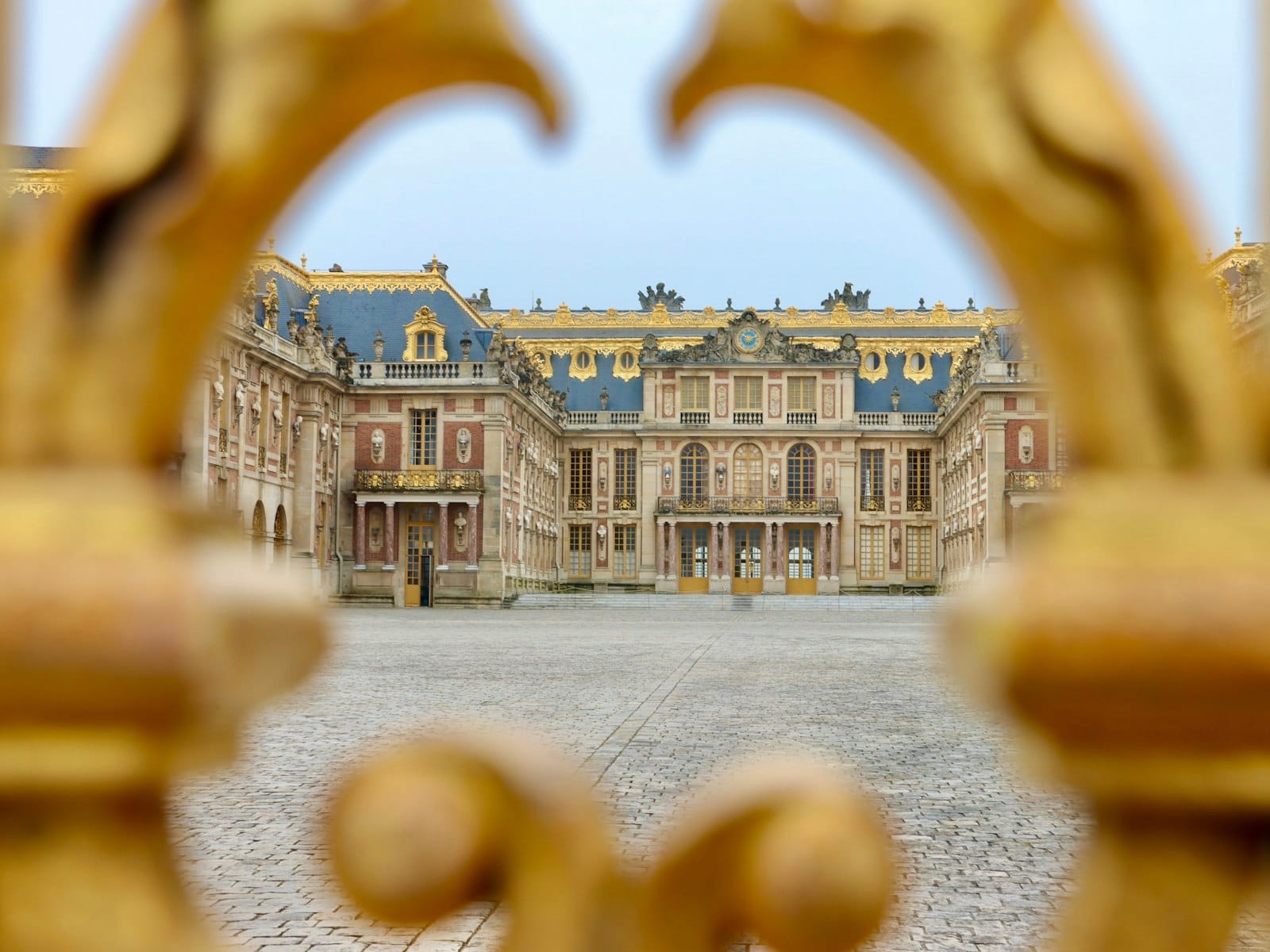
The Palace of Versailles — the Château de Versailles in French — is not simply a palace. It is a statement of absolute power frozen in stone, gilding, and geometry. What began as a modest hunting lodge built for Louis XIII in 1631 was transformed by Louis XIV into the largest royal residence in Europe, a project he drove relentlessly from 1661 until the complex reached its finished form around 1710. The Sun King moved his entire court here in 1682, making Versailles the seat of French government until the Revolution forced the royal family back to Paris in 1789. Today it is a UNESCO World Heritage Site, inscribed in 1979, and one of the most visited monuments on the planet.
The scale is the first thing that stops visitors in their tracks. The palace facade stretching along the garden side runs to 680 metres. The estate covers 800 hectares — more than twice the area of New York's Central Park. Inside the palace alone there are roughly 700 rooms, including the 73-metre-long Hall of Mirrors lined with 357 mirrors facing 357 windows that look out over the formal gardens. No photograph adequately prepares you for the physical reality of the place.
💡 Local tip
Book timed-entry tickets online well in advance — especially for weekends and summer months. Walk-up tickets exist but queues at security can run 45–90 minutes. The official ticket page is en.chateauversailles.fr/plan-your-visit/tickets-and-prices.
How the Experience Changes Through the Day
Arriving at 9:00 am when the Palace opens is the single most effective strategy. The main gate at Place d'Armes faces east, so the early light catches the gilded royal arms above the entrance at an almost theatrical angle. Security lines are manageable in the first hour, and the State Apartments — the Salon of War, the Salon of Apollo, the Hall of Mirrors — are navigable without being shoulder-to-shoulder. By 10:30 am, tour groups from Paris begin to arrive in waves, and the Hall of Mirrors shifts from magnificent to claustrophobic.
The gardens follow a different rhythm. The formal parterre gardens directly behind the palace are most photogenic in the two hours after opening, when the low morning light throws long shadows across the sculpted hedges and the fountain basins reflect blue sky rather than midday glare. From around 11:00 am onward, visitors spread outward and the vast geometry of André Le Nôtre's design absorbs the crowds far more graciously than the palace corridors can. On Musical Fountain Show days (typically Tuesdays, Saturdays, and Sundays from late spring through early autumn), the fountains run to Baroque music from around 11:00 am — a spectacle that turns what might feel like a static landscape into something kinetic and genuinely moving.
A useful rhythm for a full-day visit: Palace first thing in the morning, lunch in the gardens or the Angelina café inside the estate, then the Trianon estates in the afternoon when they open at noon. The Estate of Trianon — the Grand Trianon, the Petit Trianon, and Marie Antoinette's Hamlet — sees dramatically fewer visitors than the main palace and offers a completely different emotional register: intimate, domestic, and in some rooms genuinely evocative of the people who lived there.
Tickets & tours
Hand-picked options from our booking partner. Prices are indicative; availability and final rates are confirmed when you complete your booking.
Bike tour of Versailles Palace with skip-the-line tickets
From 109 €Instant confirmationFree cancellationVisit Monet's Giverny and Versailles in one day
From 137 €Instant confirmationFree cancellationPalace of Versailles and the Trianon with transportation from Paris
From 129 €Instant confirmationFree cancellationSmall-Group Paris to Versailles Day Trip with Garden Stroll
From 109 €Instant confirmationFree cancellation
Inside the Palace: What to Prioritise
The standard visitor route takes you through the King's State Apartments, starting from the Salon of Hercules on the ground floor and progressing through a sequence of rooms named for Roman gods — Venus, Diana, Mars, Mercury, Apollo — each reflecting a different function in the Sun King's carefully choreographed daily ritual. The ceilings are painted by Charles Le Brun, and the accumulated effect of silk damask walls, gilded cornices, and inlaid marble floors is less like a home and more like a continuous argument for divine-right monarchy. That was entirely the point.
The Hall of Mirrors is obligatory, but spend time also in the King's Chamber, where Louis XIV died in 1715 at the age of 77 after a reign of 72 years. The room has a gravity that the mirror gallery, despite its brilliance, does not. If you have a second day or a return visit in mind, the rooms of the Queen's Apartments and the Royal Chapel reward attention that the crowds rarely allow on a first pass.
The palace also contains extensive galleries dedicated to French history, including paintings of major battles commissioned by Louis-Philippe in the 19th century. These rooms are included in the Passport ticket but often missed entirely — worth considering if you want to escape the main tourist flow. For context on how Versailles fits into Paris's broader museum landscape, the best museums in Paris guide outlines how to sequence major collections across the city.
The Gardens: More Than a Walk Between Buildings
André Le Nôtre designed the gardens of Versailles between 1661 and 1700, and they represent the definitive statement of the French formal garden style: nature subordinated absolutely to human geometry. The main axis runs west from the palace across the Grand Parterre, past the Latona Fountain, down the Royal Walk to the Apollo Fountain, and then along the 1.6-kilometre Grand Canal. The canal alone was once used for gondola rides organized by the Sun King; today you can rent rowboats on it, which is one of the more quietly pleasurable ways to spend an afternoon here.
Beyond the formal axes, the gardens contain a network of bosquets — enclosed grove rooms hidden between hedges, each with its own fountain or sculpture program. Many are only accessible on Musical Fountain Show days or during seasonal events. The Colonnade Bosquet, a circular arcade of 32 marble columns, is among the most architecturally striking and rarely as crowded as the main parterre. Wear comfortable shoes: walking the gardens end to end covers several kilometres, and the ground between the gravel paths can be uneven after rain.
ℹ️ Good to know
Admission to the Parc (the larger free park area beyond the formal gardens, including the Grand Canal) is free year-round. The formal Gardens charge a seasonal admission on Musical Fountain Show days. Check the official site for the current show schedule before you visit.
If Versailles inspires an interest in formal French garden design, the Jardin des Tuileries in central Paris — also shaped by Le Nôtre's influence — makes an instructive comparison on a much more accessible scale. For dedicated garden lovers, Monet's Gardens at Giverny offer a completely different aesthetic: romantic, impressionistic, and equally renowned.
The Trianon Estates: A Palace Within a Palace
The Estate of Trianon, which opens at noon, is where Versailles becomes genuinely human. The Grand Trianon was built by Louis XIV as a private retreat from courtly ceremony — its low pink marble colonnade and quieter rooms feel almost modest by Versailles standards. Napoleon later used it as a personal residence and redecorated several rooms in Empire style, so the Grand Trianon offers an unexpected layer of history beyond the Sun King's era.
The Petit Trianon, given by Louis XVI to Marie Antoinette in 1774, is where the queen's complicated legacy plays out in physical space. Her private theatre, her English-style garden, and especially the Hamlet — a working farm hamlet she had built to play at rural simplicity — have been read alternately as evidence of her frivolity and as a remarkable assertion of personal space within suffocating court protocol. The Hamlet in particular, with its thatched-roof cottages reflected in a small lake, is one of the most unexpected and atmospheric corners of the entire estate.
Getting There and Practical Details
The RER C train is the standard approach: take it toward Versailles Château Rive Gauche from any central Paris station on the C line (Saint-Michel Notre-Dame, Musée d'Orsay, Invalides, Champ de Mars Tour Eiffel). The journey takes approximately 35 minutes, and the station is a 10-minute walk from the main entrance at Place d'Armes. The train runs frequently, and the fare is a standard Île-de-France zone ticket — not a Paris metro ticket, so purchase the correct zone-appropriate ticket at the station.
The Palace is closed every Monday. Opening hours for the Palace begin at 9:00 am; the Estate of Trianon opens at noon. Closing times shift seasonally, generally extending later in summer. Always verify exact times on the official website before your visit. The Paris Museum Pass covers admission to the Palace and Trianon without queuing at the ticket office — holders still need to collect a free Passport ticket at the site.
The Paris Museum Pass guide breaks down exactly when the pass saves money versus individual tickets across different itinerary types.
⚠️ What to skip
Versailles is not a quick stop. Planning less than four hours is almost always a mistake. The palace alone takes 1.5–2 hours at a reasonable pace; the gardens add at minimum another hour; the Trianon estates deserve at least 90 minutes. Build this into your itinerary rather than trying to squeeze it between morning and evening Paris plans.
Wheelchair access is available throughout the Palace, with elevators and ramps installed in key areas. Adapted parking and tours for visitors with disabilities are available — advance booking is strongly recommended. Baby strollers are permitted in the gardens but some interior rooms require folding them due to narrow passages. Photography without flash is generally permitted throughout the palace and gardens.
Versailles fits naturally into a broader day-trip itinerary southwest of Paris. For other notable destinations within an hour of the city, the day trips from Paris guide covers Versailles alongside Fontainebleau, Chartres, and Giverny with transit details for each.
Honest Assessment: What Versailles Does Well and Where It Falls Short
Versailles earns its reputation. The Hall of Mirrors is one of those rare spaces where the reality exceeds the image — the interplay of natural light, mirrors, and painted vaulting at 73 metres long is genuinely impressive in a way that photographs cannot replicate. The scale of the gardens, particularly when fountains are running, creates an atmosphere that nothing else in the Paris region matches.
The limitations are real too. The standard visit route through the State Apartments is narrated almost entirely through audio guide or signage, and the storytelling is thin compared to what a well-staffed museum might offer. In peak summer, the Hall of Mirrors becomes so congested that visitors essentially shuffle through it in a slow-moving line, which strips away any contemplative possibility. The food options on-site are expensive relative to quality, with the exception of the Angelina café branch inside the estate. Bringing your own picnic for the gardens is both permitted and strongly advisable.
Visitors who find formal European interiors repetitive, or who have already toured several French châteaux, may find diminishing returns in the State Apartments. For those visitors, the Trianon estates and the gardens offer better value for time and a more textured experience.
Insider Tips
- The afternoon discount (from 2:30 pm for the Palace on certain days) gives a reduced-rate entry — useful if you plan to spend the later hours in the gardens and Trianon rather than the main palace. Check the official pricing page for the current reduced-rate window.
- The bosquet grove rooms inside the formal gardens are only fully open on Musical Fountain Show days. If you want to see them, check the seasonal show schedule and plan accordingly — the Colonnade Bosquet and the Ballroom Bosquet in particular are worth the effort.
- Walk north of the Grand Canal to the Trianon estates on foot rather than taking the tourist train. The path is quieter and gives a sense of the estate's true scale that the train ride entirely obscures.
- The rooms dedicated to the 19th-century History of France galleries (on the ground floor south wing) are almost always empty, even on the busiest days. If you need ten minutes of quiet mid-visit, they provide it.
- On weekday mornings in late September and October, visitor numbers drop sharply. The gardens take on autumnal colour, the light is low and golden, and the Hall of Mirrors becomes navigable again. This is arguably the single best window to visit the entire estate.
Who Is Palace of Versailles For?
- First-time visitors to France who want to understand the scale and ambition of pre-Revolutionary royal culture
- Architecture and design enthusiasts interested in French Baroque at its most ambitious
- Garden lovers, particularly on Musical Fountain Show days when the full designed landscape comes alive
- History readers familiar with Louis XIV, Marie Antoinette, or the French Revolution who want to stand in the physical setting
- Photographers working in early morning or autumn light, when the estate sheds its peak-season crowds
Nearby Attractions
Combine your visit with:
- Bois de Vincennes
Covering nearly 1,000 hectares on the eastern edge of Paris, the Bois de Vincennes is the city's largest green space, combining ancient woodland, three lakes, a botanical garden, a world-class zoo, and a medieval royal castle. It rewards both casual afternoon strollers and full-day explorers.
- Château de Fontainebleau
Older than Versailles and used by more French monarchs, the Château de Fontainebleau is a UNESCO World Heritage palace 55 km southeast of Paris. With over 1,900 rooms, free formal gardens, and a manageable crowd count compared to other royal sites, it rewards visitors who make the 40-minute train trip from Paris.
- Château de Vaux-le-Vicomte
Built between 1656 and 1661 for finance minister Nicolas Fouquet, Château de Vaux-le-Vicomte is the largest privately owned château in France. Its formal gardens, gilded state rooms, and extraordinary backstory make it one of the most rewarding half-day trips from Paris.
- Château de Vincennes
Rising at the eastern edge of Paris, Château de Vincennes is one of the most complete medieval royal fortresses in Europe. Home to France's tallest medieval keep and a stunning Gothic chapel, it rewards visitors who venture beyond the tourist centre with centuries of largely undisturbed royal history.