Monet's Gardens at Giverny: The Complete Visitor's Guide
Seventy-five kilometres west of Paris, the gardens that inspired the Impressionist master's greatest paintings are still growing exactly as he designed them. The Clos Normand's colour-saturated flower beds and the serene water garden with its Japanese bridge are among the most photographed landscapes in France — but they reward careful timing and advance planning.
Quick Facts
- Location
- 84 rue Claude Monet, 27620 Giverny, France — 75 km west of Paris
- Getting There
- Train from Paris Saint-Lazare to Vernon-Giverny, then shuttle bus or taxi (20 min)
- Time Needed
- 1.5 to 2 hours (self-guided); allow 30 extra min for the house interior
- Cost
- Adults €13 / Children (7–17) €7 / Under 7 free. Book online in advance.
- Best for
- Art lovers, garden enthusiasts, photographers, Impressionism fans
- Official website
- claudemonetgiverny.fr/en
What Giverny Actually Is
Monet's Gardens at Giverny — officially the Maison et jardins de Claude Monet, managed by the Fondation Claude Monet — are not a museum in the conventional sense. There are no canvases on the walls of the garden, no curated labels beside each planting bed. What you walk through is the living source material: the actual landscape that Claude Monet designed, tended obsessively, and painted for more than four decades. The water lilies on the pond are the water lilies. The Japanese bridge is the Japanese bridge. That directness is what makes the place unlike anywhere else in France.
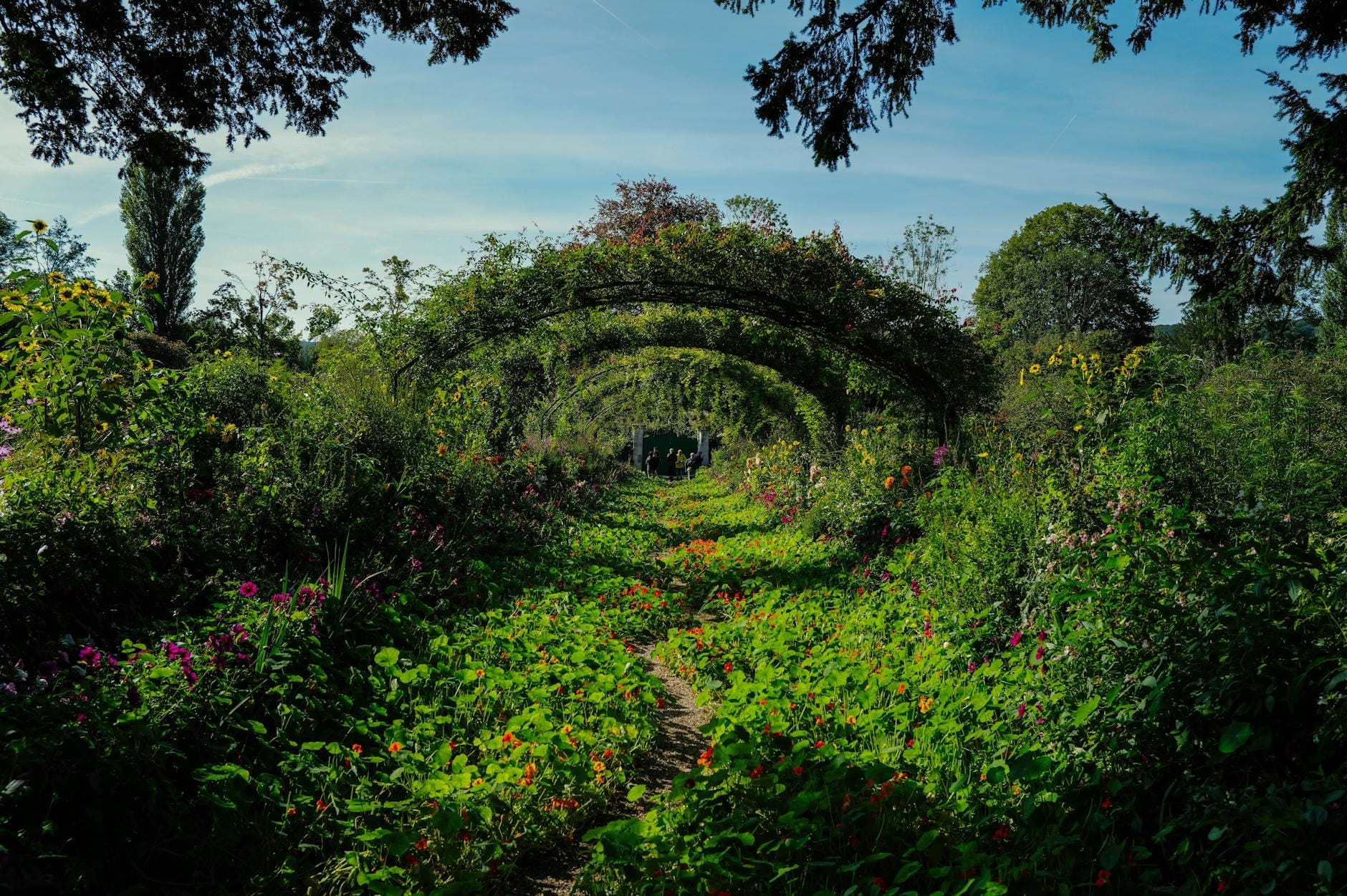
The property comprises two distinct spaces connected by a tunnel under the road. The Clos Normand is the main flower garden directly in front of the pink-rendered house: two hectares of regimented beds spilling over with nasturtiums, dahlias, irises, roses, and foxgloves arranged so that something is always in bloom from April through October. Across the tunnel, the water garden is a quieter, more contemplative space centred on the lily pond, the weeping willows, and the arching green bridge that appears, in some form, in more than 250 of Monet's paintings.
💡 Local tip
Book tickets online before you travel. Giverny is the second most visited tourist attraction in Normandy and timed-entry slots sell out days ahead during peak season (May–June). Walk-up tickets are available on site, but queues can be long on summer weekends.
A Brief History: From Artist's Retreat to Public Landmark
Monet first saw Giverny from a train window in 1883 and rented, then later purchased, the property. He lived and worked here until his death in 1926, a period spanning 43 years. During that time he redesigned the grounds almost entirely to serve as creative raw material, diverting a tributary of the Epte river to create the water garden in 1893 — a project that required permission from local authorities who feared the exotic plants would poison the water supply.
After Monet's death, the property was inherited by his son Michel, who died without children in 1966 and bequeathed it to the Académie des Beaux-Arts. The gardens had fallen into near-total decay by then. What visitors see today is the result of a painstaking restoration begun in the late 1970s, carried out with the help of Monet's own photographs and the recollections of his step-daughter Blanche Hoschedé-Monet. The site reopened to the public in 1980 and has attracted visitors from across the world ever since.
To understand how Giverny fits into Monet's artistic output, it helps to visit the Musée de l'Orangerie in Paris beforehand. The eight enormous Nymphéas panels there — painted in the final decade of Monet's life, largely from memory and failing eyesight — acquire a completely different weight once you have stood on the actual bridge and looked down at the actual pond.
Tickets & tours
Hand-picked options from our booking partner. Prices are indicative; availability and final rates are confirmed when you complete your booking.
Full-Day Trip to Giverny and Claude Monet's House and Gardens from Paris
From 89 €Instant confirmationFree cancellationExcursion to Giverny Monet's Gardens and Versailles Palace with audio guide and lunch
From 199 €Instant confirmationFree cancellationHalf-day trip to Giverny with Monet's House and Gardens from Paris
From 73 €Instant confirmationFree cancellationMonet's House and Gardens ticket and Giverny bike tour from Paris
From 119 €Instant confirmationFree cancellation
The Clos Normand: Colour as Architecture
The Clos Normand greets you the moment you pass through the entrance gate. The layout is formal: a central alley flanked by two parallel borders, with rose-draped arches overhead creating a tunnel of petals in June. But the planting within that framework is deliberately unruly, with taller plants leaning into pathways and ground-level flowers creeping across the gravel. Monet did not want a tidy English garden. He wanted colour masses, and his head gardener today maintains that same philosophy.
Peak bloom in the Clos Normand shifts through the season. April brings tulips and forget-me-nots in drifts of blue, pink, and yellow. By late May and June, alliums, irises, and oriental poppies dominate. Dahlias and sunflowers carry the display through September and into October. If you visit in early April, the water garden will still be sparse and the willow branches bare — beautiful in an understated way, but different from the full summer spectacle.
The house itself, painted in shades of green with pink rendered walls, sits at the far end of the Clos Normand and is included in the admission price. Inside, the rooms are small and densely decorated: the blue-tiled kitchen, the yellow dining room hung with Monet's collection of Japanese woodblock prints by Hiroshige and Hokusai, and the upstairs bedrooms. The house tour takes around 20 to 30 minutes and gives concrete context to the Japanese influence that shaped the water garden's design.
The Water Garden: The Pond You Already Know
The water garden is reached via an underpass beneath the rue Claude Monet — a brief, slightly claustrophobic transition that makes the emergence on the other side feel more dramatic. The pond is smaller than most visitors expect. The water lily leaves crowd the surface from June onward, and the reflection of the arched bridge shifts through the morning as the light angle changes. By 10 am, before the crowds fully arrive, the surface is still and the reflection is nearly perfect. By noon it is gone, broken by foot traffic on the bridge and boats trimming the water plants.
The planting around the pond follows a deliberate sequence: bamboo groves, weeping willows trailing into the water, wisteria cascading over the bridge in May, and water irises at the pond's edge. Monet was specific about the colour palette — predominantly white, mauve, and blue-purple, with the green of the lily pads as the constant anchor. That restraint, after the exuberance of the Clos Normand, is intentional and effective.
ℹ️ Good to know
Photography tip: The Japanese bridge is best photographed in the first hour after opening (10–11 am) or on overcast days, when diffuse light eliminates harsh shadows and gives the surface a mirror-like quality. Midday sun in summer creates strong contrast that often disappoints. A polarising filter, if you shoot with a camera, will cut surface glare significantly.
When to Go: Seasons, Times, and Trade-offs
The gardens are open every year from April 1 to November 1, daily from 10 am to 6 pm (last admission 5:30 pm). Outside this period, the property is closed entirely. Within the season, the experience changes dramatically by month and by hour.
Late May and early June offer the most layered display: the Clos Normand irises overlap with the first roses, and wisteria over the Japanese bridge is at its peak. These are also the most popular weeks, and weekend visitor numbers can make quiet contemplation difficult. If June is your only option, arrive exactly at opening — the half-hour between 10 and 10:30 am, before the tour buses discharge, has a different quality entirely from the 11:30 am to 2 pm window when the site is fullest.
September is underrated. The dahlias and late roses are still strong, the crowds are noticeably thinner, and the light has the lower-angle warmth of early autumn. Water lily coverage is at its maximum in late August and September. October visits are possible but the Clos Normand is winding down; the water garden remains atmospheric right up to closure.
⚠️ What to skip
Giverny is outdoors. On overcast or rainy days the garden loses much of its photographic appeal, though the colours of wet petals can be remarkable. Check the weather forecast for the Vernon-Giverny area specifically — it sits in a river valley and can experience different conditions from central Paris. Wear flat, comfortable shoes: the gravel paths in the Clos Normand are uneven.
Getting There from Paris: Trains, Shuttles, and Timing
The standard route from Paris is a direct train from Paris Saint-Lazare to Vernon-Giverny station, which takes approximately 1 hour 15 minutes. Services run regularly on weekdays, but the schedule is reduced on Sundays — check timetables on the SNCF Connect app before booking. From Vernon station, a shuttle bus runs directly to Giverny during the garden's opening season, taking around 20 minutes. Taxis are also available at the station if you prefer.
By car, the drive from central Paris via the A13 motorway takes roughly 75 minutes in normal traffic and around 90 minutes on a busy weekend morning. There is a paid car park adjacent to the site. Cycling is an alternative for the fit traveller: a marked cycle route (the 'Seine à Vélo') runs from Vernon to Giverny, and bike rentals are available at the station exit under the name Givernon.
If you are combining Giverny with other day trips, note that it pairs naturally with a visit to the medieval town of Vernon itself, or with the wider Normandy region. For more Paris day trip options, see the day trips from Paris guide.
Inside the Visit: Practical Walkthrough
The self-guided visit has no fixed route, but the natural flow leads you from the entrance gate through the Clos Normand to the house, then back through the tunnel to the water garden. Allow 45 to 60 minutes for the flower garden and house, and a further 30 to 45 minutes in the water garden. Rushing through in under an hour is possible but misses the point: the gardens are designed for slow movement and repeated viewing from different angles.
Inner garden alleys are closed to protect the planting beds, so access is via the perimeter and central paths only. The gardens are accessible to visitors with reduced mobility; the house is not wheelchair accessible. Visitors with a disabled card receive priority access via the group entrance on Sente Leroy. Pets, picnics, painting, and drawing are not permitted on the grounds. There is no luggage storage, and large bags are forbidden under France's current Vigipirate security plan.
The restaurant Les Nymphéas, located directly opposite the entrance, serves traditional cuisine and is open throughout the season. For visitors combining Giverny with a full Paris art itinerary, the Musée Marmottan Monet in Paris holds the world's largest collection of Monet's works and makes an excellent companion visit — either before or after the trip to Giverny.
Who Will Love It and Who Should Think Twice
Giverny is genuinely excellent for anyone with an interest in Impressionism, garden design, or photography. Families with children who have a tolerance for walking and looking will find the house interior engaging — the blue kitchen and the Japanese prints tend to capture young attention — though toddlers may struggle with the gravel paths and the instruction not to touch anything.
It is less suited to visitors who are primarily after a quick sightseeing tick. The journey from Paris is around 1.5 hours each way, which makes a round trip from central Paris a full half-day or a full day if you take your time. Those expecting a dramatic or architecturally complex destination may find the site — essentially a house and two gardens — modest relative to the travel investment. The experience rewards patience and prior context; it is not the kind of place that immediately overwhelms.
If you are planning a full itinerary around Impressionist Paris and Normandy, the best museums in Paris guide will help you sequence the key art stops alongside your Giverny visit.
Insider Tips
- Timed entry slots for the busiest weekends in May and June sell out two to three weeks in advance. If you are visiting during peak season, lock in your date online as soon as your travel plans are confirmed.
- The first shuttle from Vernon station fills quickly on summer weekends. Consider arriving on an early train (before 9 am) and waiting at the station rather than scrambling onto the first bus at capacity. There is a café at the station.
- Exit is final — once you leave, you cannot re-enter. Walk through both sections in full before deciding to leave, and save the water garden for the end when the crowd thins slightly in the early afternoon.
- The village of Giverny itself has a handful of small galleries and the Musée des Impressionnismes Giverny, which focuses on American Impressionism. It is a 10-minute walk from Monet's house and worth 45 minutes if you have time after the gardens.
- Free admission is available for certain categories (check the official site for the current list before you go). Students of fine art and art history may qualify for reduced rates.
Who Is Monet's Gardens at Giverny For?
- Art and Impressionism enthusiasts who want to walk through Monet's actual source material
- Photographers seeking painterly garden compositions, especially in early morning light
- Garden and horticulture lovers interested in colour-theory planting at scale
- Couples or solo travellers on a half-day or full-day excursion from Paris
- Travellers combining Paris with wider Normandy sightseeing
Nearby Attractions
Combine your visit with:
- Bois de Vincennes
Covering nearly 1,000 hectares on the eastern edge of Paris, the Bois de Vincennes is the city's largest green space, combining ancient woodland, three lakes, a botanical garden, a world-class zoo, and a medieval royal castle. It rewards both casual afternoon strollers and full-day explorers.
- Château de Fontainebleau
Older than Versailles and used by more French monarchs, the Château de Fontainebleau is a UNESCO World Heritage palace 55 km southeast of Paris. With over 1,900 rooms, free formal gardens, and a manageable crowd count compared to other royal sites, it rewards visitors who make the 40-minute train trip from Paris.
- Château de Vaux-le-Vicomte
Built between 1656 and 1661 for finance minister Nicolas Fouquet, Château de Vaux-le-Vicomte is the largest privately owned château in France. Its formal gardens, gilded state rooms, and extraordinary backstory make it one of the most rewarding half-day trips from Paris.
- Château de Vincennes
Rising at the eastern edge of Paris, Château de Vincennes is one of the most complete medieval royal fortresses in Europe. Home to France's tallest medieval keep and a stunning Gothic chapel, it rewards visitors who venture beyond the tourist centre with centuries of largely undisturbed royal history.