Château de Vincennes: The Medieval Royal Castle Paris Keeps Overlooking
Rising at the eastern edge of Paris, Château de Vincennes is one of the most complete medieval royal fortresses in Europe. Home to France's tallest medieval keep and a stunning Gothic chapel, it rewards visitors who venture beyond the tourist centre with centuries of largely undisturbed royal history.
Quick Facts
- Location
- 1 Avenue de Paris, 94300 Vincennes (eastern edge of Paris)
- Getting There
- Château de Vincennes (Métro Line 1), last stop eastbound; 2-min walk to entrance
- Time Needed
- 1.5 to 2 hours
- Cost
- €13 adult; free for under-18s and EU residents under 26; included in Paris Museum Pass
- Best for
- Medieval history, Gothic architecture, families wanting a real castle experience
- Official website
- www.chateau-de-vincennes.fr/en
What Is Château de Vincennes?
Château de Vincennes is a genuine medieval royal fortress, not a romantic folly or a later reconstruction. Built primarily between 1361 and 1369 under King Charles V, it served as the principal residence of the French crown before Versailles drew the court west in the 17th century. The complex sits at the last stop of Métro Line 1, roughly fifteen minutes from central Paris, yet it draws a fraction of the visitors who queue for the Louvre or Versailles.
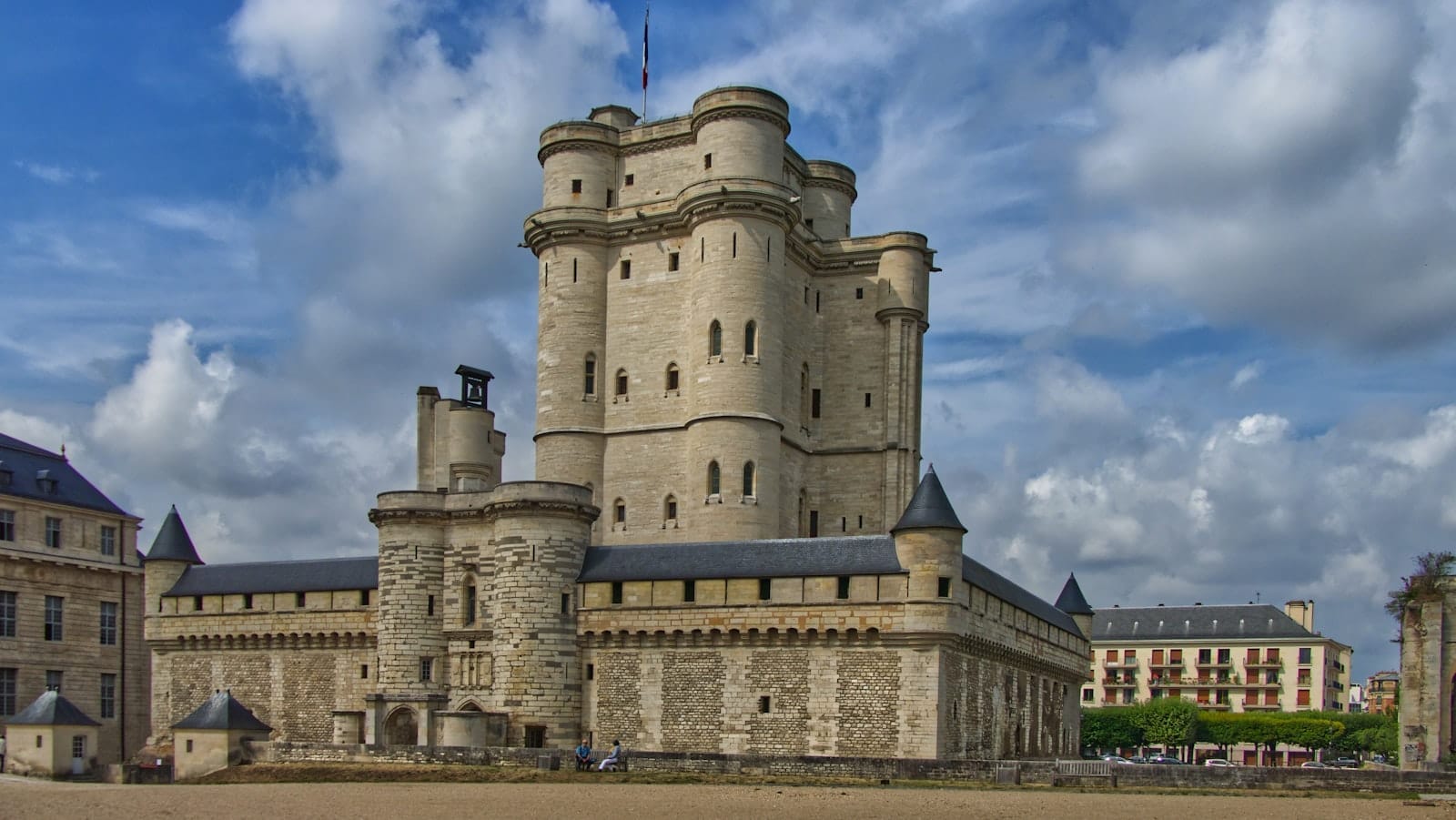
What you see today is largely Charles V's vision: a vast rectangular enclosure bounded by a 1,100-metre fortified wall with nine towers, anchored by the donjon, the great keep that dominates the skyline. The Sainte-Chapelle, begun in 1379 and not completed until 1552, stands at the southern end of the enclosure. The site originated as a 12th-century royal hunting lodge and grew across two centuries of Capetian ambition.
💡 Local tip
Free admission applies on the first Sunday of each month from November through March, and on the third weekend of September (European Heritage Days). EU residents under 26 and all children under 18 enter free year-round on presentation of valid ID.
The Donjon: Europe's Tallest Medieval Keep
At 52 metres, the donjon is the tallest surviving medieval keep in Europe, and the anchor around which the rest of Château de Vincennes organises itself. Up close, the scale is startling in a way photographs don't prepare you for: six storeys of pale limestone rising from a wide dry moat, walls nearly three metres thick at the base.
Each floor documents a different phase of the castle's life. Higher floors tell the story of the keep's role as a state prison, a function shared with the Bastille. Among those held here were the philosopher Denis Diderot in 1749 and the Comte de Mirabeau in 1777. The Duc d'Enghien was executed in the moat in 1804 on Napoleon's orders, an act that shocked the European courts of the time.
The spiral staircase connecting the floors is original medieval stonework: narrow, worn smooth in the centre, lit by arrow-slit windows. Climbing it delivers a tactile sense of the castle's age that no exhibit can replicate. Reach the roof terrace on a clear day and you get an unobstructed panorama across Paris to the west and the forests of the Île-de-France to the east. Morning light works best for the westward view.
⚠️ What to skip
The donjon staircase is steep and narrow with uneven medieval steps. It is not suitable for visitors with significant mobility limitations or anyone uncomfortable with confined spiral ascents.
Tickets & tours
Hand-picked options from our booking partner. Prices are indicative; availability and final rates are confirmed when you complete your booking.
Vincennes Chateau de Vincennes Ticket and In-App Audio Tour
From 20 €Instant confirmationAudioguided visit of Fontainebleau and Vaux le Vicomte
From 105 €Instant confirmationFree cancellation2-Day Excursion to Mont Saint-Michel, Loire Valley Chateaux and Wine Tasting from Paris
From 475 €Instant confirmationFree cancellationPrivate day trip to Vaux-le-Vicomte and Fontainebleau from Paris
From 1.380 €Instant confirmationFree cancellation
The Sainte-Chapelle: Gothic Light Without the Crowds
The Sainte-Chapelle within Château de Vincennes is regularly overlooked even by visitors who know its more famous namesake on the Île de la Cité. That oversight is unwarranted. Consecrated after nearly 175 years of construction, the chapel is a late-Gothic structure of considerable authority: enormous tracery windows fill the nave with light through partially restored 16th-century stained glass.
Without the timed-entry pressure of the city-centre chapel, you can stand beneath the vaulting as long as you like. The window light peaks in late morning when sun enters from the south-facing bays. Photography is permitted throughout. For a comparison of the two chapels, see the full guide to the Sainte-Chapelle on the Île de la Cité.
How the Experience Changes Through the Day
Arrive at opening (10:00) to find the courtyards almost entirely empty. Tour groups rarely appear before 11:00, and in that window the dry moat, the pale limestone keep, and the cobbled enclosure belong almost entirely to you. Low morning light turns the stonework golden. You hear pigeons in the battlements and very little else.
Midday is the busiest period, particularly on weekends and during French school holidays. The open-air courtyards offer little shade in summer; bring water if visiting between June and August. There is no café inside the enclosure, but Vincennes town has bakeries and cafés within a few minutes' walk of the main entrance on Avenue de Paris.
Late afternoon brings a second quiet window. Slanted light catches the texture of the fortified wall and towers in ways flat midday light cannot. Closing runs seasonally: 18:00 from late May to late September, 17:00 the rest of the year. Arriving ninety minutes before closing allows comfortable time for both the keep and the chapel.
After your visit, the Bois de Vincennes starts just beyond the castle's eastern perimeter. France's largest urban park offers lake walks, a Buddhist temple, and the Parc Floral, a practical and quiet extension to the day.
Getting There and Tickets
Métro Line 1 runs directly to the Château de Vincennes terminus from central Paris in roughly 15 minutes. Turn right out of the station onto Avenue de Paris; the castle entrance is less than 200 metres ahead and visible immediately. No mapping app required.
Adult tickets cost €13 and can be bought at the on-site ticket window or online. The castle is included in the Paris Museum Pass. Under-18s enter free regardless of nationality; EU residents aged 18 to 25 enter free with valid ID. Guided tours in French run regularly; English-language tours are available on selected dates. Check the official site for current schedules.
The ground-level enclosure and chapel are accessible for visitors with reduced mobility; the donjon interior is not. For context on whether the Museum Pass makes financial sense for your trip, see the Paris Museum Pass guide. To build the castle into a wider schedule, the 3-day Paris itinerary places it well on a day combining eastern Paris monuments.
Why the Castle Survived and What That Means for Visitors
Unlike many French royal properties, Château de Vincennes survived intact largely because it transitioned into military use. A garrison meant ongoing maintenance rather than neglect or demolition for building materials. Prosper Mérimée initiated restoration in the 19th century, and Viollet-le-Duc, who also worked on Notre-Dame and Carcassonne, contributed to subsequent conservation. The result is a medieval complex in better structural condition than almost any comparable site in Europe.
The castle carries direct biographical weight. Henry V of England died here in 1422, at a moment when he controlled much of France. Charles IX died here in 1574. Louis XIV spent part of his childhood at Vincennes before Versailles was built, and the two sites sit at opposite ends of French royal history: Vincennes is the medieval fortress that preceded everything, Versailles the baroque showpiece that replaced it.
Pairing Vincennes with Versailles or Château de Fontainebleau on separate days builds a coherent picture of how French royal architecture evolved across five centuries. For anyone interested in the deeper story of Paris's monuments, this is one of the most instructive comparisons available in the region.
Who Should Reconsider
Visitors expecting gilded salons and the decorative richness of Versailles will not find that at Château de Vincennes. This is a military fortress first, and its interiors are deliberately austere: stone walls, solid vaulting, purposeful spaces. If ornate decoration is the priority, Versailles or the Musée Jacquemart-André will serve you better.
Travellers with only one day in Paris may also find the journey hard to justify against competing priorities closer to the centre. For anyone with two days or more and an appetite for French history beyond the obvious monuments, however, Vincennes makes a compelling case for the detour.
Insider Tips
- Combine Château de Vincennes with the Bois de Vincennes in a single half-day. After the castle, walk east through the park to Lac Daumesnil, a 15-minute walk with a distinctly un-touristy atmosphere.
- Métro Line 1 connects Vincennes directly to the Louvre, Champs-Élysées, and Place de la Bastille, making it easy to build a thematic east-west royal itinerary across the city in a single day.
- For the best roof terrace views from the donjon, visit on a clear morning in spring or autumn. Summer haze can reduce visibility significantly across the Paris basin.
- European Heritage Days (third weekend of September) offer free entry and often include access to areas not normally open to the public, such as parts of the royal apartments.
- The audio guide available at the ticket desk is worth taking. The castle's layered history from royal residence to prison to porcelain factory to garrison is difficult to read from the architecture alone without contextual narration.
Who Is Château de Vincennes For?
- History enthusiasts wanting a serious medieval monument without the Versailles crowds
- Architecture-focused travellers interested in Gothic military construction and 19th-century restoration
- Families looking for a castle experience that genuinely feels like a castle, with a real moat and tower climb
- Museum Pass holders looking to maximise value on a quieter half-day excursion
- Visitors pairing the castle with a walk or picnic in the Bois de Vincennes
Nearby Attractions
Combine your visit with:
- Bois de Vincennes
Covering nearly 1,000 hectares on the eastern edge of Paris, the Bois de Vincennes is the city's largest green space, combining ancient woodland, three lakes, a botanical garden, a world-class zoo, and a medieval royal castle. It rewards both casual afternoon strollers and full-day explorers.
- Château de Fontainebleau
Older than Versailles and used by more French monarchs, the Château de Fontainebleau is a UNESCO World Heritage palace 55 km southeast of Paris. With over 1,900 rooms, free formal gardens, and a manageable crowd count compared to other royal sites, it rewards visitors who make the 40-minute train trip from Paris.
- Château de Vaux-le-Vicomte
Built between 1656 and 1661 for finance minister Nicolas Fouquet, Château de Vaux-le-Vicomte is the largest privately owned château in France. Its formal gardens, gilded state rooms, and extraordinary backstory make it one of the most rewarding half-day trips from Paris.
- Cité des Sciences et de l'Industrie
France's largest science and technology museum sits inside a landmark glass-and-steel building at the northern edge of Parc de la Villette. With interactive permanent galleries, a digital planetarium, an Argonaute submarine, and dedicated children's spaces, it rewards a solid half-day and punches well above the expectations of a typical museum visit.