Sacré-Cœur Basilica: What to Know Before You Climb Montmartre Hill
The Basilique du Sacré-Cœur de Montmartre is one of Paris's most recognizable landmarks, rising above the city on the summit of the Butte Montmartre. Entry to the basilica is free and it stays open until 10:30 PM, making it one of the few major Parisian monuments you can visit at dusk. The views from the forecourt alone justify the climb.
Quick Facts
- Location
- 35 Rue du Chevalier de la Barre, 75018 Paris (Montmartre, 18th arrondissement)
- Getting There
- Métro line 2: Anvers station (~10 minutes walk including stairs, or take the Funiculaire de Montmartre)
- Time Needed
- 45–90 minutes for the basilica; add 30 minutes if climbing the dome
- Cost
- Basilica entry is free; dome visit requires a contribution (check on-site ticket office for current rates)
- Best for
- Architecture lovers, panoramic views, early-morning quiet, evening atmosphere
- Official website
- www.sacre-coeur-montmartre.com/en
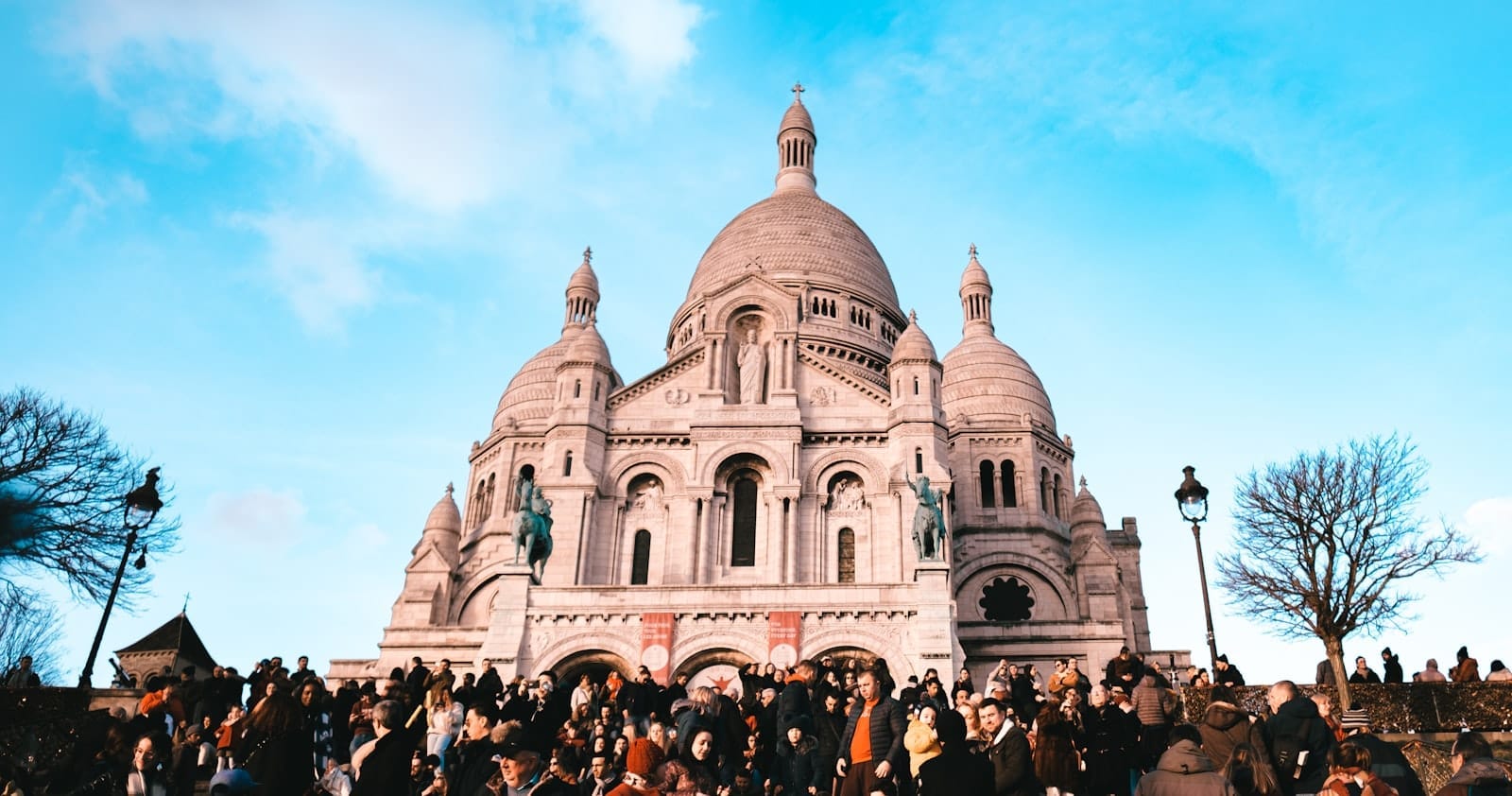
What Sacré-Cœur Actually Is
The Basilique du Sacré-Cœur de Montmartre stands at the summit of the Butte Montmartre, the highest natural point in Paris at roughly 130 metres above sea level (about 80 metres above the Seine). From the forecourt, the city unfolds in every direction: from La Défense on the western horizon to the faint outline of the Bois de Vincennes to the east. The Eiffel Tower appears small and almost incidental from here, which gives you a sense of just how central this hill is to the city's geography. For more on how to fit this into a wider trip, see our 3-day Paris itinerary.
The basilica is a Roman Catholic minor basilica, not a cathedral, a distinction that matters architecturally. It was built as a votive church, a collective act of religious expiation following France's defeat in the Franco-Prussian War of 1870–71 and the upheaval of the Paris Commune. The National Assembly voted to construct it in 1873, the foundation stone was laid that same year, and construction began in 1875. The basilica was not completed until 1914, and consecration was delayed by World War I until 1919, meaning the building spans nearly half a century of French history in its stones.
ℹ️ Good to know
The basilica is open daily from 6:30 AM to 22:30 (10:30 PM) with no admission charge. Dress modestly: shoulders and knees should be covered. Bags may be checked at the entrance.
The Architecture: Romanesque-Byzantine in White Stone
Architect Paul Abadie won the design competition from nearly 80 entrants with a Romanesque-Byzantine scheme that owes more to the Périgueux cathedral and the churches of Constantinople than to anything typically Parisian. The result is deliberately foreign-looking: multiple domes, rounded arches, and a pale, almost luminous exterior that sets it apart from the Gothic grey of Notre-Dame or the classical limestone of the Panthéon.
That whiteness is not maintenance, it is chemistry. The facade is built from travertine stone quarried at Château-Landon and Souppes-sur-Loing, both in the Seine-et-Marne. This particular travertine releases calcite when it rains, which continuously bleaches the surface, meaning the building actually self-cleans and stays whiter as it ages. After more than a century of Paris weather, it is brighter now than when it was first completed.
The central dome reaches 83 metres (272 feet) and can be climbed via a narrow staircase of approximately 280 steps. There is no elevator. The climb is not for those with mobility difficulties, a fear of confined spaces, or very young children, but for those who manage it, the 360-degree panorama from the top is one of the genuinely elevated views of Paris, distinct from the Eiffel Tower perspective because you are looking across rooftops rather than down through iron lattice.
💡 Local tip
Dome visits run from 10:30 AM to 8:30 PM (last admission 8:00 PM), but check the official website the morning of your visit — the dome closes occasionally for maintenance or in bad weather.
Tickets & tours
Hand-picked options from our booking partner. Prices are indicative; availability and final rates are confirmed when you complete your booking.
Sacre Coeur and Montmartre self-guided audio tour
From 4 €Instant confirmation2-hour Montmartre Hill and Sacre-Coeur guided walking tour
From 50 €Instant confirmationFree cancellationParis Essential dinner cruise at 6.15pm
From 99 €Instant confirmationFree cancellationEiffel Tower reserved elevator entrance to 2nd floor with walking tour and Seine cruise
From 94 €Instant confirmationFree cancellation
Inside the Basilica: The Mosaic and the Bell
The interior rewards a slower look than most visitors give it. The great apse mosaic, designed by Luc-Olivier Merson, is the largest in France at 473.78 square metres. It depicts Christ in Majesty flanked by the Virgin Mary, Joan of Arc, and various saints, rendered in deep gold, crimson, and cobalt. The scale only becomes apparent when you stand directly beneath it and trace the individual tile lines.
Beneath the main floor, the crypt houses the tombs and is open to visitors. The great organ, one of the finest instruments in France, is currently undergoing restoration work expected to continue through the end of 2026. During this period, musical celebrations are accompanied by the choir organ rather than the full instrument.
In the bell tower hangs the Savoyarde, the largest bell in France. Cast in 1895, it measures 3 metres in diameter and weighs 18,835 kilograms. You will not see it during a standard visit, but on feast days and solemn occasions, its deep resonance carries well beyond the hill. If you are in Montmartre on a Sunday morning and hear something low and sustained beneath the street noise, that is it.
How the Experience Changes Through the Day
Early morning is the most rewarding time to visit. Between 6:30 AM and 8:00 AM, the forecourt is nearly empty. The city below is quiet, the light is pale and horizontal, and the stone turns from grey to cream as the sun rises over the eastern arrondissements. At this hour, the interior is used for genuine prayer, the candles are freshly lit, and the smell of incense is noticeable from the doorway. You are a visitor in someone else's ritual space, and that context changes how you look at the mosaics.
By mid-morning the crowds arrive steadily. The steps of the Sacré-Cœur become a social space: groups eating baguettes, artists working on small canvases, people photographing the view. It does not thin out significantly until after 6 PM. The late evening window, from around 7 PM to closing at 10:30 PM, is consistently underrated. The city lights below, the floodlit dome above, and a noticeably smaller crowd make for a completely different visit from the tourist-peak afternoon.
Rain changes the calculus. Light rain actually improves the appearance of the stone, intensifying the white. Heavy rain drives crowds off the steps and into the basilica itself, where the interior feels more intimate. The view from the forecourt in light rain, with wet stone and city lights smeared across the horizon, is among the more atmospheric sights Paris offers.
Getting There: The Climb and the Funicular
Take Métro line 2 to Anvers station. From the exit, the walk to the basilica entrance takes roughly 10 minutes, but it involves a significant ascent: either the long staircase of the Rue Foyatier or the winding streets of the neighborhood above. The Funiculaire de Montmartre offers a cable-car alternative from the base of the hill directly to the terrace level near the entrance — it runs on a standard Paris transport ticket (Navigo pass or individual ticket). For more detail on getting around the city, see our guide on getting around Paris.
From the Abbesses Métro station (line 12), the approach through the streets of Montmartre is more scenic and passes through the residential and artistic core of the neighborhood. It takes about 15 minutes on foot but is the route that gives you the most context. The surrounding streets, particularly around the Place du Tertre, are worth exploring as part of a longer visit to Montmartre.
⚠️ What to skip
The area around the steps and the Anvers Métro exit is a known pickpocket zone. Keep bags closed and in front of you, especially when stopping to look at the view. Ignore anyone approaching with a string bracelet or clipboard petition.
Historical and Political Context Worth Knowing
Sacré-Cœur was not built in a political vacuum, and understanding its origins makes it more interesting to visit. The French National Assembly voted to construct it as an act of national penitence after the traumatic defeat by Prussia in 1870–71 and the bloody suppression of the Paris Commune in 1871, when the French Army killed an estimated 10,000 to 30,000 Communards, many of them in Montmartre itself. The decision to place a church of expiation on this hill was read by many Parisians at the time as a conservative Catholic monument planted on the ground where the radical insurrection had been most intense. The debate around it was fierce.
That political charge has mostly faded for modern visitors, but knowing it sharpens the experience. The building is not simply decorative; it was designed to mean something specific at a particular moment of national crisis. Whether that meaning was appropriate is a question the French themselves have argued over for 150 years. Walking into the basilica with that context in mind, you see the votive candles and the adoration differently.
Practical Notes for Your Visit
Sacré-Cœur is an active place of worship with perpetual Eucharistic adoration maintained since 1885. Silence and respectful behavior are expected inside. Photography inside the basilica is restricted, though the exterior and forecourt are free to photograph. The forecourt is one of the best photo spots in Paris for wide city panoramas, particularly in the early morning or at blue hour before sunset.
There are no restrooms inside the basilica or at the dome. Public facilities are available in the surrounding streets and near the Anvers Métro station. The basilica itself is not wheelchair accessible at the dome or the crypt, though the main nave is reachable. For a broader list of viewpoints across the city, see our guide to the best views in Paris.
Visiting Sacré-Cœur pairs naturally with the rest of Montmartre: the Place du Tertre, the Musée de la Vie Romantique, the vineyards of Montmartre, and the Moulin Rouge at the foot of the hill. If you are combining it with other major sites, consider whether the Paris Museum Pass is worth it for your itinerary, though note that Sacré-Cœur itself does not require a ticket.
💡 Local tip
If you are visiting Paris in spring or autumn, late afternoon light hits the western face of the basilica directly, turning the travertine a warm amber that photographs very differently from the flat midday white. Plan for a return visit at different hours if you can.
Insider Tips
- The wooden pews inside fill up fast during Sunday morning Mass (10:30 AM is the main liturgy). Arrive early if you want to observe the service with a seat, or come right as it ends to have the nave to yourself for a few minutes before the next wave of tourists enters.
- The steep western staircase (Rue Foyatier) that most visitors climb leads directly to the forecourt, but the gentler Rue Lamarck approach from the north lets you avoid the majority of souvenir sellers and arrive without the crowd pressure.
- The forecourt is one of the few open elevated spaces in Paris where you can legally drink a picnic wine while watching the sunset. Bring supplies from the shops in the streets below, not from the vendors near the top who charge a significant premium.
- For the clearest photographs of the basilica from below, the small park at Square Louise Michel at the foot of the funicular frames the dome cleanly. Early morning gives you the shot without other visitors in frame.
- The crypt, accessed from inside the basilica, is frequently overlooked by visitors hurrying to the dome. It is quiet, cool, and contains a small permanent exhibition on the construction history of the building.
Who Is Sacré-Cœur Basilica For?
- Architecture enthusiasts interested in Romanesque-Byzantine design and French religious building history
- Travelers who want a high panoramic view of Paris without paying admission — the forecourt view is free
- Early-morning visitors seeking a calm, atmospheric Paris experience before the crowds build
- Those spending a half-day in Montmartre who want to combine a cultural monument with neighborhood exploration
- Evening visitors looking for a dramatically floodlit landmark that stays open until 10:30 PM
Nearby Attractions
Other things to see while in Montmartre:
- Moulin Rouge
Open since 1889, the Moulin Rouge is the home of the French cancan and one of Paris's most theatrical nights out. The Féerie revue features 80 performers, 1,000 costumes, and nearly two hours of spectacle at the foot of Montmartre.