Moulin Rouge: Inside Paris's Most Iconic Cabaret
Open since 1889, the Moulin Rouge is the home of the French cancan and one of Paris's most theatrical nights out. The Féerie revue features 80 performers, 1,000 costumes, and nearly two hours of spectacle at the foot of Montmartre.
Quick Facts
- Location
- 82 Boulevard de Clichy, 75018 Paris (Montmartre)
- Getting There
- Blanche (Line 2) — directly across the street
- Time Needed
- 2–4 hours (show only: ~1h45m; dinner-show: ~4h)
- Cost
- Show + champagne from €98; dinner-show from €205. Verify current pricing on moulinrouge.fr.
- Best for
- Couples, first-time visitors, special occasion evenings
- Official website
- www.moulinrouge.fr/en/homepage
What the Moulin Rouge Actually Is
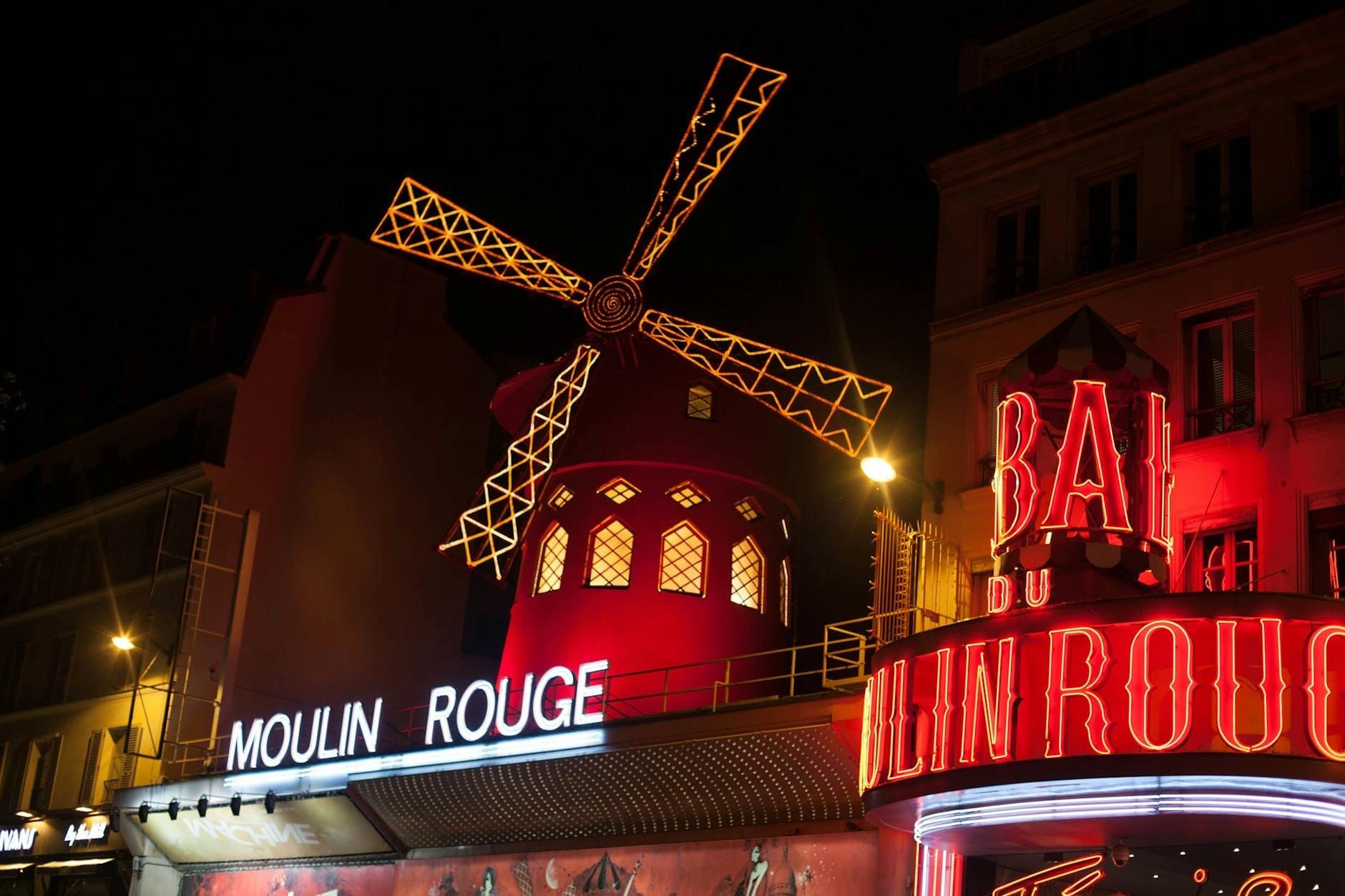
The Moulin Rouge is not a museum or a historical relic that trades on nostalgia. It is a working cabaret that has staged nightly performances since it opened in 1889, and it remains the most internationally recognized entertainment venue in Paris. The famous red windmill on the roof of 82 Boulevard de Clichy glows above the street long before you reach it, visible from the top of the hill in Montmartre and marking the point where the 18th arrondissement meets the Boulevard de Clichy.
The current show, Féerie, has been running since 1999 and features around 80 performers: the Doriss Girls (the venue's international dance troupe), acrobats, illusionists, and specialty acts from across Europe. The production deploys roughly 1,000 costumes sewn with feathers, sequins, and rhinestones across sets designed to fill every surface of the stage. The running time is approximately one hour and 45 minutes.
💡 Local tip
Book at least 2–3 weeks ahead for weekends and 4–6 weeks for high season (April–September and December). The Moulin Rouge sells out regularly, and last-minute box office tickets are rare.
The History Behind the Red Windmill
The Moulin Rouge opened on 6 October 1889, the same year the Eiffel Tower was inaugurated, in a Montmartre that was then a working-class neighborhood on the edge of the official city limits. Co-founded by Charles Zidler and Joseph Oller, the venue was designed to be deliberately provocative: a place where Parisian bourgeoisie could mix with artists, bohemians, and entertainers under conditions of calculated excess.
It was here that the French cancan was formalized into the high-kicking choreography now recognized globally. Performers like La Goulue became the first cabaret celebrities, their likenesses captured in the lithograph posters of Henri de Toulouse-Lautrec, who spent years sketching from ringside tables. The building burned down in 1915 and was rebuilt in its current form. A superstition maintained by every director since 1962 holds that each show's title must begin with the letter F: Frou-Frou, Frisson, Femmes, Formidable, and now Féerie.
Tickets & tours
Hand-picked options from our booking partner. Prices are indicative; availability and final rates are confirmed when you complete your booking.
Dinner cruise, 2nd floor Eiffel Tower and Moulin Rouge Show
From 265 €Instant confirmationFree cancellationInteractive bus tour of Paris and dinner-show at the Moulin Rouge
From 260 €Instant confirmationFree cancellationInteractive bus tour of Paris and ticket for the show at Moulin Rouge
From 178 €Instant confirmationEdith Piaf exploration game and music tour in Paris
From 10 €Instant confirmationFree cancellation
What to Expect the Night of Your Visit
Boulevard de Clichy at dusk is one of Paris's more charged streetscapes. By 8 pm, the pavement in front of the venue fills with people checking booking confirmations and being photographed in front of the illuminated windmill. Taxis arrive in sequence. The air smells of exhaust and, depending on the season, chestnuts from a street vendor near the Metro exit.
Inside, the salle seats roughly 850 people at tiered tables curving toward a wide, deep stage. Seating is assigned and allocated on a first-booked basis: the earlier you reserve, the closer to the stage you are likely to sit. Each place comes with a half-bottle of champagne included in the base price. The Féerie show opens immediately with the cancan ensemble and moves through aquatic numbers (in a tank built into the stage floor), aerial acts, illusion sequences, and comedy pieces, all backed by a live pit orchestra.
ℹ️ Good to know
Photography is permitted during the cancan finale only. For the rest of the show, phones and cameras must be put away. Ushers enforce this throughout the performance.
Show-Only vs. Dinner-Show: Which to Choose
The show-only option starts at 9 pm, runs to approximately 10:45 pm, and is priced from €98 per person including champagne. On Fridays and Saturdays a second show runs at 11 pm. Doors for the 9 pm show open around 8 pm. The dinner-show begins at 7 pm with a three or four-course meal served before the 9 pm performance; prices start at around €205 (three courses) and €235 (four courses), each with a half-bottle of champagne. A live orchestra plays during dinner.
An honest note: the dinner is competent rather than remarkable. Many visitors eat beforehand at a restaurant in the neighborhood or in the Opéra district, then attend the show-only option. This is the more economical and gastronomically satisfying route.
Getting There and Practical Details
The nearest Metro station is Blanche on Line 2, directly across the street. Pigalle (Lines 2 and 12) is a five-minute walk east. Buses 30, 54, 68, 74, and 95 all serve the area. Arrive at least 30 minutes before your scheduled time, 45 to 60 minutes for the dinner-show, as security checks can be slow on busy nights. The dress code is smart-casual: no trainers, shorts, or sportswear. The Moulin Rouge is clear about this on booking confirmations and will turn guests away at the door.
Wheelchair access and reduced-mobility seating is available; contact reservation@moulinrouge.fr or +33 1 53 09 82 82 in advance. The venue is closed on select public holidays including 1 January, 1 May, 14 July, and 25 December — verify your specific date with the venue before booking.
⚠️ What to skip
The Moulin Rouge is not covered by the Paris Museum Pass or any city discount card. There are no student, senior, or family discounts.
The Exterior and the Neighborhood
The facade is one of the most photographed spots in the 18th arrondissement. You do not need a ticket to stand outside and photograph it. The best time is between 8:30 pm and 10 pm when the illumination is at full brightness. For a wider shot, stand near the Blanche Metro entrance; for a tighter frame on the windmill blades, move directly below. The Sacré-Cœur Basilica is a 15-minute walk uphill, and combining both is a natural evening circuit through Montmartre.
If the Moulin Rouge exceeds your budget but the cancan era interests you, the permanent collections at the Musée d'Orsay hold significant works by Toulouse-Lautrec and his contemporaries, placing the venue's cultural moment in full context.
Is It Worth Your Evening?
As a theatrical production, the Féerie show is technically excellent: choreography is tight, staging is large-scale, and the energy is sustained throughout. As a cultural experience, it is one of the few places in Paris where the performing arts tradition of the Belle Époque remains alive as entertainment rather than reconstruction. For a first visit to Paris or a special occasion, it is a genuinely memorable evening.
That said, the Moulin Rouge is one of the most heavily trafficked tourist experiences in the city. Tables are close together, the room is loud, and the atmosphere is unapologetically commercial. Visitors who prefer intimate venues or spontaneous nightlife will find it alienating. For broader context on building an evening around the show, see the 3-day Paris itinerary or the full guide to things to do in Paris.
Insider Tips
- Book directly through moulinrouge.fr to avoid third-party markups and confirm seating quality. Unofficial resellers offer no guarantee on seat placement.
- The 11 pm show on Fridays and Saturdays draws a smaller, later-night crowd with better seat availability closer to the date — and a noticeably different atmosphere from the 9 pm show.
- Seating is allocated in booking order. If your group exceeds six people, call the reservations line directly rather than booking online to confirm joined tables.
- For the clearest exterior photograph with minimal crowd in the foreground, arrive by 7:30 pm on a weekday. Weekend pavements are dense from 8 pm onwards.
- The streets immediately north of the venue lead quickly into quiet residential Montmartre; the streets south along Rue Pigalle are livelier for a pre-show or post-show drink.
Who Is Moulin Rouge For?
- First-time visitors to Paris wanting a landmark evening
- Couples celebrating anniversaries or special occasions
- Travelers interested in the performing arts culture of Belle Époque Paris
- Groups looking for a structured, high-energy shared event
- Anyone who appreciates large-scale theatrical choreography and production design
Nearby Attractions
Other things to see while in Montmartre:
- Sacré-Cœur Basilica
The Basilique du Sacré-Cœur de Montmartre is one of Paris's most recognizable landmarks, rising above the city on the summit of the Butte Montmartre. Entry to the basilica is free and it stays open until 10:30 PM, making it one of the few major Parisian monuments you can visit at dusk. The views from the forecourt alone justify the climb.