Parc de la Villette: Paris's Most Ambitious Park (And Why It Rewards Exploration)
Parc de la Villette is a 55.5-hectare post-industrial landscape in northeast Paris where a former slaughterhouse became one of Europe's most inventive public spaces. Designed by architect Bernard Tschumi, it combines serious cultural institutions with free open-air lawns, canal paths, children's playgrounds, and a summer cinema. Entry to the park itself is free, making it one of the best-value days out in the city.
Quick Facts
- Location
- 211 Avenue Jean Jaurès, 75019 Paris (19th arrondissement)
- Getting There
- Porte de la Villette (Métro line 7) or Porte de Pantin (Métro line 5)
- Time Needed
- 2–5 hours (or a full day with ticketed attractions)
- Cost
- Park entry free; Cité des Sciences from €12 (adults), La Géode extra; children's playgrounds free
- Best for
- Families, architecture fans, science lovers, picnic afternoons, outdoor concerts
- Official website
- www.lavillette.com/en
What Is Parc de la Villette?
Parc de la Villette is the third-largest park in Paris, covering 55.5 hectares (137 acres) in the 19th arrondissement on the northeastern edge of the city. Unlike the formal French gardens around the Louvre or Luxembourg, this is not a park of sculpted hedgerows and symmetrical fountains. It is a deliberately intellectual landscape, designed between 1984 and 1987 by Swiss architect Bernard Tschumi on land that had previously housed the city's main abattoir and livestock market, one of the largest in the world at its peak. The transformation from industrial site to cultural campus is one of the more radical reinventions in modern European urban planning.
Tschumi's design, which won an international competition in 1983, is built around a theory of deconstructivism: the idea that architecture should challenge familiar expectations rather than fulfil them. Across the park, 26 identical bright-red steel structures called 'folies' punctuate the landscape at regular 120-metre intervals, each adapted for a different use: a café, a children's workshop, an information point, a lookout tower. They are simultaneously playful and strange, and deliberately so. The Canal de l'Ourcq cuts through the middle of the site, adding a reflective waterway that links the park to the broader canal network of northeast Paris.
ℹ️ Good to know
The park is open daily from 5:30am to 1am (hours vary seasonally). Entry is free for all visitors. Individual venues inside (Cité des Sciences, La Géode, Philharmonie de Paris) have their own ticketing and opening hours — check each one before your visit.
The Lay of the Land: How the Park Is Organised
First-time visitors are often surprised by how non-park-like parts of La Villette feel. There are wide paved plazas, geometric covered walkways, and exhibition spaces alongside the grassy areas. The site is loosely divided into a northern sector, dominated by the Cité des Sciences et de l'Industrie, and a southern sector, anchored by the Grande Halle de la Villette and the Philharmonie de Paris. The Canal de l'Ourcq runs east-west between them, and a long covered walkway called the 'galerie de la Villette' connects the two halves, useful on wet days.
The grassy 'prairies', ten themed lawns scattered across the park, are where most Parisians actually spend their time. Prairie du Triangle near the southern entrance fills with families on weekend afternoons; Prairie de la Fontaine aux Lions draws picnickers in summer. These are not manicured lawns you hesitate to step on: they are worn, well-used green spaces with the comfortable shabbiness of a park that is genuinely lived in. For context on how this fits into the broader park landscape of Paris, see the best parks and gardens in Paris guide.
Tickets & tours
Live prices and dates from our booking partner. If you book, we may earn a commission at no extra cost to you.
Parc Asterix Ticket with round-trip transport from Paris
From 112 €Instant confirmationFree cancellationRound-trip transportation from Paris to Parc Asterix
From 52 €Instant confirmationFree cancellationRound-trip transportation from Paris to Parc Asterix
From 52 €Instant confirmationFree cancellationParc Asterix ticket with round-trip transport from Paris
From 112 €Instant confirmationFree cancellation
The Major Attractions Inside the Park
Cité des Sciences et de l'Industrie
The northern end of the park is defined by the Cité des Sciences et de l'Industrie, one of Europe's largest science museums. The building itself, designed by Adrien Fainsilber and opened in 1986, is worth attention before you even buy a ticket: a steel-and-glass structure that incorporates water moats, greenhouse domes, and natural light in ways that were startlingly forward-thinking for its era. Inside, the permanent exhibitions cover space, life sciences, mathematics, and technology at a level that genuinely engages adults alongside children. Full-price adult entry costs €12, with reduced rates available. A separate ticket is required for Cité des Sciences exhibitions, and the museum is closed on Mondays.
Adjacent to the museum, La Géode is the unmistakable mirrored sphere sitting on a shallow pool of water. It houses a hemispherical IMAX cinema with one of the largest screens in France. The reflection it casts across the water in morning light is one of the more photographed images in the park. Screenings tend to be nature documentaries and immersive films; check the programme in advance as sessions sell out, especially on weekends.
Philharmonie de Paris
At the southern edge of the park, the Philharmonie de Paris, designed by Jean Nouvel and opened in 2015, is one of the city's most important concert halls and one of its most architecturally discussed buildings. The pixelated aluminium facade shifts between silver and grey depending on the light and angle, and is striking from across the lawn. The Philharmonie hosts the Orchestre de Paris as its resident ensemble and presents a full calendar of classical, jazz, and world music. Even if you are not attending a concert, the building's public terrace offers one of the better elevated views over the park. Check the Philharmonie de Paris programme before your visit, as same-day tickets are sometimes available at reduced prices.
Grande Halle de la Villette
The Grande Halle is a 19th-century cast-iron market hall that was part of the original abattoir complex and one of the few structures preserved from the site's industrial past. The bones of the building, soaring iron arches and original riveted frames, are visible from inside. Today it functions as a major event venue for concerts, trade fairs, and the annual Villette Sonique music festival. Its scale is impressive, and it is worth walking through even when no event is on, simply to appreciate the engineering of the original structure.
How the Park Changes Through the Day
Arrive before 9 am on a weekday and the park belongs to joggers and dog walkers. The canal path running along the Canal de l'Ourcq is a serious running route for local residents, and you will share the wide promenades almost entirely with people in trainers. The folies cast long shadows across the empty plazas and the Géode's reflection sits undisturbed on its pool. This is the best time to photograph the architecture without crowds in the frame.
By mid-morning the science museum fills with school groups, particularly from Tuesday to Friday. The queues at the Cité des Sciences ticket windows can be substantial by 10 am. If visiting with children, book tickets online in advance and arrive at opening time. The prairies start to fill from around noon, when Parisians arrive with supermarket bags, blankets, and sometimes portable speakers. On summer afternoons, the large lawns have the energy of a low-key outdoor gathering without the admission price.
Evenings shift the atmosphere considerably. The Philharmonie's concert schedule draws a dressed-up crowd from across the city. In summer, the Cinéma en Plein Air festival sets up on the Prairie du Triangle: screenings happen after dark and tickets are cheap, with films projected on a large inflatable screen while the audience lies on rented deck chairs or their own blankets. This is one of the more genuinely enjoyable outdoor cultural events Paris offers every year.
💡 Local tip
For summer outdoor cinema (Cinéma en Plein Air), arrive 45 minutes early to secure a good spot on the lawn. Bring a blanket regardless of the daytime temperature — evenings cool quickly in Paris, even in July.
Walking the Canal and the Folies
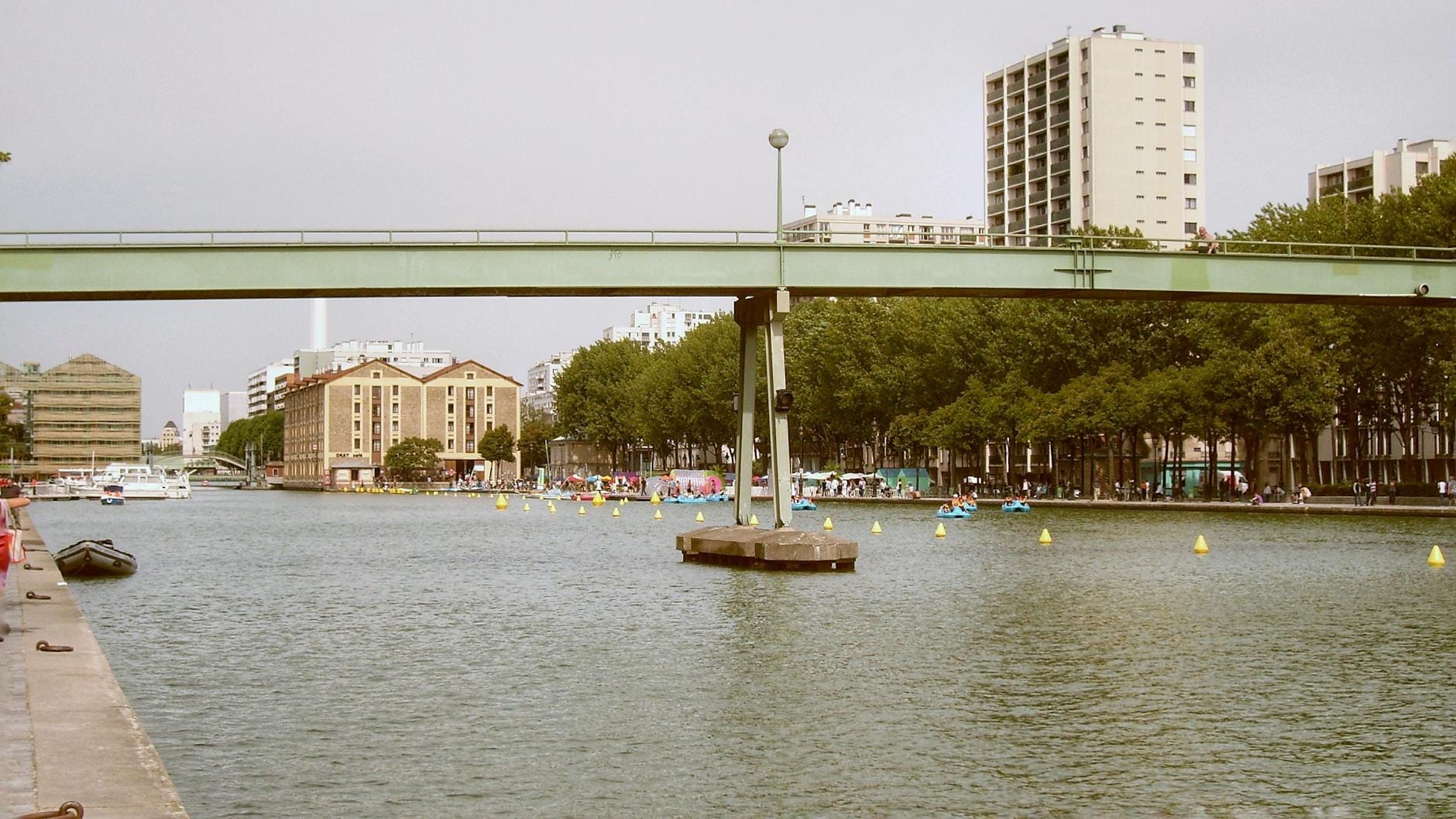
One of the more underused pleasures of La Villette is simply walking the canal path east along the Canal de l'Ourcq, which continues beyond the park into the working-class neighbourhoods of northeast Paris. Within the park, the canal is lined with houseboats and the occasional floating bar-barge; the reflections of the surrounding buildings make it particularly appealing in late afternoon. The Canal de l'Ourcq continues east into neighbourhoods most tourists never reach, offering a quieter counterpoint to the busier Canal Saint-Martin to the southwest.
The folies reward a deliberate circuit. Because they look identical from a distance, bright red, cubic, three storeys tall, it is easy to walk past them without noticing the individual adaptations. Folie R2 near the Porte de la Villette entrance houses a café; others contain children's activity spaces, first-aid points, or simply remain open as covered shelters. The theory behind them was that they should be 'pure signifiers' without predetermined meaning, which in practice means some are more useful than others.
Practical Information and Getting There
The easiest approach is by Métro line 7 to Porte de la Villette, which deposits you directly at the northern entrance beside the Cité des Sciences. Line 5 to Porte de Pantin brings you to the southern entrance near the Philharmonie. Both journeys take under 25 minutes from central Paris. There is no significant advantage to one entrance over the other: choose based on which attraction you are prioritising.
The park is broadly accessible: the main paths are wide and flat, though some grass areas are uneven. Pushchairs and wheelchairs navigate the paved sections without difficulty. Cyclists are welcome on the main paths, and the Canal de l'Ourcq towpath connects to a wider cycling network across northeast Paris. For a broader sense of how to move around Paris by public transport and bike, the getting around Paris guide covers the essentials.
Weather matters more here than at most Paris attractions. The park loses much of its appeal on grey, cold days when the lawns empty and the exposed plazas feel bleak. The covered galerie and the indoor attractions remain viable in any weather, but the experience of La Villette is fundamentally outdoor. Spring (April to June) and early autumn (September to October) are the best seasons, offering mild temperatures and the full programme of outdoor events. Avoid midsummer weekends if you dislike crowds: the prairies can be extremely full on sunny Saturdays.
⚠️ What to skip
Some visitors expecting a conventional park find La Villette disorienting on first arrival: the scale is large, the layout is not immediately legible, and the paved plazas can feel institutional. Pick up a free map at the information point near the Porte de la Villette entrance, or download the park map from lavillette.com before you go.
Is La Villette Worth the Trip from Central Paris?
For visitors staying in central Paris, La Villette is a deliberate journey: around 25 minutes by Métro from the Marais, further from the 7th arrondissement. It is not on the classic tourist circuit and does not pretend to be. That is part of its appeal. This is a park used by Parisians rather than tourists, and the resulting atmosphere is different from the performative charm of Montmartre or the manicured formality of the Tuileries.
Families with children get the most out of a full day here: the Cité des Sciences is genuinely excellent, the playgrounds are large and free, and the canal provides a natural anchor for walks between venues. Architecture enthusiasts will find the Tschumi folies, the Fainsilber science building, and the Nouvel Philharmonie worth studying in sequence. If you are building a Paris itinerary and weighing how to allocate time in the northeast, the Paris with kids guide and the 3-day Paris itinerary both address how to fit La Villette into a broader schedule.
Those who might not enjoy it: visitors with very limited time who have not yet seen the major central monuments, travellers who find abstract architecture alienating rather than interesting, and anyone arriving on a cold wet day without a specific indoor programme. La Villette on a grey November Tuesday, with no ticket to the Philharmonie or the science museum, is not an experience that justifies the journey from central Paris on its own.
Insider Tips
- The Philharmonie de Paris sometimes offers free access to its rooftop terrace outside concert hours. The elevated view over the park and the folies is one of the better vantage points in this part of Paris: check the website the morning of your visit to confirm availability.
- La Géode screenings sell out on weekend mornings. Book online 24–48 hours ahead if visiting with children; weekday afternoon slots are usually available without advance booking.
- The canal-facing side of the Cité des Sciences building, looking south toward the Géode, is the best photography position. Shoot in the first two hours after sunrise when the mirrored sphere reflects the sky without harsh shadows and before the crowds arrive.
- Several of the red folies contain free water fountains, useful on summer days when the park's café prices reflect its tourist-adjacent location. Not all fountains are labelled: look for the small blue spigots at ground level on the folie structures.
- The Zénith de Paris, a 6,300-capacity concert venue at the park's eastern edge, hosts major pop and rock touring acts. If a show coincides with your visit, the park fills with concert-goers from early evening and the atmosphere around the canal shifts noticeably.
Who Is Parc de la Villette For?
- Families with children aged 5–14 (Cité des Sciences, free playgrounds, ten open lawns)
- Architecture and design enthusiasts (Tschumi, Fainsilber, and Nouvel in one park)
- Long-stay visitors and returnees wanting a day that feels genuinely local rather than touristic
- Classical music and live events audiences (Philharmonie, Grande Halle, Zénith programme)
- Visitors combining a canal walk with a half-day of culture in northeast Paris
Nearby Attractions
Other things to see while in La Villette & Northeast Paris:
- Canal de l'Ourcq
Stretching 108 km from the Bassin de la Villette into the Seine-et-Marne countryside, Canal de l'Ourcq is where Parisians actually spend their weekends. This is not a postcard canal. It is a working waterway with a genuine neighbourhood feel, electric boat rentals, seasonal festivals, and some of the city's most unhurried people-watching.
- Philharmonie de Paris
Opened in 2015 and designed by Jean Nouvel, the Philharmonie de Paris is one of Europe's great concert halls, combining extraordinary acoustics with bold architecture. Set inside Parc de la Villette, it hosts around 500 concerts a season alongside music exhibitions, family programs, and a rooftop terrace with panoramic city views.
Planning a trip? Discover personalized activities with the Nomado app.