Bourbon Street, New Orleans: The Real Visitor's Guide
Rue Bourbon is one of America's most recognizable streets, stretching 13 blocks through the French Quarter from Canal Street to Esplanade Avenue. The nightlife reputation is well-earned, but the street has genuine historical depth and a quieter, more complex daytime character that most visitors never see.
Quick Facts
- Location
- French Quarter, New Orleans, LA 70116 — runs from Canal St. to Esplanade Ave.
- Getting There
- Canal Streetcar or Riverfront Streetcar to Canal St., then walk 1 block
- Time Needed
- 1–3 hours depending on stops; late-night visits can stretch longer
- Cost
- Free to walk; drinks at bars typically $6–$14; no admission to the street itself
- Best for
- Nightlife first-timers, Mardi Gras visitors, anyone curious about French Quarter history
- Official website
- www.neworleans.com/plan/streets/bourbon-street
What Bourbon Street Actually Is
Bourbon Street, known formally as Rue Bourbon, is a 13-block public street cutting through the heart of the French Quarter from Canal Street (the downtown end) toward Esplanade Avenue (the upriver end), where it continues into the Marigny neighborhood. It was laid out in 1721 or 1722 by French engineer Adrien de Pauger and named after the French royal House of Bourbon, not the whiskey — American bourbon whiskey as a named style only emerged in the late 18th to early 19th century — long after the street was named. The street predates the United States itself.
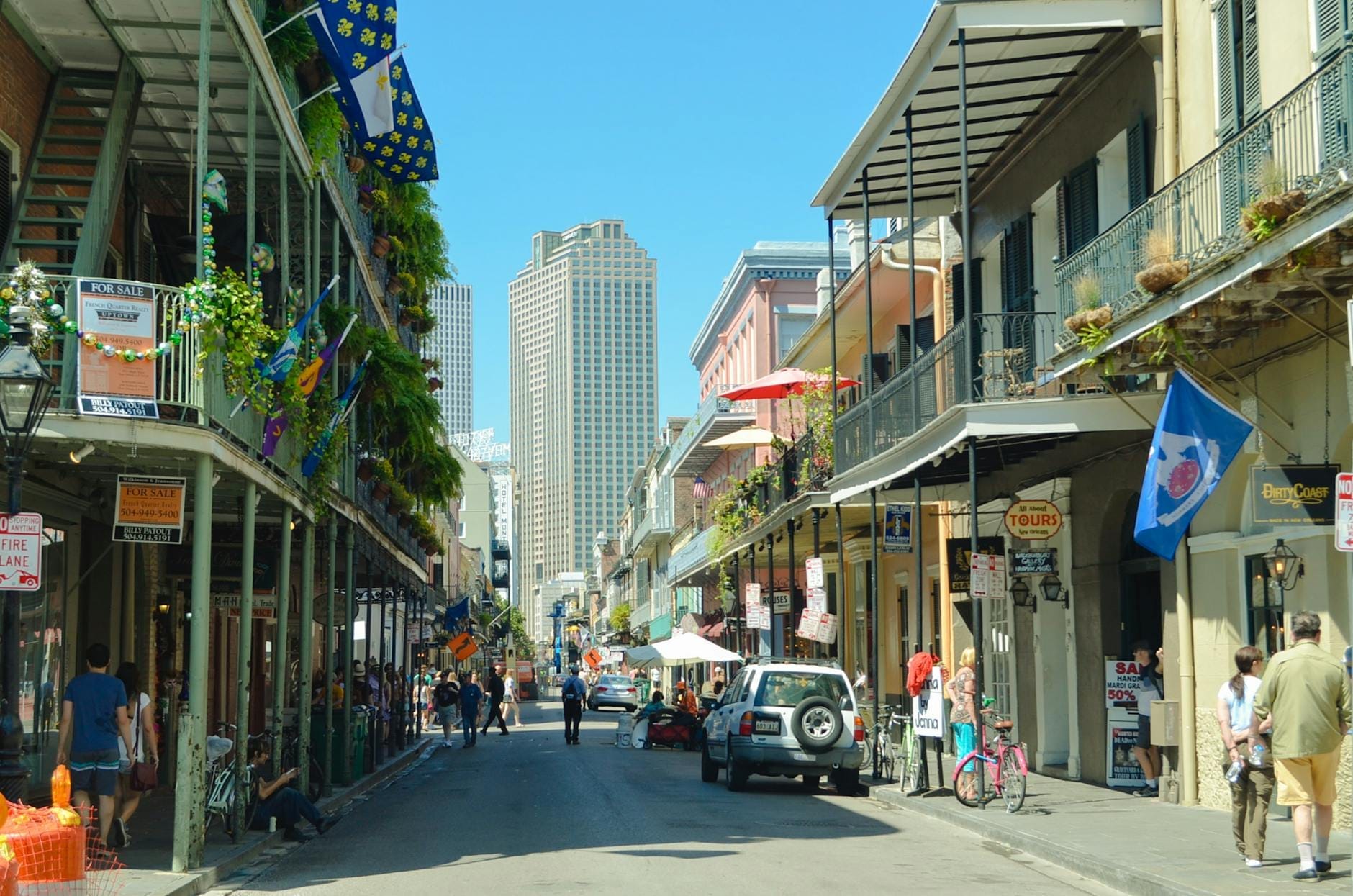
The majority of Bourbon Street falls within the Vieux Carré, the historic French Quarter district protected by the Vieux Carré Commission. Contrary to what many visitors assume, a significant portion of the street is residential. The bars, clubs, and souvenir shops are concentrated in the lower blocks from Canal to St. Ann Street. North of St. Ann, the character shifts quickly toward quieter Creole townhouses and local restaurants.
ℹ️ Good to know
The street is public and free to walk 24 hours a day, every day of the year. Louisiana's open-container laws allow you to carry alcoholic drinks on the street in plastic cups, not glass.
The Street by Time of Day
Morning is the version of Bourbon Street that locals know. Between 7 and 11 a.m., the lower blocks smell of stale beer and bleach, with hosing-down crews working the sidewalks outside the clubs. The neon signs are off or dimmed. A few bars never close, their doors open to the daylight, playing music for a handful of night-shift workers finishing drinks. It's genuinely interesting as a study in contrast, though not comfortable for everyone.
Afternoon shifts the crowd. By 1 p.m., tourists with to-go daiquiris start appearing. The upper blocks near Esplanade are quieter at any hour, shaded by second-story balconies draped with iron lacework that dates to the Spanish colonial period. The light falls differently on the plaster facades in the afternoon, and it's the best window for photography before the crowds make compositions impossible.
After dark is when Bourbon Street becomes the thing people have heard about. From roughly 9 p.m. onward, the lower blocks between Canal and St. Peter are pedestrian-heavy, with live music spilling from every open door, competing brass bands, and the constant sound of plastic cups on concrete. It is loud in a specific, layered way: country from one bar, R&B from the next, a distant trumpet. During peak season and weekends, it can feel claustrophobic. That's not a complaint, just a calibration.
💡 Local tip
For the most manageable experience on a busy night, enter Bourbon Street from a side street like St. Peter or Toulouse rather than from the Canal Street end, where the crowd compression is worst.
Tickets & tours
Hand-picked options from our booking partner. Prices are indicative; availability and final rates are confirmed when you complete your booking.
Spooky kid-friendly family ghost tour
From 32 €Instant confirmationFree cancellationWalking the Devil's Empire tour with HELLVISION™ in New Orleans
From 32 €Instant confirmationFree cancellationThe New Orleans haunted cemetery city bus tour
From 43 €Instant confirmationFree cancellationWhitney Plantation Tour
From 72 €Instant confirmationFree cancellation
Historical Depth Beyond the Neon
Jean Lafitte's Blacksmith Shop at 941 Bourbon Street is believed to be among the oldest structures in the Mississippi Valley, built by the early 18th century by the Lafon family. The building is a briquette-entre-poteaux structure, a French colonial technique using brick packed between wooden posts, and it survived because of its construction method while later brick buildings crumbled. Today it operates as a bar, dimly lit by candles, and the low ceilings and rough walls are not aesthetic choices: they're original.
The Old Absinthe House at 240 Bourbon Street dates to the early 19th century and once served absinthe to patrons including, by legend, Andrew Jackson and the pirate Jean Lafitte. The marble absinthe fountains inside are still in place. Neither of these sites announces itself loudly. You have to know to look for them among the louder venues.
The street's architecture reflects three centuries of governance: French, Spanish, and American. The wrought-iron balconies visitors associate with the French Quarter are largely a Spanish colonial addition, installed after fires in 1788 and 1794 destroyed much of the original French construction. For a fuller picture of French Quarter architecture and its layers, the New Orleans history guide traces that evolution in detail.
Navigating the Street Practically
Bourbon Street is entirely walkable and requires no reservations, tickets, or planning to visit. The Canal Streetcar and Riverfront Streetcar both stop at or near Canal Street, putting you at the street's southern entrance. From most French Quarter hotels, it's a walk of under ten minutes.
Footwear matters more than people expect. The sidewalks in the historic blocks are uneven, with displaced bricks and occasional gaps, particularly on side streets. Heels are common on weekend nights, but flat shoes handle the terrain more reliably. Accessibility is inconsistent: curb cuts exist at major intersections, but historic building interiors and older bars often have no ramp access. During Mardi Gras and major events, the street goes pedestrian-only and crowds can make navigation by wheelchair extremely difficult.
The most direct connection to the rest of the French Quarter is through the intersecting streets: Royal Street runs parallel one block toward the river and has a calmer, more gallery-and-antiques character that makes a useful counterpoint. Jackson Square is a 10-minute walk east and south, anchoring the riverfront end of the Quarter.
⚠️ What to skip
New Orleans summers are genuinely punishing: heat indexes of 100–110°F (38–43°C) are common June through August. Hydration on Bourbon Street is easy to forget when alcohol is everywhere. Plan outdoor walking for morning or evening if you're visiting in summer.
The Upper Blocks: A Different Street
Cross St. Ann Street heading toward Esplanade and the noise level drops noticeably within half a block. This stretch, sometimes called the 'Quieter Bourbon,' has local restaurants, a few neighborhood bars without cover charges or door staff, and residential buildings with potted plants on iron balconies. The foot traffic thins to something manageable even on Saturday nights.
The upper blocks are where Bourbon Street stops performing for tourists and starts just existing. It's worth walking this section before doubling back to the activity below St. Ann, if only to get a sense of what a residential French Quarter street actually looks like when it isn't hosting a party.
At the Esplanade end, you're positioned a few minutes' walk from Louis Armstrong Park and the Tremé neighborhood, which has its own live music tradition that predates Bourbon Street's commercialization by generations. The New Orleans jazz music guide covers the distinction between tourist-facing live music venues and the deeper local scene.
Who This Street Is Not For
Bourbon Street's reputation is its biggest liability with certain travelers. If you're expecting a jazz venue or a food destination, this is not the primary place to find either. The live music on Bourbon tends toward high-volume cover bands and DJ sets calibrated for a party crowd. The food options in the lower blocks skew toward tourist pricing and convenience over quality.
Travelers seeking serious live jazz will find a more authentic experience at Preservation Hall on St. Peter Street, two blocks away, or on Frenchmen Street in the Marigny, where local musicians play for smaller, more attentive audiences.
Travelers with sensory sensitivities, those sober by choice in an environment that heavily promotes drinking, and anyone who strongly dislikes crowds should think carefully before visiting the lower blocks after dark on weekends. The street is a functional public thoroughfare, but in peak hours it operates as a very dense outdoor party, and there is no quieter corner in the active section to retreat to.
Insider Tips
- Visit Jean Lafitte's Blacksmith Shop (941 Bourbon) in the mid-afternoon before the night crowd arrives. The candlelit interior and pre-1772 construction are best appreciated when you can actually pause and look around without being jostled.
- To-go daiquiris are legal and iconic, but the best ones are not on Bourbon Street. Walk one block to a smaller bar on Toulouse or Dumaine for the same drink at a lower price with no queue.
- The balconies on the lower blocks are attached to the bars below, and access typically requires buying a drink inside. They're worth it for the perspective on a busy night, but check with staff before heading upstairs.
- If you're visiting during Mardi Gras, Bourbon Street's balcony-level throws (beads, cups, doubloons) are concentrated in the 200 and 300 blocks. The further from Canal Street you stand, the thinner the balcony activity gets.
- Parking anywhere near Bourbon Street is expensive and stressful. The Canal Streetcar from the CBD drops you at Canal and Bourbon in under 15 minutes from the Central Business District, and costs a fraction of garage parking.
Who Is Bourbon Street For?
- First-time visitors to New Orleans who want to experience the famous nightlife scene firsthand
- Mardi Gras and festival travelers for whom the street is a central venue
- History-minded visitors willing to look past the neon at the colonial-era architecture and landmark bars
- Night owls comfortable in dense, loud, alcohol-forward environments
- Travelers combining a French Quarter walk with Royal Street galleries and Jackson Square
Nearby Attractions
Other things to see while in French Quarter:
- The Cabildo
Standing on the edge of Jackson Square since 1799, The Cabildo is the building where the Louisiana Purchase transfer was formally completed in 1803, reshaping a continent. Today it houses the Louisiana State Museum's flagship collection on state history, from colonial rule to Reconstruction, making it the most historically consequential building in New Orleans.
- Café du Monde
Open since 1862, Café du Monde on Decatur Street is the oldest coffee stand in New Orleans and one of the most recognizable spots in the French Quarter. The menu is deliberately simple: beignets dusted in powdered sugar and café au lait made with chicory. What makes or breaks the visit is knowing when to go and what to expect.
- Court of Two Sisters
The Court of Two Sisters on Royal Street is one of New Orleans' most enduring dining institutions, serving a daily jazz brunch buffet in a courtyard that has been gathering people since the 18th century. The combination of live jazz, Creole cuisine, and centuries-old architecture makes it unlike anything else in the city.
- French Market
The French Market stretches six blocks through the French Quarter, from the edge of Jackson Square to the old New Orleans Mint. Free to enter and open daily, it combines a farmers market, flea market, craft vendors, and open-air food stalls in a setting with roots stretching back before the United States existed.