Royal Street, New Orleans: Art, Antiques, and 300 Years of Creole Character
Royal Street runs through the heart of the French Quarter as the neighborhood's most refined corridor, lined with antique dealers, fine art galleries, ironwork balconies, and buildings dating to the early 19th century. It's a public street open at all hours, but its real character emerges during the pedestrian mall hours when buskers claim the sidewalk and the street itself becomes a slow, unhurried promenade.
Quick Facts
- Location
- French Quarter, New Orleans, Louisiana (runs from Canal Street through Faubourg Marigny)
- Getting There
- RTA Canal Streetcar (Canal Street stop); Riverfront Streetcar (French Market stop). Walk into the Quarter from either.
- Time Needed
- 1.5–3 hours for a leisurely walk; half a day if you browse galleries and step inside shops
- Cost
- Free public access; shops and galleries range from window-browsing to serious antique investment
- Best for
- Architecture lovers, antique browsers, photographers, slow walkers, history readers
- Official website
- www.neworleans.com/plan/streets/royal-street
What Royal Street Actually Is
Royal Street is one of the oldest streets in New Orleans, running parallel to the more famous Bourbon Street but with an entirely different personality. Where Bourbon trades in noise and neon, Royal deals in quiet elegance: antique furniture, fine art, wrought iron, and architecture that has survived fires, floods, and three centuries of occupation. The street's French name, Rue Royale, comes from the colonial era, and its Spanish-era designation, Calle Real, still appears on historic street signs along the route, a detail most visitors walk past without noticing.
The street stretches from Canal Street through the French Quarter and continues downriver through the Faubourg Marigny and Bywater, though the Industrial Canal interrupts the street grid before the Lower Ninth Ward; the visitor-relevant stretch runs through the French Quarter between Canal and Esplanade Avenue. Within that stretch, three blocks of Royal Street between St. Louis and St. Ann Streets close to traffic daily to create a pedestrian zone during afternoon hours. During those windows, the street closes to cars, and the sidewalk spills out into the full width of the road.
💡 Local tip
Arrive during afternoon pedestrian hours for the full experience: street musicians set up at corners, artists display work on the pavement, and the architecture becomes easier to appreciate without traffic in the frame.
The Architecture: What You're Actually Looking At
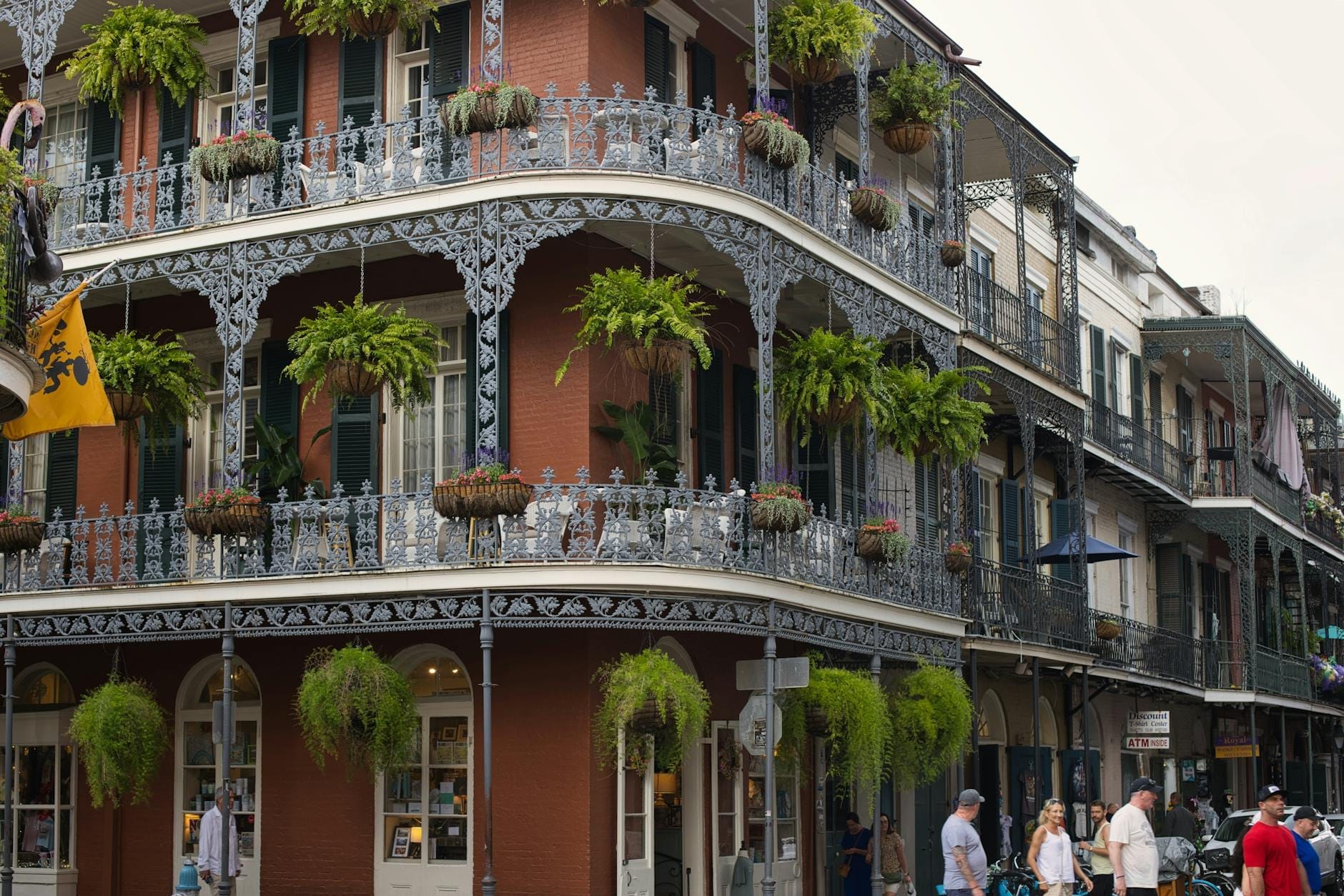
The structures lining Royal Street are predominantly Creole townhouses and Spanish Colonial buildings constructed between roughly 1807 and 1817, after two catastrophic fires leveled much of the original French Quarter in 1788 and 1794. What looks like French architecture is in many cases the product of Spanish rule: thick stucco walls, interior courtyards, and wrought-iron balconies replacing the earlier wooden ones. The ironwork here is not decorative whimsy. It was functional, allowing residents to occupy a semi-outdoor space above the street-level heat and noise.
The 600 block has a documented history tied to the Cavelier family, who developed the properties in the years following the second fire. Several buildings on this stretch retain their original footprint and façade proportions, even where interiors have been renovated. Look at the proportions: tall ground-floor openings designed for commercial use, narrower upper-floor windows for residential quarters, and the recessed carriageways that once gave access to rear courtyards where enslaved people worked and lived. That history is embedded in the physical structure of the street.
One of the most significant buildings on the street is the Louisiana Supreme Court, which has occupied its Royal Street building since 1911 and underwent major renovation in 2004. It's worth pausing at the exterior even if you're not entering. For a broader look at how the French Quarter fits into New Orleans' architectural story, the Cabildo on Jackson Square provides essential context, as it's one of the few surviving structures from the Spanish colonial period that predates even the Royal Street streetscape.
Tickets & tours
Hand-picked options from our booking partner. Prices are indicative; availability and final rates are confirmed when you complete your booking.
Spooky kid-friendly family ghost tour
From 32 €Instant confirmationFree cancellationWalking the Devil's Empire tour with HELLVISION™ in New Orleans
From 32 €Instant confirmationFree cancellationThe New Orleans haunted cemetery city bus tour
From 43 €Instant confirmationFree cancellationWhitney Plantation Tour
From 72 €Instant confirmationFree cancellation
How the Street Changes by Time of Day
Royal Street in the early morning, before 9 a.m., belongs to the neighborhood. Shopkeepers hose down sidewalks, delivery trucks idle near service entrances, and the only sounds are pigeons and distant traffic from Canal. The light is soft and directional, hitting the upper balconies before it reaches the street level, and the ironwork throws geometric shadows across pale stucco. If you care about photography, this is your hour. No crowds, no buskers, no tour groups blocking sightlines.
By mid-morning, the galleries and antique shops begin opening, typically between 10 and 11 a.m. The street takes on a different tempo: measured, commercial but not aggressive. Antique dealers here are generally knowledgeable and not particularly pushy. You can spend twenty minutes examining a piece of 19th-century Louisiana furniture and leave without buying anything without anyone making you feel unwelcome.
Afternoons during the pedestrian mall hours are when Royal Street becomes genuinely social. A jazz duo might set up at one corner while a solo guitarist works another block down. The smell of warm pralines drifts from a candy shop, competing with coffee from nearby cafés. Tourists slow down here in a way they rarely do on Bourbon Street, partly because there's less urgency and partly because the architecture forces a kind of attention. Evenings on Royal are quieter than you might expect given the French Quarter's reputation. Most shops close by 5 or 6 p.m., and the street reverts to a residential feel.
ℹ️ Good to know
Royal Street becomes noticeably crowded on weekend afternoons, especially between Jackson Square and St. Louis Street. If crowds are a concern, weekday mornings offer the same shops and architecture with a fraction of the foot traffic.
The Shops and What They Sell
Royal Street has more antique dealers per block than almost anywhere else in the American South. The inventory skews toward European and American 18th- and 19th-century furniture, silver, chandeliers, oil paintings, and decorative arts. Serious buyers come here from across the country. If you're not in the market for a $4,000 armoire, there's still value in window shopping: the displays are often museum-quality, and some dealers are genuinely willing to explain provenance and period to curious browsers.
Fine art galleries occupy a significant stretch of the street as well, with work ranging from Louisiana landscape painting in the tradition of the Newcomb School to contemporary works by local artists. The quality is uneven across galleries, so trust your eye rather than the price tag. Several shops specialize in vintage maps, prints, and ephemera, which make more portable purchases than furniture.
For those who want a broader shopping and cultural context in the Quarter, the French Market a few blocks away offers craft vendors, local food, and a very different atmosphere. The two experiences complement each other rather than overlap.
Getting There and Moving Around
Royal Street is walkable from most French Quarter hotels in under ten minutes. From Canal Street, it begins immediately as you cross into the Quarter. The St. Charles Streetcar stops at Canal Street, from where Royal Street is a short walk east. The Canal Streetcar also terminates near Canal and the river. Rideshare drop-offs work well at the Canal Street end. There is no parking to speak of within the pedestrian mall zone during mall hours, and the surrounding streets have metered parking that fills quickly on weekends.
The street is flat and paved, though some sidewalk sections have uneven brick or stone. Most antique shops and galleries have at least one step at the entrance, and not all have ramps. Visitors who use mobility aids should be aware that the pedestrian mall portion of the street itself is fully accessible when closed to vehicles, but individual storefronts vary. The wrought-iron balconies overhead present a photographable canopy but also a drip hazard after rain: standing water collects above and falls unpredictably.
⚠️ What to skip
After heavy rain, water drips from the iron balconies long after the shower ends. In summer, the humidity compounds this. A compact umbrella is useful year-round on Royal Street.
Royal Street in Relation to the Broader Quarter
Royal Street is one block from Jackson Square, and the connection is worth making deliberately. The square anchors the riverfront end of the street's most active blocks, and the artists and tarot readers who work the square's perimeter represent a different New Orleans tradition from the gallery dealers on Royal. Walking from the square up Royal and then cutting across to Bourbon Street at any point gives you a clear sense of how dramatically different two parallel streets can feel within the same neighborhood.
If you're treating Royal Street as part of a longer French Quarter itinerary, consider pairing it with a visit to the New Orleans Jazz Museum at the Old U.S. Mint on Esplanade Avenue, which sits at the far end of the Royal Street corridor. The museum occupies a building that has served as a federal mint, a Confederate barracks, and a state prison at different points in its history, and its current exhibition on jazz history is one of the better curated stops in the French Quarter.
Royal Street also makes for a natural introduction to a self-guided walking tour of the French Quarter. The street's historical layering, from Spanish colonial construction through 19th-century commercial development to present-day gallery culture, gives it a narrative coherence that most tourist corridors lack.
Who Should Temper Their Expectations
Royal Street rewards patience. Travelers looking for quick, high-energy experiences will find it underwhelming after the first two blocks. The antique shops are not museums, and unless you're a buyer or a genuine enthusiast, the interiors can feel samey after a while. The street's reputation can also set up outsized expectations: it is elegant and historically significant, but it's also a commercial strip, and some storefronts are more tourist-facing than the street's overall character suggests.
Visitors primarily interested in New Orleans nightlife will find Royal Street closes early and offers nothing in that direction. The energy is daytime and deliberate. Families with young children can certainly walk the street, but there's little to hold a child's attention beyond the buskers. Anyone visiting during a hot, humid August afternoon should know that the street has no shade structures: the balconies help on some blocks, but the heat on Royal Street at 2 p.m. in summer is the same heat everywhere else in the Quarter.
Insider Tips
- The street signs on Royal Street include the old Spanish designation 'Calle Real' in smaller text below the modern sign. It's easy to miss, but it's one of the few places in the city where all three of New Orleans' colonial identities appear on a single block.
- Several antique dealers on Royal Street will ship purchases internationally and are experienced with customs documentation for furniture and art. If you're seriously interested in something large, ask about their shipping partners before you walk away.
- The pedestrian zone on Royal Street is one of the better spots in the Quarter for street musicians because the acoustics off the building façades are genuinely good. If you hear a strong jazz ensemble, stop: the quality is not guaranteed elsewhere on the tourist circuit.
- Early October and late March tend to offer the best combination of mild weather and manageable crowds on Royal Street. High summer brings heat and humidity that makes lingering outdoors genuinely difficult, and the peak Mardi Gras weeks bring crowd levels that change the character of the street entirely.
- Look up at the second-floor balconies rather than the shop windows. The ironwork patterns differ building by building, and some of the most intricate examples in the Quarter are on Royal Street buildings that have unremarkable ground-floor retail.
Who Is Royal Street For?
- Architecture and history enthusiasts who want to read a street as a document of three centuries of colonial and commercial history
- Antique collectors and fine art buyers looking for established, reputable dealers rather than market stalls
- Photographers working in the early morning hours when the light, shadows, and empty sidewalks create strong compositions
- Slow travelers who prefer a half-day of deliberate exploration over a checklist of attractions
- Visitors building a French Quarter walking itinerary who want a counterpoint to Bourbon Street's pace and character
Nearby Attractions
Other things to see while in French Quarter:
- Bourbon Street
Rue Bourbon is one of America's most recognizable streets, stretching 13 blocks through the French Quarter from Canal Street to Esplanade Avenue. The nightlife reputation is well-earned, but the street has genuine historical depth and a quieter, more complex daytime character that most visitors never see.
- The Cabildo
Standing on the edge of Jackson Square since 1799, The Cabildo is the building where the Louisiana Purchase transfer was formally completed in 1803, reshaping a continent. Today it houses the Louisiana State Museum's flagship collection on state history, from colonial rule to Reconstruction, making it the most historically consequential building in New Orleans.
- Café du Monde
Open since 1862, Café du Monde on Decatur Street is the oldest coffee stand in New Orleans and one of the most recognizable spots in the French Quarter. The menu is deliberately simple: beignets dusted in powdered sugar and café au lait made with chicory. What makes or breaks the visit is knowing when to go and what to expect.
- Court of Two Sisters
The Court of Two Sisters on Royal Street is one of New Orleans' most enduring dining institutions, serving a daily jazz brunch buffet in a courtyard that has been gathering people since the 18th century. The combination of live jazz, Creole cuisine, and centuries-old architecture makes it unlike anything else in the city.