The Cabildo: Where Louisiana's Defining Moments Happened
Standing on the edge of Jackson Square since 1799, The Cabildo is the building where the Louisiana Purchase transfer was formally completed in 1803, reshaping a continent. Today it houses the Louisiana State Museum's flagship collection on state history, from colonial rule to Reconstruction, making it the most historically consequential building in New Orleans.
Quick Facts
- Location
- 701 Chartres Street, Jackson Square, French Quarter, New Orleans, LA 70130
- Getting There
- Riverfront streetcar to French Quarter stop; walkable from Canal Street
- Time Needed
- 1.5 to 2.5 hours
- Cost
- Paid admission; groups of 15+ receive $2 off per ticket. Verify current adult pricing at the official site before visiting.
- Best for
- History enthusiasts, architecture lovers, first-time visitors to New Orleans
- Official website
- louisianastatemuseum.org/museum/cabildo
What The Cabildo Actually Is
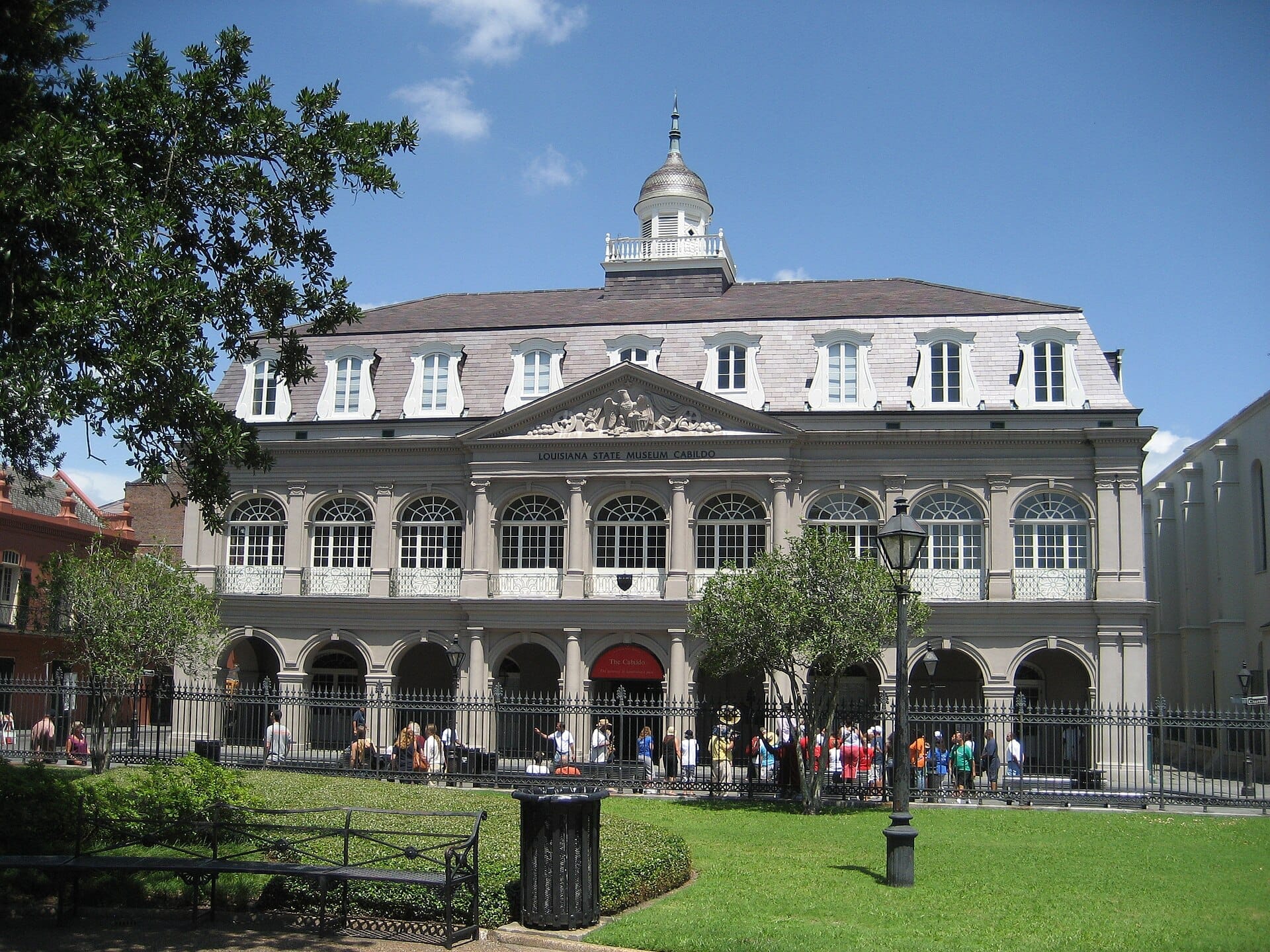
The Cabildo is not just another French Quarter landmark with a good-looking facade. It is a three-story Spanish colonial building built between 1795 and 1799, constructed after a catastrophic fire leveled much of New Orleans in 1788. For the better part of its early life it served as the seat of Spanish colonial government, then briefly as the site where French and American officials formalized the Louisiana Purchase in December 1803 — one of the largest land transfers in history. Later it housed the Louisiana Supreme Court, where Homer Plessy was arrested in 1892 and his case reached the Louisiana Supreme Court on appeal, before ultimately going to the US Supreme Court in 1896. Few buildings in North America carry that density of consequence within a single structure.
Since 1911 it has operated as part of the Louisiana State Museum, with exhibits that lean heavily into the state's colonial period, the Napoleonic connections surrounding the Louisiana Purchase, and the complicated social history of 19th-century Louisiana. The building itself suffered a damaging fire in 1988 that destroyed its original mansard roof; the current roof is a faithful restoration completed in 1994.
ℹ️ Good to know
Hours: Daily 9:00 a.m. to 4:00 p.m. Last ticket sold at 3:30 p.m. Closed on select state holidays including Memorial Day. A café operates Thursday through Sunday, 11:00 a.m. to 4:00 p.m., through May 31, 2026. Verify hours before visiting at louisianastatemuseum.org/museum/cabildo.
The Architecture: Reading the Building From Outside
Before you pay admission, spend a few minutes on the plaza looking at the exterior. The Cabildo anchors the left flank of St. Louis Cathedral on Jackson Square, its pale stucco facade and arched ground-floor arcade giving it a Castilian gravity that sets it apart from the more ornate French Creole buildings elsewhere in the Quarter. The arcade was a practical choice in the subtropical heat, designed to draw pedestrian traffic through the shade while the business of colonial administration happened in the floors above.
The building pairs visually with the Presbytere on the cathedral's right side, and together they frame St. Louis Cathedral in a deliberate show of civic and religious authority that Spanish planners intended for maximum effect. The symmetry reads best from the center of Jackson Square, particularly in the morning when the light hits the plaza from the east and the cathedral's white towers are bright against whatever the sky is doing. It is one of the few genuinely photogenic compositions in the city that works at any time of year.
Tickets & tours
Hand-picked options from our booking partner. Prices are indicative; availability and final rates are confirmed when you complete your booking.
Spooky kid-friendly family ghost tour
From 32 €Instant confirmationFree cancellationWalking the Devil's Empire tour with HELLVISION™ in New Orleans
From 32 €Instant confirmationFree cancellationThe New Orleans haunted cemetery city bus tour
From 43 €Instant confirmationFree cancellationWhitney Plantation Tour
From 72 €Instant confirmationFree cancellation
Inside: What the Exhibits Cover and How Long They Take
The permanent collection moves through Louisiana history in roughly chronological order across the building's three floors. The lower levels cover the colonial period in considerable depth, with artifacts from both French and Spanish rule, maps, military items, and documents related to the transfer ceremonies of 1803. The Louisiana Purchase exhibit is the emotional center of the building for most visitors, partly because of the room itself, a high-ceilinged salon where the transfer ceremony took place, and partly because the scale of what that transaction meant is easier to grasp when you're standing in the actual space.
Upper floors address antebellum Louisiana, the role of slavery in shaping the state's economy and social structure, and Reconstruction. The museum does not sanitize these chapters, which makes it more valuable than many of the city's more superficially curated historic sites. The Plessy v. Ferguson connection is addressed directly, including the backstory of Homer Plessy's deliberate act of civil disobedience on a New Orleans streetcar in 1892 and the Supreme Court ruling four years later that codified segregation for more than fifty years.
Plan for at least 90 minutes if you intend to read the exhibit panels seriously. Two hours is more comfortable. The building is not enormous, but the content density rewards a slow pace. If you are visiting with children under ten, the historical weight of much of the material will land unevenly, though the artifacts themselves, weapons, portraits, and period objects, tend to hold younger attention better than the text.
💡 Local tip
Photography tip: The upper-floor balcony overlooking Jackson Square offers one of the few elevated vantage points in the French Quarter with an unobstructed view across the plaza toward the Mississippi River. Bring a camera. The view is better in the morning before street activity crowds the foreground.
How the Experience Changes by Time of Day
Arriving at or shortly after opening at 9:00 a.m. gives you the quietest version of the building. The plaza outside is still relatively calm, tour groups have not yet arrived, and the interior galleries feel more contemplative. By late morning, organized tour groups begin filtering through, and the smaller exhibit rooms can feel congested. The acoustic quality of the building, with its high ceilings and hard plaster walls, amplifies group noise considerably.
Midday visits in summer (June through August) are functional but not comfortable, primarily because walking between the Cabildo and any other attraction involves stepping into heat that regularly reaches the low 90s Fahrenheit with high humidity. If you are building a French Quarter morning itinerary, the Cabildo pairs well with a later stop at a shaded courtyard restaurant before the afternoon temperature peaks. Late afternoon, the last-entry window closes at 3:30 p.m., so a 2:30 or 3:00 p.m. arrival is possible but rushed.
Getting There and Practical Logistics
The Cabildo sits directly on Jackson Square at 701 Chartres Street, which puts it within walking distance of most French Quarter hotels and short walking distance from the French Market and the riverfront. The Riverfront streetcar line stops nearby; the Canal Street lines are a short walk away. Rideshare drop-off is straightforward on Decatur Street along the river side of the square. There is no dedicated parking adjacent to the building — driving is not recommended for this part of the French Quarter during daytime hours.
Accessibility in a building of this age and classification is worth verifying directly before you arrive. The Cabildo is a Spanish colonial structure with multiple floors, and historic preservation constraints can limit elevator access in buildings of this type. Contact the Louisiana State Museum directly or check the official site for current accessibility information.
If the Cabildo is part of a broader day covering New Orleans history, it pairs logically with a visit to St. Louis Cemetery and New Orleans Jazz Museum — both within a short walk. For a deeper dive into the city's historical context, the New Orleans history guide provides useful framing for what you will encounter inside.
Honest Assessment: Worth Your Time or Not?
The Cabildo is not a museum that competes on production value. You will not find immersive technology installations or theatrical lighting. What you get is a serious, well-curated state history museum inside a building that actually matters, which is a rarer combination than it sounds. For travelers who want to understand why New Orleans exists the way it does, why it has the cultural contradictions it has, why Creole identity is so complicated, and how the Louisiana Purchase cascaded through American history, this is the most direct ninety minutes you can spend.
Travelers who are primarily here for nightlife, food culture, or the atmospheric street experience of the French Quarter can reasonably skip it without missing the essential New Orleans experience. The Cabildo rewards intellectual curiosity, not Instagram moments. The balcony view is the one exception: it is genuinely impressive and worth the price of admission on its own for photographers.
If you are traveling with young children and need attractions calibrated for short attention spans, the Aquarium of the Americas a short walk away along the riverfront is likely a better use of your afternoon. The Cabildo's text-heavy exhibits and age-sensitive historical content are better suited to adults and older teenagers.
Insider Tips
- The last-ticket window closes at 3:30 p.m., which is easy to miss if you are wandering Jackson Square in the afternoon. Set a phone reminder if you plan to visit late in the day.
- Group admission (15 or more with a reservation) includes a $2 per-ticket discount. If you are traveling with a larger party, call ahead rather than simply arriving together.
- The café operates Thursday through Sunday through May 2026 — useful for a mid-visit break, but do not rely on it as a lunch plan on Mondays through Wednesdays.
- The upper-floor balcony overlooking Jackson Square is consistently underused by visitors who rush through the exhibits. Budget five to ten minutes there specifically. The vantage point across the plaza to the river is not replicable from street level.
- If you plan to visit multiple Louisiana State Museum properties during your trip, ask at the admission desk about combination ticketing options with other sites in the system.
Who Is The Cabildo For?
- History-focused travelers who want primary-source context for Louisiana's colonial and antebellum periods
- Architecture enthusiasts interested in Spanish colonial civic design in North America
- First-time visitors to New Orleans who want to understand the city's cultural and political foundations before exploring the streets
- Photographers looking for an elevated, legally accessible view of Jackson Square
- Educators or researchers interested in the Plessy v. Ferguson origins and Reconstruction-era Louisiana
Nearby Attractions
Other things to see while in French Quarter:
- Bourbon Street
Rue Bourbon is one of America's most recognizable streets, stretching 13 blocks through the French Quarter from Canal Street to Esplanade Avenue. The nightlife reputation is well-earned, but the street has genuine historical depth and a quieter, more complex daytime character that most visitors never see.
- Café du Monde
Open since 1862, Café du Monde on Decatur Street is the oldest coffee stand in New Orleans and one of the most recognizable spots in the French Quarter. The menu is deliberately simple: beignets dusted in powdered sugar and café au lait made with chicory. What makes or breaks the visit is knowing when to go and what to expect.
- Court of Two Sisters
The Court of Two Sisters on Royal Street is one of New Orleans' most enduring dining institutions, serving a daily jazz brunch buffet in a courtyard that has been gathering people since the 18th century. The combination of live jazz, Creole cuisine, and centuries-old architecture makes it unlike anything else in the city.
- French Market
The French Market stretches six blocks through the French Quarter, from the edge of Jackson Square to the old New Orleans Mint. Free to enter and open daily, it combines a farmers market, flea market, craft vendors, and open-air food stalls in a setting with roots stretching back before the United States existed.