St. Louis Cemetery No. 1: Inside New Orleans' Oldest City of the Dead
Saint Louis Cemetery No. 1 is New Orleans' oldest surviving cemetery, dating to 1789, and one of the most historically significant burial grounds in North America. Guided tours are required for entry, weaving through tight rows of above-ground whitewashed tombs that tell the story of the city's Creole, Catholic, and African American heritage.
Quick Facts
- Location
- 501 Basin St, New Orleans, LA 70112 (Tremé, one block from the French Quarter)
- Getting There
- Walk from the French Quarter via Basin Street; short ride from the French Quarter on the Canal streetcar
- Time Needed
- 1 to 1.5 hours (guided tour duration)
- Cost
- Paid guided tour required; verify current prices at cemeterytourneworleans.com before visiting
- Best for
- History enthusiasts, architecture lovers, those interested in Creole culture and New Orleans folklore
- Official website
- cemeterytourneworleans.com
What Saint Louis Cemetery No. 1 Actually Is
Saint Louis Cemetery No. 1 is not a park or a photo opportunity. It is an active Catholic burial ground and the oldest extant cemetery in New Orleans, established in 1789 by Spanish colonial decree to replace the earlier St. Peter Cemetery, which was lost in the catastrophic fire of 1788. Placed on the National Register of Historic Places in 1975, it covers roughly a square block at the edge of the Tremé neighborhood and holds the remains of some of the most consequential figures in Louisiana history.
The cemetery is also listed on the Louisiana African American Heritage Trail, a recognition of how deeply its history reflects the lives of free people of color, enslaved individuals, and prominent Creole families whose stories run through the foundation of New Orleans itself. This is not background decoration. It is the subject.
ℹ️ Good to know
Since 2015, the Archdiocese of New Orleans has restricted entry to guided tours only. Unaccompanied visitors — even with Catholic affiliations — are not admitted unless attending a funeral. Plan ahead: tours run Monday through Saturday 9am–4pm and Sunday 9am–1pm. The cemetery is closed on Mardi Gras Day.
Above-Ground Tombs: Architecture Born From Necessity
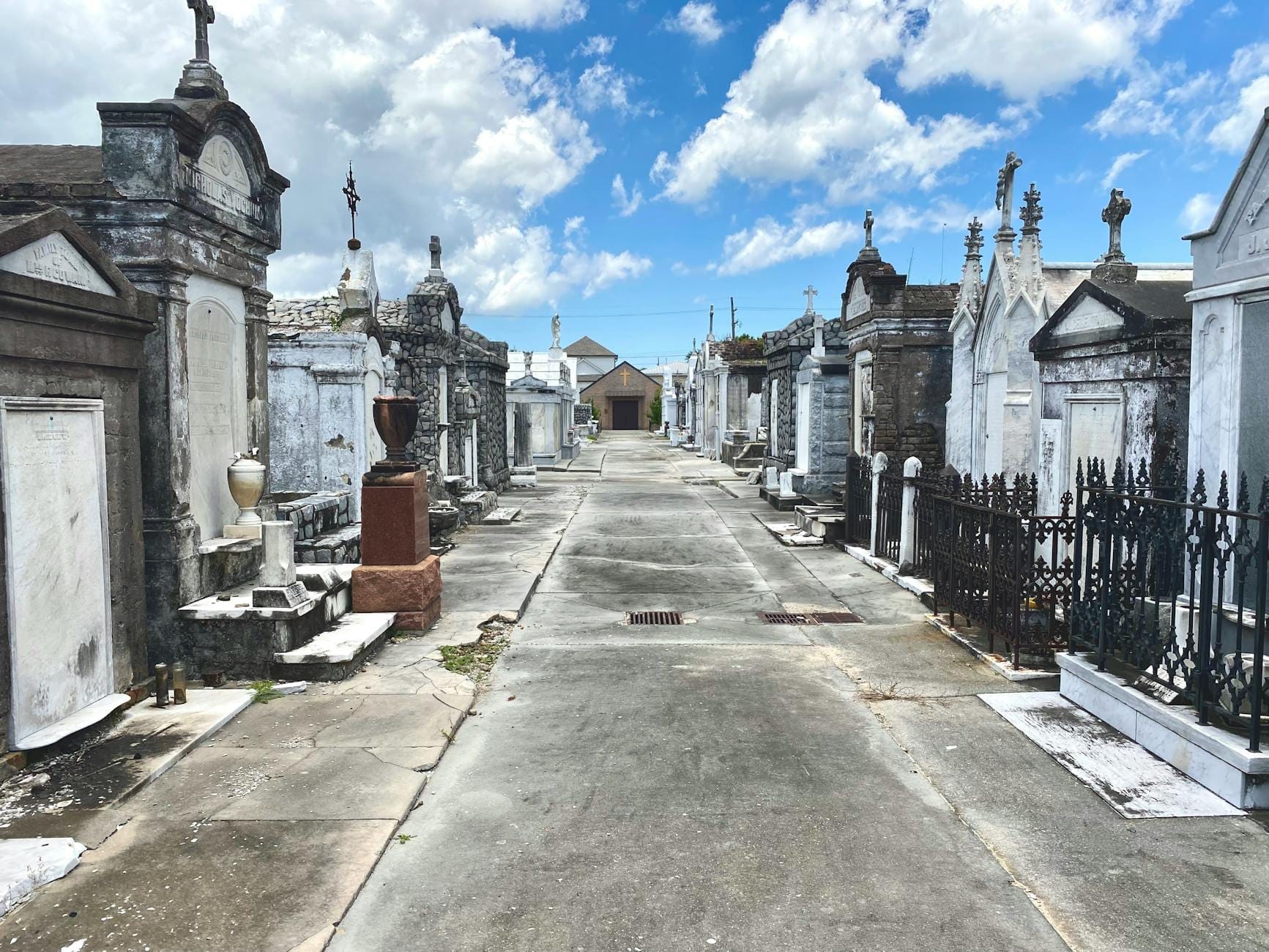
The defining visual of any New Orleans cemetery is the above-ground vault, and Saint Louis No. 1 is where this tradition reaches its most concentrated form. The city sits mostly at or below sea level, and in the 18th and 19th centuries, attempts to bury the dead conventionally in this waterlogged ground often resulted in caskets rising to the surface after heavy rains. The Spanish colonial administration mandated above-ground interment as a practical solution, and the tradition became a cultural cornerstone.
The tombs range from modest plastered brick single-vaults to elaborate multi-tiered family structures that stand over six feet tall. Many are painted white or cream, though decades of subtropical humidity, heat, and rain leave many in various states of weathered decay. The effect in person is striking: the aisles between tombs are narrow, sometimes just wide enough for two people to pass, and on a warm morning the heat radiates off the stone surfaces. Walking through feels less like visiting a monument and more like navigating a dense, silent neighborhood.
Some society tombs here, built by benevolent associations to serve their communities, hold dozens of individuals stacked in sequential burials. New Orleans tradition holds that remains are moved to the lower chamber after one year and one day, once the subtropical heat has completed decomposition, allowing the vault to receive a new occupant. It is a system shaped entirely by the physical reality of the land.
Tickets & tours
Hand-picked options from our booking partner. Prices are indicative; availability and final rates are confirmed when you complete your booking.
New Orleans St. Louis Cemetery tickets and guided tour
From 21 €Instant confirmationFree cancellationThe New Orleans haunted cemetery city bus tour
From 43 €Instant confirmationFree cancellationGarden District and Lafayette Cemetery walking tour
From 21 €Instant confirmationFree cancellationGarden District and Lafayette Cemetery Tour
From 33 €Instant confirmationFree cancellation
The Notable Tombs and Who Is Buried Here
The tomb most visitors ask about is that associated with Marie Laveau, the 19th-century Voodoo practitioner whose influence over New Orleans society extended well beyond her death in 1881. The tomb, belonging to the Glapion family, has long been a site of folk ritual: for decades, visitors left triple-X marks on the whitewashed surface and small offerings at its base, asking Laveau for favors. The practice caused real damage to the historic plaster, and the Archdiocese has since actively discouraged it. Do not mark the tomb. Tours address Laveau's history directly, which is far more interesting than the mythology.
Bernard de Marigny, the Creole aristocrat who introduced the dice game craps to America and whose gambling losses led him to subdivide his family's plantation into what became the Marigny neighborhood, is also interred here. So is Homer Plessy, whose 1892 act of civil disobedience on a New Orleans streetcar led to the Supreme Court case Plessy v. Ferguson. For more on Plessy's neighborhood legacy and the Tremé's place in African American history, the Congo Square and Louis Armstrong Park nearby provide essential context.
What the Guided Tour Covers (and Why It Matters)
The guided tour requirement, instituted after years of vandalism including the defacement of historic tombs, is genuinely the right call for a site this fragile and this layered. Tours run roughly 45 minutes to an hour and typically cover the cemetery's founding, the logic of above-ground burial, notable interments, the role of benevolent societies in New Orleans Creole culture, and the complicated history of Marie Laveau and Voodoo practice in Louisiana.
The official tour operator is listed at cemeterytourneworleans.com. Verify current tour pricing and availability before your visit, as rates are subject to change. Book in advance, particularly between October and May when demand peaks. Arriving without a reservation on a busy weekend means you may not get in.
💡 Local tip
Book your tour at least a day ahead during fall and spring travel seasons. Morning tours, especially on weekdays, tend to have smaller groups, which gives guides more time for questions and allows you to linger at individual tombs without the press of a larger crowd.
If you plan to pair this visit with broader exploration of New Orleans history, the New Orleans history guide covers the colonial and antebellum periods that shaped the cemetery's founding era. For ghost and folklore-focused visits, the cemetery connects naturally to New Orleans ghost tours and Voodoo history content worth reading before you go.
How the Experience Changes Through the Day
Morning tours, particularly those departing close to the 9am opening, offer the most atmospheric experience. The light is soft and raking, throwing long shadows between the rows of tombs, and the heat has not yet built to the oppressive levels that New Orleans afternoons deliver from May through September. The sounds of Basin Street traffic feel distant once you are inside the walls. There is a particular stillness in the morning that the midday tours do not replicate.
By late morning and into the early afternoon, group sizes tend to increase and the heat becomes a genuine factor in summer. The stone tombs absorb and radiate heat intensely, and the narrow aisles offer little air movement. If you are visiting between June and August, bring water, wear light clothing, and seriously consider the earliest available tour slot.
Sunday hours cut off at noon, which limits options. For travelers combining a Sunday visit with the French Quarter, the tight Sunday window can work if you book the first available slot and then walk south to breakfast before the quarter gets crowded.
Practical Walkthrough: Getting There, Staying Comfortable, Photography
Saint Louis Cemetery No. 1 sits at Basin and St. Louis Streets, technically in the Tremé, just one block from the French Quarter's northwest edge. It is an easy walk from most French Quarter hotels: head north on any street until you hit Basin, then turn left. The walk from Jackson Square takes about ten minutes on foot.
The Canal Street streetcar stops nearby and is a practical option if you are coming from further afield. For orientation in the broader neighborhood, the Tremé neighborhood is one of the oldest African American neighborhoods in the country, and there is real history in every direction from the cemetery gates.
Footwear matters. The ground inside is uneven, covered with compacted earth, sand, and oyster shells, a traditional New Orleans cemetery surface chosen to elevate the ground slightly above the surrounding grade. Sandals work, but sturdy walking shoes are more comfortable. The aisles are narrow enough that a rolling bag or large backpack will be a nuisance to yourself and others.
Photography is permitted during guided tours, and the cemetery offers exceptional compositional material: peeling plaster, iron crosses, weathered inscriptions in French and English, and the compressed geometry of the vault rows. Wide-angle lenses capture the density of the space well. For detail shots of inscriptions, a macro setting or portrait mode delivers more than a wide shot. Tripods are not practical given the tight quarters.
⚠️ What to skip
Do not touch or mark any tomb surface. Do not leave offerings on or against tombs unless specifically directed by cemetery staff. The site is a consecrated, active burial ground under Archdiocesan jurisdiction. Disrespectful behavior results in removal from the tour and potential trespass consequences.
Who Should Reconsider This Visit
Travelers who struggle in heat and humidity should plan carefully in summer months: the enclosed, sun-baked interior offers almost no shade, and tours do not offer the option to wait inside cooler areas. Anyone with mobility limitations should know that the paths between tombs are narrow and the ground is irregular; no specific ADA accommodations are documented, and navigating with a wheelchair or mobility aid will be genuinely difficult in most sections.
If your primary interest is atmosphere and folklore rather than history, you may find that a dedicated Voodoo and ghost tour covers the Marie Laveau mythology in more theatrical depth. The cemetery itself rewards curiosity about architecture and history more than it delivers gothic spectacle.
Insider Tips
- Book the first tour of the day on a weekday. Group sizes are smaller, the light is better for photography, and the temperature inside the cemetery walls is significantly cooler before 10am.
- The cemetery's exterior wall along Basin Street is itself historically significant. Take a moment to look at the plastered brick construction before entering: it reflects the same Spanish colonial building techniques as the tombs inside.
- If you want context for the Homer Plessy tomb before your visit, read even a short summary of Plessy v. Ferguson. Plessy's 1892 arrest after boarding a Canal Street streetcar led to the Plessy v. Ferguson case, decided by the Supreme Court in 1896, just a few blocks from here, and knowing the backstory transforms the moment at his grave.
- Do not rely on the Sunday morning slot if you have tight departure logistics. The noon cutoff leaves no buffer if your tour runs long or you want time to linger near the entrance.
- The blocks immediately surrounding the cemetery on Basin Street have limited café options. Eat before you go or plan to walk back into the French Quarter afterward, where options are plentiful.
Who Is St. Louis Cemetery No. 1 For?
- History and architecture travelers who want to understand how New Orleans' colonial and Creole past shaped the city physically
- Visitors interested in African American heritage and the stories of free people of color in antebellum Louisiana
- Photographers looking for distinctive compositional subjects beyond the French Quarter's standard streetscapes
- Anyone on a structured New Orleans history itinerary looking to connect the city's cemeteries, Voodoo heritage, and Creole culture in one stop
- Travelers who want a genuinely quiet, contemplative experience away from the louder parts of the tourist circuit
Nearby Attractions
Other things to see while in Tremé:
- Congo Square
Tucked inside Louis Armstrong Park in New Orleans' Tremé neighborhood, Congo Square is a 2.35-acre historic site where enslaved Africans and free people of color once gathered to drum, dance, and preserve West African traditions. That defiant act of cultural continuity profoundly shaped the traditions that gave rise to jazz. Today the square is free to visit, quietly powerful, and deeply underappreciated by first-time visitors.
- Louis Armstrong Park
Louis Armstrong Park is a 32-acre public park in the Tremé neighborhood, just steps from the French Quarter, that anchors the origins of jazz, blues, and African American musical tradition. Home to Congo Square, a striking 12-foot sculpture of Louis Armstrong, and the Mahalia Jackson Theater, it is one of the most historically layered outdoor spaces in the American South.