Congo Square: The Open-Air Cradle of American Music
Tucked inside Louis Armstrong Park in New Orleans' Tremé neighborhood, Congo Square is a 2.35-acre historic site where enslaved Africans and free people of color once gathered to drum, dance, and preserve West African traditions. That defiant act of cultural continuity profoundly shaped the traditions that gave rise to jazz. Today the square is free to visit, quietly powerful, and deeply underappreciated by first-time visitors.
Quick Facts
- Location
- Louis Armstrong Park, Tremé neighborhood, New Orleans, LA (bounded by St. Philip, Rampart, Basin & St. Peter Streets)
- Getting There
- Walk from the French Quarter via Rampart Street (5-10 min from Jackson Square). RTA buses serve the surrounding streets. No on-site parking.
- Time Needed
- 30–60 minutes for the square itself; 1.5–2 hours if you explore all of Louis Armstrong Park
- Cost
- Free to enter (Louis Armstrong Park has no admission fee — verify current access hours before visiting)
- Best for
- History lovers, music fans, cultural travelers, and anyone tracing the roots of jazz and African American heritage
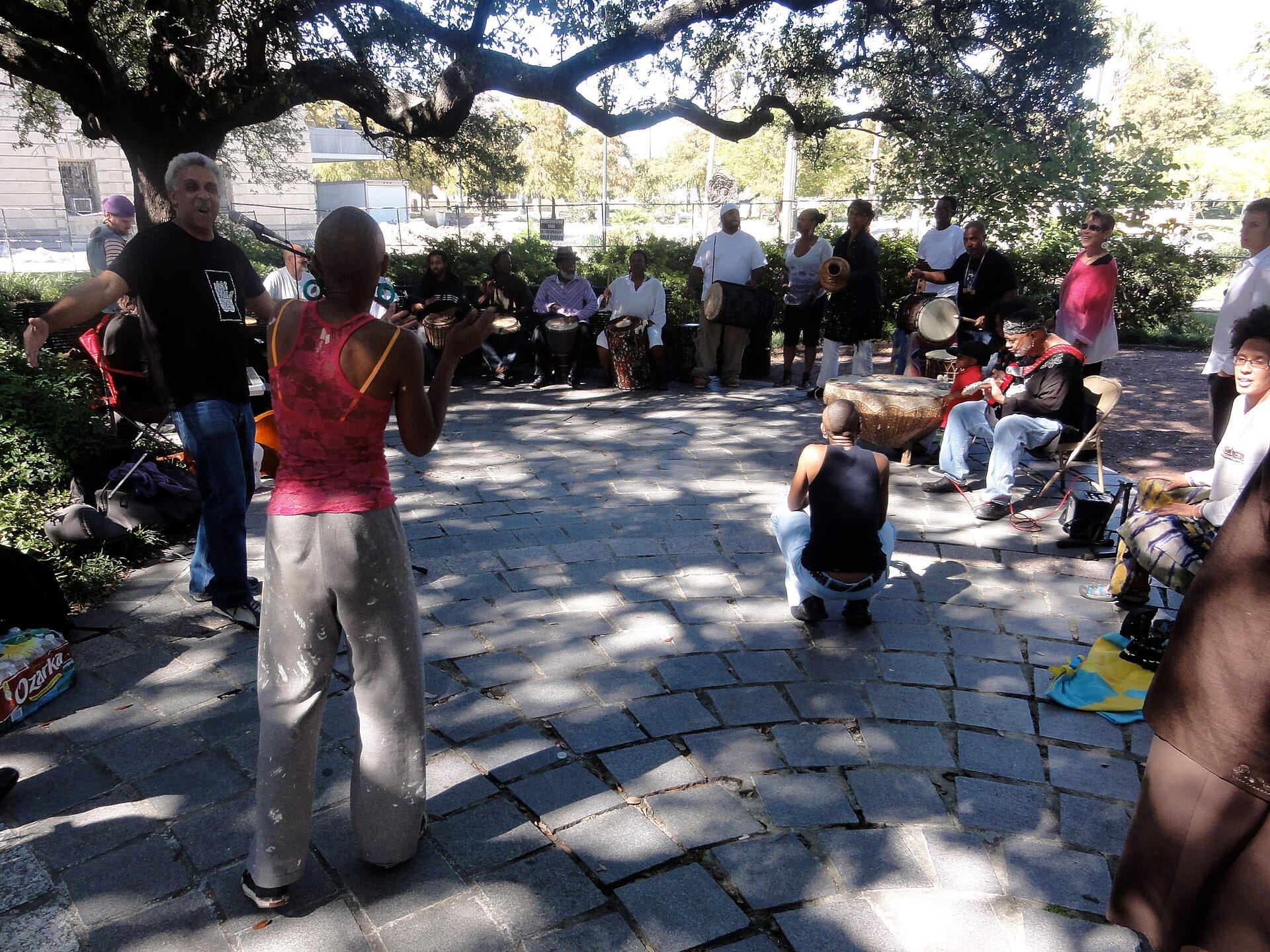
Why Congo Square Matters More Than Most Visitors Realize
Congo Square does not announce itself loudly. There are no ticket booths, no costumed guides, no dramatic facades. What you find instead is a wide, open paved space shaded by old trees, ringed by a low ornamental fence, sitting inside the 31-acre Louis Armstrong Park in the Tremé neighborhood. It is easy to walk through in five minutes and feel like you have seen it. That would be a mistake.
The site's full official name is Congo Square (French: Place Congo), and its significance cannot be separated from the neighborhood around it. Tremé is widely recognized as the oldest African American neighborhood in the United States, and Congo Square was its public anchor for generations.
Beginning in Louisiana's early colonial period, the colonial administration permitted enslaved Africans and free people of color to gather here on Sundays. They brought drums, stringed instruments, and the movement vocabularies of West and Central Africa. The dances, rhythms, and call-and-response structures practiced in this square fed directly into what became jazz, blues, and eventually most of American popular music. The square's current size, approximately 2.35 acres, is roughly half of what it occupied during the nineteenth century.
ℹ️ Good to know
Congo Square is listed on the National Register of Historic Places under two designations: Congo Square itself (#92001763) and the broader New Orleans Jazz National Historic Park (#01000277). It is also part of the African-American Heritage Cultural District.
The History You Are Standing On
Louisiana's Code Noir, the colonial legal framework governing enslaved people, technically prohibited gatherings, but local custom and administrative tolerance created a unique exception here. Sunday assemblies at this square became a documented and observed phenomenon by at least the late eighteenth century. Travelers from Europe and the American Northeast wrote accounts describing hundreds of people dancing in concentric circles, playing skin drums and wind instruments, singing in West African languages, and trading goods. Nothing comparable existed anywhere else in North America during the era of chattel slavery.
The cultural lifeline these gatherings maintained was not symbolic. Specific musical forms, including the bamboula dance rhythm, percussion patterns that survive in second-line drumming, and the call-and-response vocal structure of the blues, trace directly to what was practiced here. Ethnomusicologists have documented these connections carefully. When you hear a New Orleans brass band today, the rhythmic DNA goes back to this square.
The square's history after the Civil War is less celebrated but equally instructive. In 1893, city authorities renamed it Beauregard Square, after Confederate General P.G.T. Beauregard, a renaming that effectively erased its African American identity from official maps for 118 years. On April 28, 2011, the New Orleans City Council passed Ordinance Calendar No. 28,411 restoring the name Congo Square. The restoration was not a small symbolic gesture. It was the result of years of community organizing, particularly through organizations like Congo Square Connection. To understand more about this history, the New Orleans history guide provides broader context for the city's layered, often contested past.
Tickets & tours
Hand-picked options from our booking partner. Prices are indicative; availability and final rates are confirmed when you complete your booking.
Spooky kid-friendly family ghost tour
From 32 €Instant confirmationFree cancellationWalking the Devil's Empire tour with HELLVISION™ in New Orleans
From 32 €Instant confirmationFree cancellationThe New Orleans haunted cemetery city bus tour
From 43 €Instant confirmationFree cancellationWhitney Plantation Tour
From 72 €Instant confirmationFree cancellation
What the Visit Actually Feels Like
Congo Square sits in the southwest corner of Louis Armstrong Park. You enter the park from the main gate on North Rampart Street, passing under a large arch. The gate itself is worth pausing at: the ironwork and the wide ceremonial entrance set a tone. From there a short walk brings you to the square's open space, framed by mature trees whose canopy creates dappled light on sunny afternoons.
The ground underfoot is hard paving, and the atmosphere on a weekday morning is genuinely quiet, sometimes even solitary. This is not a polished theme-park experience. There are interpretive markers and a bronze plaque that explain the historical record, but the square rewards visitors who come with some prior knowledge, whether from the excellent New Orleans Jazz Museum nearby or from dedicated reading.
On weekends, especially during festivals and community events, the energy shifts considerably. Local musicians sometimes perform in or near the square. The park hosts the Congo Square New World Rhythms Festival annually, which transforms this space into exactly what it historically was: a site of communal music-making with roots in African tradition. If your visit coincides with this event or with Jazz Fest season, check the Jazz Fest guide for scheduling details.
Time of Day: How the Square Changes
Early morning, between 7 and 9 a.m., is the most atmospheric time to visit if you want the place to yourself. The light comes in low through the park's tree canopy, there is usually birdsong, and the surrounding streets of Tremé are still quiet. The contrast between the stillness of the space now and the density of human activity it once held is easier to feel when the crowds have not arrived.
Midday in summer (June through August) is genuinely uncomfortable. New Orleans' humid subtropical climate pushes temperatures into the low 90s Fahrenheit (above 33°C) with high humidity. The square has limited shade, so a midday visit in July or August requires real heat tolerance. Bring water, wear sun protection, and plan to be brief.
Late afternoon in the shoulder seasons, specifically March through May and October through November, is the sweet spot. The light is golden, the temperature sits in the 70s Fahrenheit (low 20s Celsius), and the park's landscaping looks its best. Evening visits are possible but the park does have closing hours, so check current access times before arriving after dark.
⚠️ What to skip
Louis Armstrong Park's opening hours are subject to change and are not always consistently posted. Verify current hours with the City of New Orleans Parks and Parkways Department or on-site signage before planning an evening visit.
The Surrounding Context: Tremé and What to Pair With Your Visit
Congo Square is most meaningful when understood as part of the Tremé neighborhood, not as an isolated site. The streets immediately surrounding Louis Armstrong Park contain some of the oldest Creole cottages in New Orleans, several of which predate the Civil War. The Tremé neighborhood is also where the tradition of the second line parade was born and where it is still most alive. Catching a second line here is one of the more authentic experiences available in New Orleans.
Within the park itself, the New Orleans Jazz Museum is an excellent complement to a Congo Square visit, providing documented exhibits on the musical lineage that Congo Square helped create. The two sites together form a coherent half-day itinerary that gives the music a historical anchor.
Just across Rampart Street to the south is the edge of the French Quarter, and a short walk east takes you toward Frenchmen Street in the Marigny, where the living tradition of New Orleans jazz plays out nightly in small clubs. Pairing a daytime visit to Congo Square with an evening on Frenchmen Street gives you the historical roots and the present-day expression of the same musical tradition in a single day.
Photography, Accessibility, and Practical Notes
Congo Square is an open, flat, paved area with no significant elevation changes, making it fully accessible for visitors using wheelchairs or mobility aids. The park's main entrance path from Rampart Street is paved and wide.
For photography, the most compelling compositions come from standing at the edge of the square and shooting toward the interior with the park's trees framing the shot. The interpretive markers and plaques photograph well in morning or late afternoon light when shadows are long and the contrast is soft. Overcast days actually work well here because the flat, diffused light reduces glare off the paving.
There are no food vendors or facilities inside Louis Armstrong Park itself. The nearest cafes and restaurants are along Rampart Street or a short walk into the French Quarter. If you are combining this visit with a longer Tremé walk, bring water, particularly in summer.
💡 Local tip
The park's main ceremonial gate on North Rampart Street is one of the most photographed entrances in New Orleans. Arrive early to shoot it without crowds, and notice the bronze bust of Louis Armstrong just inside the entrance.
Who Will Love This Place, and Who Should Reconsider
Visitors who arrive with some background knowledge of African American history, the origins of jazz, or the history of slavery in the Gulf South will find Congo Square genuinely moving. The weight of what happened here is real and the site rewards reflection. For travelers who enjoy reading historical markers and sitting with the resonance of a place, this is one of the most significant outdoor sites in the United States.
Travelers looking for spectacle, on the other hand, may find the square underwhelming if they come without context. It is not a curated museum experience. The interpretive signage is informative but limited. Visitors who want a more guided deep dive into the history might consider pairing this visit with one of the dedicated New Orleans walking tours that cover the Tremé neighborhood and Congo Square specifically.
Families with younger children can absolutely visit, though the site lacks the interactive elements that make museums like the Aquarium of the Americas engaging for kids. For a mixed adult-and-child itinerary, plan to spend no more than 20 to 30 minutes here and combine it with the park's open green space, where children can move freely.
Insider Tips
- The Congo Square New World Rhythms Festival, held annually in the spring, is one of the few times the square returns to something like its historic function: open-air drumming and dancing rooted in African traditions. Check the city's events calendar for the exact date.
- The name restoration in 2011 from 'Beauregard Square' is not mentioned on all tourist maps or older guidebooks. If you hear locals refer to it as Beauregard Square, they are using an outdated name that carries a complicated history.
- Enter the park from the main Rampart Street gate rather than any side entrance. The ceremonial arch and the immediate visual of Armstrong Park's landscaping sets up the visit properly and gives you spatial orientation before you reach the square.
- The St. Louis Cemetery No. 1 is a short walk away and is thematically connected: it is where many of the free people of color who gathered at Congo Square are buried. Tours of the cemetery (required for entry) can be booked through the Archdiocese of New Orleans.
- If you visit on a Sunday morning, listen for brass band second lines starting in the neighborhood. These are community events, not tourist productions, and they sometimes pass near the park. A second line on the streets of Tremé on a Sunday is one of the most authentic cultural experiences New Orleans offers.
Who Is Congo Square For?
- History and culture travelers who want to understand the deeper roots of American music beyond just attending a show
- Jazz enthusiasts tracing the origins of the genre from its earliest documented source
- Photographers seeking meaningful, low-crowd subjects with strong architectural and natural framing
- Travelers building a Tremé neighborhood walk that covers the oldest African American community in the country
- Anyone participating in the Congo Square New World Rhythms Festival or surrounding events
Nearby Attractions
Other things to see while in Tremé:
- Louis Armstrong Park
Louis Armstrong Park is a 32-acre public park in the Tremé neighborhood, just steps from the French Quarter, that anchors the origins of jazz, blues, and African American musical tradition. Home to Congo Square, a striking 12-foot sculpture of Louis Armstrong, and the Mahalia Jackson Theater, it is one of the most historically layered outdoor spaces in the American South.
- St. Louis Cemetery No. 1
Saint Louis Cemetery No. 1 is New Orleans' oldest surviving cemetery, dating to 1789, and one of the most historically significant burial grounds in North America. Guided tours are required for entry, weaving through tight rows of above-ground whitewashed tombs that tell the story of the city's Creole, Catholic, and African American heritage.