Jackson Square: The Living Heart of the French Quarter
Jackson Square is a 2.5-acre National Historic Landmark at the center of New Orleans' French Quarter, framed by the St. Louis Cathedral and the Pontalba Buildings, steps from the Mississippi riverfront, with Decatur Street and the levee between the square and the water. Free to enter and open daily, it draws street performers, portrait artists, fortune tellers, and more than 2 million visitors a year.
Quick Facts
- Location
- Bounded by Chartres, St. Ann, Decatur, and St. Peter Streets, French Quarter, New Orleans, LA
- Getting There
- Riverfront Streetcar (French Market Station); RTA bus lines on Decatur St
- Time Needed
- 30 minutes to 2 hours depending on how long you linger
- Cost
- Free admission. Open 8:00 AM–7:00 PM (DST); 8:00 AM–6:00 PM (winter)
- Best for
- History, photography, people-watching, street performance, orientation to the French Quarter
- Official website
- nola.gov/next/parks-parkways/topics/parks-squares/jackson-square
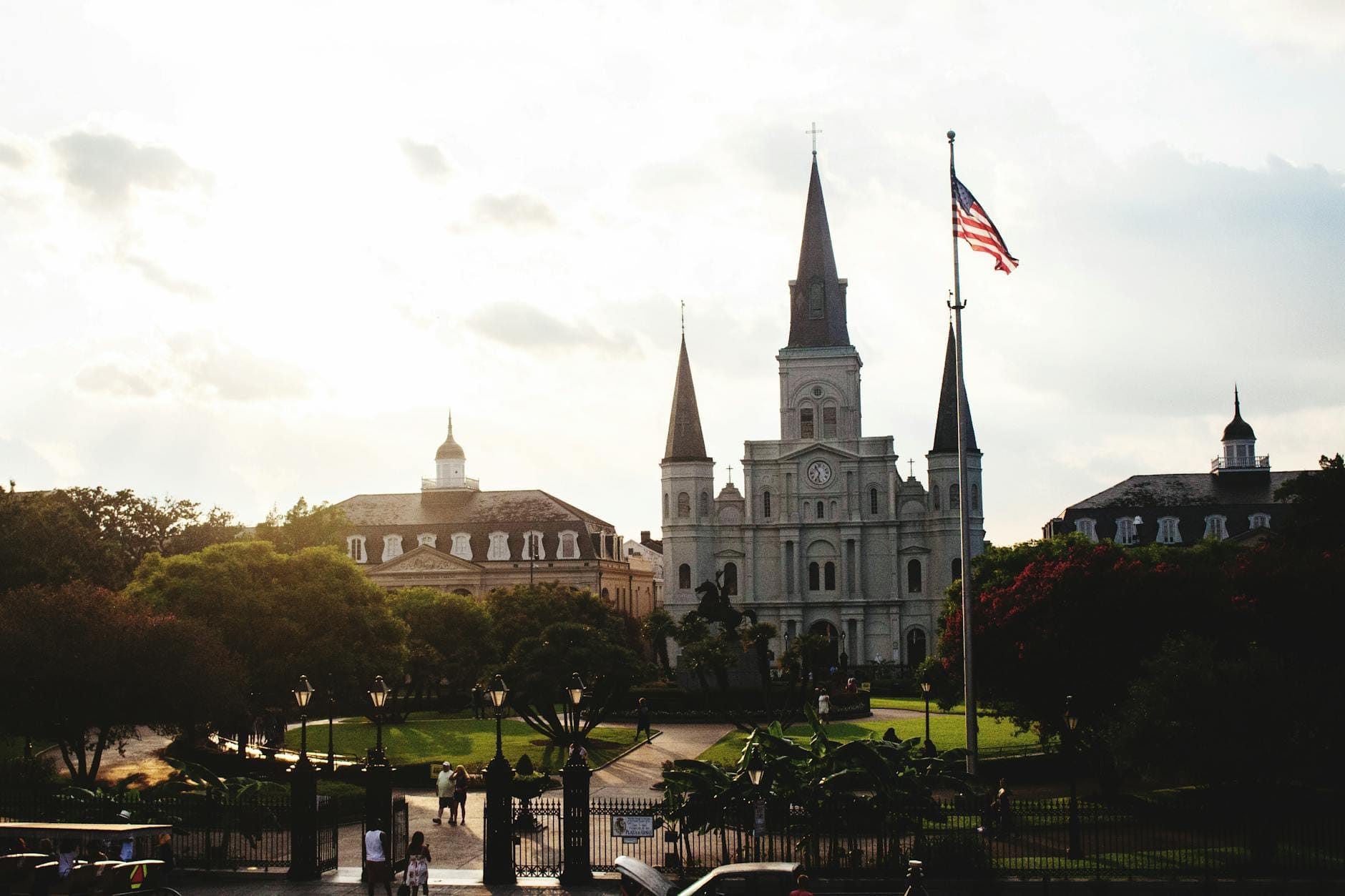
What Jackson Square Actually Is
Jackson Square is a 2.5-acre public park and National Historic Landmark in the heart of the French Quarter, designated in 1960. Originally called Place d'Armes under French colonial rule and Plaza de Armas under the Spanish, it was renamed Jackson Square on January 28, 1851, in honor of General Andrew Jackson's victory at the Battle of New Orleans in 1815. The bronze equestrian statue of Jackson at the center of the square, erected in 1856, remains one of the most recognizable public monuments in the American South.
The square is not just a park. It is the geographic and symbolic anchor of the French Quarter, framed on three sides by landmark buildings, steps from the Mississippi riverfront, with Decatur Street and the levee between the square and the water. The St. Louis Cathedral rises directly behind the central axis; the matching Pontalba Buildings, built in the 1840s, line the north and south flanks. The whole composition was a deliberate exercise in colonial urban planning, and it still reads that way today: formal, symmetrical, and surprisingly intact for a city that has absorbed centuries of flood, fire, and reinvention.
ℹ️ Good to know
Jackson Square is free to enter. Gates open at 8:00 AM year-round and close at 7:00 PM during Daylight Saving Time or 6:00 PM in winter. The surrounding pedestrian areas and artists' perimeter operate on looser schedules.
What You See When You Arrive
Approaching from Decatur Street, the square opens up through iron gates flanked by a gauntlet of fortune tellers, tarot card readers, and portrait artists who set up along the wrought-iron fence perimeter. This outer ring operates independently of the gated park itself and runs on its own informal timetable, often appearing by mid-morning and thinning after dark.
Inside the fence, the layout is formal: manicured gardens with crushed gravel walkways radiating outward from the central plaza where Jackson's statue stands. The grounds are well-maintained, with iron benches positioned for sitting and watching. The cathedral's triple steeples dominate the skyline behind the statue, and on clear mornings the geometry of the whole composition is worth stopping to absorb. The American Planning Association recognized this as one of its Great Places in America in 2012, and standing here, it is not hard to understand why.
The perimeter sidewalks along St. Peter and St. Ann Streets host most of the street performers: living statues, jazz musicians, brass ensembles, and bucket drummers. The energy level shifts dramatically by hour. Early morning is quiet and photogenic. By 10 or 11 AM the performers begin setting up. Afternoons, especially on weekends, can feel crowded to the point of sensory overload. Evenings, once the gates close, the action migrates to the sidewalks and the nearby Moon Walk riverfront promenade.
💡 Local tip
For the best photographs of the St. Louis Cathedral, arrive before 9:00 AM. The light falls directly on the facade in the morning, and the square has not yet filled with tour groups or performers' equipment.
Tickets & tours
Hand-picked options from our booking partner. Prices are indicative; availability and final rates are confirmed when you complete your booking.
Spooky kid-friendly family ghost tour
From 32 €Instant confirmationFree cancellationWalking the Devil's Empire tour with HELLVISION™ in New Orleans
From 32 €Instant confirmationFree cancellationThe New Orleans haunted cemetery city bus tour
From 43 €Instant confirmationFree cancellationWhitney Plantation Tour
From 72 €Instant confirmationFree cancellation
The History Surrounding You
The square predates the United States itself. French colonial planners laid out Place d'Armes in 1721 as a military parade ground for the newly founded city of New Orleans. Under Spanish rule, it was rebuilt after two catastrophic fires in 1788 and 1794 leveled much of the original French colonial construction. The buildings visitors see today, including the cathedral, are largely Spanish-era reconstructions, which explains why the so-called French Quarter is architecturally more Spanish than French.
The St. Louis Cathedral at the square's northern edge dates its current structure to 1850, though a church has stood on the site since 1727. It is the oldest continuously operating Catholic cathedral in the United States. The Pontalba Buildings running along the square's flanks were constructed between 1849 and 1851 by Baroness Micaela Almonester de Pontalba, and are among the oldest apartment buildings in the United States. Together, these structures form an architectural ensemble with almost no parallel in North America.
The Cabildo, immediately to the left of the cathedral, is where the Louisiana Purchase transfer documents were signed in 1803. It now operates as a Louisiana State Museum. The matching Presbytère to the cathedral's right is also a state museum, currently featuring a permanent Mardi Gras exhibition. Both charge admission. Visiting one or both significantly deepens the historical context of what you are looking at from the square.
How the Experience Changes by Time of Day
Jackson Square is genuinely a different place at different hours, and knowing that in advance changes how you plan your visit. Early morning, roughly 7:00 to 9:30 AM, is the version most visitors never see: the square's gates may not yet be open, but the surrounding area is still and cool, the cathedral is lit softly, and the river is visible from the Moon Walk steps without any crowd pressure.
Midday to mid-afternoon is peak volume. Street performers compete loudly for position, tour groups arrive by the bus, and the perimeter fortune tellers are in full session. This is when the square feels most like the version you have probably seen in photographs, but it is also when it feels most like a performance of itself. If you are sensitive to noise or crowd density, this window is the least comfortable.
Late afternoon into early evening offers a middle ground. The tour groups thin out, the light turns golden over the Mississippi, and the atmosphere settles into something more genuinely local. After the gates close, many visitors drift toward Café du Monde directly across Decatur Street for beignets and café au lait, which is one of the more reliable rituals in the entire city.
⚠️ What to skip
During major festivals, including Mardi Gras, Jazz Fest, and Halloween weekend, Jackson Square and the surrounding streets reach extreme crowd density. The square itself may have restricted access during some events. Check the city's event calendar before visiting during late February, late April, or late October.
Practical Navigation
Jackson Square sits inside the French Quarter at its riverfront edge. The Riverfront Streetcar stops near the French Market, roughly a two-minute walk. RTA buses run along Decatur Street. Walking from most French Quarter hotels takes under fifteen minutes. From the Central Business District, the walk across Canal Street and down into the Quarter is about 20 minutes on foot, or you can take the Riverfront Streetcar.
The square is flat and the main walkways are firm and navigable. The perimeter artists often spread their work along the sidewalk, which can narrow passageways significantly during busy hours. For visitors with mobility considerations, Decatur Street provides the widest access points. Strollers are manageable inside the park but crowded on the surrounding sidewalks during peak hours.
There is no parking lot adjacent to the square. Decatur Street has limited metered parking; the nearest garages are in the CBD near Canal Street. For most visitors staying in the French Quarter, walking is the only realistic option. Rideshare drop-offs work best on Decatur Street.
If you are building an itinerary around the square, consider pairing it with the French Market a short walk downriver, the New Orleans Jazz Museum at the Old U.S. Mint several blocks away, or an evening on Royal Street for galleries and street musicians. The square itself is a strong anchor for a half-day or full-day French Quarter walk.
Photography, Weather, and Honest Caveats
Jackson Square is one of the most photographed locations in New Orleans, and the challenge is getting an image that feels like yours rather than a postcard. The standard shot is from Decatur Street looking north through the gates toward the cathedral. A more interesting angle is from the Moon Walk promenade, looking back at the cathedral above the square's roofline, especially at dusk.
New Orleans summers are genuinely brutal. From June through September, temperatures regularly reach the low 90s Fahrenheit (around 33°C) with high humidity, and afternoon thunderstorms are common. Jackson Square offers almost no shade. If you visit in summer, morning is not just preferable, it is practically necessary for comfort. Bring water. The square has no concessions inside.
One honest caveat worth stating: the square can feel overly commercial during peak tourist season. The perimeter fortune tellers and portrait artists are persistent but not aggressive, and the street performers range in quality from genuinely talented to performative noise. If you are looking for the authentic, quieter side of New Orleans, the square is more of a starting point than a destination. It points outward toward the city, rather than containing the city within itself.
Insider Tips
- The fortune tellers and tarot readers along the square's iron fence do not charge a fixed rate upfront. Ask the price before sitting down. Rates vary widely and some readers expect a tip on top of the stated fee.
- The view of the cathedral from the levee side (Moon Walk) is underused. Cross Decatur Street and walk up the steps to the river promenade for a wider, less obstructed composition than anything you can get inside the square itself.
- If the square gates are closed when you arrive (before 8:00 AM or after closing), the artists' perimeter and surrounding sidewalks are still accessible and often more atmospheric without the crowd inside.
- Both the Cabildo and the Presbytère on either side of the cathedral charge separate admission as Louisiana State Museums. They are worth the time if you have any interest in Louisiana history or Mardi Gras culture. Neither requires advance booking for individuals.
- Street performers inside the perimeter tend to set up around mid-morning. If you want a quieter square with fewer competing sounds, aim for the first hour after the gates open.
Who Is Jackson Square For?
- First-time visitors to New Orleans who want a geographic and historical orientation to the city
- Photography enthusiasts, especially those willing to arrive early for ideal light on the cathedral
- History travelers interested in French and Spanish colonial architecture in North America
- Families looking for a free, open outdoor space with surrounding walkable attractions
- Couples who want a scenic evening starting point before dinner in the French Quarter
Nearby Attractions
Other things to see while in French Quarter:
- Bourbon Street
Rue Bourbon is one of America's most recognizable streets, stretching 13 blocks through the French Quarter from Canal Street to Esplanade Avenue. The nightlife reputation is well-earned, but the street has genuine historical depth and a quieter, more complex daytime character that most visitors never see.
- The Cabildo
Standing on the edge of Jackson Square since 1799, The Cabildo is the building where the Louisiana Purchase transfer was formally completed in 1803, reshaping a continent. Today it houses the Louisiana State Museum's flagship collection on state history, from colonial rule to Reconstruction, making it the most historically consequential building in New Orleans.
- Café du Monde
Open since 1862, Café du Monde on Decatur Street is the oldest coffee stand in New Orleans and one of the most recognizable spots in the French Quarter. The menu is deliberately simple: beignets dusted in powdered sugar and café au lait made with chicory. What makes or breaks the visit is knowing when to go and what to expect.
- Court of Two Sisters
The Court of Two Sisters on Royal Street is one of New Orleans' most enduring dining institutions, serving a daily jazz brunch buffet in a courtyard that has been gathering people since the 18th century. The combination of live jazz, Creole cuisine, and centuries-old architecture makes it unlike anything else in the city.