Pontalba Buildings: The Story Behind Jackson Square's Iconic Red-Brick Row Houses
Flanking Jackson Square on two sides, the Pontalba Buildings are a pair of matching four-story red-brick row houses built between 1849–1851. Built by the formidable Baroness Micaela Almonester Pontalba, they introduced cast-iron gallery work to New Orleans and remain among the oldest continuously occupied apartment buildings in the United States. Entry to the exteriors and grounds is free.
Quick Facts
- Location
- 500 St. Ann St (Lower) & 500 St. Peter St (Upper), French Quarter, New Orleans, LA 70116
- Getting There
- Walkable from most French Quarter hotels; Canal Streetcar (Canal St stop) provides transit access
- Time Needed
- 30–60 minutes for exterior and arcade walk; add 45–60 min if visiting the 1850 House museum inside
- Cost
- Free to view exterior and walk the arcades; 1850 House museum has a separate admission (verify current price)
- Best for
- Architecture enthusiasts, history buffs, photography, and anyone exploring Jackson Square
- Official website
- louisianastatemuseum.org
What the Pontalba Buildings Actually Are
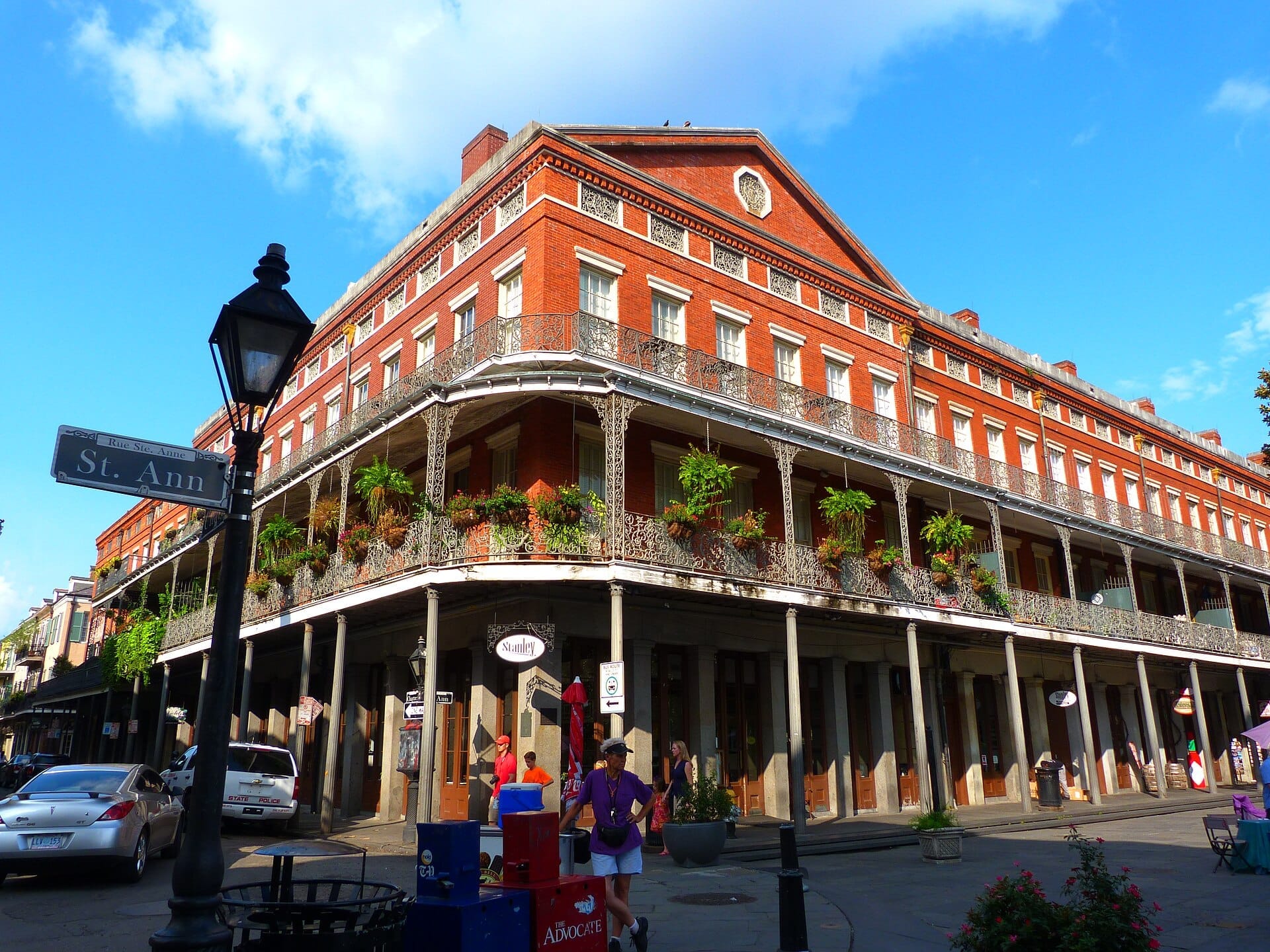
The Pontalba Buildings are two matching one-block-long row houses that close off the north and south sides of Jackson Square, forming a near-perfect architectural frame around one of the most photographed public spaces in the American South. Each building is four stories tall, built from deep red brick, and runs the full length of the block. Their ground floors contain shops and restaurants that open directly onto the square's perimeter walkway. Above them, three floors of residential apartments look down through elaborate cast-iron galleries onto the street below.
The Upper Pontalba faces St. Peter Street and is owned by the City of New Orleans. The Lower Pontalba faces St. Ann Street and is managed by the Louisiana State Museum, which operates the 1850 House museum within it. Despite being built as a matched pair, they had slightly different construction timelines: the Upper was completed in 1850, the Lower in 1851. Both are U.S. National Historic Landmarks.
ℹ️ Good to know
The apartments above the shops are private residences, not open to the public. Only the ground-floor arcade and the 1850 House museum (in the Lower Pontalba) are accessible to visitors. Verify the 1850 House hours and admission before visiting, as museum hours can vary seasonally.
The Woman Who Built Them: Baroness Micaela Almonester Pontalba
The story of the Pontalba Buildings is inseparable from the story of the woman who commissioned them. Micaela Almonester Pontalba was born in New Orleans in 1795, the daughter of Don Andres Almonester y Roxas, who financed the reconstruction of the St. Louis Cathedral and the Cabildo after the fire of 1788. She inherited considerable property along the square and, after a turbulent marriage to a French nobleman that ended with her father-in-law shooting her (she survived, losing fingers), she returned to New Orleans and channeled her formidable energy into real estate.
Pontalba hired architect James Gallier Sr. for preliminary plans and later Henry Howard to complete the work. She was notoriously hands-on, reportedly arguing with contractors and overseeing decisions personally. Her initials, 'A' and 'P' for Almonester and Pontalba, are woven into the cast-iron gallery railings on both buildings. Look closely at the ironwork from street level and you'll see them rendered in an interlocking monogram, easy to miss if you're not looking for it.
The construction was part of a deliberate effort to revitalize the Creole district of the French Quarter, which had been losing commercial ground to the American sector upriver. To read more about the city's layered history, the New Orleans history guide provides a useful framework for understanding the cultural competition that shaped the city's architecture.
Tickets & tours
Hand-picked options from our booking partner. Prices are indicative; availability and final rates are confirmed when you complete your booking.
Spooky kid-friendly family ghost tour
From 32 €Instant confirmationFree cancellationWalking the Devil's Empire tour with HELLVISION™ in New Orleans
From 32 €Instant confirmationFree cancellationThe New Orleans haunted cemetery city bus tour
From 43 €Instant confirmationFree cancellationWhitney Plantation Tour
From 72 €Instant confirmationFree cancellation
The Architecture: What to Look For
The Pontalba Buildings introduced decorative cast-iron gallery work to New Orleans, predating the lacy ironwork that would later define the French Quarter streetscape. This is an important architectural distinction. The buildings themselves follow an American commercial Italianate style, with brick facades, arched openings at street level, and long recessed galleries on each upper floor. The galleries are wide enough to walk comfortably, and they run the full length of each building's facade.
The proportions are worth pausing over. Each building is a full city block long and four stories tall, which gives them an imposing civic presence unusual for residential structures of the period. They were among the largest buildings in New Orleans when completed. From the opposite side of Jackson Square, they provide the visual anchor that makes the square feel enclosed and intentional rather than just an open plaza.
For comparison, the cast-iron galleries on Royal Street were mostly added in later decades, inspired in part by what the Pontalba Buildings demonstrated was possible. The 'AP' monogram on the Pontalba ironwork remains one of the most distinctive architectural signatures in the Quarter.
What It Feels Like to Visit: Hour by Hour
Early morning, before 9 a.m., is when the buildings show their best face. The brick takes on a warm amber tone in the low-angle light, and the square in front of them is quiet enough that you can actually examine the ironwork and the proportions without navigating crowds. Street artists begin setting up along the square's fence around this time, and the smell of coffee drifts from nearby cafes, but the arcade walkways beneath the buildings are mostly empty. This is the time to photograph them without tourists in every frame.
By mid-morning the scene shifts considerably. Jackson Square fills with portrait artists, tarot readers, and tour groups, and the ground-floor shops and restaurants beneath the Pontalba buildings start drawing foot traffic. The arcade becomes a natural shelter point, shaded and slightly cooler than the open square. On humid summer afternoons, that covered walkway is genuinely useful. In July or August, temperatures regularly reach into the low 90s°F (around 33°C) with high humidity, and even a few minutes of shade feels significant.
At dusk, when the gas-style lanterns along the square illuminate and the St. Louis Cathedral glows across the park, the Pontalba Buildings settle into the background in a way that's almost cinematic. The upper gallery windows are lit from within by residents, which reminds you that these are functional homes, not a preserved set piece. That quality, the coexistence of private life and public spectacle, is part of what makes this block feel lived-in rather than museumified.
💡 Local tip
For photography, position yourself at the Moon Walk side of the Mississippi levee looking back toward Jackson Square. From there, both Pontalba Buildings frame the cathedral perfectly. Late afternoon light from the southwest hits the Upper Pontalba facade directly.
Inside the 1850 House Museum
The 1850 House, located within the Lower Pontalba Building on St. Ann Street, is operated by the Louisiana State Museum and offers the only legitimate interior access visitors can get. The museum recreates a middle-class Creole apartment as it would have appeared around 1850, furnished with period pieces that illustrate daily domestic life in antebellum New Orleans. The scale is modest, as these were not grand mansions but comfortable city apartments, and the furnishings reflect that: functional, tasteful, and specific to the Creole merchant class.
The staircase alone is worth noting. It's narrow and curved, original to the building, and gives a physical sense of the building's age that no exterior view can provide. The floorboards creak. The plaster walls are thick. Verify current opening hours and admission prices directly with the Louisiana State Museum before visiting, as these are subject to change.
Practical Walkthrough: How to Approach a Visit
The Pontalba Buildings sit directly on Jackson Square, which means you'll almost certainly pass them as part of any French Quarter walk. The most efficient approach is to treat them as the architectural framework of the square itself rather than a separate destination requiring a detour. Walk the full length of the Lower Pontalba arcade on St. Ann, then cross the square and walk the Upper Pontalba arcade on St. Peter. The two walks together take about 15 minutes at a slow pace.
Getting there is straightforward from most French Quarter hotels on foot. If arriving by transit, the Canal Streetcar runs along Canal Street a few blocks north and connects to the broader RTA network. Ride-hailing via Uber or Lyft is practical if you're coming from further afield, such as the Garden District or Mid-City.
Accessibility note: the ground-level arcade walkways are paved, but the surrounding area uses historic brick pavers that can be uneven and slippery after rain. Wheelchair access to the 1850 House interior is limited by the original staircase. For anyone combining this with other nearby sites, St. Louis Cathedral and the Cabildo are immediately adjacent and make a natural grouping for a half-day of French Quarter history.
⚠️ What to skip
During major events like Mardi Gras or Jazz Fest, the streets around Jackson Square become extremely crowded and vehicle access is often restricted. Navigating the area on foot is still possible, but allow extra time and expect the arcade walkways to be packed.
Honest Assessment: Is It Worth Your Time?
If you're already visiting Jackson Square, which most visitors to the French Quarter do, the Pontalba Buildings require no extra effort to see. They are part of the same experience. The question of whether to seek them out as a primary destination is different. As pure exterior architecture, they reward people who find historical building context interesting. The average visitor taking in the square will register them as a backdrop and move on, which is fine.
Visitors with little interest in 19th-century urban history or Creole architecture may find the exterior visit underwhelming without some background knowledge. The interior 1850 House museum is compact and not as extensive as the larger Louisiana State Museum properties. It's a supplement to, not a replacement for, the broader museum experience.
Those who want to dig deeper into New Orleans' architectural heritage should consider pairing this with a French Quarter walking tour that covers the development of the Creole and American sectors. The context makes the buildings significantly more interesting.
Insider Tips
- Look for the interlocking 'AP' monogram woven into the cast-iron gallery railings from street level. It's easy to walk past without noticing, but once you see it, you'll spot it on both buildings.
- The arcade beneath the Lower Pontalba (St. Ann side) tends to be slightly quieter than the Upper Pontalba side, which gets more foot traffic from Café du Monde visitors. If you want to examine the ironwork in relative peace, start on St. Ann.
- Residents on the upper floors occasionally tend flower boxes on the galleries. In spring, the upper levels of both buildings take on a noticeably different character with color at the railings. It's worth looking up.
- Avoid visiting immediately after heavy rain. The historic brick pavers around Jackson Square drain slowly, and the corners near the arcade entrances can accumulate standing water.
- The 1850 House is often overlooked by visitors who assume the entire building is residential. It's a small museum but a surprisingly effective one for understanding what life actually looked like inside these walls in the mid-19th century.
Who Is Pontalba Buildings For?
- Architecture enthusiasts wanting to understand the origins of New Orleans' famous ironwork galleries
- History travelers interested in the story of Baroness Pontalba and antebellum Creole New Orleans
- Photographers looking to capture the full Jackson Square composition at golden hour
- Visitors doing a French Quarter history circuit that includes the Cabildo and St. Louis Cathedral
- Anyone curious about what 19th-century urban apartment living in New Orleans actually looked like
Nearby Attractions
Other things to see while in French Quarter:
- Bourbon Street
Rue Bourbon is one of America's most recognizable streets, stretching 13 blocks through the French Quarter from Canal Street to Esplanade Avenue. The nightlife reputation is well-earned, but the street has genuine historical depth and a quieter, more complex daytime character that most visitors never see.
- The Cabildo
Standing on the edge of Jackson Square since 1799, The Cabildo is the building where the Louisiana Purchase transfer was formally completed in 1803, reshaping a continent. Today it houses the Louisiana State Museum's flagship collection on state history, from colonial rule to Reconstruction, making it the most historically consequential building in New Orleans.
- Café du Monde
Open since 1862, Café du Monde on Decatur Street is the oldest coffee stand in New Orleans and one of the most recognizable spots in the French Quarter. The menu is deliberately simple: beignets dusted in powdered sugar and café au lait made with chicory. What makes or breaks the visit is knowing when to go and what to expect.
- Court of Two Sisters
The Court of Two Sisters on Royal Street is one of New Orleans' most enduring dining institutions, serving a daily jazz brunch buffet in a courtyard that has been gathering people since the 18th century. The combination of live jazz, Creole cuisine, and centuries-old architecture makes it unlike anything else in the city.