Court of Two Sisters: The French Quarter's Most Famous Courtyard Brunch
The Court of Two Sisters on Royal Street is one of New Orleans' most enduring dining institutions, serving a daily jazz brunch buffet in a courtyard that has been gathering people since the 18th century. The combination of live jazz, Creole cuisine, and centuries-old architecture makes it unlike anything else in the city.
Quick Facts
- Location
- 613 Royal St, French Quarter, New Orleans, LA 70130
- Getting There
- Riverfront Streetcar (Toulouse St stop) or short walk from Canal St
- Time Needed
- 2–3 hours for the full jazz brunch experience
- Cost
- No admission fee; jazz brunch buffet pricing in the $$–$$$ range (verify current rates before visiting)
- Best for
- Creole food lovers, history enthusiasts, couples, leisurely weekend brunches
- Official website
- www.courtoftwosisters.com
What Is the Court of Two Sisters?
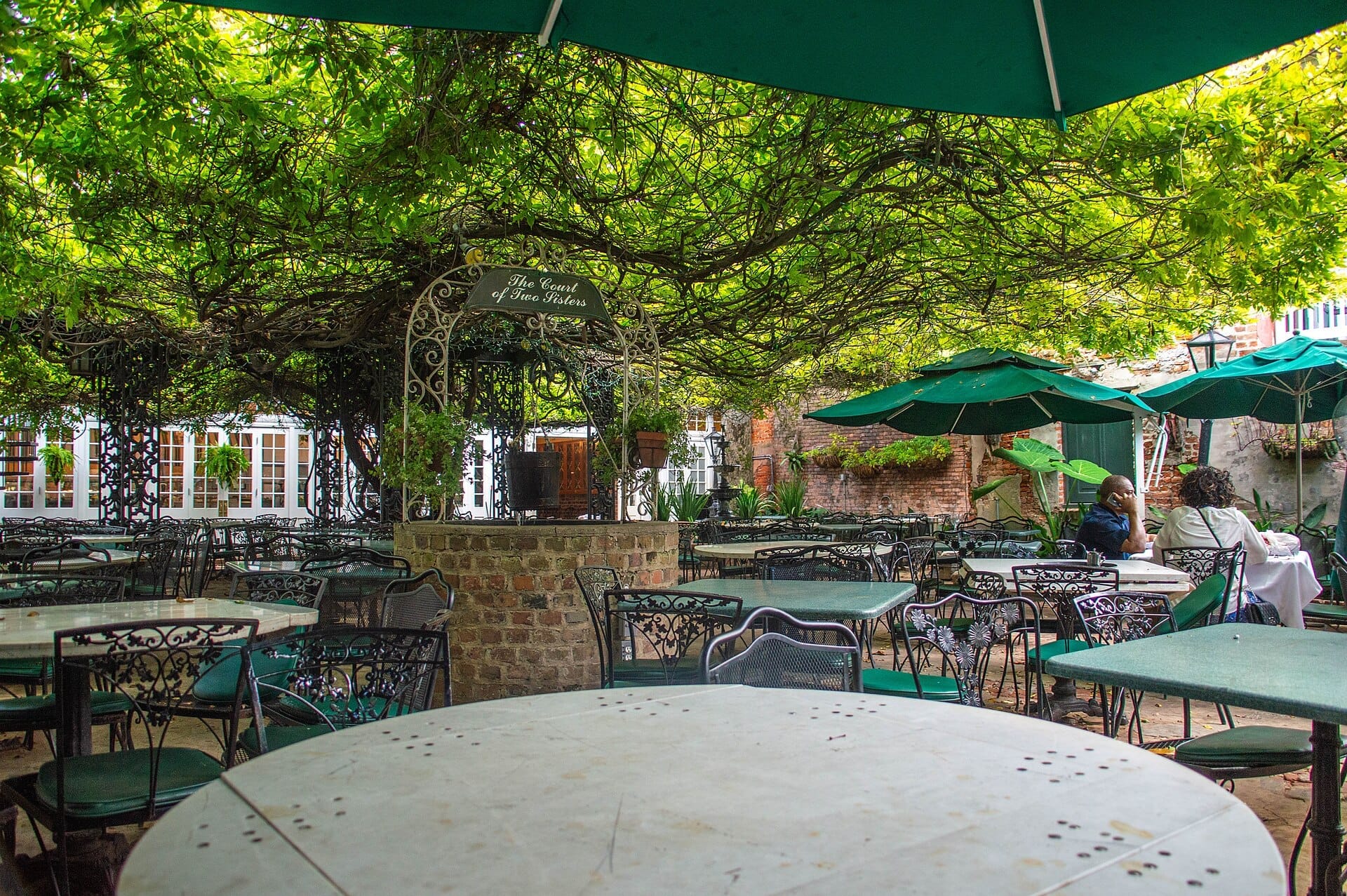
The Court of Two Sisters is a restaurant and historic property at 613 Royal Street in the French Quarter, best known for its daily jazz brunch served in one of the largest courtyard gardens in the neighborhood. The experience sits somewhere between a cultural landmark and a serious meal: the jazz trio plays continuously from 9 a.m., the courtyard smells of wisteria and coffee, and the buffet spans dozens of Creole and Cajun dishes. It is the kind of place that sounds slightly touristy on paper but delivers something genuinely worth experiencing.
For visitors exploring the French Quarter, this is one of the few places where a meal doubles as a full architectural and historical encounter. The property has been continuously occupied since 1726, making it older than the United States itself.
💡 Local tip
Reservations are strongly recommended, especially for weekend brunches and courtyard seating. Walk-ins are sometimes possible on weekday mornings, but the courtyard fills quickly after 10 a.m.
The History Behind the Name
The site dates to 1726, when it served as the residence of Sieur Etienne de Perier, the French governor of Louisiana. The current structure was built in 1832 for Jean Baptiste Zenon Cavelier, and like much of the French Quarter's architecture, it reflects the Spanish Colonial period's influence: thick masonry walls, wrought-iron balconies, and a central courtyard designed to channel airflow through a building without air conditioning.
The restaurant's name comes from Emma and Bertha Camors, two sisters who operated a notions shop on this property from 1886 until the early 20th century. They sold fine gowns, fabrics, and novelties, and they welcomed customers into the courtyard for tea, establishing the social tradition the space still carries today. The Fein family purchased the property in 1963 and has operated it for three generations, which explains the consistency in quality and character that many long-term visitors remark upon.
That layered ownership history, French colonial origins, Spanish-period construction, Creole shopkeeper identity, and family restaurant stewardship, mirrors the broader story told throughout New Orleans history. Understanding that context makes the visit richer.
Tickets & tours
Hand-picked options from our booking partner. Prices are indicative; availability and final rates are confirmed when you complete your booking.
Spooky kid-friendly family ghost tour
From 32 €Instant confirmationFree cancellationWalking the Devil's Empire tour with HELLVISION™ in New Orleans
From 32 €Instant confirmationFree cancellationThe New Orleans haunted cemetery city bus tour
From 43 €Instant confirmationFree cancellationWhitney Plantation Tour
From 72 €Instant confirmationFree cancellation
The Courtyard: What It Actually Looks and Feels Like
The courtyard is large by French Quarter standards, roughly half a city lot, with multiple seating areas separated by fountain features, potted palms, and old brick pathways. In late spring, the wisteria is in bloom overhead, and the scent mingles with coffee and beignet dough in a way that is hard to describe without sounding like a brochure. Even outside bloom season, the space is visually dense: ferns hanging from cast-iron brackets, magnolia leaves catching the light, the sound of a fountain competing softly with a jazz trio.
Early arrivals (before 9:30 a.m.) get the courtyard at its most peaceful, when morning light comes in low and the crowd is thin enough to hear the musicians clearly. By 11 a.m. the room fills substantially, the ambient noise rises, and the experience shifts toward festive rather than serene. Neither version is wrong, but they are genuinely different. If you want a quiet, contemplative brunch, arrive early on a weekday. If you want the full celebratory atmosphere, come at 11 a.m. on a Saturday.
ℹ️ Good to know
The courtyard has both fully open and partially covered sections. During summer months (June–August), temperatures in New Orleans regularly reach the low 90s°F (33°C) with high humidity. Request a shaded table or plan your visit for the fall or spring season if heat is a concern.
The Jazz Brunch: Food and Music
The jazz brunch runs daily from 9:00 a.m. to 3:00 p.m. and is offered as a buffet. The spread is extensive: expect shrimp Creole, grillades and grits, eggs Benedict, crawfish dishes, red beans and rice, carved meats, cheese boards, and multiple dessert options including bread pudding with whiskey sauce. The buffet format means you can try a wide range of Creole cooking in a single sitting, which works particularly well for first-time visitors who want a comprehensive taste of the local cuisine.
The live jazz trio performs throughout the brunch service, rotating through traditional New Orleans jazz, blues, and second line rhythms. For visitors who want to understand the city's musical heritage more deeply, the New Orleans Jazz Museum is a few blocks away on Esplanade Avenue and pairs well with this experience.
Dinner is offered as an à la carte service. The dinner menu leans into Creole fine dining with dishes like turtle soup, duck, and Gulf seafood preparations. The atmosphere is quieter at dinner, and the courtyard takes on a different character under evening lighting. Reservations are essential for dinner.
The Architecture: Reading the Building
The building itself is worth a slow look before you sit down. The facade on Royal Street dates to the 1832 reconstruction and displays the hallmarks of New Orleans Creole townhouse design: arched carriageway entrance, thick stuccoed brick walls, and upper-floor galleries fronted by decorative ironwork. The carriageway, the tunnel-like passage that leads from Royal Street into the courtyard, was originally designed to allow horse-drawn vehicles to pass through to the rear. Walking through it today, you pass from the noise and movement of Royal Street into a space that feels removed from the city.
Royal Street itself is one of the French Quarter's most architecturally intact corridors, lined with galleries, antique shops, and historic properties. The Royal Street experience rewards a slow walk before or after your meal.
Practical Information for Visitors
The restaurant is located at 613 Royal Street, which puts it squarely in the heart of the French Quarter, two blocks from Bourbon Street and about four blocks from Jackson Square. The Riverfront Streetcar has a stop near Toulouse Street, a short walk away. Most visitors staying in the French Quarter or Central Business District can walk here in under 15 minutes.
The property is listed as wheelchair accessible, with table service available throughout. Non-smoking throughout. Private dining options exist for groups. Dress code is smart casual for brunch and slightly more polished for dinner, though the restaurant does not enforce a strict code. Children are welcome at brunch.
For those planning a broader French Quarter day, combining this brunch with a walk to Jackson Square and the surrounding streets makes for a natural and unhurried morning itinerary.
⚠️ What to skip
Brunch prices are not listed on the restaurant's website and should be confirmed directly or by calling ahead. As a buffet in a high-profile French Quarter location, expect pricing at the upper end of casual dining. Verify current rates before visiting.
Honest Assessment: Who This Works For and Who It Does Not
The Court of Two Sisters earns its reputation primarily through the courtyard itself and the quality of the Creole buffet. The jazz is live and authentic, not recorded background music. The history is real and visible in the bones of the building. For a certain kind of traveler, this is exactly what New Orleans is supposed to feel like.
That said, visitors looking for a cutting-edge dining experience or a local neighborhood restaurant will find this too formal and too oriented toward the tourist experience. The buffet format and large dining room mean that service, while professional, lacks the intimacy of smaller Creole establishments. If your priority is eating where locals eat rather than where history happened, this may not be your first choice.
Travelers on a tight budget should also consider alternatives. The budget options in New Orleans can still deliver exceptional Creole food at a fraction of the price. The Court of Two Sisters is a splurge, and it is most rewarding for those who treat it as such.
Insider Tips
- Request a table near the fountain when making your reservation. The sound of the water provides a buffer from the crowd noise as the room fills up toward midday.
- Arrive right at 9 a.m. on a weekday if you want the courtyard mostly to yourself. The early crowd is thin, the light is best for photography, and the buffet has just been refreshed.
- The carriageway entrance on Royal Street is always open during service hours. Even if you are not eating, pausing in the passage to look through into the courtyard costs nothing and gives you a sense of the space.
- For the best wisteria viewing, visit between late March and early May. The blooms are fragrant and photogenic, and this window also coincides with some of the best weather of the year in New Orleans.
- If the brunch crowd feels overwhelming, note that the dinner service is considerably quieter and the à la carte format allows for a more focused experience of the kitchen's Creole cooking.
Who Is Court of Two Sisters For?
- First-time visitors to New Orleans wanting a comprehensive introduction to Creole cuisine in a historic setting
- Couples looking for a special occasion brunch with atmosphere and live music
- Architecture and history enthusiasts interested in French Quarter Creole townhouse design
- Travelers who appreciate leisurely meals where the setting is part of the experience
- Groups celebrating milestones who can make use of the private dining options
Nearby Attractions
Other things to see while in French Quarter:
- Bourbon Street
Rue Bourbon is one of America's most recognizable streets, stretching 13 blocks through the French Quarter from Canal Street to Esplanade Avenue. The nightlife reputation is well-earned, but the street has genuine historical depth and a quieter, more complex daytime character that most visitors never see.
- The Cabildo
Standing on the edge of Jackson Square since 1799, The Cabildo is the building where the Louisiana Purchase transfer was formally completed in 1803, reshaping a continent. Today it houses the Louisiana State Museum's flagship collection on state history, from colonial rule to Reconstruction, making it the most historically consequential building in New Orleans.
- Café du Monde
Open since 1862, Café du Monde on Decatur Street is the oldest coffee stand in New Orleans and one of the most recognizable spots in the French Quarter. The menu is deliberately simple: beignets dusted in powdered sugar and café au lait made with chicory. What makes or breaks the visit is knowing when to go and what to expect.
- French Market
The French Market stretches six blocks through the French Quarter, from the edge of Jackson Square to the old New Orleans Mint. Free to enter and open daily, it combines a farmers market, flea market, craft vendors, and open-air food stalls in a setting with roots stretching back before the United States existed.