French Market New Orleans: America's Oldest Market Explained
The French Market stretches six blocks through the French Quarter, from the edge of Jackson Square to the old New Orleans Mint. Free to enter and open daily, it combines a farmers market, flea market, craft vendors, and open-air food stalls in a setting with roots stretching back before the United States existed.
Quick Facts
- Location
- 1100 N. Peters Street, French Quarter, New Orleans, LA 70116
- Getting There
- RTA Riverfront Streetcar (French Market stop); walkable from Jackson Square
- Time Needed
- 1 to 2 hours for a full walk-through; longer if you browse the flea market
- Cost
- Free entry. Individual vendor purchases vary.
- Best for
- History buffs, casual browsers, souvenir shoppers, food explorers
- Official website
- www.frenchmarket.org
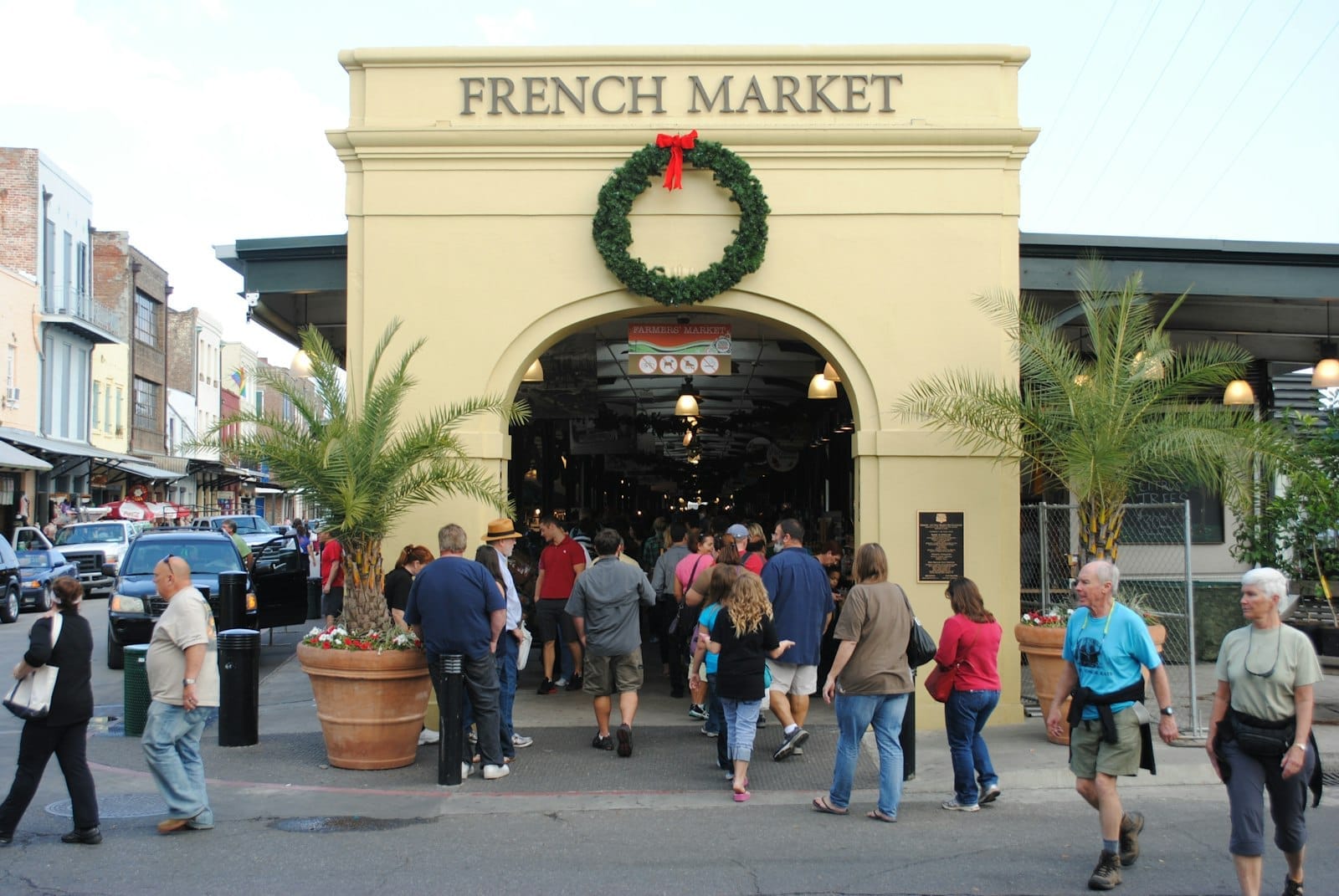
What the French Market Actually Is
The French Market is a six-block open-air market district running along the Mississippi River side of the French Quarter. It begins where Decatur Street brushes up against Jackson Square, near the iconic green-and-white awnings of Café du Monde, and extends downriver toward Esplanade Avenue. That stretch covers retail shops under the historic colonnades, a daily farmers market with food stalls and café-style seating, and a flea market at the far end where local vendors sell everything from brass instruments to handmade jewelry.
Free to enter every day of the week, including holidays, the market draws a wide mix of visitors: tourists on their first morning in the city, locals picking up fresh produce, street musicians setting up near the food stalls, and the occasional jogger cutting through from the Moon Walk along the river. It is not a quiet, curated experience. It is loud, sometimes chaotic, and smells alternately of roasted coffee, fried food, and river air. That combination is exactly the point.
ℹ️ Good to know
Retail shops are open 10am to 6pm daily. The Flea Market vendors run until 5pm daily; the Farmers Market and food eateries run 10am to 6pm daily. Verify hours before visiting, as these can shift around major events.
A Market Older Than the United States
The French Market traces its origins to a Native American trading post that predated European colonization, making it the oldest continuously operating market of its kind in the United States. By 1791 the market was operating in an organized capacity under the city, and it has remained in continuous use since. The brick-and-stucco structure most visitors walk through today has genuine historical substance beneath the tourist veneer.
The Meat Market building dates to 1813 and is noted in historical records. The Vegetable Market was designed by city surveyor Joseph Pilie and constructed between 1822 and 1830. Both structures still stand. The deep covered arcades with their cast-iron columns were built to handle the subtropical heat and frequent rain of New Orleans, and they work just as well now as they did two centuries ago.
For travelers already interested in the layered colonial history of this neighborhood, the market is worth reading alongside a broader look at the French Quarter and its architectural inheritance from French and Spanish rule.
Tickets & tours
Hand-picked options from our booking partner. Prices are indicative; availability and final rates are confirmed when you complete your booking.
Spooky kid-friendly family ghost tour
From 32 €Instant confirmationFree cancellationSinister Criminal Intentions
From 33 €Instant confirmationFree cancellationGhosts and Spirits Walking Tour
From 23 €Instant confirmationFree cancellationCity Sightseeing hop-on hop-off bus tour of New Orleans
From 0 €Instant confirmationFree cancellation
Moving Through the Market: A Practical Walkthrough
Most visitors start at the Jackson Square end, where the covered colonnade section holds a row of permanent retail shops. These lean heavily toward New Orleans souvenirs: hot sauce collections, Mardi Gras beads, Saints gear, praline candy, and Creole spice mixes. Quality varies significantly from stall to stall. The better food vendors tend to be toward the middle of the market, in the open Farmers Market section, where local producers and food stalls set up with more day-to-day turnover.
The Farmers Market section is where the market feels most like a living neighborhood institution. You will find fresh produce, local honey, specialty hot sauces, and a cluster of small food counters selling everything from Louisiana-style seafood to empanadas. Seating is informal and shared. This is a reasonable place to grab a quick lunch, especially if you are in between sights and do not want to commit to a full sit-down meal.
The flea market at the downriver end, near the Old U.S. Mint, operates daily and draws a different crowd entirely. Vendors here sell antiques, vintage clothing, handmade crafts, African and Caribbean imports, and a fair amount of general merchandise. Prices are negotiable in most cases. If you are looking for something genuinely local rather than mass-produced, this end of the market gives you a better chance of finding it.
💡 Local tip
The flea market end is less crowded than the Jackson Square end for most of the morning. If browsing is your goal, start at the Mint end and work back toward Café du Monde.
How the Experience Changes Through the Day
Early morning, after the market opens at 10am, the covered arcades are used by joggers and locals cutting through to the river. The smell of coffee from nearby Café du Monde drifts across the intersection. Once the market opens, the colonnade shops fill with the first tour groups of the day fairly quickly, particularly between 10am and noon.
Midday is the market at full activity. Street musicians set up near the food stalls. The farmers market seating fills with a mix of lunch visitors and resting walkers. The heat, particularly from June through September when temperatures regularly reach the low 90s Fahrenheit, makes the covered sections noticeably more appealing. In summer, the shade of the colonnades is not a small detail; it is the reason these buildings were designed the way they were.
Late afternoon, especially after 4pm, sees the retail shops beginning to wind down. The flea market vendors start packing up closer to 6pm. If you want the most relaxed version of this visit, aim for a weekday afternoon in the shoulder seasons: March through May, or October through early November, when temperatures sit in the 60s to low 80s Fahrenheit and the crowds are thinner than on weekend mornings.
⚠️ What to skip
Summer visits between June and September mean high heat and humidity. Bring water, wear breathable clothing, and use the covered arcades rather than the open sections at peak midday heat.
What the Market Connects To
The French Market sits at the center of one of the French Quarter's most walkable stretches. Jackson Square is less than a two-minute walk from the upper end of the market, making it a natural pairing. The Moon Walk, the riverside pedestrian promenade, runs directly behind the market and gives you unobstructed views of the Mississippi River and passing river traffic.
The Café du Monde is directly adjacent at the Jackson Square end. It is the most obvious place to start or end a market visit with a coffee and beignets, though the lines during peak morning hours can stretch 20 to 30 minutes. The Pontalba Buildings facing Jackson Square are also within easy walking distance and represent some of the oldest apartment buildings in the United States.
For travelers who want to extend their time in the area, Royal Street is one block inland and runs parallel to the market for its full length. It offers a quieter version of French Quarter shopping, with a higher concentration of antique dealers and art galleries.
Photography and Practical Notes
The colonnade architecture photographs well in the late afternoon when the light comes in at a low angle through the arches. Early morning before vendors set up also gives you clean shots of the structural ironwork without crowds in the frame. The flea market end is visually dense and rewards close-up photography: stacked ceramics, hanging beads, handmade masks, and the weathered faces of vendors who have been working this market for years.
The market is largely accessible for mobility aids along the main colonnade walkway, which is flat and paved. Some of the flea market sections involve uneven surfaces and tighter stall configurations. Restrooms are available within the market district; look for signage near the Farmers Market section.
A note on honest expectations: the French Market is not a farmers market in the artisanal sense that word implies in many cities. Parts of it are clearly oriented toward tourist traffic, with the same branded merchandise found in shops along Bourbon Street. The genuine local character survives in the farmers market section and in the flea market at the far end. Visitors expecting an undiscovered culinary institution may find those sections underwhelming. Visitors who understand what it is, a working commercial market with real historical roots and a lively street atmosphere, tend to enjoy it considerably more.
Insider Tips
- Start at the Mint end of the flea market and work toward Jackson Square. You will cover the same ground but with less congestion early in the morning when vendors at that end are just setting up.
- Free musical performances happen in the market periodically, particularly on weekends. There is no schedule posted in advance, but if you hear live music from the street, walk toward it rather than away from it.
- The food stalls in the Farmers Market section offer some of the more affordable quick-eat options in this part of the French Quarter. Compare prices before committing; portions and quality vary considerably between adjacent stalls.
- If you are buying hot sauce, Creole spice mixes, or local food products, the Farmers Market vendors often give small samples. Ask before assuming.
- The market sits directly on the RTA Riverfront Streetcar line. If you are staying anywhere along Canal Street or the CBD, the streetcar gets you to the French Market stop without a taxi or rideshare.
Who Is French Market For?
- First-time visitors who want a single location that covers food, shopping, history, and river views in one walk
- Travelers looking for locally made or distinctive souvenirs rather than mass-produced items (focus on the flea market end)
- History-minded visitors interested in pre-American urban commercial architecture
- Budget travelers: the market is free, the food stalls are affordable, and the street music costs nothing
- Anyone combining a morning visit to Jackson Square and Café du Monde with a casual walk along the riverfront
Nearby Attractions
Other things to see while in French Quarter:
- Bourbon Street
Rue Bourbon is one of America's most recognizable streets, stretching 13 blocks through the French Quarter from Canal Street to Esplanade Avenue. The nightlife reputation is well-earned, but the street has genuine historical depth and a quieter, more complex daytime character that most visitors never see.
- The Cabildo
Standing on the edge of Jackson Square since 1799, The Cabildo is the building where the Louisiana Purchase transfer was formally completed in 1803, reshaping a continent. Today it houses the Louisiana State Museum's flagship collection on state history, from colonial rule to Reconstruction, making it the most historically consequential building in New Orleans.
- Café du Monde
Open since 1862, Café du Monde on Decatur Street is the oldest coffee stand in New Orleans and one of the most recognizable spots in the French Quarter. The menu is deliberately simple: beignets dusted in powdered sugar and café au lait made with chicory. What makes or breaks the visit is knowing when to go and what to expect.
- Court of Two Sisters
The Court of Two Sisters on Royal Street is one of New Orleans' most enduring dining institutions, serving a daily jazz brunch buffet in a courtyard that has been gathering people since the 18th century. The combination of live jazz, Creole cuisine, and centuries-old architecture makes it unlike anything else in the city.