Moon Walk New Orleans: The French Quarter's Riverfront Promenade
The Moon Walk is a nearly 3,500-foot brick promenade hugging the Mississippi River at the edge of the French Quarter. Free, open-air, and surprisingly peaceful at the right hour, it offers unobstructed river views, public sculpture, and a direct connection to Jackson Square — all without costing a cent.
Quick Facts
- Location
- Riverfront between Governor Nicholls Street Wharf and Woldenberg Park, French Quarter, New Orleans
- Getting There
- RTA Riverfront Streetcar; walkable from Jackson Square via Washington Artillery Park
- Time Needed
- 30–60 minutes for a full stroll; longer if you linger at the steps
- Cost
- Free
- Best for
- River views, morning walks, public art, photography, and a quiet escape from Bourbon Street
What the Moon Walk Actually Is
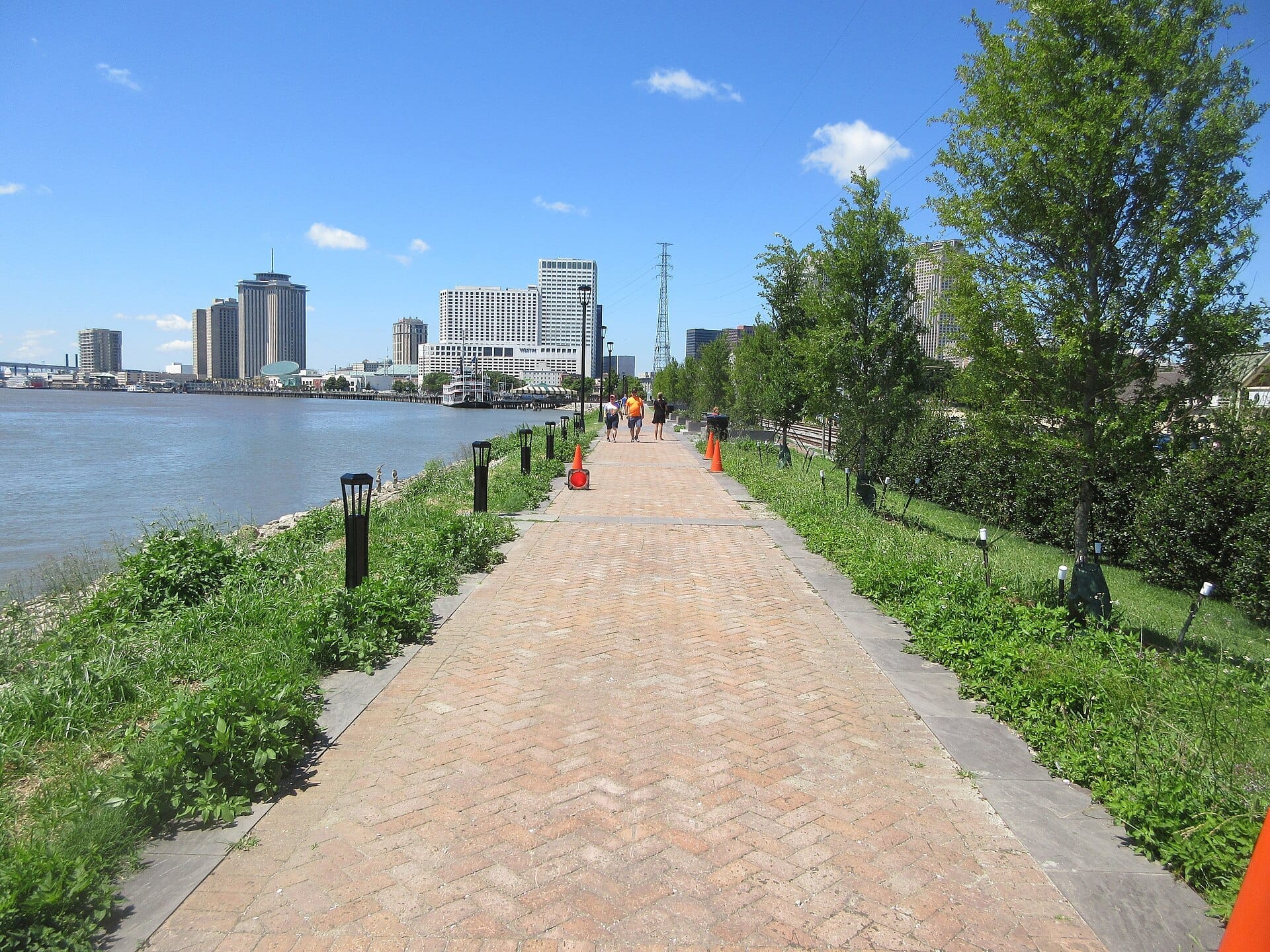
The Moon Walk is a public riverfront promenade running nearly 3,500 feet along the east bank of the Mississippi River, stretching from the Governor Nicholls Street Wharf in the upper French Quarter down to the Aquarium of the Americas and Woldenberg Park. The name has nothing to do with moonlight or the dance move: it honors Maurice 'Moon' Landrieu, the New Orleans mayor who first opened the original wooden boardwalk in 1975, returning public access to a riverfront that had been dominated by industrial wharves for generations.
The version you walk today features a brick surface with cut stone pavers, laid on top of the existing levee system and dedicated during the city's tricentennial celebration. Wide concrete steps, 70 feet across, descend directly to the river's edge — one of the few places in the city where you can actually get close enough to feel the current, or watch a container ship pass at what feels like arm's length.
ℹ️ Good to know
The Moon Walk sits between a concrete flood wall and the railroad tracks on one side and the Mississippi River on the other. Crossing those tracks on foot is not legal or safe — use the designated grade crossings at St. Philip, Dumaine, St. Peter, Toulouse, St. Louis, Conti, or Bienville Streets.
What You See: River, Sky, and the City's Skyline
The Mississippi River at this point is wide, brown, and relentlessly moving. It carries enormous volume south toward the Gulf, and when river traffic is active, you can watch tugboats nudging barges, or a cruise ship docking at the Julia Street terminal. The Crescent City Connection Bridge frames the view to the southwest. Behind you, the upper floors and spire of St. Louis Cathedral peek above the levee, creating one of the most photographed angles in New Orleans.
Looking back across the tracks and flood wall toward the French Quarter, the roofline of the Jackson Square complex comes into view. From the Washington Artillery Park overlook — the formal connection point between Jackson Square and the Moon Walk — you get an elevated perspective over both the square and the river simultaneously. Sunset from that overlook, with the cathedral lit in the background, is one of the most striking urban views in the American South.
The promenade is dotted with iron benches and black metal lampposts at regular intervals, and three designated gathering nodes break up the linear path. Some sections are tree-lined, which provides shade in summer months when the brick surface radiates considerable heat by midday. On weekday mornings, the bench-sitters tend to be locals: older residents with coffee cups, joggers cooling down, people watching river traffic with the relaxed attention of those who have been doing it for decades.
Tickets & tours
Hand-picked options from our booking partner. Prices are indicative; availability and final rates are confirmed when you complete your booking.
Walking the Devil's Empire tour with HELLVISION™ in New Orleans
From 32 €Instant confirmationFree cancellationGhosts and Spirits Walking Tour
From 23 €Instant confirmationFree cancellationNew Orleans Garden District small group guided walking tour
From 31 €Instant confirmationFree cancellationNew Orleans French Quarter self-guided walking audio tour
From 10 €Instant confirmation
Public Art Along the Promenade
The Moon Walk holds three significant public artworks that are worth slowing down for, rather than walking past.
The Monument to the Immigrants by Franco Allesandrini acknowledges the waves of European and Caribbean arrivals who shaped New Orleans into one of the most culturally layered cities in North America. Robert Schoen's 'Old Man River' figure stands as a direct reference to the river's mythological status in American culture, a status that writers from Mark Twain to Langston Hughes have reinforced in print. The Holocaust Memorial, dedicated in 2003 and designed by Israeli-French artist Jacob Agam, is a more somber installation, and its presence on a public promenade rather than inside a museum gives it a different kind of weight.
If you plan to spend significant time with the art and history of the riverfront, this walk pairs naturally with a visit to the National WWII Museum in the Central Business District, or the exhibits inside the Cabildo just steps away at Jackson Square.
How the Experience Changes by Time of Day
Early morning, roughly 6:30 to 9:00 AM, is when the Moon Walk earns its best reviews. The light on the river in the hour after sunrise turns the water from brown to copper, mist sometimes sits low above the current, and the French Quarter behind you is mostly quiet. The benches are occupied but not crowded. The smell is river water, diesel from the tugboats, and occasionally the salt-sweet exhaust from a nearby bakery if the wind is right.
By late morning and into the afternoon, particularly on weekends, the foot traffic increases substantially. Tour groups cross from Jackson Square, cruise passengers in transit between the ship and the Quarter, and families from the nearby Aquarium fill the promenade. The brick surface retains heat aggressively in summer, and between June and August, the midday walk in direct sun is genuinely uncomfortable. Carry water, wear sunscreen, and consider the shade sections near the northern end of the promenade.
Evening brings a different character. Street musicians sometimes set up near the Washington Artillery Park crossing. The river lights shift from orange to black. The cathedral glows. It can feel romantic or slightly lonely depending on your company, and neither of those things is wrong. Later at night, the promenade is quieter but also less populated, which is worth factoring into your comfort level.
⚠️ What to skip
At night, the Moon Walk is publicly lit but relatively isolated from the main activity of the French Quarter. It is not dangerous by reputation, but standard urban awareness applies: keep valuables out of sight and avoid long stretches alone very late at night. Review current safety advisories before your trip.
Getting There and Getting Around
The most natural approach is on foot from Jackson Square, through Washington Artillery Park, where a ramp and steps bring you down to the promenade level. Grade crossings at seven streets including St. Peter, Toulouse, and St. Louis provide entry and exit points along the length of the walk. The RTA Riverfront Streetcar runs parallel to the promenade along the French Quarter side and stops near the Aquarium of the Americas at the southern end, making a one-way stroll convenient: walk the promenade in one direction and ride the streetcar back.
The Steamboat Natchez departs from the dock near the Toulouse Street crossing, and boarding passengers pass through the Moon Walk area as part of their approach. If you have the Natchez on your itinerary, arrive 20 minutes early and use that time to walk a section of the promenade first.
The Aquarium of the Americas and Woldenberg Park anchor the southern end of the Moon Walk, and the transition between the two spaces is seamless. Families visiting the aquarium frequently extend their time outdoors along the promenade before or after.
Photography: Where to Stand and When
The signature shot from the Moon Walk is the St. Louis Cathedral framed above the levee wall, best captured from the river steps looking back toward the city. A wide-angle lens or a phone camera in landscape mode works well here. The cathedral spire appears in the upper third of the frame, the levee wall provides a strong horizontal line, and if you time it for golden hour, the warm stone of the cathedral glows.
For the river itself, position yourself at the wide concrete steps and shoot downriver toward the Crescent City Connection Bridge. Passing ships create natural foreground interest. The most photographed spots in New Orleans include this stretch of riverfront precisely because it combines architecture, water, and sky in a single frame without telephone lines or parking lots interrupting the composition.
💡 Local tip
For the best light on the river and the cathedral, visit during the 30 minutes before and after sunrise. The promenade is nearly empty at that hour, the reflection on the water is extraordinary, and the heat has not yet built up on the brick surface.
Is the Moon Walk Worth Your Time?
If you are visiting Jackson Square or the French Quarter, the Moon Walk costs you nothing and requires only a five-minute detour through Washington Artillery Park. The river views are real, the public art is thoughtfully placed, and on the right morning it is one of the more quietly powerful experiences available in the city.
Travelers who may not get much from this stop: those with very limited mobility who find uneven brick surfaces and levee steps difficult, people whose only goal is nightlife (the area is subdued compared to Bourbon Street two blocks away), and visitors during peak summer afternoons who may find the heat genuinely punishing. That said, even in summer, the early morning version of this walk is worth setting an alarm for.
The Moon Walk is not the kind of attraction that justifies a trip to New Orleans on its own. But if you are already in the French Quarter, skipping it entirely means missing the only place in the neighborhood where the Mississippi River is right in front of you, immediate and enormous, doing what it has done for the entire history of this city.
Insider Tips
- The wide concrete steps leading to the river are an excellent place to sit and eat breakfast from Café du Monde, which is a short walk away. The smell of beignet powder drifting across the levee in the morning is a distinctly New Orleans experience.
- The Steamboat Natchez dock near Toulouse Street is a useful orientation point on the promenade. If you can hear the calliope playing from the steamboat, you are in the right section of the walk.
- The promenade's brick surface becomes slippery when wet. New Orleans gets significant rainfall year-round, and the levee steps especially lose traction quickly after a shower. Wear flat-soled shoes with grip.
- Three public art monuments are spread along the promenade but are easy to walk past without realizing what they are. Look for interpretive plaques near each installation: the Monument to the Immigrants, 'Old Man River,' and the Jacob Agam Holocaust Memorial are all worth a pause.
- For the least crowded experience when cruise ships are in port, walk the northern section of the promenade (toward Governor Nicholls Wharf) rather than the southern end near the Aquarium, where cruise passengers tend to cluster.
Who Is Moon Walk For?
- Early risers who want a quiet start before the French Quarter wakes up
- Photographers chasing the cathedral-and-river composition at golden hour
- Families with children who want open outdoor space and river views without an admission fee
- History-minded travelers interested in how New Orleans reclaimed its public riverfront
- Visitors on a tight budget looking for meaningful, free experiences in the French Quarter
Nearby Attractions
Other things to see while in French Quarter:
- Bourbon Street
Rue Bourbon is one of America's most recognizable streets, stretching 13 blocks through the French Quarter from Canal Street to Esplanade Avenue. The nightlife reputation is well-earned, but the street has genuine historical depth and a quieter, more complex daytime character that most visitors never see.
- The Cabildo
Standing on the edge of Jackson Square since 1799, The Cabildo is the building where the Louisiana Purchase transfer was formally completed in 1803, reshaping a continent. Today it houses the Louisiana State Museum's flagship collection on state history, from colonial rule to Reconstruction, making it the most historically consequential building in New Orleans.
- Café du Monde
Open since 1862, Café du Monde on Decatur Street is the oldest coffee stand in New Orleans and one of the most recognizable spots in the French Quarter. The menu is deliberately simple: beignets dusted in powdered sugar and café au lait made with chicory. What makes or breaks the visit is knowing when to go and what to expect.
- Court of Two Sisters
The Court of Two Sisters on Royal Street is one of New Orleans' most enduring dining institutions, serving a daily jazz brunch buffet in a courtyard that has been gathering people since the 18th century. The combination of live jazz, Creole cuisine, and centuries-old architecture makes it unlike anything else in the city.