St. Louis Cathedral: New Orleans' Most Iconic Landmark, Explained
The Cathedral Basilica of St. Louis, King of France has stood at the edge of Jackson Square since the French colonial era, surviving fire, hurricanes, and centuries of reinvention. Often described as one of the oldest continuously active Roman Catholic cathedrals in the United States, the St. Louis Cathedral has anchored Jackson Square since the 18th century, and is one of the most photographed buildings in the American South. This guide covers what to see inside, when crowds are lightest, and how the experience shifts between a quiet weekday morning and a packed Saturday afternoon.
Quick Facts
- Location
- 615 Pere Antoine Alley, French Quarter, New Orleans, LA — facing Jackson Square
- Getting There
- Walk from Canal St. streetcar stop (5 min); Riverfront streetcar to Toulouse St. (7 min walk)
- Time Needed
- 30–60 minutes for the interior; longer if you combine with Jackson Square
- Cost
- Free entry; donations welcomed
- Best for
- History lovers, architecture enthusiasts, photographers, and anyone wanting context for the French Quarter
- Official website
- www.stlouiscathedral.org
Why This Building Matters
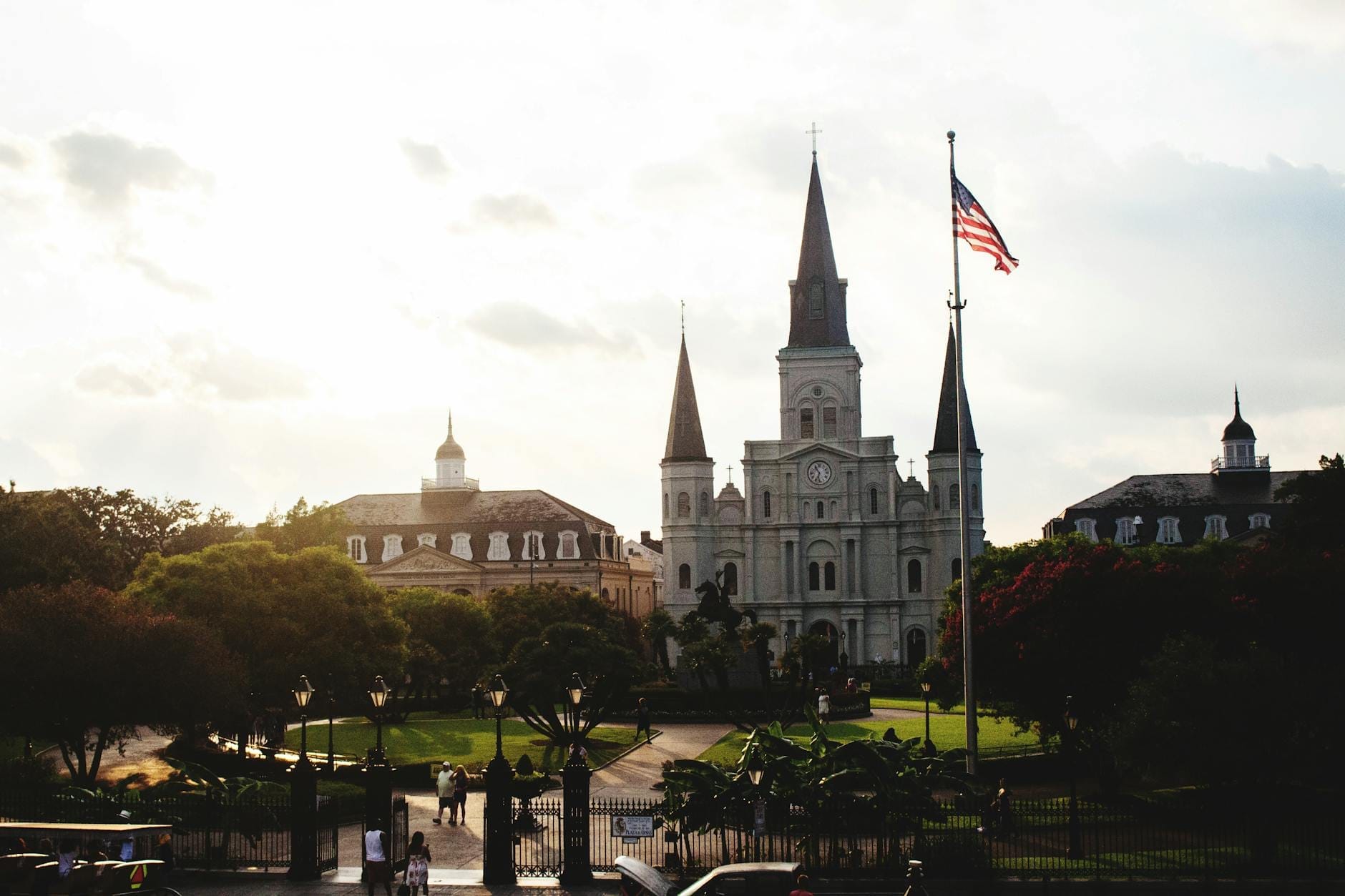
The Cathedral Basilica of St. Louis, King of France is not just a church. It is the architectural and symbolic center of New Orleans, a city whose identity was shaped as much by Catholicism as by jazz, commerce, and the Mississippi River. Every version of New Orleans has organized itself around this spot. The original structure went up in 1727, making this site often cited as one of the oldest continuously active Catholic cathedrals in the United States. What stands today is largely the result of an 1851 reconstruction, but the institution and its location have never changed.Standing in the French Quarter and looking at the cathedral from Jackson Square, it is easy to understand why early colonial administrators placed the church here deliberately: the triple spires are visible from the river, the building faces the parade ground, and its clock tower (added by architect Benjamin Henry Latrobe in 1819) once served as a navigational reference for river pilots. That combination of religious function and civic symbolism is still legible in the building today.
ℹ️ Good to know
The cathedral was designated a minor basilica by Pope Paul VI in 1964, giving it a formal ecclesiastical rank above an ordinary parish church. Masses are held regularly, so visits during services require respectful silence and may limit access to certain areas of the nave.
Three Centuries of Fire, Rebuilding, and Reinvention
The first wooden church on this site burned down in 1788 during the Good Friday Fire, one of the worst disasters in colonial New Orleans history. A replacement was completed and dedicated in 1794 under Spanish colonial rule, which explains the Spanish Baroque influences that survived into later renovations. The current structure was significantly remodeled and expanded in 1849–1851 under architect J.N.B. de Pouilly, who gave the building its present French Baroque silhouette with three distinctive steepled towers. The central clock tower, the tallest, reaches approximately 130 feet.
That 1851 renovation also set the interior proportions visitors see today: a wide nave with barrel-vaulted ceilings, flanked by side aisles and topped by the frescoes that define the upper walls. The frescoes were added in 1872 by Erasmus Humbrecht and depict scenes from the life of St. Louis IX of France, the cathedral's namesake. They cover most of the ceiling above the nave and are best viewed from the center aisle, where the full compositional arc is readable. The stained glass windows date to 1929 and came from the Oidtmann workshop in Germany, adding saturated color that shifts noticeably depending on the angle of exterior light.
Tickets & tours
Hand-picked options from our booking partner. Prices are indicative; availability and final rates are confirmed when you complete your booking.
New Orleans St. Louis Cemetery tickets and guided tour
From 21 €Instant confirmationFree cancellationSpooky kid-friendly family ghost tour
From 32 €Instant confirmationFree cancellationWalking the Devil's Empire tour with HELLVISION™ in New Orleans
From 32 €Instant confirmationFree cancellationThe New Orleans haunted cemetery city bus tour
From 43 €Instant confirmationFree cancellation
What You See When You Walk In
The entrance on Pere Antoine Alley opens into a narthex before the nave. The scale inside is larger than the exterior suggests. The central aisle runs roughly 160 feet toward the main altar, with wooden pews on both sides. Above the altar, a large painted mural of St. Louis announcing the Seventh Crusade dominates the apse. It is one of the first things your eye is drawn to, even before the ceiling frescoes register.
The Humbrecht ceiling frescoes are the most significant interior feature and deserve more than a glance upward. Take a position in the middle of the nave and let your eyes track the full sequence: scenes from St. Louis IX's life rendered in a 19th-century academic style with relatively accurate medieval costuming. The quality is uneven by modern art-historical standards, but the ambition is clear, and the fact that they have survived over 150 years in a city prone to moisture damage is itself remarkable.
Side chapels along both aisles contain smaller devotional altars and older statuary. These quieter recesses are where you notice the smell of candle wax and old stone that is absent in the main nave. In the morning, before the midday crowds arrive, the light through the German stained glass panels on the south side creates long patches of amber and cobalt across the floor tiles.
How the Experience Changes by Time of Day
Early morning, typically between 8 and 10 a.m., is the most rewarding window for a visit. Jackson Square itself is quiet at this hour, the portrait artists and street musicians haven't set up yet, and the cathedral interior has a stillness that is hard to find later. Light from the east-facing windows enters at a low angle and catches the gold detail on the altar. A handful of worshippers may be present, but the building does not feel crowded.
By late morning, tour groups begin arriving, and the acoustics of the nave amplify the ambient noise of large groups to a distracting degree. Early afternoon on weekends is the peak of foot traffic, with lines occasionally forming outside the main entrance. If your visit falls during a Mass, the nave is in active liturgical use and photography at the altar is not appropriate. Weekend Masses are typically scheduled in the morning; verify the current schedule on the cathedral's official website before planning around them.
Late afternoon offers a secondary window, particularly in the fall and winter months when the light drops below the surrounding buildings and hits the facade directly. The famous view of the cathedral from across Jackson Square is best photographed from this angle, with the equestrian statue of Andrew Jackson in the foreground. If the sky is clear, the white stucco facade against a deep blue sky is the image most visitors are looking for.
💡 Local tip
For the cleanest exterior photograph with the Jackson Square fountain and the cathedral in full frame, stand at the center of the square's iron fence on Decatur Street, facing north. Arrive before 9 a.m. on weekdays to avoid portrait artists, performers, and tour groups filling the foreground.
St. Anthony's Garden and the Surrounding Context
Directly behind the cathedral lies St. Anthony's Garden, a formal courtyard on what was originally the site of a colonial cemetery. It is one of the quieter green spaces in the French Quarter and provides the best unobstructed view of the cathedral's rear facade, including architectural details that the crowded Jackson Square frontage does not allow you to study. The garden is flanked on both sides by the Pontalba Buildings, the red-brick apartment blocks dating to 1849 that frame the square on its east and west sides. Together, the cathedral, the garden, and the Pontalba Buildings form an urban ensemble that is largely unchanged in profile since the mid-19th century.
The broader Jackson Square area connects naturally to a half-day loop through the lower French Quarter. The French Market is a short walk downriver, and Café du Monde sits directly across Decatur Street from the square, making it the obvious spot for a coffee and beignet before or after the cathedral. The combination is so common it has become almost ritualistic for first-time visitors, and for good reason: it works.
Practical Notes for Visitors
Entry to the cathedral is free, and donations are welcomed at boxes near the entrance. There is no dress code enforced at the door, but the interior is an active place of worship, and respectful attire is appropriate. Shoulders and knees covered is the general standard for Catholic sacred spaces.
The building is generally accessible, with a level entrance from Pere Antoine Alley, though the side aisles and some chapels have narrow clearances. Photography is permitted in the nave when services are not in progress, but flash photography is generally discouraged near the altar and frescoes. Tripods are not permitted inside.
Getting to the cathedral requires no transit planning if you are already in the French Quarter: it is the landmark the neighborhood orients around. If arriving from elsewhere in the city, the Canal Street streetcar drops you at the top of the Quarter, a roughly five-minute walk to Jackson Square. Alternatively, the Riverfront streetcar stops closer to the river, with a short walk back up toward the square. For a fuller picture of what else is worth your time nearby, this overview of top attractions in New Orleans provides useful context.
⚠️ What to skip
Opening hours vary and can be affected by Mass schedules, private events, and holidays. Verify current hours directly with the cathedral before visiting, especially on Sunday mornings and during major Catholic feast days.
An Honest Assessment: What This Attraction Is and Is Not
The Cathedral Basilica of St. Louis is a genuinely significant building with a layered history, but visitors expecting the interior grandeur of a European cathedral of comparable age will find the scale more modest. New Orleans was a colonial outpost, not a medieval capital, and the building reflects that. What it offers instead is historical continuity: the same site, the same institutional presence, 300 years of unbroken religious and civic function in a city that has reinvented itself repeatedly. That continuity is the draw, and it is substantial if you come knowing what to look for. For deeper historical context on how this building fits into the city's story, the New Orleans history guide is worth reading before your visit.
Visitors who are primarily interested in active religious experience will find the cathedral fully functional for that purpose. Visitors who are architecture specialists may find the 1851 reconstruction less interesting than buildings with less restoration intervention. Those looking for the quietest, most atmospheric version of the visit should come on a weekday morning in November or February, when the Quarter is calmer and the light is low and directional.
Insider Tips
- The best exterior light on the facade falls in late afternoon, roughly 3–5 p.m. in summer and 2–4 p.m. in winter. The white stucco catches warm light and the triple spires read clearly against the sky without the harsh contrast of midday.
- St. Anthony's Garden behind the cathedral is almost always less crowded than the Jackson Square frontage. Walk around to the back via Pere Antoine Alley or Royal Street for a quieter look at the building's rear elevation and the formal garden layout.
- The ceiling frescoes are difficult to photograph without a wide-angle lens due to the narrow nave width. If you have a phone, use the ultra-wide setting and position yourself at the center of the nave, approximately halfway between the entrance and the altar.
- Mass schedules are posted on the cathedral's official website and change seasonally. If you want to attend a service rather than just tour, Sunday morning Masses in particular can be worth the early start for the full liturgical context of the space.
- The surrounding Jackson Square area is dramatically quieter before 9 a.m. on weekdays. Arriving at this hour means the square itself, the fountain, and the cathedral approach are largely clear, which is useful both for photography and for simply understanding the spatial relationship between the buildings without a crowd.
Who Is St. Louis Cathedral For?
- First-time visitors to New Orleans who want to understand the city's colonial and religious history in a single stop
- Architecture enthusiasts interested in French Baroque and Spanish colonial influences in American ecclesiastical buildings
- Photographers seeking the definitive French Quarter exterior shot or interior fresco documentation
- Travelers on a budget: the cathedral is free and pairs naturally with the no-cost Jackson Square experience
- Those following a broader French Quarter walking itinerary who want a calm, indoor interlude between the noisier street-level attractions
Nearby Attractions
Other things to see while in French Quarter:
- Bourbon Street
Rue Bourbon is one of America's most recognizable streets, stretching 13 blocks through the French Quarter from Canal Street to Esplanade Avenue. The nightlife reputation is well-earned, but the street has genuine historical depth and a quieter, more complex daytime character that most visitors never see.
- The Cabildo
Standing on the edge of Jackson Square since 1799, The Cabildo is the building where the Louisiana Purchase transfer was formally completed in 1803, reshaping a continent. Today it houses the Louisiana State Museum's flagship collection on state history, from colonial rule to Reconstruction, making it the most historically consequential building in New Orleans.
- Café du Monde
Open since 1862, Café du Monde on Decatur Street is the oldest coffee stand in New Orleans and one of the most recognizable spots in the French Quarter. The menu is deliberately simple: beignets dusted in powdered sugar and café au lait made with chicory. What makes or breaks the visit is knowing when to go and what to expect.
- Court of Two Sisters
The Court of Two Sisters on Royal Street is one of New Orleans' most enduring dining institutions, serving a daily jazz brunch buffet in a courtyard that has been gathering people since the 18th century. The combination of live jazz, Creole cuisine, and centuries-old architecture makes it unlike anything else in the city.