Preservation Hall: Where New Orleans Jazz Has Never Left the Room
Preservation Hall is a small, weathered music venue on St. Peter Street in the French Quarter where traditional New Orleans jazz is performed nightly by some of the city's most dedicated musicians. Founded in 1961, it draws around 180,000 visitors a year, yet the room still feels like a secret. No air conditioning, no bar service, no distractions — just the music.
Quick Facts
- Location
- St. Peter Street, French Quarter, New Orleans, LA
- Getting There
- Walk from Canal Street streetcar stop; RTA buses on nearby routes
- Time Needed
- 45–60 minutes per show set
- Cost
- Ticketed entry; verify current pricing at official website before visiting
- Best for
- Jazz lovers, first-time visitors to New Orleans, anyone who wants to hear the real thing
- Official website
- www.preservationhall.org
What Preservation Hall Actually Is
Preservation Hall is not a jazz club in the conventional sense. There is no full bar, no table service, no mood lighting calibrated for atmosphere. It is a small, deliberately spare room on St. Peter Street in the French Quarter that has been presenting traditional New Orleans jazz nightly since 1961. The name means exactly what it says: this is a place dedicated to preserving a musical form that was, by the mid-twentieth century, at genuine risk of disappearing.
Allan and Sandra Jaffe founded the hall after recognizing that the older generation of New Orleans jazz musicians, the direct inheritors of the music's earliest traditions, had few regular venues left to them. The Jaffes gave them a home. Today, their son Ben Jaffe serves as creative director, and the mission has not changed in substance, though the hall now also runs the Preservation Hall Foundation, a nonprofit that funds youth music education, coordinates the Junior Jazz Band, and maintains historical archives of the music and its players.
ℹ️ Good to know
Preservation Hall attracts approximately 180,000 visitors per year. Shows typically run in short sets throughout the evening. Arrive early: the line forms on St. Peter Street and can stretch half a block before doors open. Verify current showtimes and ticket prices directly with the venue, as these details change seasonally.
The Physical Experience: What You Walk Into
The building's exterior is one of the most photographed facades in the French Quarter: worn plaster, peeling paint, a modest entrance that gives nothing away about what happens inside. This is not neglect. The weathered look is part of the identity, a deliberate choice to keep the venue grounded in its history rather than renovating it into something sleeker and less honest.
Inside, the room is small. Benches line the walls and fill the center. Latecomers stand against the back or crouch on the floor near the stage. There is no air conditioning, a fact that matters considerably between June and September when New Orleans temperatures regularly reach the low 90s Fahrenheit (around 33°C). The heat in the room during a packed summer show is not casual discomfort; it is an immersive physical fact. Bring water if you run warm. In cooler months, October through March, the room feels more comfortable, though it still fills fast.
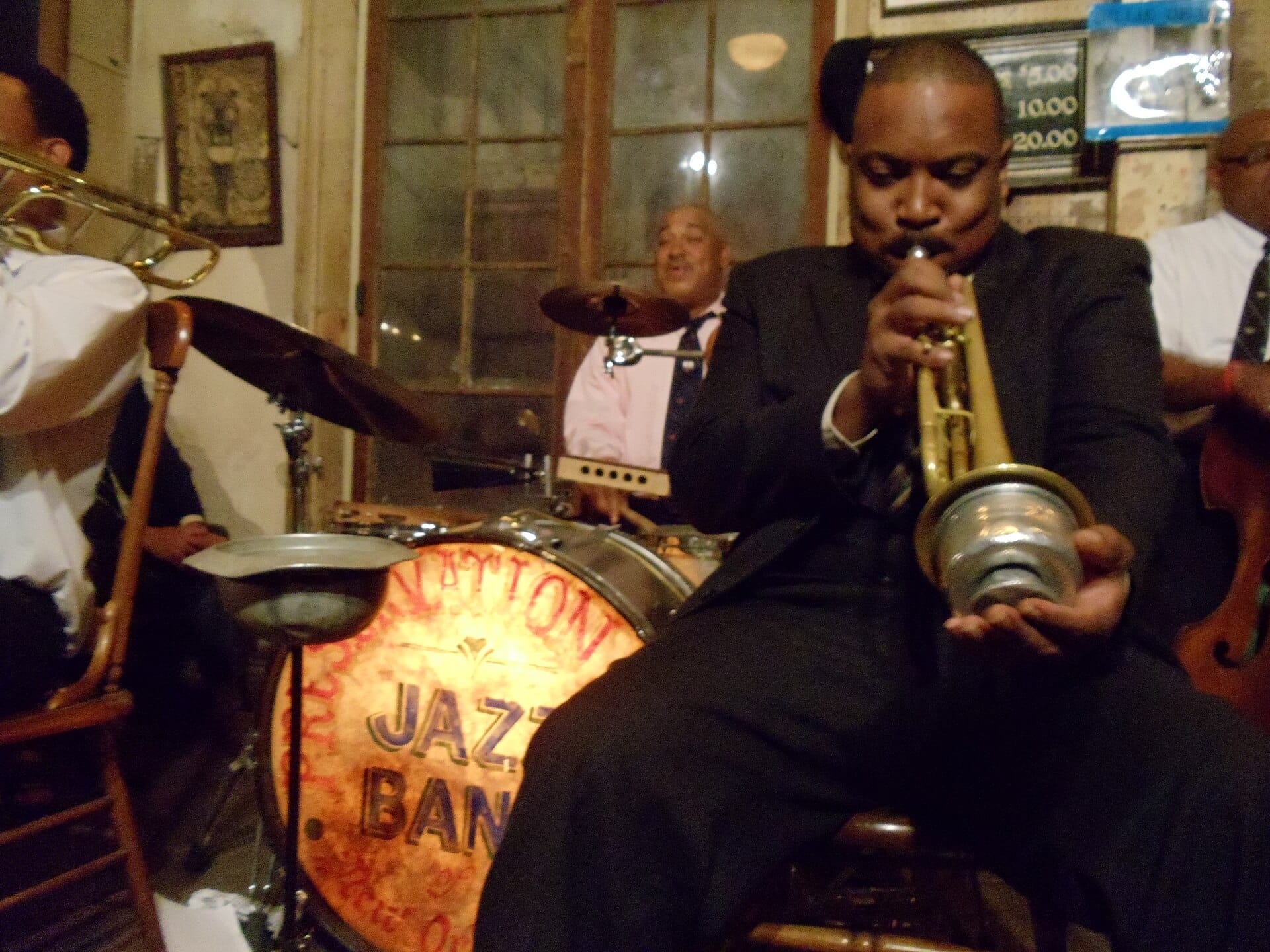
The stage is low and close. You are rarely more than twenty feet from the musicians, often closer. The instruments are right there: trumpet, trombone, clarinet, tuba, drums, sometimes a banjo. The sound is direct and physical in a way that no sound system in a larger venue can replicate. When the tuba hits a downbeat, you feel it.
💡 Local tip
If you want a bench seat rather than standing room, queue at least 30 to 45 minutes before the set time. The line moves quickly once doors open, but the hall reaches standing-room capacity fast on weekends and during festival seasons.
Tickets & tours
Hand-picked options from our booking partner. Prices are indicative; availability and final rates are confirmed when you complete your booking.
Spooky kid-friendly family ghost tour
From 32 €Instant confirmationFree cancellationWalking the Devil's Empire tour with HELLVISION™ in New Orleans
From 32 €Instant confirmationFree cancellationThe New Orleans haunted cemetery city bus tour
From 43 €Instant confirmationFree cancellationWhitney Plantation Tour
From 72 €Instant confirmationFree cancellation
The Music: Why This Venue Exists
Traditional New Orleans jazz, sometimes called Dixieland in older literature though the term is now used cautiously, is a collective improvisation style rooted in the late 19th and early 20th century. It draws from blues, ragtime, marching band music, and the African musical traditions that survived and evolved in New Orleans, particularly in areas like Congo Square and the Treme neighborhood. By the 1950s, much of the city's mainstream entertainment economy had moved on to rock and R&B, leaving the older jazz musicians with fewer paid opportunities.
This is the context in which Preservation Hall was born. The Jaffes were not creating a tourist attraction. They were solving a specific problem: aging, technically brilliant musicians needed a place to play and earn a living. The hall charged modest admission, passed the hat, and kept the music going. More than sixty years later, the hall still operates on the same philosophical premise, though the economics have evolved. For deeper context on how jazz shaped the city's identity, the New Orleans Jazz Museum in the French Quarter provides historical archives and rotating exhibits that complement a Preservation Hall visit well.
The musicians who play here are not there to perform a nostalgic simulation. Many are deep practitioners of a lineage, players who have spent careers learning from older masters. The sets cover traditional repertoire but leave room for interpretation. No two performances are identical.
Time of Day and Crowd Behavior
Preservation Hall operates in the evenings. The crowd outside St. Peter Street in the early evening tends to be a mix: tourists from nearby hotels, visitors who have planned specifically for this, and some locals showing friends from out of town. The French Quarter at this hour is fully awake, with the sounds of other bars and street performers audible from the queue. Once you step inside, the exterior noise disappears almost immediately, replaced by the particular acoustic intimacy of a room that has been optimized by decades of use.
Weekend evenings, and any evening during Jazz Fest, Mardi Gras season, or October's packed festival calendar, see the longest lines and the most competitive seating. If you are visiting during these periods, treat Preservation Hall as a priority reservation rather than a casual walk-up. A broader look at timing your New Orleans visit around music and culture is covered in the New Orleans jazz music guide.
Weeknights in the off-season, roughly November through early February outside of the Mardi Gras run-up, offer the shortest waits and the most relaxed atmosphere inside the hall. The music is no less serious; the room is simply less packed.
Who This Is For, and Who Should Reconsider
Preservation Hall is an all-ages venue, and the experience works well for attentive children old enough to sit or stand quietly for 45 to 60 minutes. The music is loud in an acoustic sense, not electronically amplified to concert levels, so it is not overwhelming in the way some live music venues can be for young visitors.
Visitors who need reliable climate control, cushioned seating, or drink service during a performance should set expectations accordingly or explore other live music options in the city. Frenchmen Street in the Marigny neighborhood, just east of the French Quarter, has multiple venues with full bar service and a wide range of jazz, blues, and funk acts, many of them free or low-cost. It is a different experience, more casual and socially oriented, but comfortable in ways Preservation Hall is not designed to be.
Visitors primarily looking for a party atmosphere will find Preservation Hall quietly demanding. The audience is expected to listen. Talking during performances is frowned upon, and the room's intimacy makes inattentiveness visible. This is a feature, not a flaw, but it is worth knowing before you buy a ticket.
Getting There and Navigating the French Quarter
Preservation Hall sits on St. Peter Street in the heart of the French Quarter. The neighborhood is walkable from most French Quarter hotels, and the area around St. Peter Street is well-trafficked in the evenings. The Canal Street streetcar line and RTA buses provide public transit access to the Quarter's edges; from Canal Street, Preservation Hall is a short walk into the interior of the Quarter.
Parking is limited and expensive in the French Quarter. Rideshare drop-off is straightforward; pickup can involve a short walk to a less congested street. If you are combining Preservation Hall with dinner, several restaurants are within a few blocks, though reservations are strongly advised on weekends. Plan for some time on St. Peter Street before your set: the street itself, with its balconied buildings and evening foot traffic, is worth arriving early for.
⚠️ What to skip
The French Quarter is a high-pedestrian area with active street life after dark. Standard urban awareness applies: keep valuables secured and stay on well-lit, populated streets. For general guidance on navigating the city safely, consult up-to-date local travel resources before your trip.
Photography and Practical Notes
Photography policies inside Preservation Hall vary and are enforced at the venue's discretion. The low light, close quarters, and respectful atmosphere toward performers generally make flash photography inappropriate regardless of what is officially permitted. The exterior of the building, with its peeling paint and hand-lettered signage, photographs well in the late afternoon light before the evening crowds arrive.
Preservation Hall is one node in a wider ecosystem of music and culture in New Orleans. If you want to understand the broader history that produced this music, a visit to Congo Square in Louis Armstrong Park, just north of the French Quarter, provides essential context: this is where African musical traditions were publicly maintained during the antebellum period, directly shaping what eventually became jazz. Pairing these two visits in a single afternoon and evening creates a coherent historical arc from origin to living practice.
For travelers building a fuller itinerary around New Orleans music and culture, the 3-day New Orleans itinerary maps out how to connect these experiences without backtracking.
Insider Tips
- The benches closest to the stage fill first, but the standing area at the back puts you near the door for a faster exit between sets, useful if you are catching a second show elsewhere that evening.
- Summer visits are more intense physically due to the lack of air conditioning. Dress in light, breathable fabric and consider bringing a small personal water bottle. The discomfort is real but most visitors report that the music more than compensates.
- If you are traveling during Jazz Fest in late April or early May, Preservation Hall performers often play the festival grounds during the day and then return to St. Peter Street at night. Catching the same musicians in both settings, open-air festival stage and intimate hall, is one of the more distinctive experiences the city offers.
- The Preservation Hall Jazz Band also tours internationally, and the hall hosts special events outside the regular set schedule. Check the official website for any special programming before your visit rather than assuming the standard evening format.
- Arriving early enough to read the notices and photographs posted near the entrance adds context to the performance. The hall posts information about its musicians and history that most visitors miss in the rush to find a seat.
Who Is Preservation Hall For?
- First-time visitors to New Orleans who want an authentic, historically grounded music experience
- Jazz enthusiasts and music students with an interest in the traditional New Orleans style
- Couples or small groups looking for a focused, non-nightclub evening out
- Families with older children who can engage with live music attentively
- Travelers building a cultural itinerary around the history and origins of American music
Nearby Attractions
Other things to see while in French Quarter:
- Bourbon Street
Rue Bourbon is one of America's most recognizable streets, stretching 13 blocks through the French Quarter from Canal Street to Esplanade Avenue. The nightlife reputation is well-earned, but the street has genuine historical depth and a quieter, more complex daytime character that most visitors never see.
- The Cabildo
Standing on the edge of Jackson Square since 1799, The Cabildo is the building where the Louisiana Purchase transfer was formally completed in 1803, reshaping a continent. Today it houses the Louisiana State Museum's flagship collection on state history, from colonial rule to Reconstruction, making it the most historically consequential building in New Orleans.
- Café du Monde
Open since 1862, Café du Monde on Decatur Street is the oldest coffee stand in New Orleans and one of the most recognizable spots in the French Quarter. The menu is deliberately simple: beignets dusted in powdered sugar and café au lait made with chicory. What makes or breaks the visit is knowing when to go and what to expect.
- Court of Two Sisters
The Court of Two Sisters on Royal Street is one of New Orleans' most enduring dining institutions, serving a daily jazz brunch buffet in a courtyard that has been gathering people since the 18th century. The combination of live jazz, Creole cuisine, and centuries-old architecture makes it unlike anything else in the city.