Melbourne Architecture Guide: Victorian Heritage to Contemporary Design
Melbourne's built environment tells the story of a city that went from a colonial outpost to a gold rush boomtown to a modern metropolis in under two centuries. This guide covers the key buildings, neighbourhoods, and walking routes to understand how it all fits together.
Tickets & tours
Live prices and dates from our booking partner. If you book, we may earn a commission at no extra cost to you.
TL;DR
- Melbourne's architecture spans styles from the 1850s gold rush to 21st-century contemporary design, all walkable within the central grid.
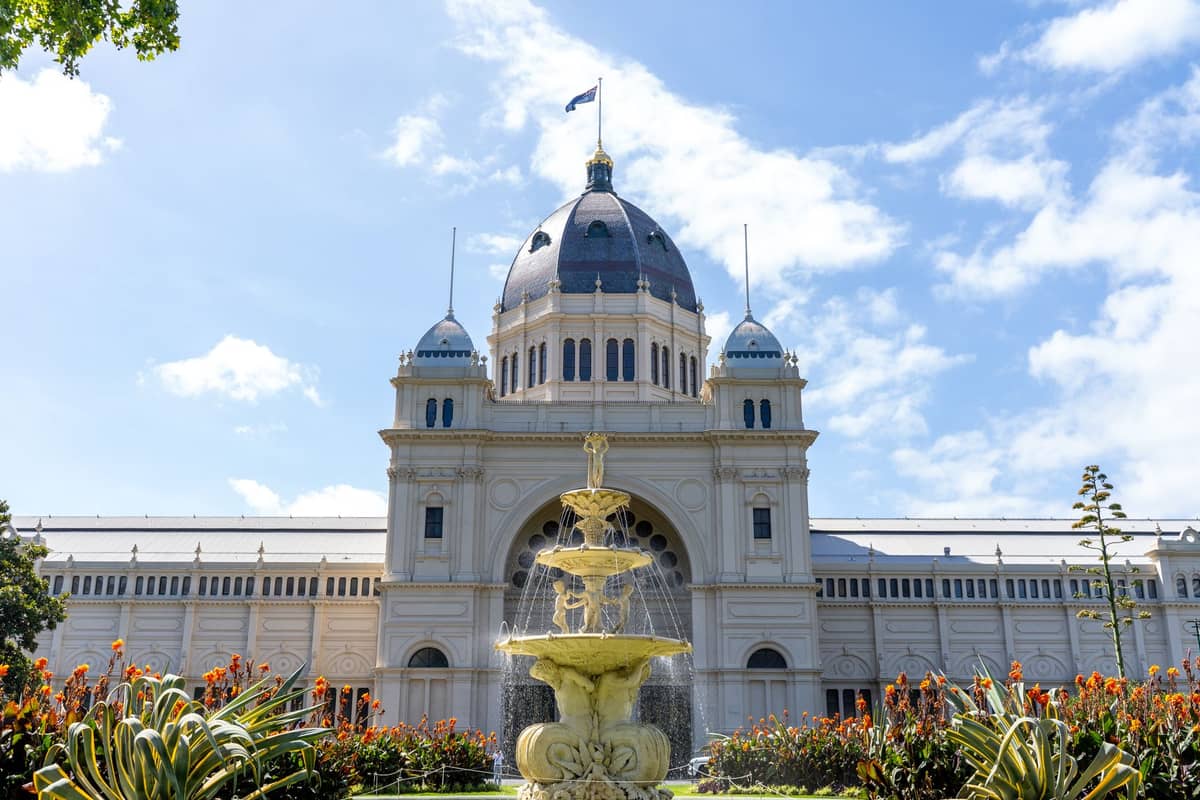
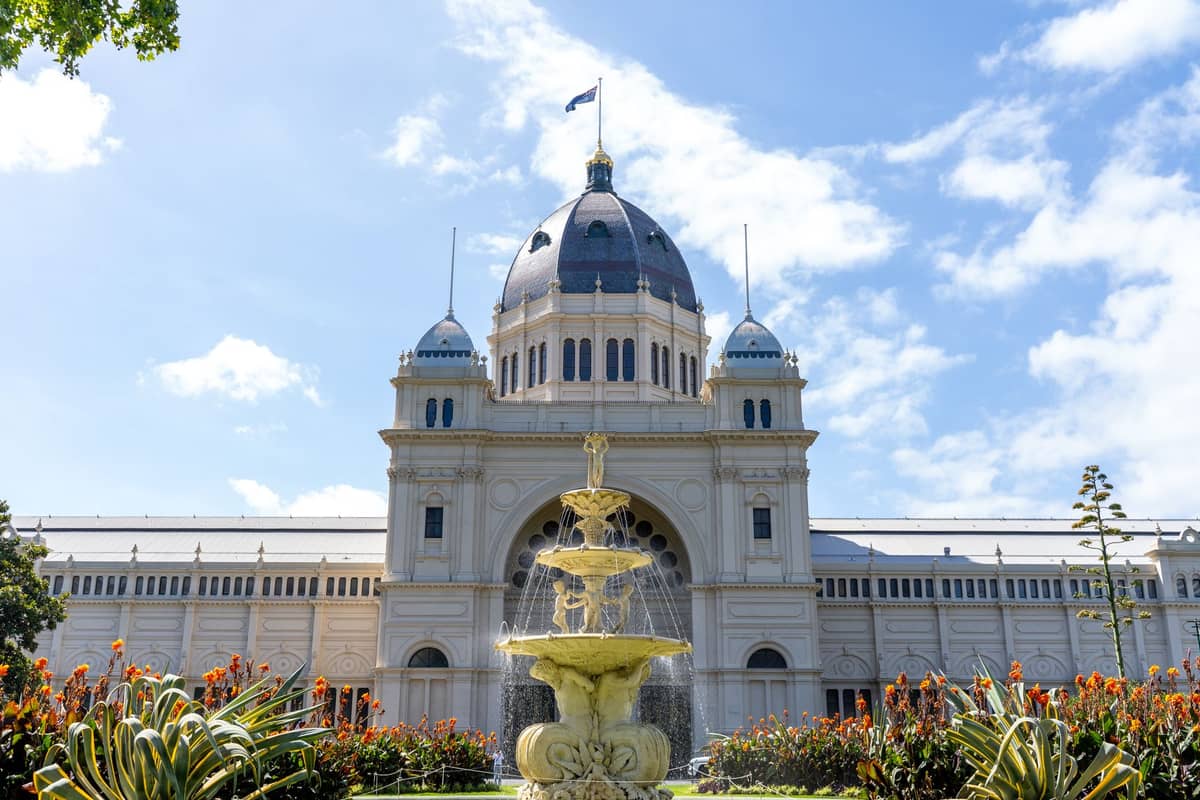
- The Royal Exhibition Building is the city's only World Heritage-listed structure; book the Dome Promenade tour well in advance.
- Free guided tours of Parliament House run regularly on Fridays (90 min, book ahead); Melbourne Town Hall tours run Mon and Wed-Fri.
- Heritage-listed does not mean freely open inside: check each building's access rules before visiting.
- The central Free Tram Zone makes it easy to hop between precincts. See the full getting around Melbourne guide for transport logistics.
Why Melbourne's Architecture Stands Apart
Melbourne sits on the traditional lands of the Wurundjeri Woi-wurrung and Bunurong peoples of the Kulin Nation, and the city's built history begins long before European settlement. The Kulin peoples shaped this landscape for tens of thousands of years before the first colonial buildings arrived in the 1830s. What followed was one of the fastest urban explosions in 19th-century history, driven by the 1850s gold rush that flooded Victoria with wealth and ambition. Within a generation, Melbourne had grand civic institutions, ornate terrace rows, arcaded shopping streets, and public gardens that rivalled the capitals of Europe.
That gold rush legacy is why Melbourne's Victorian-era architecture is so remarkably intact. The city built fast and built well, in bluestone and render, with cast-iron lacework and soaring domes. The economic crash of the 1890s, paradoxically, helped preserve much of it: there was no money to demolish and rebuild. Today, those same 19th-century streetscapes sit beside modernist icons from the 1950s-70s, postmodern experiments from the 1980s-90s, and genuinely striking contemporary towers. Few cities of Melbourne's size offer such a compressed, legible architectural timeline.
ℹ️ Good to know
Melbourne's central city is laid out on a grid planned in 1837 by Robert Hoddle. The grid, combined with a network of laneways, makes self-guided architectural walks highly practical. Most major landmarks are within about 1.5 km of Flinders Street Station.
The Gold Rush Civic Buildings: Where to Start
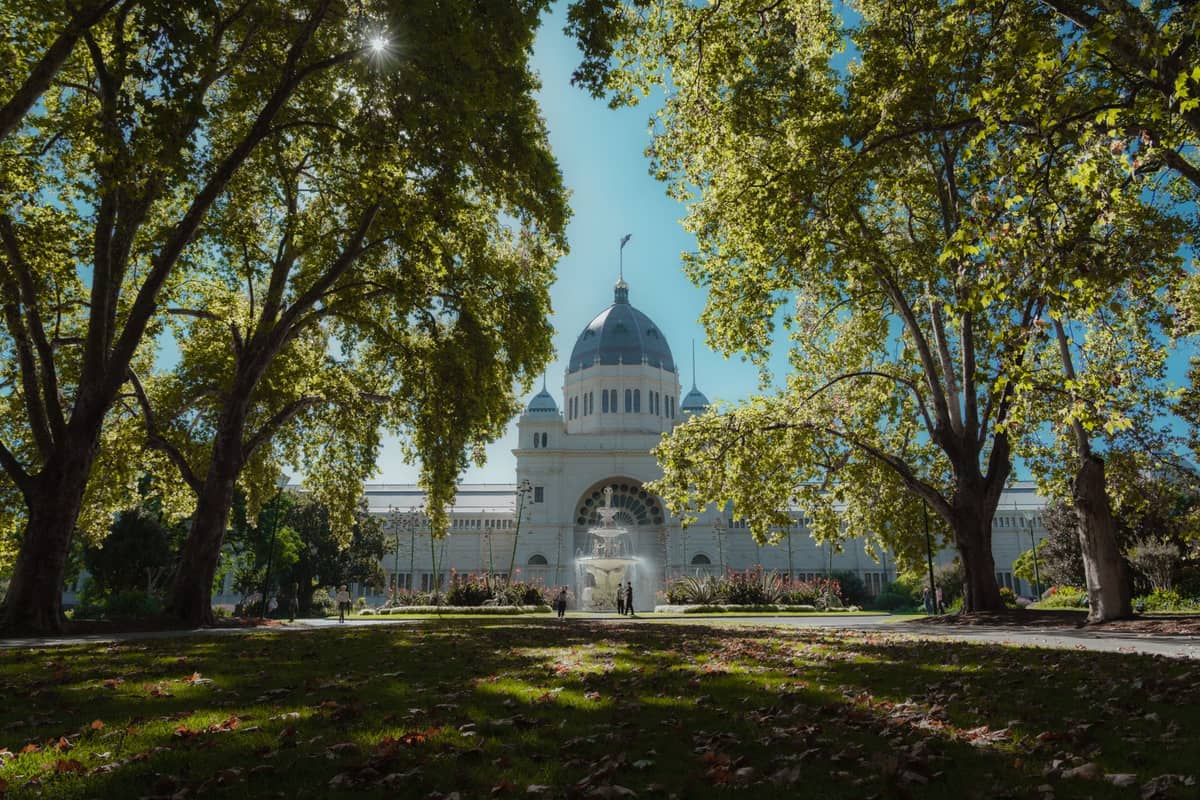
The logical starting point for any architectural tour is the civic spine running from Flinders Street Station north to the Royal Exhibition Building in Carlton Gardens. Along the way you pass a concentration of public buildings that would make any European city proud.
- Royal Exhibition Building (1880) Built for the Melbourne International Exhibition and now World Heritage-listed, this is the centrepiece of Carlton Gardens. The Dome Promenade tour runs at 10 a.m. and 2 p.m. daily (subject to availability) and requires advance booking. Check the What's On Melbourne official listing for current pricing before you go.
- Parliament House (1856, ongoing) One of Australia's oldest parliament buildings, with a facade that deliberately mimics ancient Greek temples. Free architecture tours run most Fridays, last approximately 90 minutes, require advance booking, and ask for photo ID. Some rooms are inaccessible when parliament is sitting.
- Melbourne Town Hall (1867) A Second Empire-style hall on Swanston Street with an interior that rewards exploration. Free guided tours run Monday and Wednesday-Friday; bookings are essential and tours do not operate on public holidays. Room access can vary depending on events.
- State Library Victoria (1856) The La Trobe Reading Room dome, completed in 1913, is one of the great interior spaces in Australia. Entry is free and no booking is required for general visits.
- St Paul's Cathedral (1891) Gothic Revival in style, designed by William Butterfield, at the intersection of Flinders and Swanston Streets. Free to enter; small donations are welcomed.
⚠️ What to skip
Heritage-listed status does not mean unrestricted interior access. Parliament House has limited availability when in session, Town Hall tour itineraries change with room bookings, and the Royal Exhibition Building Dome is ticketed. Always confirm access before visiting, especially on public holidays.
Arcades, Laneways, and the Commercial Layer
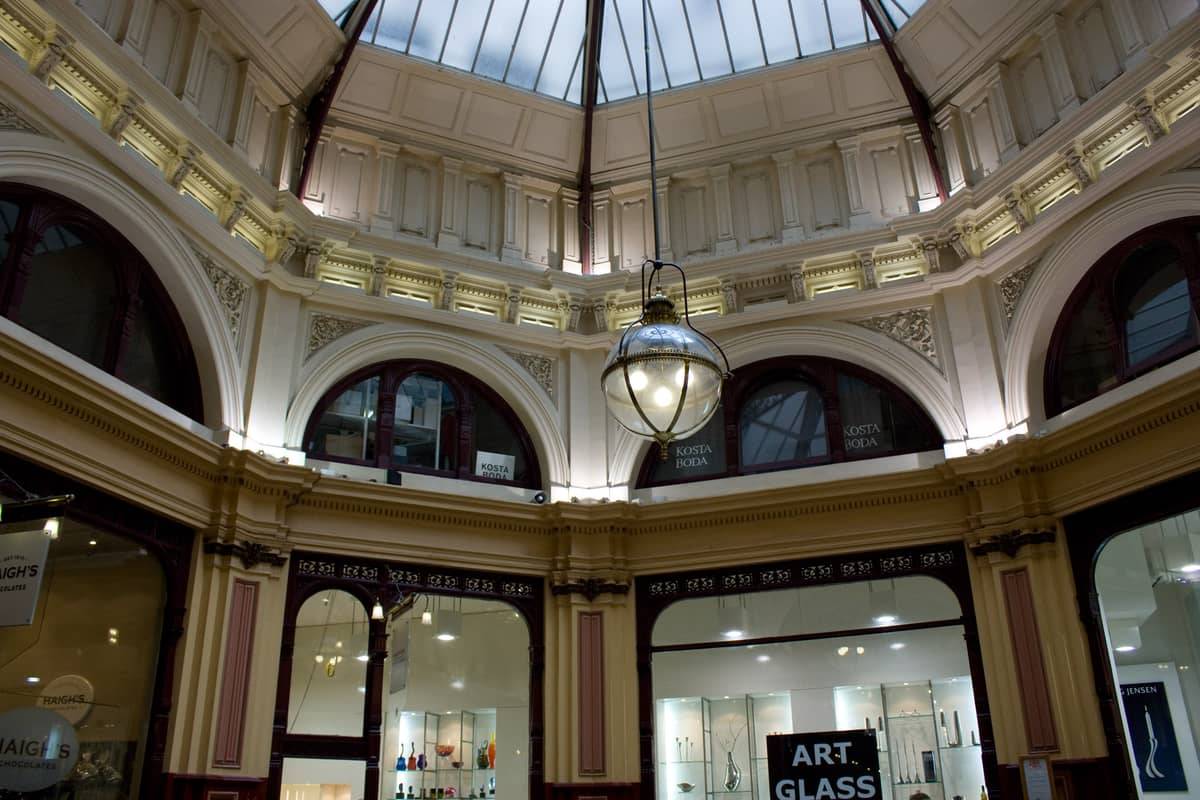
Parallel to the civic story runs a commercial one. Melbourne's Victorian-era arcades are among the finest surviving examples of 19th-century retail architecture in the southern hemisphere. The Block Arcade (1892) on Collins Street features mosaic tile floors and a glass-roofed atrium that genuinely stop people mid-stride. The Royal Arcade (1869), running between Bourke Street Mall and Little Collins Street, is Melbourne's oldest surviving arcade and home to the famous Gog and Magog clock figures.
Below street level and running between the major blocks, Melbourne's laneway network adds another architectural dimension. Degraves Street is the most photographed, with its tight corridor of cafe awnings and bluestone paving, but the broader laneway system is worth exploring systematically. The Melbourne laneway guide covers the network in detail, including how the laneways have become an architectural canvas for street art and adaptive reuse.
Collins Street between Queen and Spring Streets is sometimes called the 'Paris End', and while the comparison is pushed hard by marketing, the streetscape does reward close attention: Venetian Gothic, Italianate, and classical facades squeezed together at ground level, with 20th-century towers rising behind them. The 1930s Manchester Unity Building on Swanston Street is one of the city's finest examples of Gothic Revival commercial architecture, with a spectacular tiled arcade at ground level.
20th-Century and Contemporary Landmarks
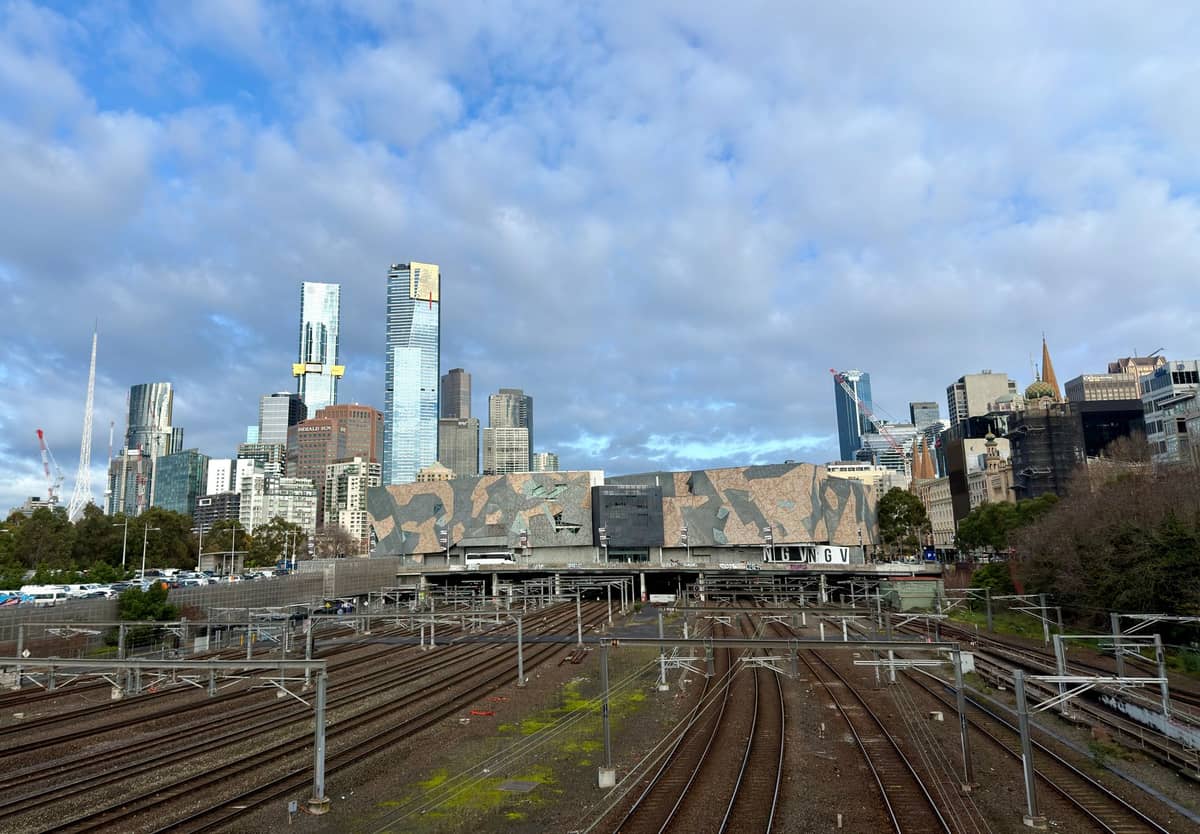
Melbourne's post-war architecture is more mixed in quality, but several landmarks stand out. Federation Square (2002) remains the city's most debated contemporary project. The fractured zinc and sandstone facade divides opinion sharply, but the urban design ambition is hard to dismiss: it created a genuine civic square on previously dead railway land at the Flinders Street intersection. The Ian Potter Centre: NGV Australia inside Federation Square is worth visiting on its own terms.
Across the river, the Southbank precinct shows what happens when commercial development dominates urban planning. The high-rise towers along the south bank of the Yarra are largely unremarkable from an architectural standpoint, though the Arts Centre Melbourne spire (1984) remains an iconic silhouette. The Eureka Skydeck tower, completed in 2006, is more interesting for the view it offers of Melbourne's cityscape than for its own architecture.
For genuinely interesting contemporary architecture, look north of the CBD. The Melbourne Museum in Carlton Gardens (2000) by Denton Corker Marshall uses a bold blue-green canopy roof to dramatic effect. In Docklands, the precinct has struggled with urban activation but contains some ambitious commercial buildings worth examining. The broader lesson from Melbourne's 21st-century development is that the city's best contemporary architecture tends to happen on institutional commissions rather than commercial ones.
✨ Pro tip
The best free vantage point for understanding Melbourne's layered skyline is from Birrarung Marr, the park between Federation Square and the Yarra. From here you can see the Victorian civic towers, the 1980s-90s postmodern commercial buildings, and the contemporary residential towers all in one frame.
Neighbourhood Architecture Beyond the CBD
The inner suburbs carry their own architectural character. Fitzroy and Carlton are defined by rows of Victorian terrace houses, many with elaborate cast-iron lacework verandahs that were produced in local foundries during the 1870s-1890s boom. These terraces were subdivided into flats through the 20th century and have since been gentrified back into family homes, but the streetscapes remain largely intact.
In St Kilda, the dominant form is the Edwardian mansion flat, built in the 1900s-1920s for a wealthier bayside suburb. The area also contains the Luna Park entrance facade (1912), one of the most photographed pieces of vernacular architecture in the city. Rippon Lea Estate in nearby Elsternwick shows what serious wealth looked like in suburban Melbourne: a polychrome brick mansion from 1868 set in elaborate grounds, now managed by the National Trust.
- Fitzroy: Victorian terrace rows on Nicholson and George Streets; Heide Museum of Modern Art nearby in Bulleen for mid-century architecture in a garden setting
- Carlton: Lygon Street terrace shops and the Melbourne Museum's bold contemporary canopy roof
- Richmond/South Yarra: Church Street rows and the Como House estate (1847), another National Trust property
- Williamstown: well-preserved 19th-century maritime town with bluestone warehouses and Victorian civic buildings, accessible by ferry from the CBD
Self-Guided Walks and Organised Tours
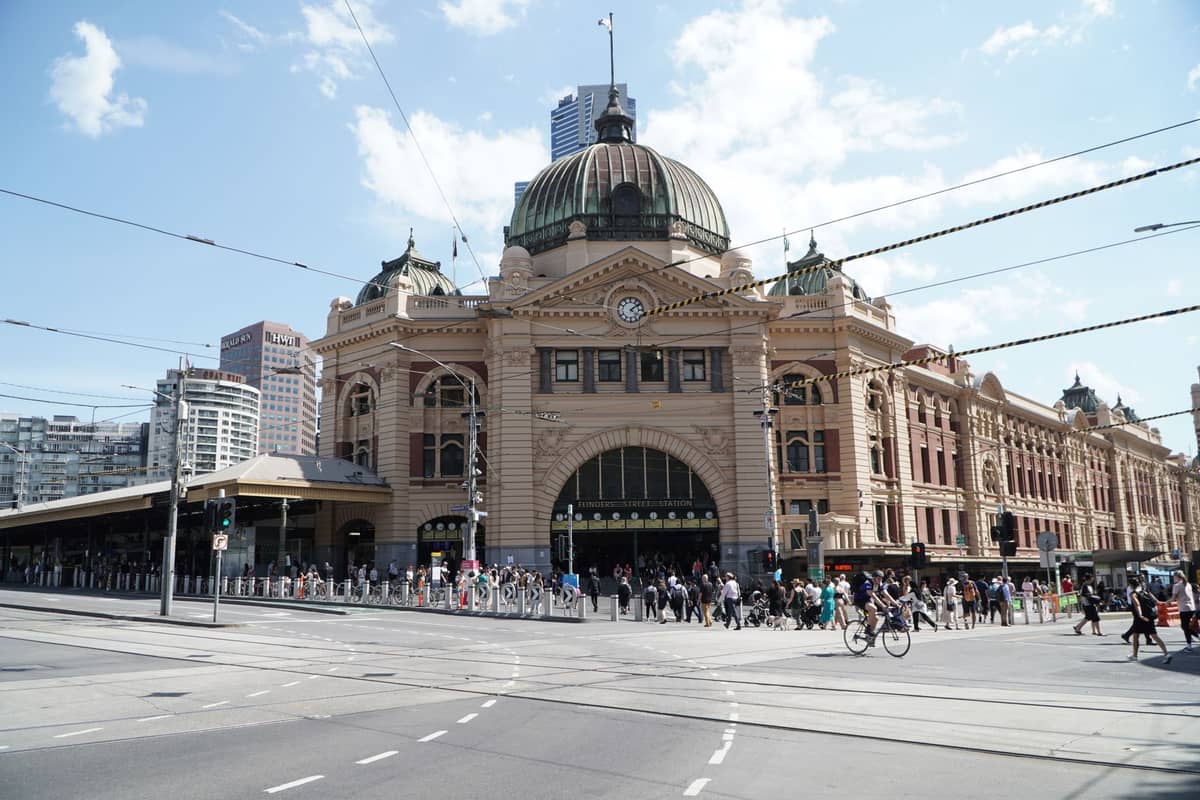
A self-guided walk of the central grid is entirely practical and free. Start at Flinders Street Station, walk north on Swanston Street to the State Library, then cut east on La Trobe Street to the Royal Exhibition Building in Carlton Gardens. Return via Spring Street past Parliament House and the Windsor Hotel, south on Collins Street to the arcades, then loop through the laneway network. This covers most of the Victorian civic layer in around two to three hours at an unhurried pace.
For guided tours, several operators run architecture-specific walks. MELTours and Melbourne Walks both offer architecture-focused options; check current availability and pricing directly as these change seasonally. The Open House Melbourne event, held annually in July, opens dozens of buildings that are otherwise closed to the public, including working offices, private residences, and infrastructure sites. It is the single best opportunity to see Melbourne's architecture from the inside. Wear comfortable walking shoes regardless of which approach you take: the central grid's bluestone footpaths are uneven in places.
💡 Local tip
Open House Melbourne Open House Melbourne (usually held in July) is free and grants access to buildings not normally open to the public. Some popular buildings require timed entry bookings that open weeks in advance. Check the Open House Melbourne website when that year's program is released. is free and grants access to buildings not normally open to the public. Some popular buildings require timed entry bookings that open weeks in advance. Check the Open House Melbourne website in June for that year's program.
FAQ
What is the best area in Melbourne to see Victorian architecture?
The central CBD grid between Flinders Street and La Trobe Street contains the highest concentration of Victorian civic and commercial architecture. Collins Street (particularly the eastern 'Paris End'), Spring Street, and the Royal Exhibition Building precinct are the priority stops. The inner suburbs of Fitzroy and Carlton add Victorian terrace streetscapes.
Can you go inside the Royal Exhibition Building?
Yes, but access is structured. The building hosts regular events and the Melbourne Museum adjoins it. For architectural access, the Dome Promenade tour is the main option: it runs at 10 a.m. and 2 p.m. daily (subject to availability) and requires advance booking. Check the official What's On Melbourne listing for current prices and availability before planning your visit.
Is the Parliament House architecture tour really free?
Yes. The architecture tour is free and runs approximately 90 minutes, typically on Fridays. You need to book in advance through the Parliament of Victoria websiteYou need to book in advance through the Parliament of Victoria website. Access to some rooms is not guaranteed, particularly when parliament is sitting or rooms are in use. Access to some rooms is not guaranteed, particularly when parliament is sitting or rooms are in use.
What is Open House Melbourne and when does it happen?
Open House Melbourne is an annual event, Open House Melbourne is an annual event, usually held in July, during which buildings open their doors to the public for free. It includes working office towers, private homes, heritage sites, and infrastructure not normally accessible. Some buildings require timed bookings that fill quickly, so register and plan ahead once the program is released., during which hundreds of buildings open their doors to the public for free. It includes working office towers, private homes, heritage sites, and infrastructure not normally accessible. Some buildings require timed bookings that fill quickly, so register and plan ahead once the program is released in June.
How do I get between Melbourne's architecture landmarks without a car?
The central Free Tram Zone covers most of the CBD and connects to the major civic landmarks. Beyond the grid, Melbourne's train network reaches Richmond, Carlton, and St Kilda Road. Williamstown is accessible by ferry from Southgate or by train from Southern Cross Station. Most of the central architecture walk is easily done on foot in half a day.
Tickets & tours
Live prices and dates from our booking partner. If you book, we may earn a commission at no extra cost to you.
Planning a trip? Discover personalized activities with the Nomado app.