Arts Centre Melbourne: What to Know Before You Visit
Arts Centre Melbourne is the city's principal performing arts complex, anchored by the iconic 162-metre Spire rising above Southbank. From orchestral concerts in Hamer Hall to theatre, dance, and cabaret across multiple stages, the precinct offers far more than a single night out.
Quick Facts
- Location
- 100 St Kilda Road, Southbank VIC 3004
- Getting There
- Trams 1, 3, 5, 6, 16, 64, 67, 72 to Stop 14 (Arts Precinct); or walk from Flinders Street Station via Princes Bridge
- Time Needed
- 1–2 hours to explore the precinct; allow a full evening for performances
- Cost
- Free to enter the public areas; event tickets priced by show (check artscentremelbourne.com.au)
- Best for
- Performance lovers, architecture enthusiasts, evening itineraries along the Southbank promenade
- Official website
- www.artscentremelbourne.com.au
What Is Arts Centre Melbourne?
Arts Centre Melbourne is Australia's largest performing arts complex and Victoria's primary cultural institution for live performance. Sitting at 100 St Kilda Road on the south bank of the Yarra River, the precinct comprises two main buildings: Hamer Hall, Melbourne's premier concert hall, and the Theatres Building, which contains multiple stages including the State Theatre, Playhouse, and Fairfax Studio. The two buildings are connected by a covered walkway and sit within easy walking distance of the Yarra River promenade.
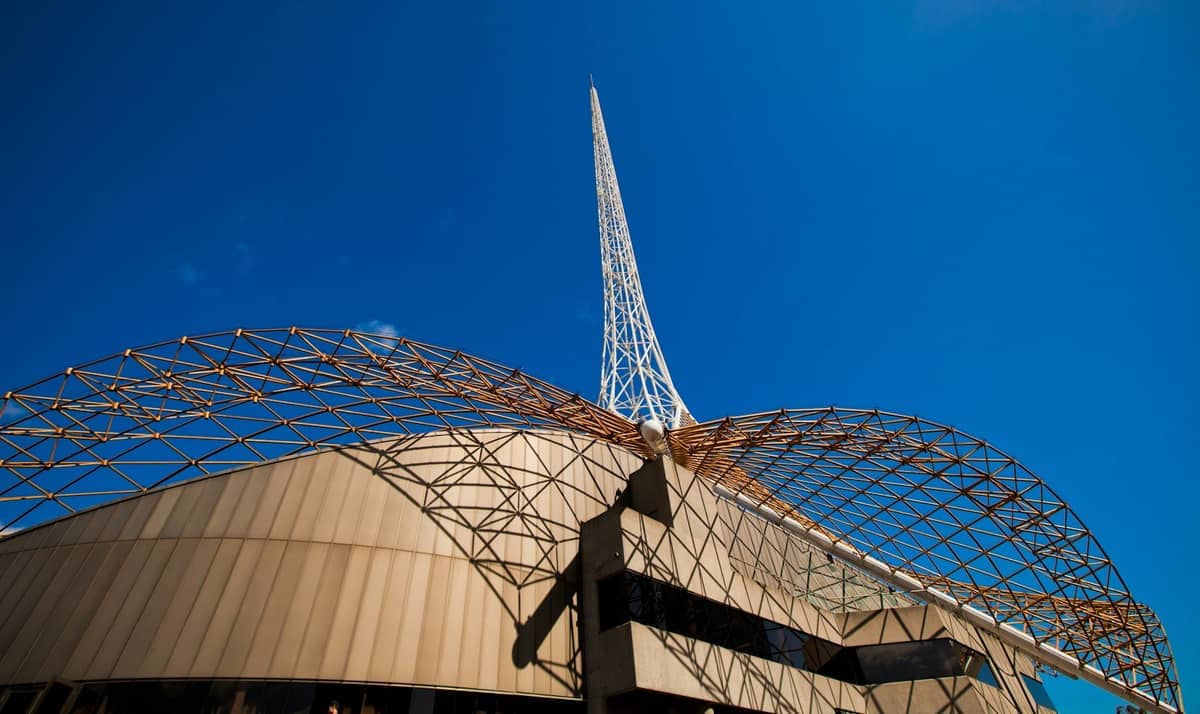
Above the Theatres Building rises the Spire, completed on 12 January 1996, reaching 162 metres above street level with a 10-metre mast at its peak. By day it is a gleaming lattice of steel; after dark it is lit in shifting colours that serve as an informal signal that something is on. The Spire has become one of the more immediately recognisable elements of Melbourne's southern skyline.
ℹ️ Good to know
Hamer Hall is open Sunday–Friday 10 am–6 pm and Saturday 9 am–6 pm. Theatres Building hours vary by day and event schedule. Confirm both on the official visit page before arriving.
The Architecture and Its History
The complex was designed by architect Roy Grounds, who also shaped the National Gallery of Victoria next door. Construction was lengthy and complicated: the Theatres Building officially opened on 29 October 1984, meaning parts of the precinct waited nearly two decades from initial planning to public use. The buildings sit partially underground, which is why the Spire appears so dramatically tall relative to the surrounding structures. You are, in effect, looking at the top floors of a building whose lower levels descend beneath street level.
The Theatres Building's exterior combines moat-like water features, textured concrete, and the steel spire into a form that remains genuinely distinctive. It polarises opinions. Some visitors find it heavy and impenetrable from the street; others appreciate that it turns inward, prioritising acoustic integrity and audience experience over street-facing grandeur. Hamer Hall, by contrast, underwent a major renovation completed in 2012, and its interior now has a warmth and clarity that regular concertgoers recognise as one of the better acoustic environments in Australia.
The precinct sits alongside the NGV International, forming a cultural corridor along St Kilda Road that stretches south toward the Domain. If you are building a day around Melbourne's arts institutions, the two venues are naturally combined.
Tickets & tours
Live prices and dates from our booking partner. If you book, we may earn a commission at no extra cost to you.
Great Ocean Road reverse itinerary tour from Melbourne
From 77 €Instant confirmationFree cancellationHidden bars of Melbourne guided tour
From 115 €Instant confirmationFree cancellationSecrets of Melbourne guided tour
From 60 €Instant confirmationFree cancellationPenguin Parade Express Guided Tour from Melbourne
From 95 €Instant confirmationFree cancellation
What the Precinct Feels Like at Different Times of Day
During the day, the Arts Centre precinct is calmer than its reputation suggests. The outdoor areas along the Southbank promenade see foot traffic from office workers and tourists, but the buildings themselves are relatively quiet before early evening. This is actually a useful time to walk through the lobbies, look at any current exhibitions in the foyers, and get your bearings before a performance later. Hamer Hall's glass facade lets in a generous amount of afternoon light, and the views across to the Yarra are best appreciated without a crowd.
From around 6 pm on performance nights, the atmosphere changes quickly. The walkways fill with people dressed across a broad range of formality, from suits and heels to jeans and sneakers. There is no strict dress code, and Melbourne audiences tend toward a relaxed interpretation of 'smart.' The bar areas open, there is a particular smell of warm timber and carpet that belongs specifically to large concert venues, and the low hum of audience anticipation becomes almost physical in the corridors.
If you are not attending a performance, Sunday afternoons occasionally bring markets or free events to the forecourt area. Check the Arts Centre's events calendar before visiting, because the public programming extends beyond ticketed shows and includes free community events that can make an otherwise unremarkable afternoon genuinely interesting.
Getting There and Getting Around the Precinct
Tram is the most practical option. Routes 1, 3, 5, 6, 16, 64, 67, and 72 all serve Stop 14 (Arts Precinct) on St Kilda Road. Several of these routes run through the Free Tram Zone in the city centre, so if you are already in the CBD, the tram is free. From Flinders Street Station, the walk takes around ten to twelve minutes: cross Princes Bridge heading south, keep to the left side of St Kilda Road, and the Spire becomes visible as a navigational landmark from the bridge itself.
💡 Local tip
Walking from Flinders Street Station via Princes Bridge is the most pleasant option on a clear evening. The path runs alongside the Yarra River and gives you a clear view of the Spire as you approach.
The tram stop and car park are wheelchair accessible. Wheelchair spaces are available at events subject to availability, and hearing assistance is available in selected venues. If accessibility is a specific requirement, contact the box office in advance to confirm arrangements for the specific venue and event you are attending.
The precinct connects naturally to Southbank, and the riverside promenade makes for an easy pre-show walk from Federation Square, which is roughly a fifteen-minute stroll across Princes Bridge.
What You Can See and Do Without a Ticket
Entry to the public areas of both buildings is free. The foyers contain rotating exhibitions of visual art and design, often with work by Australian artists and occasionally connected to current productions. These are not large gallery spaces, but they are well-curated and worth ten minutes if you are early for a show. The Hamer Hall foyer in particular has a quality of finish that rewards a slow look around, and the views toward the Yarra from its upper levels are among the quieter viewpoints along this stretch of the river.
The outdoor areas around the precinct, including the river walk and the footpaths along St Kilda Road, are open around the clock. Photographers will find that the Spire is best captured in the blue hour just after sunset, when its illuminated lattice reads clearly against a darkening sky without the overexposure problems of full night photography. Position yourself across the river on the northern bank for a composition that includes the water reflection.
The surrounding Southbank area gives you access to the Eureka Skydeck and the broader restaurant and bar strip along the promenade, which makes it straightforward to build a complete evening here without needing to move far between activities.
Tickets, Performances, and What to Expect
There is no single ticket price for Arts Centre Melbourne. The venue hosts hundreds of different productions each year across its stages, from the Melbourne Symphony Orchestra in Hamer Hall to contemporary dance, opera, musical theatre, spoken word, and cabaret. Prices vary enormously depending on the production, the company presenting it, and the seat. Book directly through the Arts Centre Melbourne website to avoid third-party booking fees, and check whether the presenting company has its own ticketing arrangement, as some productions sell through separate portals.
The State Theatre is the largest stage in the Theatres Building, used for opera and large-scale productions. The Playhouse is a mid-scale proscenium house. The Fairfax Studio is a flexible black-box space that tends toward more experimental or contemporary work. If you are unfamiliar with Melbourne's performance calendar and want a starting point, checking what the Melbourne Symphony Orchestra has scheduled in Hamer Hall is a reasonable entry point, as that programme is published well in advance.
⚠️ What to skip
Latecomers are typically not admitted to performances until a suitable break, which can mean missing the first act entirely. Arrive at least twenty minutes before the advertised start time.
Who Will Get the Most From a Visit, and Who Might Not
Arts Centre Melbourne is genuinely worth visiting even if you have no performance booked. The architecture, the free foyer exhibitions, the riverside position, and the quality of the public spaces make it a worthwhile destination for anyone interested in how a city invests in cultural infrastructure. That said, the full experience is a performance: the buildings exist to serve what happens inside them, and without that context, the visit is relatively brief.
Travellers looking primarily for daytime sightseeing may find the precinct slightly underwhelming compared to the effort of reaching it. The NGV International next door offers substantially more to fill a few hours without a scheduled event. If your travel schedule is built around evenings, however, and you are open to buying a ticket to whatever happens to be on, Arts Centre Melbourne is one of the most reliable ways to spend a Melbourne evening with genuine cultural substance rather than simply eating and drinking.
For a broader sense of Melbourne's arts landscape, the best museums in Melbourne guide covers how Arts Centre Melbourne fits alongside the city's other major cultural institutions.
Insider Tips
- Check the Arts Centre Melbourne events calendar a few days before your visit for public programming and community events.
- If you are attending a performance in the Theatres Building, the bars fill quickly in the twenty minutes before curtain and at interval. Order your interval drink before the show starts to avoid a long queue.
- For the Spire at its most photogenic, stand on the northern bank of the Yarra River at blue hour (twenty to forty minutes after sunset). The river reflection adds a second image that doesn't show up in daytime shots.
- Hamer Hall's acoustic renovation in 2012 made a meaningful difference to the listening experience. Seats in the lower stalls and first circle are considered strong positions, but the hall is compact enough that even upper circle seats offer good sound.
- Tram Stop 14 on St Kilda Road is served by eight tram routes, which means frequency is high even late at night after a performance ends. You are rarely waiting more than a few minutes for a tram back toward the city.
Who Is Arts Centre Melbourne For?
- Performance lovers: opera, symphony, contemporary dance, theatre, and cabaret all share the same complex
- Architecture enthusiasts interested in mid-century and late-twentieth-century civic design
- Evening itinerary builders wanting a complete cultural night without navigating multiple suburbs
- Photographers looking for a distinctive Melbourne skyline element, especially at dusk
- Travellers pairing a cultural venue with the Southbank riverside promenade and nearby dining
Nearby Attractions
Other things to see while in Southbank:
- Eureka Skydeck
Perched on Level 88 of Eureka Tower in Southbank, Melbourne Skydeck sits roughly 285 metres above the Yarra River. Whether you come at midday for sharp sightlines or at dusk for the city lights, the views are genuinely panoramic — but timing, weather, and crowd levels make a real difference to the experience.
- NGV International
NGV International is Australia's oldest and most visited art museum, housed in a landmark 1968 building on St Kilda Road. The permanent collection is free to enter, the architecture alone justifies the visit, and major ticketed exhibitions run throughout the year.
- Polly Woodside
Polly Woodside is a beautifully preserved 1885 iron sailing barque moored at South Wharf, Southbank. Open just twice a month under National Trust care, it offers a rare, hands-on encounter with the era of deep-sea cargo shipping. This guide tells you exactly when to go, what you'll see, and whether it's worth your time.
- Royal Botanic Gardens Victoria
Established in 1846 on the traditional lands of the Kulin Nation, Melbourne Gardens is one of Australia's most significant botanic collections. Entry is free, the grounds are open daily, and the experience shifts dramatically depending on when you arrive.
Planning a trip? Discover personalized activities with the Nomado app.