NGV International: Melbourne's Grand Art Museum on St Kilda Road
NGV International is Australia's oldest and most visited art museum, housed in a landmark 1968 building on St Kilda Road. The permanent collection is free to enter, the architecture alone justifies the visit, and major ticketed exhibitions run throughout the year.
Quick Facts
- Location
- 180 St Kilda Road, Melbourne
- Getting There
- Trams 1, 3, 5, 6, 16, 64, 67 & 72 stop at Arts Precinct; Flinders Street Station ~500m on foot
- Time Needed
- 2–4 hours for permanent collection; allow a full half-day with a major exhibition
- Cost
- Free for permanent collection; ticketed special exhibitions vary in price
- Best for
- Art lovers, architecture enthusiasts, families, rainy-day visits, solo travellers
- Official website
- www.ngv.vic.gov.au
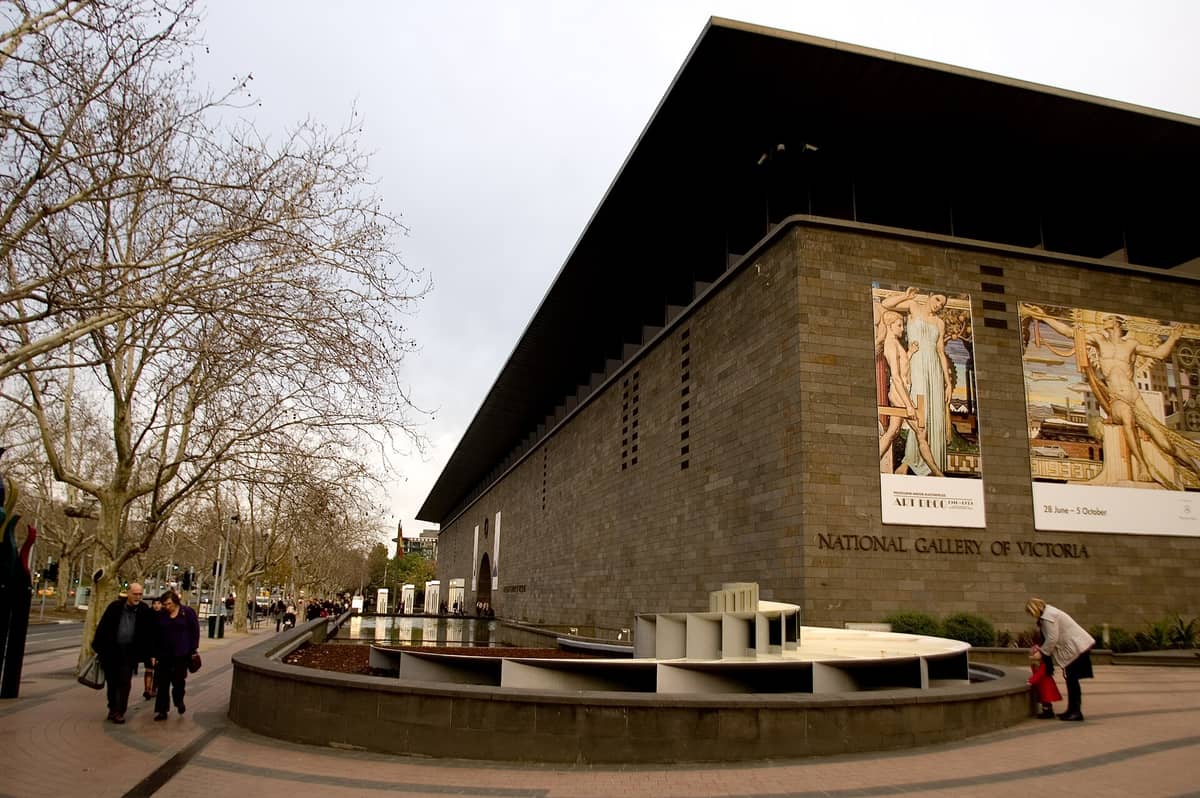
Why NGV International Deserves Your Time
NGV International is the St Kilda Road venue of the National Gallery of Victoria, Australia's oldest public art museum. It sits at the southern edge of the city's Arts Precinct, a short walk across Princes Bridge from the CBD, and draws more visitors annually than any other art museum in the country. The permanent collection spans thousands of years of art from Europe, Asia, Oceania, and the ancient world, and entry to that collection costs nothing.
The building itself is a reason to visit. Designed by Sir Roy Grounds and opened in August 1968, the bluestone and concrete structure was deliberately monumental. It does not try to blend in. Walking through the entrance you are immediately confronted by the Great Hall, whose ceiling was created by Leonard French between 1963 and 1967 and is described by the NGV as the world's largest cut-glass ceiling. The colours shift with the hour and the weather outside, and it is the kind of detail that stops people mid-step.
💡 Local tip
The NGV runs ticketed special exhibitions throughout the year that frequently sell out. Check the website and book tickets before you arrive if an exhibition is your primary reason to visit.
The Building: Architecture as Experience
Roy Grounds designed the building with a ceremonial exterior moat, a feature that still surprises first-time visitors. Water flows across a long horizontal plane at the St Kilda Road facade, and the sound of it is audible before the building fully comes into view. The effect is quietly theatrical. It separates the gallery from the street without using a fence, and it signals that something different is happening inside.
Inside, the spatial sequence is deliberate. The Great Hall functions as a decompression chamber between the city and the galleries. Natural light filters through Leonard French's ceiling in deep blues, greens, reds, and ambers, and the quality of that light changes noticeably depending on whether it is overcast or sunny outside. Morning visits, when the gallery first opens at 10am, tend to offer the clearest, calmest experience of the hall before school groups and tour parties arrive.
If you are interested in Melbourne's architectural character more broadly, the NGV sits within a particularly rich corridor. The Arts Centre Melbourne is directly adjacent, and the streetscape of St Kilda Road between the Yarra and Domain Road contains some of the city's most considered civic architecture. The NGV's place in Melbourne's architectural story is hard to overstate.
Tickets & tours
Live prices and dates from our booking partner. If you book, we may earn a commission at no extra cost to you.
Great Ocean Road reverse itinerary tour from Melbourne
From 77 €Instant confirmationFree cancellationGreat Ocean Road bus tour with a forest walk
From 90 €Instant confirmationFree cancellationYarra Valley Bus Wine Tour including lunch with a glass of wine and chocolate
From 107 €Instant confirmationFree cancellationHidden bars of Melbourne guided tour
From 115 €Instant confirmationFree cancellation
What You'll Find in the Permanent Collection
The permanent collection at NGV International covers international art from antiquity through to the twentieth century. European Old Masters, Asian decorative arts, Pre-Columbian objects, Egyptian antiquities, and twentieth-century design all share floor space across multiple levels. The collection is organised thematically and chronologically across the building, and the layout is well signposted enough that a first-time visitor can navigate independently without a guided tour.
The decorative arts galleries are often undervisited and worth seeking out. There are significant holdings in European ceramics, textiles, and furniture that don't appear in most travel write-ups about the gallery. The Asian art galleries on the upper floors are similarly substantial, with works that reflect the depth of the NGV's acquisition history over more than 150 years.
The gallery's contemporary special exhibitions, which occupy dedicated spaces and require a separate ticket, tend to be large-scale and internationally sourced. These are the exhibitions that generate queues on weekends. If you plan to see only the permanent collection, a weekday morning is genuinely quieter and more comfortable.
How the Experience Changes by Time of Day
At 10am when the doors open, the gallery is calm. The Great Hall catches the morning light well, the galleries feel spacious, and the staff are available to answer questions. This is the best window for unhurried looking, particularly in the older European galleries where crowds can feel claustrophobic later in the day.
By midday the gallery is at its most populated. School groups move through in organised clusters, the café draws a lunch crowd, and the queues for special exhibitions lengthen. If you arrive around this time, head directly to the upper floors or the decorative arts galleries, which tend to stay quieter regardless of overall visitor numbers.
Late afternoon, from around 3:30pm onward, the school groups clear and the gallery takes on a calmer atmosphere again before the 5pm close. The Great Hall ceiling catches late-afternoon light differently to morning, with warmer tones, and it is worth returning to it before you leave even if you saw it on the way in.
ℹ️ Good to know
Opening hours are daily 10am–5pm. The gallery opens at 1pm on Anzac Day (25 April) and is closed on Christmas Day (25 December). Check the NGV website for any changes before visiting.
Getting There and Getting Around
The most straightforward approach is by tram. Trams 1, 3, 5, 6, 16, 64, 67, and 72 all stop at the Arts Precinct accessible tram stop directly outside the gallery on St Kilda Road. If you are travelling from the CBD, many of these routes pass through the Free Tram Zone, meaning your journey may cost nothing depending on where you board.
On foot from Flinders Street Station, the walk takes around 8 to 10 minutes. Cross Princes Bridge over the Yarra River, continue south along St Kilda Road past the Arts Centre Melbourne, and the NGV's bluestone facade comes into view on your right. The walk passes through the southern end of Southbank, which has its own riverside cafes and parks if you want to extend the day.
Paid accessible parking is available at Arts Centre Melbourne and the Australian Ballet Centre nearby. Street parking on St Kilda Road is limited and metered. For most visitors, public transport is the more practical option, particularly on weekends when nearby parking fills quickly.
Practical Details: What to Know Before You Go
The permanent collection is free. No booking is required and no timed entry applies to the free galleries. Special exhibitions have separate ticketing, and these do require advance booking during busy periods, particularly for blockbuster shows. The NGV website lists current and upcoming exhibitions with ticket prices and booking links.
Accessibility is well handled. The St Kilda Road entrance is at street level with automatic doors, and lifts, ramps, and escalators connect all gallery floors. Wheelchairs and a motorised scooter are available for free loan at the entrance. Accessible toilets are provided throughout the building, and assistance dogs are welcome.
The gallery café is located on the ground floor and serves food through to closing time. There is also a NGV Shop near the entrance with art books, prints, and design objects. Photography is permitted in the permanent collection galleries; individual exhibition rules vary, so check signage on entry.
⚠️ What to skip
Photography rules for ticketed exhibitions differ from those in the free collection. Some special exhibitions prohibit photography entirely. Check the signage at the entrance to each exhibition space before shooting.
The NGV is one of Melbourne'sessential museums and one of the few major attractions in the city that costs nothing to experience at a serious level. If you are planning a broader cultural itinerary, it pairs naturally with the Ian Potter Centre: NGV Australia at Federation Square, which holds the NGV's Australian art collection and is also free to enter.
Who This Attraction Is and Isn't For
NGV International suits travellers who want substance rather than spectacle, though the building delivers both. It works well for solo visitors who want to move at their own pace, for couples looking for a half-day activity that doesn't require a fixed itinerary, and for families with older children who can engage with visual art for a couple of hours. The free entry removes any pressure to 'get your money's worth', which changes the experience in a subtle but real way.
Visitors travelling with very young children may find the atmosphere constraining, particularly in the more delicate decorative arts galleries where the expectation of quiet is real. Travellers who are primarily interested in Australian Indigenous art or contemporary Australian work should note that this collection is held at the Ian Potter Centre: NGV Australia at Federation Square, not at the St Kilda Road building.
Those who are indifferent to art and are visiting only because it appeared on a list will likely find the experience underwhelming. The collection rewards attention and rewards return visits, but it does not perform for passive audiences the way a theme park or a major food market does.
Insider Tips
- The Great Hall ceiling looks different in every weather condition. If you visit on a sunny morning and return on a cloudy afternoon, you'll see two genuinely different rooms. It is worth the second look.
- The decorative arts galleries on the upper floors are consistently less crowded than the European painting galleries, even during peak visitor periods. If you want space to look carefully, go up.
- For ticketed blockbuster exhibitions, the opening week is often the busiest. If the show runs for months, visiting four to six weeks after opening typically means shorter queues and better floor space.
- The exterior moat and forecourt area on St Kilda Road is a worthwhile pause before you enter. From the footpath, the building reads very differently than it does once you are inside it, and the transition through the entrance is more architecturally interesting if you've spent a moment outside first.
- The NGV Shop stocks a genuinely good selection of art and design books, including titles on Australian art and architecture that are not widely available elsewhere in the city. It is worth a browse even if you are not an habitual museum-shop visitor.
Who Is NGV International For?
- Art and design enthusiasts who want to explore a major international collection at no cost
- Architecture-focused travellers interested in late-modernist civic buildings
- Travellers on a budget looking for a full half-day activity without an admission fee
- Couples looking for a cultural anchor to a Southbank or city-centre itinerary
- Solo travellers who prefer self-directed exploration at their own pace
Nearby Attractions
Other things to see while in Southbank:
- Arts Centre Melbourne
Arts Centre Melbourne is the city's principal performing arts complex, anchored by the iconic 162-metre Spire rising above Southbank. From orchestral concerts in Hamer Hall to theatre, dance, and cabaret across multiple stages, the precinct offers far more than a single night out.
- Eureka Skydeck
Perched on Level 88 of Eureka Tower in Southbank, Melbourne Skydeck sits roughly 285 metres above the Yarra River. Whether you come at midday for sharp sightlines or at dusk for the city lights, the views are genuinely panoramic — but timing, weather, and crowd levels make a real difference to the experience.
- Polly Woodside
Polly Woodside is a beautifully preserved 1885 iron sailing barque moored at South Wharf, Southbank. Open just twice a month under National Trust care, it offers a rare, hands-on encounter with the era of deep-sea cargo shipping. This guide tells you exactly when to go, what you'll see, and whether it's worth your time.
- Royal Botanic Gardens Victoria
Established in 1846 on the traditional lands of the Kulin Nation, Melbourne Gardens is one of Australia's most significant botanic collections. Entry is free, the grounds are open daily, and the experience shifts dramatically depending on when you arrive.
Planning a trip? Discover personalized activities with the Nomado app.