Ian Potter Centre: NGV Australia — The Nation's Art Collection in the Heart of Melbourne
The Ian Potter Centre: NGV Australia at Federation Square holds the country's most comprehensive collection of Australian art, spanning Indigenous works to contemporary painting, photography, and fashion. Entry to the permanent collection is free, and the building itself rewards careful attention.
Quick Facts
- Location
- Federation Square, Melbourne CBD (corner of Flinders and Swanston Streets)
- Getting There
- Flinders Street Station is directly adjacent; tram stops on Swanston Street and at Federation Square are within the Free Tram Zone
- Time Needed
- 1.5–3 hours for permanent collection; add time for ticketed exhibitions
- Cost
- Free general entry; selected temporary exhibitions require paid tickets (prices vary)
- Best for
- Art lovers, history explorers, rainy-day visitors, families, budget travellers
- Official website
- www.ngv.vic.gov.au/location/ngv-australia/?ref=plantrip
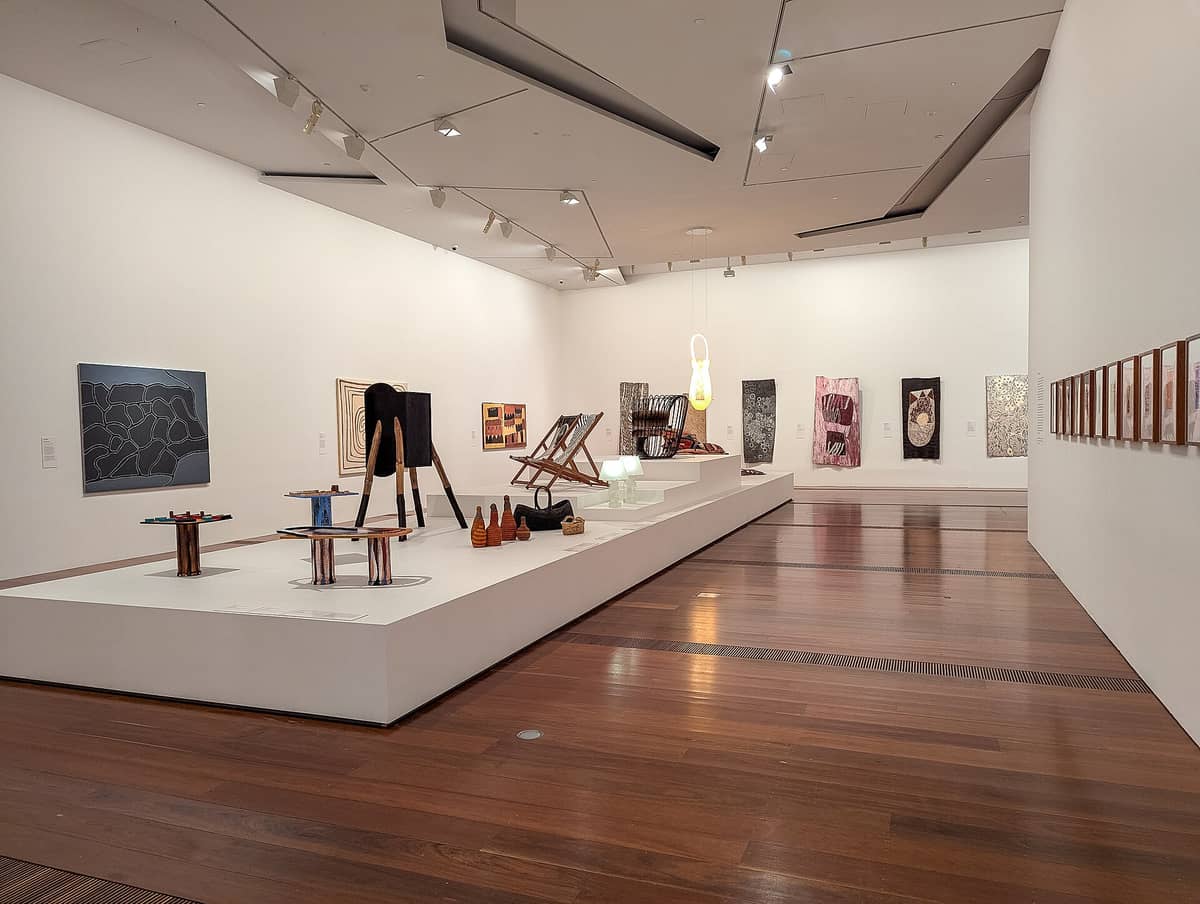
What the Ian Potter Centre Actually Is
The Ian Potter Centre: NGV Australia occupies the eastern building of Federation Square, a deliberately unconventional complex of zinc, sandstone, and perforated steel that either fascinates or puzzles visitors depending on their tolerance for bold civic architecture. Inside, the gallery presents the National Gallery of Victoria's collection of Australian art across multiple floors, making it a significant repository of Australian-made work in the country. The permanent collection is free to enter every day of the week.
It is worth being clear about what this place is and is not. This is not a natural-history museum, not a hands-on science centre, and not a place where every room will hold a child's attention. It is a serious art gallery that rewards patience and prior knowledge, while remaining genuinely accessible to first-time museum-goers who take a few minutes to orient themselves.
💡 Local tip
The gallery is generally open daily 10 am–5 pm, except Christmas Day and until 1 pm on Anzac Day. Check the NGV website before visiting on public holidays, when hours may change. General admission is free, but popular ticketed exhibitions sell out — book online in advance if a specific show is your reason for coming.
The Collection: From Bark Paintings to Boyd and Beyond
The permanent collection moves roughly chronologically, beginning with bark paintings and ceremonial objects from Aboriginal and Torres Strait Islander communities. These works are displayed with considered framing: context panels note the cultural protocols around certain imagery and the communities from which pieces originate. It is a serious engagement with First Nations art rather than a tokenistic opening gesture.
From there, the collection traces Australian colonial and post-colonial art: Eugene von Guérard's sweeping landscape paintings of the Victorian high country, Tom Roberts's iconic depictions of the shearing shed and bush life, and the Heidelberg School artists who arguably created the first distinctly Australian visual vocabulary. These rooms tend to be quieter than the upper floors, and the quality of natural light filtering through the facade panels gives the colonial paintings an unusual warmth in the afternoon.
The twentieth-century Australian galleries include works by Sidney Nolan, Arthur Boyd, Fred Williams, and Joy Hester — names central to any serious understanding of how Australian artists grappled with identity, landscape, and psychological tension. The collection does not shy away from difficulty. Visitors who arrive expecting cheerful coastal scenes may be surprised by the psychological intensity of some of the mid-century material.
Contemporary Australian work includes photography, video installation, textile design, and fashion. The fashion and textiles holdings offer a different lens on Australian design culture. If you are interested in the broader creative scene, the Australian Centre for the Moving Image sits directly across Federation Square and makes a natural companion visit.
Tickets & tours
Live prices and dates from our booking partner. If you book, we may earn a commission at no extra cost to you.
Melbourne sports precinct tour & Australian Sports Museum
From 70 €Instant confirmationFree cancellationGrampians National Park Small-Group Full-Day Tour
From 89 €Instant confirmationFree cancellationAudio-Guided Driving Tour through Great Ocean Road, Australia
From 17 €Instant confirmationGreat Ocean Road reverse itinerary tour from Melbourne
From 77 €Instant confirmationFree cancellation
How the Experience Changes by Time of Day
Arriving at opening time (10 am) on a weekday gives you the permanent collection almost entirely to yourself. The gallery staff are at their most relaxed, the building has that particular morning quietness of institutions that haven't quite woken up yet, and you can stand in front of major works without navigating around school groups. Weekend mornings are busier from the outset.
Midday on weekends and school holidays brings the most congestion, particularly in the lobby and on the ground floor near ticketed exhibition entries. If a major ticketed show is running, the queuing area and the gift shop corridor can become genuinely cramped. This is also when you are most likely to encounter large supervised school groups moving through the permanent galleries in clusters.
Late afternoon on any day tends to thin out noticeably after 3:30 pm. The light on the Federation Square facade shifts from harsh to warm, and visitors who stay into the final hour before closing often find themselves in galleries that feel considerably more spacious. The one limitation: some volunteer-led free tours run at fixed times earlier in the day, so arriving late means missing those.
The Building and Its Setting
Federation Square was completed in 2002 and remains one of the most discussed pieces of civic architecture in Australia, partly because Melburnians took years to warm to it. The Ian Potter Centre's exterior uses fractured zinc and sandstone panels. The interior spatial logic is less intuitive than it appears from outside: floors are connected by ramps, lifts and escalators, with no down escalator, which is worth knowing if you have mobility considerations.
The building's position at the corner of Flinders and Swanston Streets places it at one of Melbourne's most active intersections. Flinders Street Station is visible through the atrium glass, and the Flinders Street Station forecourt is a three-minute walk. This makes the Ian Potter Centre extremely easy to reach: it sits within the Free Tram Zone, directly adjacent to the station, and on multiple tram routes running along Swanston and Flinders Streets.
ℹ️ Good to know
Accessibility note: The gallery has step-free street-level entrances, lifts throughout, ramps and escalators, and free wheelchair hire. There is no down escalator — plan accordingly if that matters for your group.
Temporary Exhibitions: When to Pay, When to Skip
The NGV Australia regularly hosts major temporary exhibitions that attract significant attention and require separate ticketed entry. These shows tend to be well-produced and draw on international loans as well as the NGV's own holdings, but the ticket prices and crowd levels are considerably higher than the permanent collection experience. Whether a ticketed exhibition is worth your time depends on the specific show: check the NGV website well before your visit.
For most first-time visitors with limited time in Melbourne, the permanent collection alone justifies a visit. The ticketed exhibitions are an addition, not a prerequisite. Visitors who are planning their first full day in the city should note that the permanent collection at the NGV's other location, NGV International on St Kilda Road, holds international works and is also free to enter. The two galleries together represent a substantial commitment of time.
If you are building a broader arts day in Melbourne, the best museums in Melbourne guide covers how the Ian Potter Centre fits relative to other major institutions across the city.
Practical Walkthrough: What to Expect When You Arrive
Entry is from Federation Square. There is no ticketing desk for the permanent collection: you walk in and navigate from there.
Backpacks and large bags must be cloaked before visiting the galleries. The gift shop stocks books, prints, and design objects tied to exhibitions and the permanent collection. It is one of the better museum shops in the city.
Federation Square itself is worth a few minutes before or after your visit. The square hosts events throughout the year and is a central point for Melbourne's events calendar. On busy event days the surrounding area can be crowded, which affects how easy it is to move between the gallery and the surrounding streets.
⚠️ What to skip
Photography rules vary by gallery room and by exhibition. Photography is generally permitted in permanent collection spaces without flash. Ticketed exhibition rooms may prohibit cameras entirely — look for the signage at each room entrance rather than assuming.
Who Will Enjoy This Most, and Who Might Not
Visitors with a genuine interest in Australian art, history, or design will find the Ian Potter Centre hard to beat for depth and accessibility. It is also a genuinely good option on a rainy Melbourne day: it is large, free, and well-heated. Travellers who struggle to engage with static art galleries or who need constant interactive stimulation will find the permanent collection slow; there is limited hands-on content and the interpretive panels, while informative, are text-heavy.
Children who enjoy art and can handle a measured gallery pace tend to find points of engagement, particularly in the First Nations galleries and in rooms with large-format or visually striking works. Very young children and families with strollers can manage the space physically (lifts, no steps), but the content is not specifically oriented toward young visitors in the way that Scienceworks or the Melbourne Museum is.
Visitors on a tight schedule who want to see Melbourne's most famous free cultural institution should note that the NGV International on St Kilda Road, home to the international collection, tends to get more first-time visitor attention. Both are worth visiting if time allows. The NGV International is a 10–15 minute walk or a short tram ride from Federation Square.
Insider Tips
- Free guided tours of the permanent collection run on a regular schedule (check current tour listings on the NGV website). These tours offer context beyond the wall panels. They are worth considering when planning your visit.
- The upper-level contemporary galleries, particularly the fashion and textiles rooms, draw far fewer visitors than the ground and second floors. If you want space to think and look, start from the top and work down.
- The Federation Square plaza can be extremely busy during events and on warm weekend afternoons, making the approach to the gallery slow. Come via the Flinders Street side entrance when the plaza is packed.
- If you are visiting Melbourne in the cooler months (June–August), the gallery is well-heated and makes an excellent midday refuge. Crowds are generally lighter on weekday winter afternoons.
- The NGV Members program includes year-round complimentary access to the Members Lounges at NGV Australia and NGV International; check the current membership benefits before joining.
Who Is Ian Potter Centre: NGV Australia For?
- Art and design enthusiasts who want to understand Australia's visual culture beyond international names
- Budget travellers seeking high-quality cultural experiences without an entry fee
- Visitors caught in Melbourne's unpredictable weather looking for a substantial indoor programme
- Travellers interested in First Nations Australian art in a well-contextualised gallery setting
- Architecture observers curious about Federation Square's controversial and still-debated design
Nearby Attractions
Other things to see while in Melbourne CBD:
- AC/DC Lane
Renamed in 2004 to honour one of Australia's most iconic rock bands, AC/DC Lane is a compact CBD laneway lined with street art, live music venues, and a raw energy that sets it apart from Melbourne's more polished laneways. Free to visit at any hour, it rewards those who show up after dark.
- Australian Centre for the Moving Image (ACMI)
The Australian Centre for the Moving Image (ACMI) sits at the heart of Federation Square and traces the full arc of screen culture, from silent cinema to interactive digital art. General entry and the permanent exhibition are free, making it one of the most rewarding stops in the Melbourne CBD regardless of your budget or the weather outside.
- Birrarung Marr
Birrarung Marr is a free, open-access riverside park on the northern bank of the Yarra River, a short walk from Flinders Street Station. Built on a former railway yard and opened in 2002, it offers terraced lawns, Indigenous cultural context, city skyline views, and a calendar of public events that transforms the space throughout the year.
- The Block Arcade
Built between 1892 and 1893, The Block Arcade is Melbourne's finest Victorian-era shopping arcade, a covered gallery of mosaic tile floors, ornate plasterwork, and a soaring glazed roof on Collins Street. Free to enter and open daily, it rewards slow exploration and offers one of the CBD's most atmospheric pauses from street-level traffic.
Planning a trip? Discover personalized activities with the Nomado app.