The Block Arcade: Melbourne's Grand Victorian Shopping Gallery
Built between 1892 and 1893, The Block Arcade is Melbourne's finest Victorian-era shopping arcade, a covered gallery of mosaic tile floors, ornate plasterwork, and a soaring glazed roof on Collins Street. Free to enter and open daily, it rewards slow exploration and offers one of the CBD's most atmospheric pauses from street-level traffic.
Quick Facts
- Location
- 282 Collins Street (also 96 Elizabeth Street), Melbourne CBD VIC 3000
- Getting There
- Free Tram Zone covers Collins Street; nearest train stations are Flinders Street and Melbourne Central
- Time Needed
- 30–60 minutes to browse; longer if stopping for coffee or lunch
- Cost
- Free entry; shopping and dining at individual prices (AUD)
- Best for
- Architecture lovers, coffee seekers, boutique shoppers, rainy-day wanderers
- Official website
- theblock.com.au
What Is The Block Arcade?
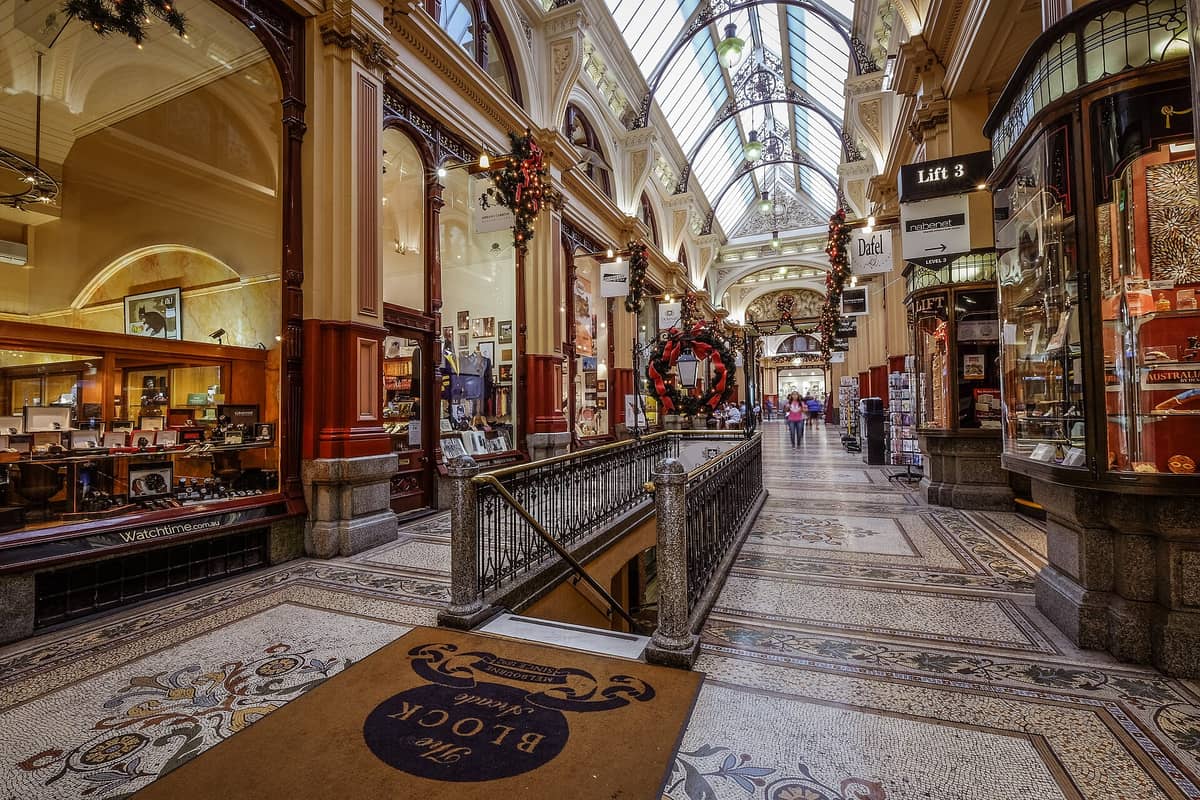
The Block Arcade is a Victorian-era covered shopping arcade stretching between Collins Street and Elizabeth Street in central Melbourne. Opened in two stages, with the Collins Street section completed in February 1892 and the Elizabeth Street section following in October 1893, it was designed to replicate the great European arcade tradition, drawing on the style of Milan's Galleria Vittorio Emanuele II. Today it remains one of the best-preserved examples of the type in Australia, listed on the Victorian Heritage Register.
The arcade is L-shaped, with a dramatic polygonal glazed-roof rotunda at the junction of its two wings. That central space, where natural light falls in shifting columns across the tessellated tile floor, is the visual heart of the building and the first detail most visitors stop to look at. Underfoot, the original mosaic floors have survived remarkably intact, their geometric patterns laid in cream, terracotta, and deep green.
💡 Local tip
The arcade has two street entrances: 282 Collins Street and 96 Elizabeth Street. Both are worth using on a single walk-through so you can appreciate the L-shaped layout fully.
The Architecture: What to Look For
Most visitors walk through The Block Arcade looking at the shops. The better approach is to look up, then down, then sideways at the shopfronts. Above the retail tenancies, the arcade's original decorative plasterwork survives in strong condition: cornices, pilasters, and foliate detailing that would have been considered a statement of civic ambition when the building opened. In the 1890s, Melbourne was one of the wealthiest cities in the British Empire, and Collins Street was its social and financial heart. The Block Arcade was not just a shopping precinct but a place to be seen.
The glazed roof is engineered to flood the interior with diffuse daylight, making the arcade feel lighter and airier than the street outside. On an overcast Melbourne morning, the effect is particularly soft. In direct afternoon sun, the light becomes sharper and more directional, throwing the relief plasterwork into stronger shadow. Photographers will find the mid-morning window, roughly 10am to noon, produces the most even, detailed shots of the floor and the full length of the arcade.
The arcade sits within a broader concentration of heritage buildings along Collins Street. If you are interested in the city's Victorian and Edwardian streetscape, the Melbourne architecture guide covers the wider CBD context, including nearby landmarks like the Royal Arcade on Bourke Street, which predates The Block by several decades.
Tickets & tours
Live prices and dates from our booking partner. If you book, we may earn a commission at no extra cost to you.
Great Ocean Road reverse itinerary tour from Melbourne
From 77 €Instant confirmationFree cancellationGreat Ocean Road bus tour with a forest walk
From 90 €Instant confirmationFree cancellationYarra Valley Bus Wine Tour including lunch with a glass of wine and chocolate
From 107 €Instant confirmationFree cancellationHidden bars of Melbourne guided tour
From 115 €Instant confirmationFree cancellation
How It Feels to Visit: Time of Day and Atmosphere
Early morning, from opening until around 9:30am, The Block Arcade is almost meditative. The shopfronts are lit, the coffee at Hopetoun Tea Rooms (a long-standing fixture near the Collins Street end) is freshly made, and foot traffic is light enough that you can walk the full length at a slow pace without being overtaken. The tile floor is quiet, the ceiling is visible, and the proportions of the space read clearly. This is genuinely the best time to appreciate the building itself.
By late morning and lunchtime, the arcade fills with office workers, tourists, and shoppers moving between Collins and Elizabeth Streets as a shortcut. The ambient noise rises considerably: the tile and plaster surfaces are reflective, so conversations carry. The Hopetoun Tea Rooms, which has operated in the arcade for well over a century, typically has a queue by 11am. If a sit-down visit there is on your list, arriving at opening or booking ahead is worth considering.
Weekday afternoons are moderately busy. Saturdays bring a different crowd: more leisure shoppers and tourists, slower-paced, more willing to stop in the central rotunda and take photographs. Sunday mornings, when the arcade opens at 9am rather than 8am, have a relaxed quality that contrasts with the working-week pace. The arcade closes at 6pm most days and at 8pm on Fridays, making a Friday evening visit possible, though most tenancies reduce traffic from around 5:30pm.
ℹ️ Good to know
Opening hours: Monday to Thursday 8am–6pm, Friday 8am–8pm, Saturday 8am–6pm, Sunday 9am–6pm. Individual shop and cafe hours may vary within these times.
Shopping and Tenancies
The arcade houses a mix of boutique retailers, jewellers, specialty food shops, and a small number of service businesses. The tenant mix skews toward quality and specificity rather than mass-market brands, which suits the building's character. You will find chocolatiers, hat makers, bespoke jewellers, and independent gift shops alongside established food-and-drink businesses.
The Hopetoun Tea Rooms deserve individual mention not because they are the only worthwhile stop but because they have become inseparable from the arcade's identity. Opened in 1893, they serve traditional high tea, cakes, and light lunches in a room that retains much of its period character. Expect a queue on weekends and a calmer experience on weekday mornings. High tea service typically requires a reservation.
The Block Arcade is not the only historic shopping precinct in central Melbourne worth exploring. Royal Arcade on Bourke Street opened in 1869, making it older, and has its own distinct character. Both reward a visit if you have an afternoon in the CBD to spend on foot.
💡 Local tip
The arcade's tenancy mix changes over time. Check the official website before visiting if you have a specific shop in mind, as individual retailers do come and go.
Getting There and Getting Around
The Block Arcade is squarely within Melbourne's Free Tram Zone, meaning trams running through the CBD cost nothing to board in this area. Collins Street is served by multiple tram routes, and Elizabeth Street has its own tram corridor. No Myki card is needed if you board and alight within the Free Tram Zone boundaries; check the Public Transport Victoria map to confirm the boundaries before you travel.
Flinders Street Station is roughly a 5-minute walk south along Elizabeth Street. Melbourne Central Station is a 5-minute walk north. Both are served by multiple metropolitan train lines. For a comprehensive overview of moving around the city, the getting around Melbourne guide covers train, tram, and bus options in detail.
The arcade is level at both entrances, with the mosaic tile floor continuing throughout. No steps separate the two wings at street level. However, specific accessibility information for all areas of the building is not published on the official website; visitors with particular requirements should contact the arcade management directly before visiting.
Fitting The Block Arcade Into a Wider CBD Itinerary
The arcade works best as part of a walking sequence through the CBD rather than as a standalone destination. Collins Street runs east to west through the city grid, connecting you toward the eastern end to Parliament House and the top of the Bourke Street retail precinct, and toward the western end to Southern Cross Station. A logical half-day loop might start at Flinders Street Station, walk north to The Block Arcade, continue through the Royal Arcade to Bourke Street, and then move into the nearby laneway network.
Melbourne's laneway culture is closely associated with the blocks surrounding The Block Arcade. Streets like Degraves Street and AC/DC Lane are within easy walking distance and offer a very different register of Melbourne's street life, coffee culture, and street art, sitting alongside the arcade's Victorian formality.
If this CBD walk is part of a broader sightseeing day, Federation Square is less than 10 minutes on foot southeast from the Collins Street entrance. It anchors the cultural precinct and connects easily to the Yarra River foreshore.
Who Will Enjoy This Most, and Who Should Give It a Miss
The Block Arcade is genuinely rewarding for anyone interested in 19th-century urban architecture, the history of retail, or Melbourne's colonial-era confidence as a city. It also suits people who want to spend time in a calm, covered space during Melbourne's unpredictable weather: rain, wind, or the city's occasional extreme heat make the arcade a logical refuge.
It is less suited to visitors whose primary interest is contemporary fashion retail or mainstream brand shopping. The tenancy mix is boutique and specialty-focused; if you are looking for major department stores or international fashion chains, the Bourke Street Mall and nearby QV Melbourne are better options. Children may find the arcade interesting for a short time but are unlikely to remain engaged for more than 15 to 20 minutes unless there is a specific cafe or food stop involved.
The arcade should also not be the centrepiece of a full day's itinerary unless you are combining it with adjacent streets and attractions. Thirty to forty-five minutes is typically enough to walk the full arcade, appreciate the architecture, and stop for a coffee. Budget an hour if you plan to sit down at the Hopetoun Tea Rooms.
Insider Tips
- Enter from Collins Street, walk the full arcade to the Elizabeth Street exit, then re-enter from Elizabeth Street and return through the shorter wing to catch the central rotunda from both angles. The geometry reads differently depending on which direction you are walking.
- The mosaic tile floors are best photographed in the early morning when foot traffic is low and the overhead light is soft. Crouching down to a low angle exaggerates the perspective of the corridor toward the glazed rotunda.
- If Hopetoun Tea Rooms is full, the cafe options on nearby Degraves Street and Centre Place are a two-minute walk south and have shorter waits on most mornings.
- The arcade is fully covered and climate-controlled by the surrounding buildings, making it one of the better places to wait out a Melbourne summer downpour or escape a cold southerly wind without stepping into a bar or shop.
- The building's Victorian Heritage listing means the structural fabric is protected. Renovations to individual tenancies must respect the heritage fabric, which is why the shopfronts retain more period character here than in many newer shopping precincts.
Who Is The Block Arcade For?
- Architecture and heritage enthusiasts wanting one of Melbourne's best-preserved Victorian commercial interiors
- Coffee and cafe culture seekers looking for a historically significant setting
- Boutique shoppers interested in jewellery, specialty food, and independent retailers
- Rainy-day visitors needing a covered, atmospheric alternative to outdoor sightseeing
- CBD walkers building a Collins Street itinerary that connects laneways, arcades, and heritage buildings
Nearby Attractions
Other things to see while in Melbourne CBD:
- AC/DC Lane
Renamed in 2004 to honour one of Australia's most iconic rock bands, AC/DC Lane is a compact CBD laneway lined with street art, live music venues, and a raw energy that sets it apart from Melbourne's more polished laneways. Free to visit at any hour, it rewards those who show up after dark.
- Australian Centre for the Moving Image (ACMI)
The Australian Centre for the Moving Image (ACMI) sits at the heart of Federation Square and traces the full arc of screen culture, from silent cinema to interactive digital art. General entry and the permanent exhibition are free, making it one of the most rewarding stops in the Melbourne CBD regardless of your budget or the weather outside.
- Birrarung Marr
Birrarung Marr is a free, open-access riverside park on the northern bank of the Yarra River, a short walk from Flinders Street Station. Built on a former railway yard and opened in 2002, it offers terraced lawns, Indigenous cultural context, city skyline views, and a calendar of public events that transforms the space throughout the year.
- Melbourne Free City Circle Tram
The Melbourne City Circle Tram, Route 35, is a free heritage-style tram that loops continuously around the central city and Docklands, with onboard commentary pointing out landmarks along the way. No ticket or myki card required. It is a practical orientation tool for first-time visitors and a genuinely pleasant way to cover ground between major sights.
Planning a trip? Discover personalized activities with the Nomado app.