Federation Square: Melbourne's Cultural Centre Explained
Federation Square sits at the symbolic heart of Melbourne, occupying 3.8 hectares above working railway lines at the corner of Swanston and Flinders Streets. Entry to the square itself is free and the space is open around the clock, making it both a civic meeting place and a gateway to some of the city's most significant cultural institutions.
Quick Facts
- Location
- Swanston St & Flinders St, Melbourne CBD VIC 3000
- Getting There
- Flinders Street Station (direct access across Flinders St); within the Free Tram Zone
- Time Needed
- 30 min to browse the square; 2–4 hours if visiting galleries
- Cost
- Free (public square). Individual galleries and events may charge separately
- Best for
- Architecture enthusiasts, gallery-goers, families, first-time Melbourne visitors
- Official website
- fedsquare.com
What Federation Square Actually Is
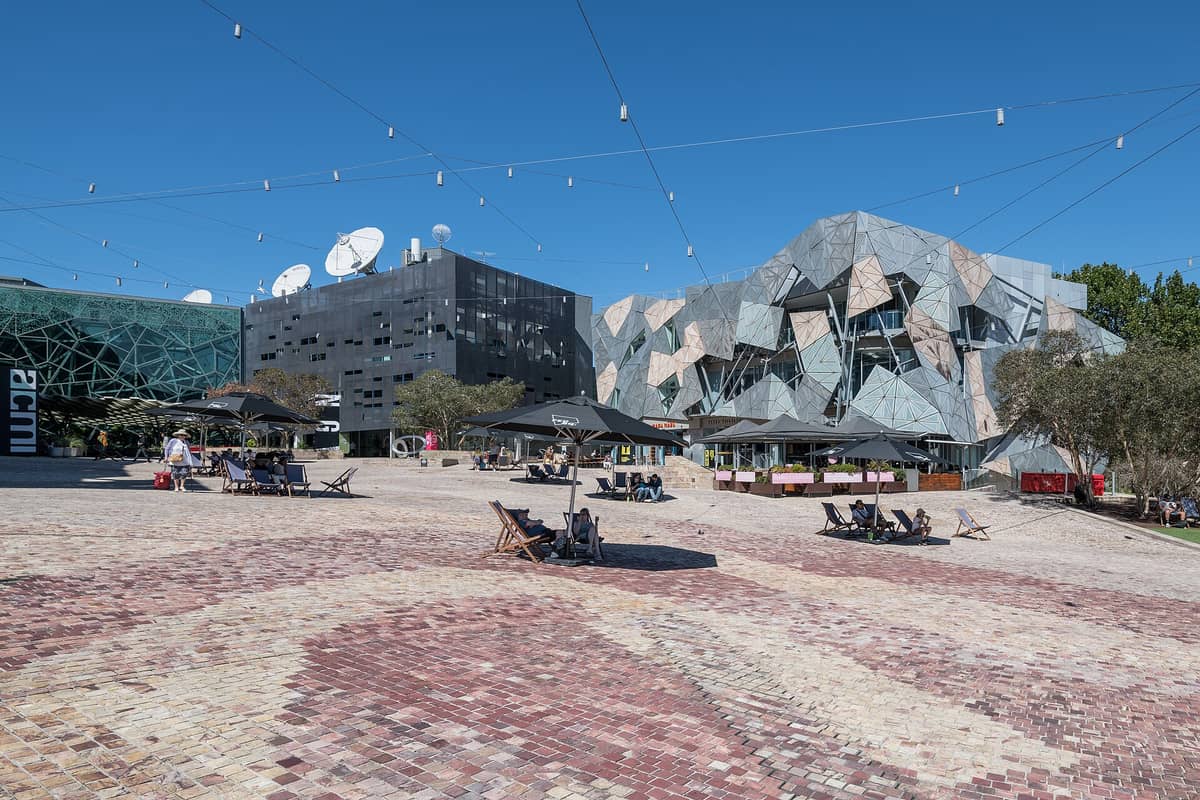
Federation Square is Melbourne's central public square and cultural precinct, opened on 26 October 2002. Built above a working rail corridor on the southern edge of the CBD, it covers 38,000 square metres and holds galleries, restaurants, broadcast studios, event spaces, and an indoor atrium. The square sits directly across Flinders Street from Flinders Street Station, one of Melbourne's most photographed landmarks, and a few steps from the Yarra River.
It is not a museum or a shopping centre. It is more accurately described as a civic forecourt that happens to contain world-class cultural institutions. The public space is free, open 24 hours, and genuinely used by Melburnians rather than being a sterile tourist zone. On any given weekday you will find office workers eating lunch on the steps, students cutting through toward Flinders Lane, and tour groups oriented around the angular sandstone facade of the Ian Potter Centre.
ℹ️ Good to know
Federation Square sits entirely within Melbourne's Free Tram Zone. If you are arriving by tram, you do not need a Myki card for travel within this zone. Flinders Street Station, just across the road, connects to most metropolitan train lines (the Sunbury, Pakenham, and Cranbourne lines use the Metro Tunnel).
The Architecture: What the Geometry Is About
The design by Lab Architecture Studio and Bates Smart is the thing most visitors notice first and understand last. The facades are clad in a repeating triangular pattern of sandstone, zinc, and glass panels, derived from a mathematical fractal known as a pinwheel tiling. No two panels are identical in orientation, yet the surface reads as coherent from a distance. Architects describe the approach as attempting a visual complexity that mirrors the layered character of a city rather than the clean rationalism of a single corporate building.
The result divides opinion. Melburnians debated the design fiercely before and after it opened, and some still do. What is harder to argue with is the spatial logic. The Main Square is slightly sunken below street level and oriented toward a large public screen, which creates a natural amphitheatre. On event nights this geometry turns the square into one of Melbourne's best outdoor viewing spaces. The Atrium, the glassed indoor corridor running along the Flinders Street edge, acts as a buffer between the noise of the street and the quieter gallery spaces inside.
If architecture interests you beyond Federation Square, the surrounding blocks contain a dense concentration of significant buildings. The Flinders Street Station Edwardian dome directly opposite, the St Paul's Cathedral a short walk north, and the Victorian-era arcades deeper in the CBD all sit within 10 minutes on foot. The Melbourne architecture guide covers these in sequence if you plan a walking route.
Tickets & tours
Live prices and dates from our booking partner. If you book, we may earn a commission at no extra cost to you.
Great Ocean Road reverse itinerary tour from Melbourne
From 77 €Instant confirmationFree cancellationGreat Ocean Road bus tour with a forest walk
From 90 €Instant confirmationFree cancellationYarra Valley Bus Wine Tour including lunch with a glass of wine and chocolate
From 107 €Instant confirmationFree cancellationHidden bars of Melbourne guided tour
From 115 €Instant confirmationFree cancellation
The Galleries Inside: What to Prioritise
The Ian Potter Centre: NGV Australia occupies the eastern end of the precinct and holds the National Gallery of Victoria's Australian art collection. This includes work by Indigenous Australian artists, colonial-era paintings, photography, and contemporary pieces. Entry to the permanent collection is free. It is one of the few places in the country where you can move from 19th-century pastoral paintings to major contemporary Aboriginal art within a single building without paying admission.
The Australian Centre for the Moving Image (ACMI) is the other anchor institution. After a substantial redevelopment completed in 2021, ACMI now runs a permanent free exhibition called The Story of the Moving Image, which traces screen culture from early cinema to video games and social media. It is genuinely engaging for adults and older children alike. Note that ACMI also runs ticketed temporary exhibitions and a cinema program; check their schedule in advance if that interests you.
💡 Local tip
Both the Ian Potter Centre and ACMI's permanent exhibitions are free. If you are on a tight budget, Federation Square offers more cultural depth per dollar than almost anywhere else in central Melbourne.
How the Square Changes Through the Day
Early morning, before 8am, Federation Square is quiet in a way the rest of the CBD is not. The cobblestones on the Main Square are damp if there has been overnight rain, and the large public screen usually runs news or promotional content at low volume. A handful of people cut through from Flinders Street Station. It is a useful time to photograph the architecture without crowds obscuring the geometry.
From mid-morning onward, the square fills steadily. The steps facing the large screen become a default meeting point for tour groups and friends. The cafes and restaurants along the Flinders Street edge and within the Atrium run at full capacity through lunch. The sound level rises noticeably. By mid-afternoon on warm days, the Main Square can feel crowded without feeling unwelcoming. It has enough open space that congestion rarely becomes uncomfortable unless a major event is scheduled.
On event nights, the square transforms. Major sporting events, New Year's Eve, and public screenings draw thousands of people, and the amphitheatre design comes into its own. The large screen becomes the focal point and the surrounding steps and cobblestones fill with seated crowds. If you are in Melbourne during one of these events, the atmosphere is worth experiencing. If you are trying to reach Flinders Street Station or cross the precinct, allow extra time.
Practical Walkthrough: Getting Around the Precinct
The site is accessed from Swanston Street to the west, Flinders Street to the north, and a riverside path along the Yarra to the south. There is no single front entrance. Most visitors arrive from the Flinders Street crossing, which drops you directly into the Main Square. The Atrium entrance on Flinders Street is the most weather-protected option on rainy days and connects directly to the gallery spaces.
Accessibility is well considered by Melbourne standards. The Main Square has an accessible marked path across its uneven cobblestone surface, which can otherwise be difficult for wheelchairs or prams. Lift access is available to the Atrium. Accessible toilets are provided. Individual venues within the precinct have their own accessibility provisions; check the Fed Square accessibility page before visiting if this is a priority.
The Yarra River runs along the southern edge of the precinct. A riverside path connects Federation Square westward toward Birrarung Marr, a small park with Indigenous art installations and river views. This is worth adding as a 20-minute walk before or after your visit, particularly in the late afternoon when the light on the Yarra is at its best.
Eating and Drinking at Federation Square
The food and drink options within Federation Square cover a wide price range. Cafe options in the Atrium and along the Flinders Street edge suit a quick coffee or light meal. Several restaurants occupy better positions with river or square views and price accordingly. None of the dining here is especially notable by Melbourne's standards, and if you are looking for the city's best eating, you will find more interesting options in the laneways a few blocks north.
That said, the convenience is real. If you have spent a few hours in the galleries and need a meal without much walking, the precinct provides reliable options. For a broader overview of what Melbourne's food culture actually looks like, the guide to eating in Melbourne gives context for the different neighbourhoods and cuisines worth seeking out.
Photography: What Works and What Doesn't
The most photographed angle is from the intersection of Swanston and Flinders Streets, looking southeast toward the Ian Potter Centre facade with Flinders Street Station in the background. This works best in the early morning or on overcast days, when the sandstone panels hold detail without harsh shadows. At midday in summer the contrast between the zinc and sandstone elements can be difficult to expose correctly.
The Atrium interior, with its geometric glass roof casting angular shadows across the floor, is worth exploring for architectural photography. A wide-angle lens captures the structural geometry better than a standard focal length. For the riverfront view looking back at the precinct, late afternoon in autumn provides warm light on the western-facing surfaces.
Who Might Not Enjoy Federation Square
Visitors expecting a traditional European-style town square, with cafes, fountains, and uniform facades, will find the angular geometry confronting rather than welcoming. The cobblestone surface of the Main Square is uneven and can be tiring if you spend time standing on it. Travellers with very limited time who are prioritising Melbourne's well-known lane culture, beaches, or day trips may find Federation Square more of a transit point than a destination.
It is also worth noting that Federation Square's impact is partly contextual. It works best as part of a broader day in the CBD, where the galleries anchor a walking loop that also takes in the riverfront, the laneways, and the station precinct. Treating it as a standalone destination for a short visit may leave you underwhelmed. The square is more useful than it is spectacular.
Insider Tips
- The Story of the Moving Image permanent exhibition is free and takes around 60-90 minutes to move through properly. Many visitors skip it assuming it is just about film history, but the video game and social media sections are genuinely engaging for adults.
- If you are visiting in warm weather, the steps facing the large screen on the western side of the Main Square catch afternoon shade from around 4pm onward. This is where locals tend to sit during outdoor screenings.
- The Atrium toilets are free, accessible, and consistently well-maintained. In a precinct where paid venues sometimes restrict bathroom access, this is useful to know.
- The riverside path on the southern edge connects directly to Birrarung Marr without crossing any roads. This is the quietest and most pleasant route if you are walking east toward the MCG or Jolimont Station.
- Fed Square's public screen shows live coverage of major Australian sporting events. If there is an AFL final or Australian Open match in progress, the Main Square effectively becomes a free outdoor venue with a substantial crowd.
Who Is Federation Square For?
- First-time visitors who want to orient themselves in the CBD before exploring further
- Art and gallery enthusiasts who want access to Australian art collections without an admission fee
- Families with children, particularly for the ACMI interactive exhibitions
- Architecture and design enthusiasts interested in post-2000 urban development
- Travellers planning to attend or watch a major public event in Melbourne
Nearby Attractions
Other things to see while in Melbourne CBD:
- AC/DC Lane
Renamed in 2004 to honour one of Australia's most iconic rock bands, AC/DC Lane is a compact CBD laneway lined with street art, live music venues, and a raw energy that sets it apart from Melbourne's more polished laneways. Free to visit at any hour, it rewards those who show up after dark.
- Australian Centre for the Moving Image (ACMI)
The Australian Centre for the Moving Image (ACMI) sits at the heart of Federation Square and traces the full arc of screen culture, from silent cinema to interactive digital art. General entry and the permanent exhibition are free, making it one of the most rewarding stops in the Melbourne CBD regardless of your budget or the weather outside.
- Birrarung Marr
Birrarung Marr is a free, open-access riverside park on the northern bank of the Yarra River, a short walk from Flinders Street Station. Built on a former railway yard and opened in 2002, it offers terraced lawns, Indigenous cultural context, city skyline views, and a calendar of public events that transforms the space throughout the year.
- The Block Arcade
Built between 1892 and 1893, The Block Arcade is Melbourne's finest Victorian-era shopping arcade, a covered gallery of mosaic tile floors, ornate plasterwork, and a soaring glazed roof on Collins Street. Free to enter and open daily, it rewards slow exploration and offers one of the CBD's most atmospheric pauses from street-level traffic.
Planning a trip? Discover personalized activities with the Nomado app.