St Paul's Cathedral Melbourne: What to Expect Before You Visit
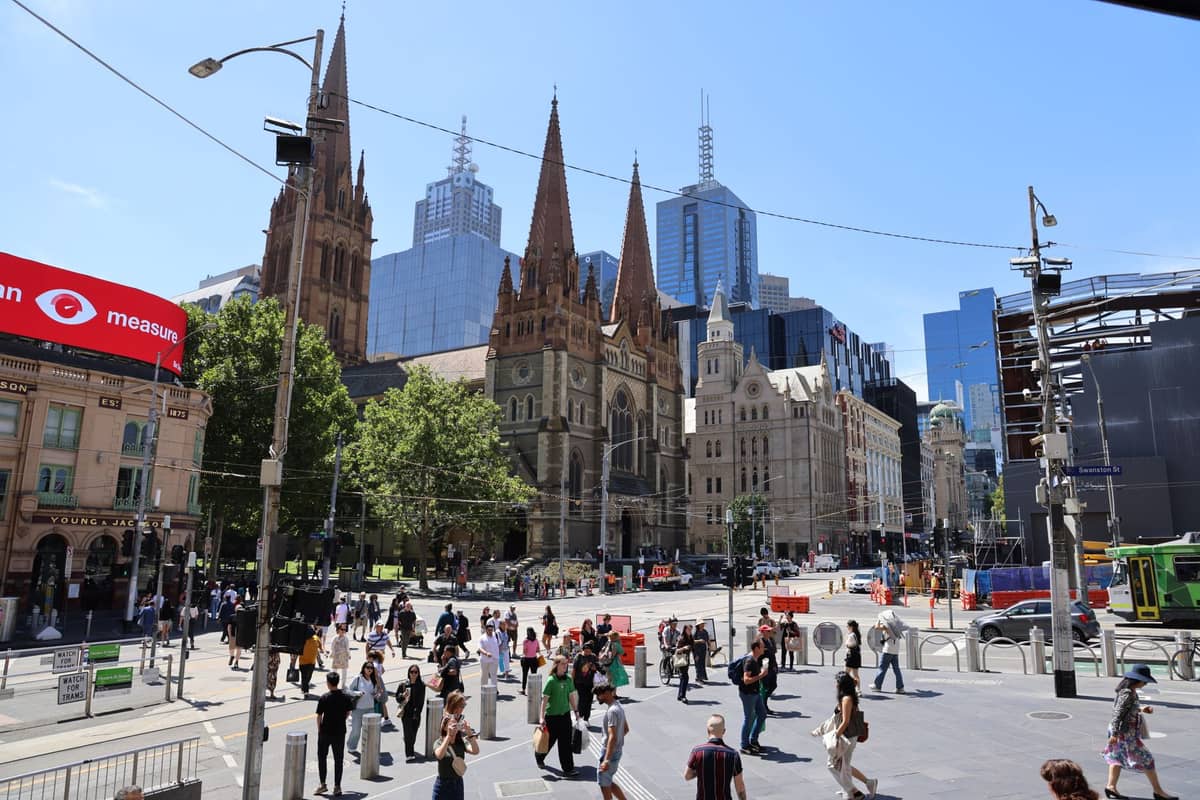
Standing at the corner of Flinders Street and Swanston Street, St Paul's Anglican Cathedral Melbourne is one of the city's most recognisable landmarks. Free to enter and open most days, it offers a rare moment of architectural calm in the middle of a busy city grid.
Quick Facts
- Location
- Corner of Flinders Street & Swanston Street, Melbourne CBD
- Getting There
- Flinders Street Station (opposite); Free Tram Zone stops outside
- Time Needed
- 30–60 minutes
- Cost
- Free entry; donations welcomed
- Best for
- Architecture lovers, quiet reflection, photography
- Official website
- cathedral.org.au
What Is St Paul's Cathedral Melbourne?
St Paul's Anglican Cathedral Melbourne occupies one of the most prominent corners in Australia: at the corner where Flinders Street meets Swanston Street. That position alone makes it impossible to miss, but the building rewards more than a passing glance. It is a full-scale Gothic Revival cathedral in the tradition of the great English churches, designed by the prominent Victorian-era architect William Butterfield and built over more than a decade before its consecration on 22 January 1891.
The central spire reaches 317 feet (about 97 metres) above street level. In a city that now surrounds it with glass towers, the cathedral's sandstone and bluestone geometry still holds its own. It is classified by the National Trust of Australia (Victoria) and remains an active place of Anglican worship, which means the rhythm of daily services shapes when and how visitors can move through it.
ℹ️ Good to know
Opening hours differ across the cathedral's own web pages. Opening hours differ across the cathedral's own web pages. The visitor information page lists Monday to Saturday, 10 am to 5 pm, while the homepage notes Monday to Friday, 10 am to 6 pm, Saturday, 10 am to 5 pm, and public holidays, 11 am to 4 pm. Always check the official site at cathedral.org.au before your visit, as services can also limit access to certain areas. Always check the official site at cathedral.org.au before your visit, as services can also limit access to certain areas.
The Architecture: What Butterfield Built
William Butterfield never set foot in Australia. He designed St Paul's Cathedral Melbourne from London, working from correspondence and plans, and the building reflects his characteristic approach: polychromatic stonework, pointed arches, high nave clerestory windows, and a distinctive use of colour and pattern. Butterfield was deeply influenced by the Gothic Revival principles of Augustus Pugin and John Ruskin, and his buildings tend to feel morally earnest in a way that purely decorative Gothic Revival structures do not.
Inside, the nave is tall and relatively narrow, which creates a strong vertical pull upward toward the timber roof. The stained glass windows are notable in both quality and narrative scope, tracing scenes from the New Testament in deep blues, reds, and ochres. Natural light moves differently through the building at different times of day: morning light enters through the eastern windows and falls directly across the chancel, while afternoon light filters through the southern nave windows and casts coloured patterns across the stone floor. If photography is your aim, the afternoon session generally produces warmer and more varied light conditions.
The organ is worth noting separately. It has a long history of restoration and modification; the Organ Historical Trust of Australia has documented its specification in detail. Visitors present during rehearsal or before a scheduled service may hear it played, which transforms the acoustic experience of the interior entirely. For more on Melbourne's architectural character more broadly, the Melbourne architecture guide covers the city's other significant buildings in context.
Tickets & tours
Live prices and dates from our booking partner. If you book, we may earn a commission at no extra cost to you.
Great Ocean Road reverse itinerary tour from Melbourne
From 77 €Instant confirmationFree cancellationGreat Ocean Road bus tour with a forest walk
From 90 €Instant confirmationFree cancellationYarra Valley Bus Wine Tour including lunch with a glass of wine and chocolate
From 107 €Instant confirmationFree cancellationHidden bars of Melbourne guided tour
From 115 €Instant confirmationFree cancellation
How the Visit Feels at Different Times of Day
Arriving shortly after the 10 am opening on a weekday, the cathedral is typically quiet. The intersection outside is already loud with tram bells, foot traffic crossing between Federation Square and Flinders Street Station, and delivery vehicles navigating the CBD grid. Stepping inside is an immediate acoustic shift: the stone walls absorb ambient city noise and replace it with a low, resonant silence punctuated by footsteps on the stone floor.
By late morning, school groups occasionally pass through, usually with a guide and a structured itinerary. They tend to move efficiently and rarely linger. By midday the cathedral fills slightly with people seeking shade or a quiet seat, some clearly tourists, others using the space simply to pause. The atmosphere at this hour is more ambient than contemplative.
Late afternoon, particularly on weekdays around 4 pm, can be one of the calmer windows. The light through the southern windows is at its most photogenic, foot traffic from the midday peak has subsided, and a closing-time quietness begins to settle over the building. Visitors who prefer unhurried time with the architecture and windows should aim for this slot, allowing themselves at least 45 minutes before the 5 pm close.
💡 Local tip
If you want to hear the organ, check the cathedral's website for scheduled services and recitals. If you want to hear the organ, check the cathedral's website for scheduled services and recitals. Attending Evensong, where visitors are welcome to join the service, allows visitors to hear the full building acoustics.
Getting There and Getting In
The location could not be more central. Flinders Street Station is directly across the road, served by all metropolitan and some regional rail lines. Tram routes 1, 3, 3a, 5, 6, 16, 64, 67, 70, 72, and 75, as well as the City Circle tram, stop out the front of the cathedral. All of this falls within Melbourne's Free Tram Zone, so there is no fare cost for tram travel from anywhere within the central city.
There is no on-site parking. The surrounding CBD blocks have commercial parking stations but rates during business hours are significant. Given the transit access, driving is not the logical choice. If you are planning a broader day in the CBD and want to understand how to move between sites efficiently, the getting around Melbourne guide explains the tram network and myki card system in detail.
Entry is through the Great West Doors on Flinders Street, with wheelchair access via a ramp through the West door. The cathedral is welcoming to all visitors regardless of faith or background. Service animals are permitted. Some interior areas have lower lighting and uneven floor surfaces near the older sections, so visitors with mobility concerns should move carefully in those spaces.
The Surrounding Corner: Context and Contrast
The intersection at Flinders Street and Swanston Street is one of the most photographed in Melbourne, and St Paul's Cathedral is part of why. Across the road, Flinders Street Station's ochre dome and arched facade creates a Edwardian counterpoint to Butterfield's Gothic spire. To the east, Federation Square offers angular contemporary architecture that deliberately sets itself apart from both heritage neighbours.
The contrast between these three buildings, all visible from a single vantage point, tells a compressed version of Melbourne's architectural history: Victorian Gothic in the 1880s, Edwardian civic confidence in the 1900s, and postmodern cultural complexity in the 2000s. Standing on the Swanston Street footpath and looking slowly across all three gives a more useful orientation to the city's development than most guidebooks provide.
Who Should Skip This, and Why
St Paul's Cathedral is not primarily a tourist attraction. It is an active place of worship that accommodates visitors, and that distinction matters. Visitors hoping for a curated museum experience with audio guides, interactive displays, or café facilities will not find them here. There is no gift shop of note and no guided tour included with entry. The experience is essentially self-directed, and those who get the most from it tend to be people who appreciate spending time inside a significant building on its own terms.
If your interest is primarily in colonial-era history, the Old Melbourne Gaol offers a more structured and dramatically different experience of Melbourne's nineteenth-century past. If you are drawn to religious art and heritage buildings but want guided context, the cathedral does host occasional organised tours; check the website for current scheduling.
Families with young children can certainly visit, though the interior does not have dedicated children's programming. A short stop works well as part of a broader CBD walk, especially when combined with Federation Square next door and the riverfront at Birrarung Marr a short walk east along the Yarra.
Photography Notes
The exterior is best captured from the Federation Square forecourt, which provides enough distance to frame the full height of the spire. Morning light from the east hits the Swanston Street facade directly; afternoon light falls on the Flinders Street elevation. Because the cathedral sits in a dense urban block, wide-angle shots are easier than telephoto compositions.
Inside, photography is generally permitted for personal use, though it is courteous to avoid using flash near people who are praying or attending a service. A phone camera handles the stained glass adequately in good light, but if you want to capture the window detail without blown highlights, shooting on an overcast day when the light is diffuse produces more even results. The chancel area and the view back toward the western doors from the front of the nave are both worth composing carefully.
⚠️ What to skip
During services, access to parts of the nave and chancel may be restricted. Photographing during an active service is inappropriate. If you arrive and a service is in progress, wait near the entrance or return at a different time.
Insider Tips
- The kneelers and pew cushions in the nave were made by parishioners and each has a unique embroidered design. If you are sitting quietly, look down at the one in front of you rather than only up at the windows.
- The Flinders Street elevation, facing south, is often in shade during winter mornings. If you want to photograph the full spire with clear sky behind it, position yourself on the Federation Square side in the morning or try the Swanston Street angle in late afternoon.
- Evensong, when sung by the cathedral choir, offers visitors a chance to experience the building's acoustics as part of a service.
- The cathedral's foundation stone was laid in 1880, meaning the building was under construction for over a decade before consecration. The quality of the stonework reflects a level of craft that was already becoming economically difficult to sustain by the late Victorian period.
- Immediately after a rainstorm, the bluestone and sandstone elements of the exterior take on a richer, deeper colour. The corner at Flinders and Swanston is worth a photograph in wet conditions if you can manage the umbrella.
Who Is St Paul's Cathedral For?
- Architecture enthusiasts who want to study high-quality Gothic Revival detailing up close
- Travellers looking for a quiet ten minutes off the CBD footpaths without spending money
- Photographers working on a Melbourne skyline or heritage architecture project
- Anyone attending a choral service or organ recital wanting excellent acoustics in a free venue
- Visitors on a self-guided walking tour of central Melbourne's nineteenth-century buildings
Nearby Attractions
Other things to see while in Melbourne CBD:
- AC/DC Lane
Renamed in 2004 to honour one of Australia's most iconic rock bands, AC/DC Lane is a compact CBD laneway lined with street art, live music venues, and a raw energy that sets it apart from Melbourne's more polished laneways. Free to visit at any hour, it rewards those who show up after dark.
- Australian Centre for the Moving Image (ACMI)
The Australian Centre for the Moving Image (ACMI) sits at the heart of Federation Square and traces the full arc of screen culture, from silent cinema to interactive digital art. General entry and the permanent exhibition are free, making it one of the most rewarding stops in the Melbourne CBD regardless of your budget or the weather outside.
- Birrarung Marr
Birrarung Marr is a free, open-access riverside park on the northern bank of the Yarra River, a short walk from Flinders Street Station. Built on a former railway yard and opened in 2002, it offers terraced lawns, Indigenous cultural context, city skyline views, and a calendar of public events that transforms the space throughout the year.
- The Block Arcade
Built between 1892 and 1893, The Block Arcade is Melbourne's finest Victorian-era shopping arcade, a covered gallery of mosaic tile floors, ornate plasterwork, and a soaring glazed roof on Collins Street. Free to enter and open daily, it rewards slow exploration and offers one of the CBD's most atmospheric pauses from street-level traffic.
Planning a trip? Discover personalized activities with the Nomado app.