Flinders Street Station: Melbourne's Most Recognisable Building
Flinders Street Railway Station sits at the symbolic heart of Melbourne, where the city's rail network began in 1854 and where the Edwardian facade has defined the CBD skyline for over a century. Whether you're catching a train or simply absorbing the city's rhythm, this is where Melbourne begins.
Quick Facts
- Location
- 207–361 Flinders Street, Melbourne CBD, corner of Flinders and Swanston Streets
- Getting There
- Flinders Street Station (all metropolitan lines); adjacent to the Free Tram Zone
- Time Needed
- 20–45 minutes to explore the exterior and concourse; longer for the heritage areas
- Cost
- Free to enter the station concourse; train travel requires a myki card (fares vary by journey)
- Best for
- Architecture lovers, history enthusiasts, photographers, first-time Melbourne visitors
- Official website
- www.metrotrains.com.au/stations/flinders-street
What Is Flinders Street Station?
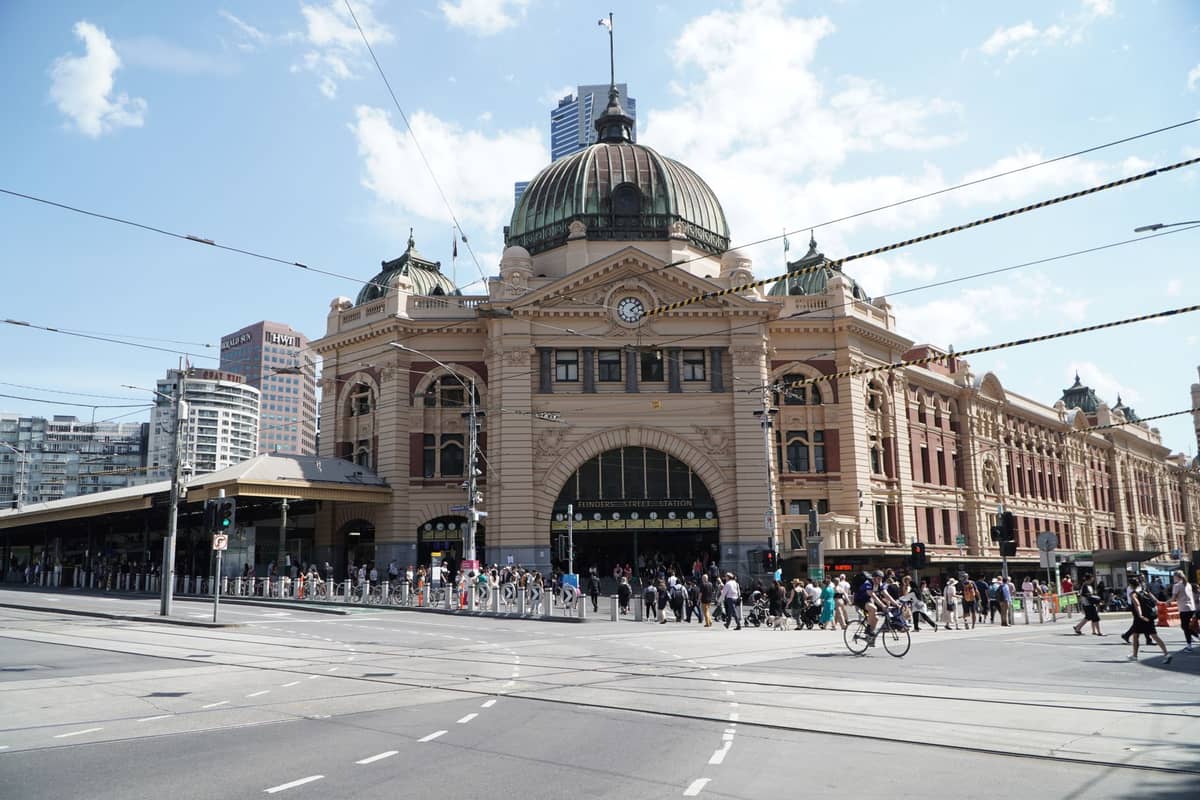
Flinders Street Railway Station is Melbourne's central metropolitan rail hub and the city's single most photographed building. designed by James Fawcett and H. P. C. Ashworth, the station stands at the corner of Flinders and Swanston Streets in the CBD, directly across from Federation Square and flanking the Yarra River. Its ochre-yellow Edwardian Baroque facade, copper dome, and row of clocks above the main entrance are as embedded in Melbourne's visual identity as any structure in Australia.
Unlike many landmark railway stations that have been converted into shopping centres or museums, Flinders Street Station is still a fully functioning part of Melbourne's public transport network. All metropolitan train lines serve it. On any given weekday, the platforms and concourse fill with commuters, tourists, school groups, and city workers, which gives the space an energy that a purely heritage attraction cannot replicate.
💡 Local tip
Entry to the station concourse is free. You only need a myki card if you are boarding a train. Tap your card at the gates to enter the paid zone, or simply walk through the main concourse to observe the architecture without travelling.
Architecture and Heritage
The current station building is listed on the Victorian Heritage Register, a recognition that reflects both its architectural significance and its social history. The design, by architects James Fawcett and H. P. C. Ashworth, draws on Edwardian Baroque influences common in early twentieth-century civic and institutional buildings across the British Empire. The result is a structure that reads as monumental from across the river but reveals considerable decorative detail up close: terracotta window surrounds, a turret at each corner, arched fenestration along Flinders Street, and the shallow copper dome that anchors the building's skyline silhouette.
The row of clocks positioned above the main entrance at the corner has particular cultural weight in Melbourne. For generations, 'meeting under the clocks' has been a city shorthand for a designated meet-up, the same way Londoners say Eros in Piccadilly. The phrase still makes sense to most locals today, even if smartphones have largely replaced the need for a fixed reference point.
The station's main platform is 708 metres long, which gives a sense of the infrastructure scale beneath the decorative exterior. For a broader look at Melbourne's architectural inheritance, the Melbourne architecture guide provides useful context for understanding how Flinders Street fits into the city's built environment, from its gold-rush-era civic buildings to its contemporary towers.
Tickets & tours
Live prices and dates from our booking partner. If you book, we may earn a commission at no extra cost to you.
Great Ocean Road reverse itinerary tour from Melbourne
From 77 €Instant confirmationFree cancellationGreat Ocean Road bus tour with a forest walk
From 90 €Instant confirmationFree cancellationYarra Valley Bus Wine Tour including lunch with a glass of wine and chocolate
From 107 €Instant confirmationFree cancellationHidden bars of Melbourne guided tour
From 115 €Instant confirmationFree cancellation
How the Station Changes Through the Day
The experience of being at Flinders Street Station varies considerably depending on when you arrive. Early mornings, particularly before 8am, carry a particular quality: the concourse is quiet enough to hear footsteps echo, the light falls at a low angle across the Flinders Street facade, and the clocks are legible without a crowd blocking the view. This is the most photogenic window for exterior shots from across the intersection at Federation Square.
By mid-morning, tourist traffic picks up and the area around the Swanston Street corner fills steadily. Between roughly 11am and 2pm, the station's surrounds are at their most photogenic but also most crowded. The Elizabeth Street side and the Yarra promenade below are good alternatives if the main entrance is congested.
Evening rush hour, from around 4:30pm to 6:30pm on weekdays, transforms the station into a genuinely kinetic experience. The concourse fills with a fast-moving crowd, the departure boards cycle constantly, and the noise level rises considerably. It is not an ideal time for leisurely observation, but it does give a clear picture of the station functioning as a piece of civic infrastructure rather than a heritage showcase.
ℹ️ Good to know
For exterior photography, the best light falls on the Flinders Street facade during late afternoon in summer and mid-morning in winter. The elevated footpath outside Federation Square provides a straight-on view across the intersection without foreground obstruction.
The Concourse and Interior Areas
Entering through the main doors on the Swanston Street corner, you step into a wide concourse with ticket gates, a myki top-up area, and the departure board overhead. The space has been incrementally updated over the decades and the interior does not carry the same uninterrupted heritage atmosphere as the exterior. That said, the proportions of the vaulted ceiling and the original ironwork remain visible in parts of the structure.
The upper level of the station, accessible via internal stairs, contains spaces that have been used variously as function rooms and gallery spaces over the years, though access to these areas is not always open to the general public without a specific event or guided activity taking place. Check current programming before planning a visit specifically for the interior heritage spaces.
The station sits at the southern edge of the CBD grid, directly beside the Yarra River and Birrarung Marr, a riverside park with open lawns and public art that provides a useful decompression zone after time in the station precinct. The river promenade here is one of the more pleasant walkways in central Melbourne.
The Surrounding Precinct
Flinders Street Station does not exist in isolation. Directly across Swanston Street sits Federation Square, with its angular bluestone and zinc facade forming an almost deliberate counterpoint to the station's rounded Edwardian curves. The visual contrast between the two buildings, separated by a six-lane intersection, is one of the more arresting street-level experiences in Australian urban design. Federation Square houses the Ian Potter Centre: NGV Australia and the Australian Centre for the Moving Image, making it a logical pairing for an afternoon that starts at the station.
A short walk east along Flinders Street or through Federation Square leads to Hosier Lane, Melbourne's most consistently maintained street art corridor. The contrast in mood between the formal heritage of Flinders Street Station and the rotating murals of Hosier Lane illustrates how varied the CBD's character is across just a few hundred metres.
West along Flinders Street, toward the river end of the CBD grid, the city transitions toward Southbank via the pedestrian bridges across the Yarra. The arts precinct, including the Arts Centre Melbourne and NGV International, is a 10–15 minute walk from the station's western exit.
Practical Information for Visitors
Flinders Street Station operates as an active rail hub around the clock, though train services follow a timetabled schedule that reduces significantly after midnight. The concourse is accessible during rail operating hours; there is no separate visitor admission process and no ticket is required to walk through the main concourse areas.
If you plan to travel by train, you will need a myki card, which can be purchased and topped up at myki machines inside the station. Fares are calculated by zone and journey; check Public Transport Victoria for current fare information before travelling. The station is within the CBD's Free Tram Zone if you arrive by tram, meaning no fare is needed for tram travel within that boundary.
Accessibility at the station includes lifts, escalators, accessible toilets, and a hearing loop. However, not all platforms have independently accessible boarding at every point, and some sections may not meet the full 1,200mm path-width standard. Travellers with specific accessibility needs should check the station's access details on the Metro Trains website before visiting.
⚠️ What to skip
Melbourne's weather is genuinely changeable. The Flinders Street exterior is exposed, and the wide intersection at Swanston Street funnels wind. If you're planning a long outdoor photography session, bring a layer regardless of the forecast.
For more on getting around the city's transit network from the station, the guide to getting around Melbourne covers myki, tram zones, and the broader network in practical detail.
Who Should Not Prioritise This Attraction
Flinders Street Station is worth seeing, but it is not an immersive attraction in the conventional sense. If you are expecting a museum-style experience with interpretive displays, curated heritage rooms, and guided storytelling, the station will likely disappoint. The interior is a working transport terminal, and outside of specific events or tours, the heritage atmosphere is largely confined to the exterior architecture.
Visitors with very limited time in Melbourne who are choosing between this and, say, the Royal Botanic Gardens or the NGV International should understand that Flinders Street Station is best treated as a starting point or a walk-past rather than a destination in its own right. Its real value is contextual: it anchors the city's geography and gives you a physical reference point for the CBD.
Insider Tips
- The best unobstructed view of the full Flinders Street facade is from the corner footpath directly outside Federation Square, not from the steps of the station itself. Cross Swanston Street and turn around.
- The row of clocks above the entrance shows the departure times for different train lines, a functional detail that most visitors photograph without realising what they're looking at.
- The station's Elizabeth Street side, running along the western flank of the building toward the river, is significantly quieter than the main Swanston Street entrance and gives a better sense of the building's full length and platform infrastructure.
- If you're visiting during Melbourne's warmer months and plan to walk to the Yarra promenade, the underpass exit near Platform 1 leads directly down to the riverbank without needing to cross Flinders Street at ground level.
- Melbourne sits on the traditional lands of the Wurundjeri Woi-wurrung and Bunurong peoples of the Kulin Nation. The station precinct is part of a landscape with deep Indigenous history that predates European settlement by tens of thousands of years.
Who Is Flinders Street Station For?
- First-time visitors to Melbourne who want to orient themselves in the city's geography
- Architecture enthusiasts interested in Edwardian Baroque civic design
- Photographers looking for an iconic urban composition, especially at golden hour
- Travellers using public transport as a base for exploring the CBD and inner suburbs
- Anyone pairing a visit to Federation Square, Hosier Lane, or the Yarra promenade
Nearby Attractions
Other things to see while in Melbourne CBD:
- AC/DC Lane
Renamed in 2004 to honour one of Australia's most iconic rock bands, AC/DC Lane is a compact CBD laneway lined with street art, live music venues, and a raw energy that sets it apart from Melbourne's more polished laneways. Free to visit at any hour, it rewards those who show up after dark.
- Australian Centre for the Moving Image (ACMI)
The Australian Centre for the Moving Image (ACMI) sits at the heart of Federation Square and traces the full arc of screen culture, from silent cinema to interactive digital art. General entry and the permanent exhibition are free, making it one of the most rewarding stops in the Melbourne CBD regardless of your budget or the weather outside.
- Birrarung Marr
Birrarung Marr is a free, open-access riverside park on the northern bank of the Yarra River, a short walk from Flinders Street Station. Built on a former railway yard and opened in 2002, it offers terraced lawns, Indigenous cultural context, city skyline views, and a calendar of public events that transforms the space throughout the year.
- The Block Arcade
Built between 1892 and 1893, The Block Arcade is Melbourne's finest Victorian-era shopping arcade, a covered gallery of mosaic tile floors, ornate plasterwork, and a soaring glazed roof on Collins Street. Free to enter and open daily, it rewards slow exploration and offers one of the CBD's most atmospheric pauses from street-level traffic.
Planning a trip? Discover personalized activities with the Nomado app.