Hosier Lane: Inside Melbourne's Living Street Art Gallery
Hosier Lane is a 100-metre cobblestone laneway in Melbourne's CBD that functions as a rotating outdoor gallery, where internationally recognised murals sit alongside fresh paste-ups applied overnight. Entry is free, access is around the clock, and the walls are never the same twice.
Quick Facts
- Location
- Hosier Lane, Melbourne VIC 3000 — between Flinders Street and Flinders Lane, opposite Federation Square
- Getting There
- Flinders Street Station (2-min walk); Free Tram Zone stops at Federation Square
- Time Needed
- 20–45 minutes to walk and photograph; longer if you linger or sketch
- Cost
- Free, no ticket required
- Best for
- Photography, street art enthusiasts, urban culture, first-time Melbourne visitors
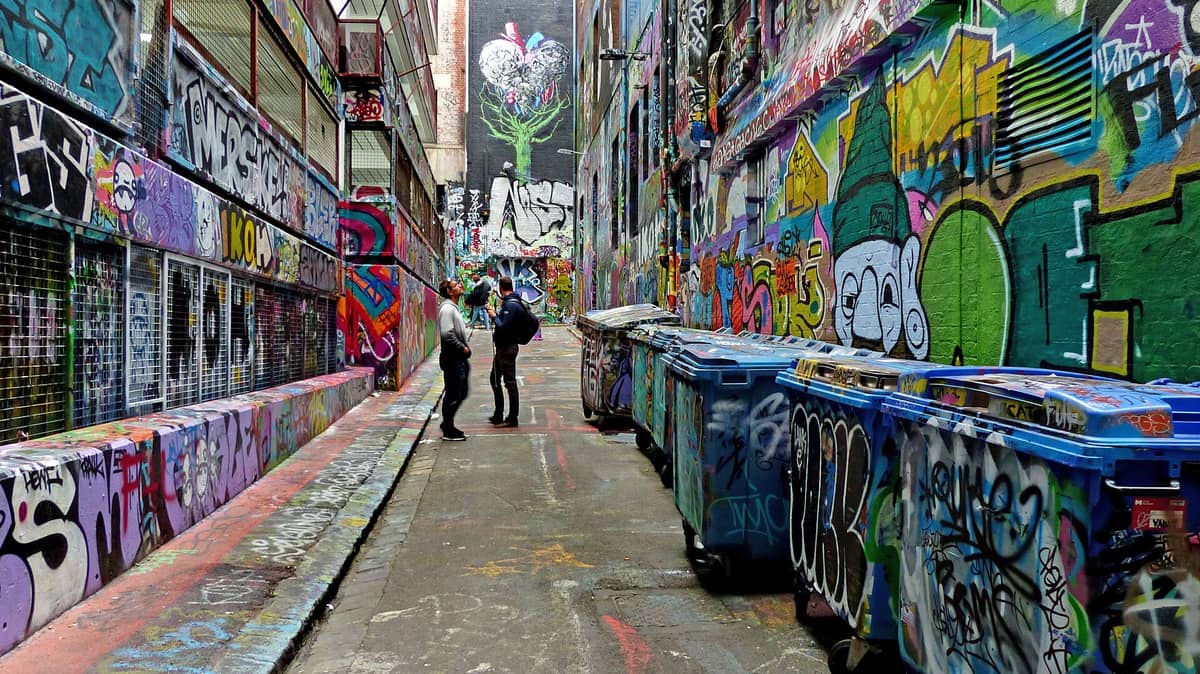
What Hosier Lane Actually Is
Hosier Lane is a narrow cobblestone laneway in central Melbourne that has functioned as an open-access street art space since the City of Melbourne's City Lights Initiative formalized it in 1998. At roughly 100 metres long, it runs between Flinders Street and Flinders Lane, directly opposite Federation Square. Every surface — ground to roofline — is covered in layered spray paint, wheatpaste, stencil work, and tile installations. Nothing is permanent. Work that existed last week may already be painted over.
This constant renewal is both the appeal and the limitation. Hosier Lane does not preserve street art; it circulates it. Pieces by internationally known artists have appeared here, only to be covered within days. That impermanence is the point, and understanding it shifts how you experience the lane.
💡 Local tip
Arrive early on weekday mornings (before 9 a.m.) for the best light and fewest people. Overcast days also work well — direct sunlight creates harsh shadows across the textured walls that can flatten photography.
How the Lane Changes Through the Day
In the early morning, Hosier Lane is quiet enough that you can hear your own footsteps on the cobblestones. The smell of aerosol paint is sometimes detectable, a sign that someone worked through the night. At this hour the murals are readable in full: large-format stencil portraits, abstract colour fields several metres wide, political text pieces, and finely rendered figurative work stacked in dense, overlapping layers.
By mid-morning, photographers with tripods and tour groups with guides begin arriving. By early afternoon the lane can feel crowded, particularly on weekends, when visitors often queue informally to photograph certain sections. The social dynamic shifts too: the lane becomes performative, with visitors posing against the most colourful sections. If you want time alone with the art, late evening or early morning on a weekday is consistently quieter.
At dusk, when the ambient light goes low and diffuse, the colours read differently. Neon-bright pieces that seem garish in direct sunlight take on unexpected depth. A few visitors return specifically at this hour for photography. There is no artificial gallery lighting, so after dark the lane is lit only by ambient city glow and phone screens.
Tickets & tours
Live prices and dates from our booking partner. If you book, we may earn a commission at no extra cost to you.
Great Ocean Road reverse itinerary tour from Melbourne
From 77 €Instant confirmationFree cancellationGreat Ocean Road bus tour with a forest walk
From 90 €Instant confirmationFree cancellationYarra Valley Bus Wine Tour including lunch with a glass of wine and chocolate
From 107 €Instant confirmationFree cancellationHidden bars of Melbourne guided tour
From 115 €Instant confirmationFree cancellation
The Art Itself: What to Look For
The layering in Hosier Lane is its most distinctive visual quality. Decades of work compress into walls where a photorealist portrait might sit above a stencil that is partially buried under a wash of colour. Run your hand along a section and the texture is thick, almost sculptural in places where paint has built up over years. The cobblestone ground is itself painted, meaning the art extends beneath your feet.
Look up as well as straight ahead. Upper sections of the walls, harder to reach, tend to hold older work longer. Tile-based pieces and mosaic installations occasionally appear at mid-height. The lane has a secondary spur that branches off at an angle — this smaller passage typically carries denser, more experimental work than the main corridor and is overlooked by visitors who turn back at the first bend.
ℹ️ Good to know
Hosier Lane intersects with Rutledge Lane at its southern end. Rutledge Lane carries similar density of street art and is worth exploring if you have time — it is less photographed and the work there sometimes runs to larger political and social commentary pieces.
History and Cultural Context
The 1998 City Lights Initiative gave street artists a formally tolerated space in central Melbourne. This was not an act of neutrality — it was a deliberate policy to distinguish sanctioned spaces from unsanctioned graffiti elsewhere in the city, and it gave artists a legal context to work in. Over the following decade, Melbourne's laneway street art culture grew into something with international recognition, and Hosier Lane became its most visited address. It sits alongside the broader laneway culture of the CBD, which also encompasses places like Degraves Street and the celebrated AC/DC Lane, though Hosier Lane remains the densest concentration of street art in the city.
The lane's relationship with street art has never been entirely without tension. Some argue that formalizing and promoting a space can change the nature of what happens there, shifting art-making from subversive act to tourism performance. That debate is visible in the lane itself: high-craft studio-style murals compete for space with rougher, more urgent text-based work. Both traditions are represented, and neither dominates consistently.
For more context on Melbourne's wider street art culture and how to explore it across the city's inner suburbs, the Melbourne street art guide covers key neighbourhoods and walking routes beyond the CBD.
Getting There and Practical Logistics
Hosier Lane is one of the easiest attractions in Melbourne to reach. Flinders Street Station is a two-minute walk away — exit onto Flinders Street, cross toward Federation Square, and the lane entrance is directly opposite. Trams within Melbourne's Free Tram Zone stop nearby on Swanston Street and Flinders Street, making it reachable without any fare.
The lane is publicly accessible at all hours. There are no gates, no ticket booths, and no staff. As a public laneway in the Melbourne CBD, it functions like any city street — open continuously. There is no official dedicated website for Hosier Lane.
On accessibility: the laneway surface is cobblestone, which creates an uneven texture underfoot. A source notes that paving works have improved conditions, but the lane is not smooth and may present difficulties for wheelchair users or those with mobility limitations. The lane is narrow, and when crowded it can feel constricted.
⚠️ What to skip
Hosier Lane is a working laneway, not a pedestrian-only zone. Vehicles occasionally use it, particularly outside peak hours. Stay alert when near the entrances at Flinders Street and Flinders Lane.
Photography: Getting the Most from the Walls
The challenge in photographing Hosier Lane is that the space is narrow, which limits how far back you can stand. Wide-angle lenses are useful for capturing full-height murals. Shooting in portrait orientation helps with the vertical scale of the work. Because the walls face each other across a confined corridor, reflected colour from one wall can cast interesting light on the opposite surface, particularly in the golden hour before sunset.
Including people in the frame adds scale and helps convey the density of the art — a figure standing in front of a 6-metre mural communicates something a cropped detail shot cannot. Early morning visits offer the combination of soft light and minimal foot traffic, which is genuinely hard to replicate at other times.
Who Should Think Twice
If you are expecting a curated gallery with artist attribution, explanation placards, or consistent quality control, Hosier Lane will likely feel chaotic. The art is intentionally unorganised and the attribution is almost never present on the wall. Some sections feature tagging or lower-effort work sitting immediately next to highly accomplished pieces, which is part of the nature of the space but may not suit every visitor.
Visitors with significant mobility limitations should note the cobblestone surface. Those travelling with strollers should be prepared for the uneven ground. The lane can also feel uncomfortably narrow when tour groups arrive, which happens regularly between 10 a.m. and 3 p.m. on weekends.
Insider Tips
- Check the secondary spur at the southern end of the lane where it meets Rutledge Lane. This branch is consistently less crowded and the art there tends toward larger political work that differs in character from the main corridor.
- The walls change faster after weekends. If you want to see fresh work, visit on a Monday or Tuesday morning when paint from the previous weekend's activity is most visible.
- Bring a wide-angle lens or use your phone's ultra-wide setting. Standard focal lengths cut off the top third of the taller murals, and the lane is too narrow to compensate by stepping back.
- The cobblestones themselves are painted. Spend a few minutes looking at the ground — some ground-level compositions are as detailed as the wall work and are almost always photographed less.
- Cross Flinders Street into Federation Square after you visit. The contrast between the lane's layered chaos and the angular geometry of Federation Square's architecture makes for an interesting visual pairing, and the square has a free art gallery inside worth adding to the same visit.
Who Is Hosier Lane For?
- Photography enthusiasts looking for texture, colour, and urban composition
- First-time Melbourne visitors wanting a quick orientation to the city's creative identity
- Street art followers tracking specific artists across cities
- Travellers with limited time who want cultural depth without museum admission costs
- Couples or solo walkers exploring the CBD on foot
Nearby Attractions
Other things to see while in Melbourne CBD:
- AC/DC Lane
Renamed in 2004 to honour one of Australia's most iconic rock bands, AC/DC Lane is a compact CBD laneway lined with street art, live music venues, and a raw energy that sets it apart from Melbourne's more polished laneways. Free to visit at any hour, it rewards those who show up after dark.
- Australian Centre for the Moving Image (ACMI)
The Australian Centre for the Moving Image (ACMI) sits at the heart of Federation Square and traces the full arc of screen culture, from silent cinema to interactive digital art. General entry and the permanent exhibition are free, making it one of the most rewarding stops in the Melbourne CBD regardless of your budget or the weather outside.
- Birrarung Marr
Birrarung Marr is a free, open-access riverside park on the northern bank of the Yarra River, a short walk from Flinders Street Station. Built on a former railway yard and opened in 2002, it offers terraced lawns, Indigenous cultural context, city skyline views, and a calendar of public events that transforms the space throughout the year.
- The Block Arcade
Built between 1892 and 1893, The Block Arcade is Melbourne's finest Victorian-era shopping arcade, a covered gallery of mosaic tile floors, ornate plasterwork, and a soaring glazed roof on Collins Street. Free to enter and open daily, it rewards slow exploration and offers one of the CBD's most atmospheric pauses from street-level traffic.
Planning a trip? Discover personalized activities with the Nomado app.