Australian Centre for the Moving Image (ACMI): Melbourne's Museum of Film and Digital Culture
The Australian Centre for the Moving Image (ACMI) sits at the heart of Federation Square and traces the full arc of screen culture, from silent cinema to interactive digital art. General entry and the permanent exhibition are free, making it one of the most rewarding stops in the Melbourne CBD regardless of your budget or the weather outside.
Quick Facts
- Location
- Fed Square, Flinders Street, Melbourne CBD (Naarm)
- Getting There
- Opposite Flinders Street Station; within the Free Tram Zone
- Time Needed
- 2–4 hours for permanent exhibition; allow a full day if attending a film screening or special event
- Cost
- Free general entry and permanent exhibition; some films and ticketed exhibitions vary in price
- Best for
- Film and pop-culture enthusiasts, families with older children, rainy-day visitors, curious first-timers
- Official website
- www.acmi.net.au
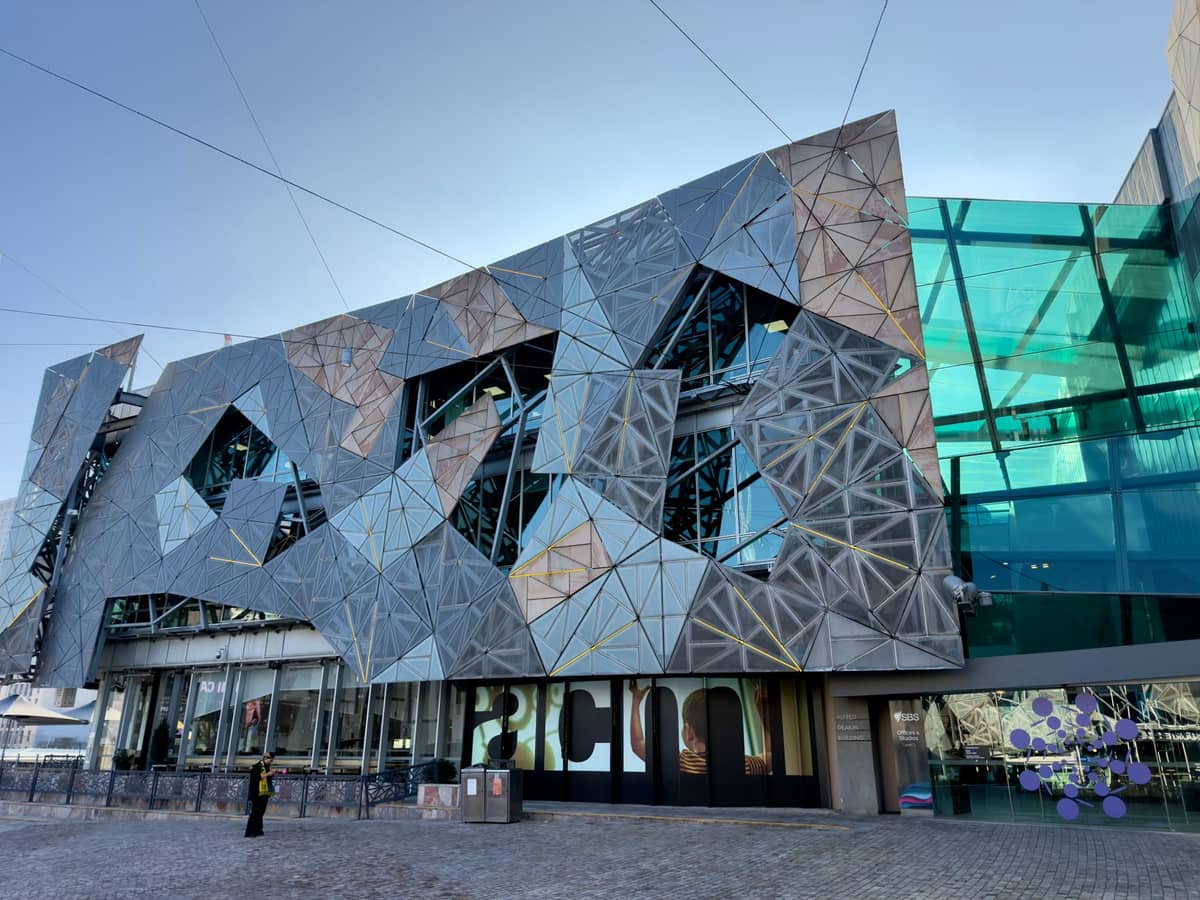
What Is ACMI?
The Australian Centre for the Moving Image, universally known as ACMI, is a public museum and cinema dedicated to screen culture in its widest sense: film, television, video games, and interactive digital art. It opened to the public in October 2002 at Federation Square, making it one of the founding cultural institutions of that precinct. The building it occupies was designed as part of the bold Federation Square project, and ACMI's street-level glazed facade looks directly across Flinders Street at one of Melbourne's most recognisable train stations.
Unlike many museums of its type, ACMI leans participatory. The programming mix includes a permanent free exhibition, a changing slate of curated exhibitions (some ticketed), two cinema screens showing art-house and archive film, and regular events tied to gaming, animation, and emerging digital media. It is not a passive institution where you read wall labels and move on. At various points you are expected to sit, interact, listen, play, and reflect.
ACMI is located within Federation Square, which itself sits in the heart of the Melbourne CBD. Both attractions are best explored together.
The Permanent Exhibition: The Story of the Moving Image
The centrepiece of any ACMI visit is The Story of the Moving Image, a free permanent exhibition that takes up a substantial portion of the building. It runs roughly chronologically through the history of screen-based storytelling, beginning with early optical devices and phenakistoscopes from the 1800s and moving through cinema, broadcast television, the video era, gaming, and into the fragmented, platform-agnostic media landscape of today.
The exhibition design is deliberately immersive. Lighting is low throughout much of the space, and screens, projections, and audio zones overlap in ways that reward slow movement. The smell of the space is neutral and air-conditioned, a deliberate contrast with the noise and heat of Flinders Street outside. Sound bleeds between zones rather than being strictly contained, so you hear the next section before you reach it. This works mostly in the exhibition's favour, building atmosphere rather than causing confusion.
One of the more practical features for visitors is the Lens, a personalised digital companion. At the start of your visit, you can tap an ACMI Lens device (available to borrow at reception) to exhibits throughout the museum, saving information, video clips, and additional context to a personal digital collection you can access after you leave. Families with children who are comfortable with tablets will find this adds genuine value rather than functioning as a gimmick.
💡 Local tip
Pick up an ACMI Lens at the entrance to the permanent exhibition. It is free to borrow and significantly deepens the experience, especially for the film history sections where it unlocks archival footage tied to specific exhibits.
Tickets & tours
Live prices and dates from our booking partner. If you book, we may earn a commission at no extra cost to you.
Melbourne sports precinct tour & Australian Sports Museum
From 70 €Instant confirmationFree cancellationGreat Ocean Road reverse itinerary tour from Melbourne
From 77 €Instant confirmationFree cancellationGreat Ocean Road bus tour with a forest walk
From 90 €Instant confirmationFree cancellationYarra Valley Bus Wine Tour including lunch with a glass of wine and chocolate
From 107 €Instant confirmationFree cancellation
The Cinemas and Ticketed Programming
ACMI operates two dedicated cinema screens that programme a mix of new art-house releases, retrospectives, archive screenings, and curated seasons tied to specific directors, themes, or national cinemas. The programming is more adventurous than a commercial multiplex and often coincides with festivals or exhibition themes. Ticket prices vary and should be checked on the ACMI website before your visit.
If you are visiting Melbourne specifically for cinema culture, ACMI's program rewards advance planning. Retrospective seasons in particular tend to sell out. Evening screenings draw a noticeably different crowd than daytime museum visitors: more adults attending solo or in pairs, less family foot traffic, and a quieter overall atmosphere in the building.
ℹ️ Good to know
ACMI's cinema and ticketed exhibition schedule is updated regularly. Check acmi.net.au for current program details, as availability and pricing vary significantly across events.
Visiting by Time of Day
ACMI is open daily from 10am to 5pm, closing on Christmas Day and opening later (1pm) on ANZAC Day (25 April). It fills steadily from around 11am on weekends and during school holidays, particularly the permanent exhibition spaces. The busiest periods tend to cluster in the early afternoon when Federation Square itself is at its most crowded.
Arriving at 10am on a weekday gives you the closest thing to a quiet experience. The low-lit exhibition spaces feel contemplative rather than crowded, and interactive stations are free to use without queuing. By 1pm on a Saturday, school groups and families with younger children can make certain zones genuinely difficult to navigate slowly. If your primary interest is the exhibition rather than a film screening, a weekday morning is the clear recommendation.
Weather matters here in a specific way: ACMI is one of Melbourne's best genuinely indoor options when the city's notoriously changeable climate turns on you. On a cold, wet winter afternoon (temperatures can sit around 7–14°C in winter), the museum offers several hours of warm, engaging shelter without any admission cost.
Getting There and Getting Around Inside
ACMI's location could not be more central. Federation Square sits directly opposite Flinders Street Station, which is served by most metropolitan train lines (Sunbury, Pakenham, and Cranbourne use the Metro Tunnel). Trams stop along Flinders Street and Swanston Street immediately adjacent to the square, and the entire area falls within Melbourne's Free Tram Zone, meaning tram travel to and from the site costs nothing if you are coming from elsewhere in the central city.
Visitors arriving by train can walk to ACMI in under two minutes from the Flinders Street Station exit. If you are combining ACMI with other CBD attractions, the City Circle Tram and the free tram network make it easy to connect to major stops across the city centre without added transport cost.
Inside the building, ACMI is spread across multiple levels connected by lifts and stairs. The Flinders Street entrance has a wheelchair ramp, and wheelchairs can be borrowed free of charge from reception with ID. Note that Federation Square's external cobblestone paving can be difficult to navigate with a mobility aid before you reach the museum entrance itself; the smoother internal surfaces are easier once you are inside.
⚠️ What to skip
Fed Square's cobbled external paving can be uneven and slippery when wet. If you are using a wheelchair or have mobility concerns, approach via the internal pathways from Flinders Street rather than crossing the open square.
Cultural Context: Why ACMI Exists Here
ACMI was established as a Victorian Government cultural institution and launched on 1 January 2002, opening its Federation Square home later that October. Its founding was part of a broader cultural investment in what became Federation Square, a precinct that also houses the Ian Potter Centre: NGV Australia and other institutions, all built on a platform above the Jolimon railway yards.
Melbourne sits on the traditional lands of the Wurundjeri Woi-wurrung and Bunurong peoples of the Kulin Nation. ACMI, as a publicly funded institution in Naarm/Melbourne, increasingly incorporates First Nations screen stories and digital art into its programming, reflecting a broader shift in how Australian cultural institutions represent the country's oldest storytelling traditions. Visitors interested in this dimension should check the current program before visiting. The nearby Ian Potter Centre: NGV Australia also holds significant First Nations works and is steps away within Federation Square.
Australia has a specific relationship with screen culture that gives ACMI additional local resonance. The country produced globally significant cinema from the 1970s revival onwards, developed some of the world's most-played video game franchises, and has a television history that shaped everyday life for generations. The permanent exhibition reflects this specifically Australian lens without being parochial about it: international screen history is covered thoroughly, with Australian contributions placed in honest comparative context.
Photography, Practical Preparation, and Who Might Skip This
Photography is generally permitted in the permanent exhibition, though individual exhibits may have restrictions, particularly those involving licensed film footage or artwork with third-party rights. The low ambient lighting throughout the exhibition makes phone cameras struggle without flash, which is usually restricted. If photography is a priority, a camera with a wide-aperture lens handles the conditions better.
There is no dress code and no bag size restriction at entry. The museum has a cafe on site and the broader Federation Square precinct has numerous food options at various price points. You do not need to bring much beyond comfortable shoes; the exhibition involves considerable standing and slow walking.
ACMI is genuinely well-suited to families, but with a qualifier: the permanent exhibition works better for children who are already engaged with screen culture, gaming, or film history. Very young children (under five or six) will find limited specific programming in the permanent exhibition, though ACMI does run family-focused events periodically. For a more structured family experience across the river, the Melbourne Museum in Carlton offers broader age-range appeal.
Visitors who approach museums primarily through physical artefacts and traditional display cases may find ACMI's screen-heavy, interaction-dependent format less satisfying than they expect. The institution rewards visitors who are comfortable spending time with digital interfaces and ambient media environments. If you strongly prefer tactile objects and chronological narrative labels, you may find the experience less immediately readable than a conventional history museum.
Insider Tips
- The Lens device is free to borrow but stocks are limited during peak periods. Arrive early and collect it at reception before entering the permanent exhibition, not midway through.
- Check the ACMI cinema program before your visit rather than assuming screenings happen continuously. The cinemas operate on a curated schedule and can be dark on certain days or during changeover periods between programs.
- If you plan to visit both ACMI and the Ian Potter Centre: NGV Australia in the same afternoon, start at ACMI. The NGV collection rewards unhurried attention and works better when you are not already saturated with screen media.
- The exhibition's sound design means certain zones bleed audio from adjacent areas. If you are sensitive to overlapping sound, the earlier sections of the chronological exhibition tend to be quieter than the gaming and digital media zones toward the end.
- ACMI's ticketed exhibitions sometimes sell out well in advance, particularly during Melbourne's major cultural festivals. Book online rather than assuming walk-up availability, especially on weekends.
Who Is Australian Centre for the Moving Image (ACMI) For?
- Film and television enthusiasts who want to understand Australian screen culture in international context
- Travelers caught in Melbourne's unpredictable weather looking for a full-afternoon indoor experience with no entry cost
- Families with children aged eight and above who are already engaged with gaming, animation, or film
- Visitors interested in digital art and interactive exhibition formats rather than traditional museum displays
- Anyone building a cultural itinerary around Federation Square who wants to spend more than ninety minutes at the precinct
Nearby Attractions
Other things to see while in Melbourne CBD:
- AC/DC Lane
Renamed in 2004 to honour one of Australia's most iconic rock bands, AC/DC Lane is a compact CBD laneway lined with street art, live music venues, and a raw energy that sets it apart from Melbourne's more polished laneways. Free to visit at any hour, it rewards those who show up after dark.
- Birrarung Marr
Birrarung Marr is a free, open-access riverside park on the northern bank of the Yarra River, a short walk from Flinders Street Station. Built on a former railway yard and opened in 2002, it offers terraced lawns, Indigenous cultural context, city skyline views, and a calendar of public events that transforms the space throughout the year.
- The Block Arcade
Built between 1892 and 1893, The Block Arcade is Melbourne's finest Victorian-era shopping arcade, a covered gallery of mosaic tile floors, ornate plasterwork, and a soaring glazed roof on Collins Street. Free to enter and open daily, it rewards slow exploration and offers one of the CBD's most atmospheric pauses from street-level traffic.
- Melbourne Free City Circle Tram
The Melbourne City Circle Tram, Route 35, is a free heritage-style tram that loops continuously around the central city and Docklands, with onboard commentary pointing out landmarks along the way. No ticket or myki card required. It is a practical orientation tool for first-time visitors and a genuinely pleasant way to cover ground between major sights.
Planning a trip? Discover personalized activities with the Nomado app.