Melbourne City Circle Tram: The Free Ride That Shows You the CBD
The Melbourne City Circle Tram, Route 35, is a free heritage-style tram that loops continuously around the central city and Docklands, with onboard commentary pointing out landmarks along the way. No ticket or myki card required. It is a practical orientation tool for first-time visitors and a genuinely pleasant way to cover ground between major sights.
Quick Facts
- Location
- Melbourne CBD and Docklands, circulating route (Route 35)
- Getting There
- Board at any Route 35 stop in the CBD; connects with Flinders Street Station tram stops
- Time Needed
- 45–60 minutes for a full loop; hop on and off as you like
- Cost
- Free — no myki card or ticket required for Route 35
- Best for
- First-time visitors, families, those with limited walking ability, anyone needing a free CBD orientation
- Official website
- yarratrams.com.au
What the City Circle Tram Actually Is
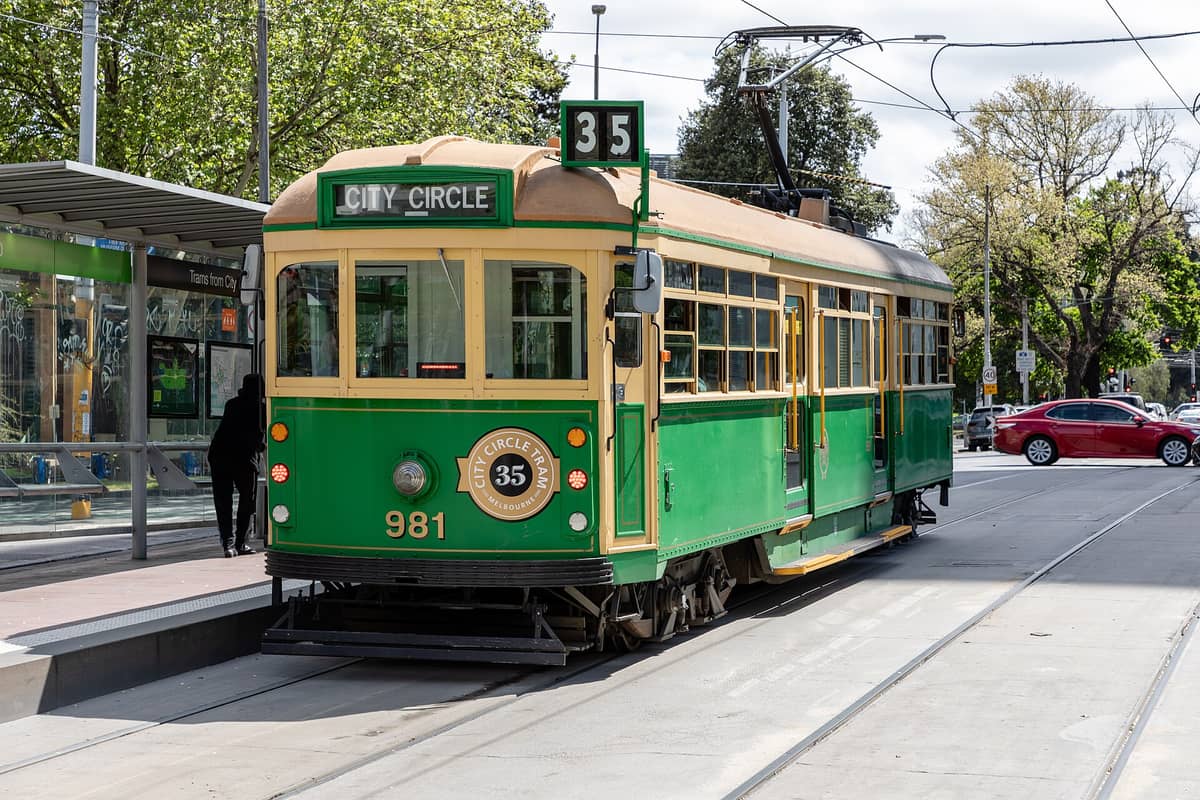
The Melbourne City Circle Tram is a free, continuously looping tram service that traces the outer edge of the CBD grid and extends into the Docklands precinct. It operates as Route 35 in Melbourne's public transport network and has been running since 29 April 1994, when it was introduced specifically as a visitor-friendly way to navigate the city centre. Unlike the rest of Melbourne's tram network, Route 35 requires no myki card, no ticket purchase, and no fare at all. You simply board at any marked stop along the circuit.
The trams used on this route have a distinctive burgundy-and-gold livery and older aesthetic that sets them apart from the low-floor models used elsewhere on the network. Onboard commentary identifies the landmarks passing outside the window, making it useful even if you stay seated for the full loop. The full circuit takes roughly 45 to 60 minutes depending on traffic signals and stop dwell times.
ℹ️ Good to know
No myki card is needed for Route 35. Simply wait at any City Circle Tram stop, No myki card is needed for Route 35. Simply wait at any City Circle Tram stop, look for the burgundy-and-gold tram with the Route 35 designation on the front, and board. The service is free regardless of how many times you ride., and board. The service is free regardless of how many times you ride.
The Route: What You'll Pass
The circuit runs along Flinders Street, Spring Street, Nicholson Street, Victoria Street, La Trobe Street, Harbour Esplanade and Docklands Drive, forming a broad loop around the CBD perimeter and Docklands. Along Flinders Street you pass the facade of Flinders Street Station, one of Melbourne's most photographed buildings, with its ochre dome and clocks. The tram then turns up Spring Street, where the classical stonework of Parliament House Melbourne looms at the top of the rise, framing the eastern edge of the CBD.
The La Trobe Street section passes close to the State Library Victoria, whose forecourt is often occupied by chess players, students, and people eating lunch. From there the route curves around toward the western side of the city before heading into the Docklands waterfront area, offering views of the marina and open water that contrast sharply with the enclosed laneway texture of the CBD interior.
Near the southern end of the loop, the tram passes within easy walking distance of Federation Square and the Yarra River precinct. If you are planning to visit Flinders Street Station, the Ian Potter Centre, or the riverside walks, you can step off here and rejoin the tram later without any additional cost.
Tickets & tours
Live prices and dates from our booking partner. If you book, we may earn a commission at no extra cost to you.
Great Ocean Road reverse itinerary tour from Melbourne
From 77 €Instant confirmationFree cancellationGreat Ocean Road bus tour with a forest walk
From 90 €Instant confirmationFree cancellationYarra Valley Bus Wine Tour including lunch with a glass of wine and chocolate
From 107 €Instant confirmationFree cancellationHidden bars of Melbourne guided tour
From 115 €Instant confirmationFree cancellation
How It Changes Through the Day
In the late morning, departing around 10 am on weekdays, the tram is often at its quietest. Light pours in from the northern side as the service heads along La Trobe Street, and you can usually secure a window seat without difficulty. This is the most comfortable time for the full loop if you want a relaxed, uninterrupted ride.
By midday and into early afternoon, the tram sees more visitors, tour groups, and families with children. Stops near Federation Square and Flinders Street fill quickly, and standing passengers become common in peak tourist season (roughly December through February and during major events). The onboard commentary is harder to follow over the noise, but the energy is also higher and the streetscape more animated.
On Thursday, Friday, and Saturday evenings, when the extended service runs until 9 pm according to published schedules, the mood shifts again. The CBD lights up along Flinders Street and the Docklands marina takes on a different quality after dark, with reflections on the water and the lit facades of the waterfront buildings. Check the current Yarra Trams timetable before planning an evening ride, as operating times may change.
⚠️ What to skip
Published operating hours for Route 35 are 10 am to 6 pm Sunday to Wednesday and 10 am to 9 pm Thursday to Saturday, except Christmas Day and Good Friday. Verify current times at yarratrams.com.au before visiting.
Practical Walkthrough: Getting On and Getting Around
Route 35 stops are marked with signage along the circuit, and the trams generally arrive about every 12 minutes. The most convenient boarding points for most visitors are on Flinders Street near Federation Square and on Spring Street near Parliament House. If you are arriving by train, Flinders Street Station sits within a short walk of multiple Route 35 stops.
The City Circle Tram is a logical starting point for a broader day in the CBD. Board for the full loop to get your bearings, note which stops are closest to what you want to see, then use the tram or your feet to return. Much of central Melbourne falls within the Free Tram Zone, which covers other tram routes as well as Route 35, so you have some flexibility in how you combine transport. The getting around Melbourne guide covers the Free Tram Zone boundaries and how to plan trips across the wider network.
Accessibility note: the City Circle Tram is not serviced by low-floor trams, and its W-Class vehicles have stepped entry. Yarra Trams lists several level-access stops along the route, but passengers who need step-free boarding should use an accessible low-floor tram service and check the stop details.
What to Bring and Photography Tips
Melbourne's weather shifts quickly regardless of season. Afternoon cloud and rain can arrive without much warning. A light layer and a small umbrella or rain jacket are worth carrying. In winter, the tram itself is heated, but waits at exposed stops can be cold and damp.
For photography, the tram's large windows offer reasonable sightlines, though reflections are a constant challenge on bright days. A circular polarising filter helps if you are shooting with an interchangeable lens camera. The Flinders Street and Spring Street sections tend to offer the most architecturally interesting frames, particularly in morning light when shadows fall across the stone facades at a low angle.
If you want to photograph the tram itself rather than from it, the corner of Flinders and Swanston Streets is the most reliable spot, with the station's dome as a backdrop. This is also where you can combine a visit to Hosier Lane and the street art precinct just a short walk east, or drop into the laneways around Degraves Street for coffee before or after the ride.
Historical and Cultural Context
Melbourne has operated trams since the 1880s, and the network grew into one of the largest in the world. By the latter half of the 20th century, tram routes had been cut significantly in many Australian cities, but Melbourne retained and gradually expanded its system. Route 35 was introduced in 1994 as a deliberate heritage tourism initiative, drawing on the city's tram identity to create an experience distinct from simply catching a commuter service.
The route passes through country that is the traditional lands of the Wurundjeri Woi-wurrung and Bunurong peoples of the Kulin Nation, whose connection to this place significantly predates European settlement. The CBD's colonial-era streetscape, with landmarks like Parliament House and the Royal Arcade, reflects the rapid growth Melbourne experienced during the gold rush period of the 1850s and beyond. The tram's commentary touches on some of this layered history, though it operates at a general introductory level.
For visitors who want to go deeper into Melbourne's architectural history, the Melbourne architecture guide covers the buildings you pass in considerably more detail, from the Victorian-era civic buildings along Spring Street to the post-war and contemporary structures that define the CBD skyline today.
Who Should Skip It
The City Circle Tram is not for everyone. If you have already spent a few days in Melbourne and know the CBD layout, the loop adds little that walking or using regular tram routes would not. The onboard commentary is informative but not especially detailed, and experienced travellers or those with a specific agenda may find the fixed route constraining.
Wheelchair users and those who need level-access boarding cannot use this service. Visitors with very young children in bulky prams may also find the stepped entry difficult. The tram can also feel slow if you are trying to get somewhere specific, as it follows a fixed outer loop rather than cutting through the CBD grid directly.
Insider Tips
- Board near the Docklands end of the route in the morning if you want a seat for the full loop.
- The tram's commentary mentions landmarks as you pass them, but it runs on a timer rather than adjusting to traffic. If the tram is running behind, the commentary can be describing something you passed 30 seconds ago. Look ahead of where the speaker is pointing.
- Route 35 does not operate on Christmas Day or Good Friday. If you are visiting over Easter or late December, check the Yarra Trams website in advance.
- Other tram routes within the Free Tram Zone also run at no cost and can get you to inner destinations faster than the City Circle loop. Use Route 35 for orientation, then switch to a directional route for efficiency.
- The Parliament House stop on Spring Street is one of the least crowded boarding points and gives you direct access to the eastern CBD, including the Treasury Gardens and Fitzroy Gardens a short walk away.
Who Is Melbourne Free City Circle Tram For?
- First-time visitors to Melbourne who want a low-effort CBD overview
- Families with children who enjoy the novelty of an older-style tram
- Travellers on a tight budget who want to cover distance without transport costs
- Visitors with limited mobility who can manage stepped entry but prefer sitting to walking long distances
- Photography enthusiasts who want to frame the Flinders Street and Spring Street facades from a moving platform
Nearby Attractions
Other things to see while in Melbourne CBD:
- AC/DC Lane
Renamed in 2004 to honour one of Australia's most iconic rock bands, AC/DC Lane is a compact CBD laneway lined with street art, live music venues, and a raw energy that sets it apart from Melbourne's more polished laneways. Free to visit at any hour, it rewards those who show up after dark.
- Australian Centre for the Moving Image (ACMI)
The Australian Centre for the Moving Image (ACMI) sits at the heart of Federation Square and traces the full arc of screen culture, from silent cinema to interactive digital art. General entry and the permanent exhibition are free, making it one of the most rewarding stops in the Melbourne CBD regardless of your budget or the weather outside.
- Birrarung Marr
Birrarung Marr is a free, open-access riverside park on the northern bank of the Yarra River, a short walk from Flinders Street Station. Built on a former railway yard and opened in 2002, it offers terraced lawns, Indigenous cultural context, city skyline views, and a calendar of public events that transforms the space throughout the year.
- The Block Arcade
Built between 1892 and 1893, The Block Arcade is Melbourne's finest Victorian-era shopping arcade, a covered gallery of mosaic tile floors, ornate plasterwork, and a soaring glazed roof on Collins Street. Free to enter and open daily, it rewards slow exploration and offers one of the CBD's most atmospheric pauses from street-level traffic.
Planning a trip? Discover personalized activities with the Nomado app.