State Library Victoria: Inside Melbourne's Magnificent Free Library
State Library Victoria is one of Melbourne's most architecturally striking public buildings, anchoring the top of the CBD since 1856. Entry is free, the Domed Reading Room is genuinely jaw-dropping, and it works equally well as a cultural visit or a quiet refuge from the city outside.
Quick Facts
- Location
- 328 Swanston Street, Melbourne CBD VIC 3000
- Getting There
- Melbourne Central station (opposite Swanston St entrance); Free Tram Zone trams on Swanston St
- Time Needed
- 45 minutes to 2 hours depending on interest
- Cost
- Free general entry; no ticket required
- Best for
- Architecture lovers, solo travellers, rainy-day visits, history buffs
- Official website
- www.slv.vic.gov.au
What Is State Library Victoria?
State Library Victoria is the oldest public library in Australia and one of the founding cultural institutions of the state of Victoria. It sits at 328 Swanston Street, at the northern end of the Melbourne CBD, and has been serving readers, researchers, and curious visitors since it first opened on 11 February 1856 as the Melbourne Public Library. Today it holds millions of items across books, photographs, maps, newspapers, artworks, and archival records, and it anchors a cultural precinct that includes the Melbourne Museum and the Royal Exhibition Building just to the north.
Unlike many institutions of its scale, the State Library charges nothing at the door. You walk in off one of Melbourne's busiest tram corridors and within thirty seconds you are inside a nineteenth-century sandstone building that opens into spaces of genuine grandeur. That contrast, street noise to vaulted silence, is part of what makes the library worth visiting even if you have no intention of reading a single page.
💡 Local tip
General entry is free and no booking is required. Opening hours are 10am to 6pm daily, but some galleries and specialist spaces close earlier, and hours vary around Christmas and public holidays. Check the official website before visiting.
The Domed Reading Room: The Centrepiece
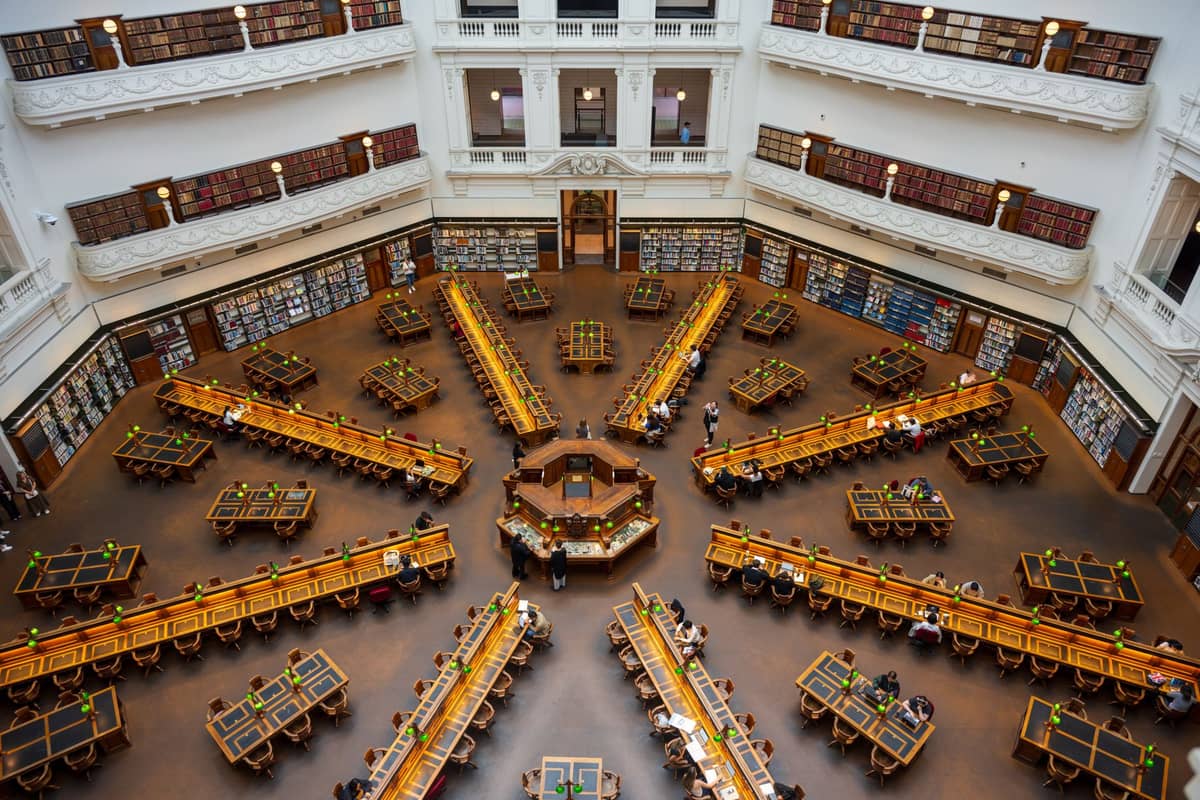
The La Trobe Reading Room, housed beneath the library's octagonal dome, is the architectural reason most people visit. The dome was completed in 1913. When built, the enormous reinforced-concrete structure was the largest in the world. Looking up from the ground floor, you see five concentric tiers of balconies rising to the oculus, lined with reading desks and warm timber detailing. Natural light filters through the dome at different angles depending on the time of day, and the room has a particular quality in the late morning, when the light is direct and the space fills with a pale, diffuse glow.
The room functions as an active reading space, not a preserved museum exhibit. Visitors sit at the desks, open laptops, spread out newspapers. The sound is a particular kind of productive quiet: paper turning, keyboards, the occasional shuffled chair. If you visit on a weekday morning, you will find students, researchers, and writers already settled in. On weekend afternoons the mix shifts, with more tourists circling the upper levels and looking down at the floor below.
Photography inside the reading room is generally permitted for personal use, but tripods and professional lighting equipment require prior permission from the library. The view from the upper balcony levels, looking down at the circular floor below, is the shot most visitors aim for. Access to the room is via stairs or lift; lifts run to the Dome Galleries when these spaces are open.
Tickets & tours
Live prices and dates from our booking partner. If you book, we may earn a commission at no extra cost to you.
Great Ocean Road reverse itinerary tour from Melbourne
From 77 €Instant confirmationFree cancellationGreat Ocean Road bus tour with a forest walk
From 90 €Instant confirmationFree cancellationYarra Valley Bus Wine Tour including lunch with a glass of wine and chocolate
From 107 €Instant confirmationFree cancellationHidden bars of Melbourne guided tour
From 115 €Instant confirmationFree cancellation
History and Cultural Context
The library's founding in 1854, just three years after the Port Phillip district became the separate colony of Victoria, reflects the civic ambition of the early gold-rush era. Victoria's gold boom generated sudden wealth and a desire to build institutions that would signal the colony's maturity. The Melbourne Public Library was one of those signals, intended from the beginning to be both a working collection and an architectural statement.
The building has been extended and modified over more than 170 years, and the result is a complex of interconnected spaces rather than a single uniform structure. Different wings carry different architectural personalities, from the restrained classical facades facing Swanston Street to the interior ironwork of older reading rooms. For visitors interested in how the city's built environment evolved, this layering is worth paying attention to. The Melbourne architecture guide provides useful context for understanding how the library fits into the broader development of the CBD.
The library stands on land that is part of the traditional Country of the Wurundjeri Woi-wurrung and Bunurong peoples of the Kulin Nation. The institution holds significant collections relating to the history of Victoria, including materials documenting both colonial settlement and the experiences of First Nations communities.
What Else to See Inside
Beyond the Domed Reading Room, the library rotates exhibition spaces across multiple gallery areas. Some exhibitions are permanent or long-running displays of collection highlights, including rare maps, historical photographs, and objects connected to Victorian history. Others are temporary shows that change several times a year. The quality and subject matter of temporary exhibitions varies, so it is worth checking the library's events calendar before visiting if a specific show is the draw.
One permanent display that draws consistent interest is the exhibition featuring Ned Kelly's armour. The library holds the actual iron armour worn by the bushranger at the Siege of Glenrowan in 1880, and it is displayed in a way that allows close inspection. For visitors unfamiliar with Kelly's place in Australian cultural history, interpretive material alongside the armour provides context. It is a genuinely arresting object: heavy, roughly made, and unmistakably real.
The library's ground floor also contains a cafe, a bookshop focused on Victorian history and culture, and a range of public computer terminals. Wireless internet access is available throughout the building. If you are planning a day that combines the library with nearby institutions, the best museums in Melbourne guide covers the cluster of major venues within easy walking distance.
Getting There and Practical Logistics
Melbourne Central station sits directly opposite the Swanston Street entrance. The walk from the station's main exit takes under two minutes. The library is also inside the Free Tram Zone, so trams along Swanston Street, Elizabeth Street, and Lonsdale Street stop nearby at no cost. If you are arriving by train from the airport via SkyBus, Southern Cross Station is about a fifteen-minute walk west along Bourke or Lonsdale Street.
The library's Swanston Street location puts it on the route of many CBD walking itineraries. It is a short walk from Melbourne Museum to the north and from Queen Victoria Market to the northwest. If you are spending a full day in the central city, it fits naturally into a morning or early afternoon slot before the reading room becomes more crowded.
ℹ️ Good to know
Accessibility: The library provides accessible entrances, lifts to most public areas, accessible parking spaces, and assistive-technology workstations. A courtesy wheelchair can be booked in advance. Some areas may require staff assistance. Check the library's Access and Inclusion page for current details.
When to Visit and What to Expect
The library is open every day of the year except for Christmas and certain public holidays, generally from 10am to 6pm. Weekday mornings before noon are the calmest period in the main reading spaces. The building picks up significantly from midday onward, particularly in school holidays when student groups move through the exhibition areas. Weekend afternoons can feel noticeably crowded in the dome area, with visitors standing at the balcony railings and the ambient noise level rising.
The library is particularly useful on a day when Melbourne's famously changeable weather turns wet or cold. It is large enough to spend two hours in without retracing your steps, and the interior temperature is stable year-round. Summer visits are comfortable even when the city outside is hot. Winter mornings, when the reading room is quiet and the light through the dome is cool and flat, have their own appeal.
Visitors who find quiet reading spaces rewarding will get more from this than those who need constant visual stimulation or interactive exhibits. If the primary goal is hands-on engagement with technology and science, ACMI a short walk south on Swanston Street offers a more interactive experience. If the goal is free art in a significant building, the Ian Potter Centre: NGV Australia at Federation Square is equally free and a twelve-minute walk away.
Who Should Consider Skipping It
Visitors with very limited time in Melbourne who are prioritising outdoor sights, beaches, or day trips may find the library difficult to justify against competing options. The architecture is the primary draw for non-researchers; if intricate heritage interiors are not of particular interest to you, the experience may not hold attention for long. Families with young children who need interactive or tactile engagement may find the quieter library environment less suited to their visit than venues designed specifically for younger audiences.
⚠️ What to skip
Bag searches may occur at the entrance. Large bags may need to be stored in lockers near the entrance before entering certain collection areas. Lockers are free to use.
Insider Tips
- Take the stairs to the upper balcony levels of the Domed Reading Room rather than just viewing it from the ground floor. The perspective looking down at the circular desk arrangements is very different from looking up, and it is worth the extra few minutes.
- The reading room is quietest on weekday mornings between 10am and noon. If the atmosphere of the space, not just the architecture, is what you are after, this is the window to visit.
- Ned Kelly's armour is a permanent display but is not always prominently signed from the main entrance. Ask staff at the information desk for the current gallery location if you cannot find it.
- The library's lawn forecourt on Swanston Street is a popular lunch spot for local workers on fine days. It is a good place to sit and observe CBD street life without going inside at all.
- Check the library's online events calendar before visiting. Free talks, tours of restricted areas, and exhibition openings occur regularly and are often easy to join without advance booking.
Who Is State Library Victoria For?
- Architecture and heritage enthusiasts who want to see one of Melbourne's finest nineteenth-century interiors at no cost
- Solo travellers looking for a calm, central space that rewards slow exploration
- Visitors caught out by Melbourne's unpredictable weather needing a substantial indoor option
- History-focused travellers interested in Victoria's gold-rush era and colonial development
- Those wanting to see Ned Kelly's armour, one of the most significant objects in Australian cultural history
Nearby Attractions
Other things to see while in Melbourne CBD:
- AC/DC Lane
Renamed in 2004 to honour one of Australia's most iconic rock bands, AC/DC Lane is a compact CBD laneway lined with street art, live music venues, and a raw energy that sets it apart from Melbourne's more polished laneways. Free to visit at any hour, it rewards those who show up after dark.
- Australian Centre for the Moving Image (ACMI)
The Australian Centre for the Moving Image (ACMI) sits at the heart of Federation Square and traces the full arc of screen culture, from silent cinema to interactive digital art. General entry and the permanent exhibition are free, making it one of the most rewarding stops in the Melbourne CBD regardless of your budget or the weather outside.
- Birrarung Marr
Birrarung Marr is a free, open-access riverside park on the northern bank of the Yarra River, a short walk from Flinders Street Station. Built on a former railway yard and opened in 2002, it offers terraced lawns, Indigenous cultural context, city skyline views, and a calendar of public events that transforms the space throughout the year.
- The Block Arcade
Built between 1892 and 1893, The Block Arcade is Melbourne's finest Victorian-era shopping arcade, a covered gallery of mosaic tile floors, ornate plasterwork, and a soaring glazed roof on Collins Street. Free to enter and open daily, it rewards slow exploration and offers one of the CBD's most atmospheric pauses from street-level traffic.
Planning a trip? Discover personalized activities with the Nomado app.