Queen Victoria Market: Melbourne's Oldest and Largest Open-Air Market
Queen Victoria Market has been feeding and surprising Melbourne since 1878. Spread across a city block in the CBD, it combines a working fresh food market with specialty shopping, street food, and a rare slice of pre-Federation Melbourne architecture. Entry is free, and it rewards early risers with the best selection.
Quick Facts
- Location
- Bounded by Peel, Franklin, Victoria and Elizabeth Streets, Melbourne CBD
- Getting There
- Free Tram Zone: routes 19, 57, 58, 59 stop nearby. Short walk from Melbourne Central or Flagstaff stations.
- Time Needed
- 1.5 to 3 hours depending on pace and appetite
- Cost
- Free entry. Budget AUD $20–50 for produce and food depending on purchases.
- Best for
- Food lovers, early-morning explorers, families, and anyone wanting a genuine Melbourne ritual
- Official website
- qvm.com.au
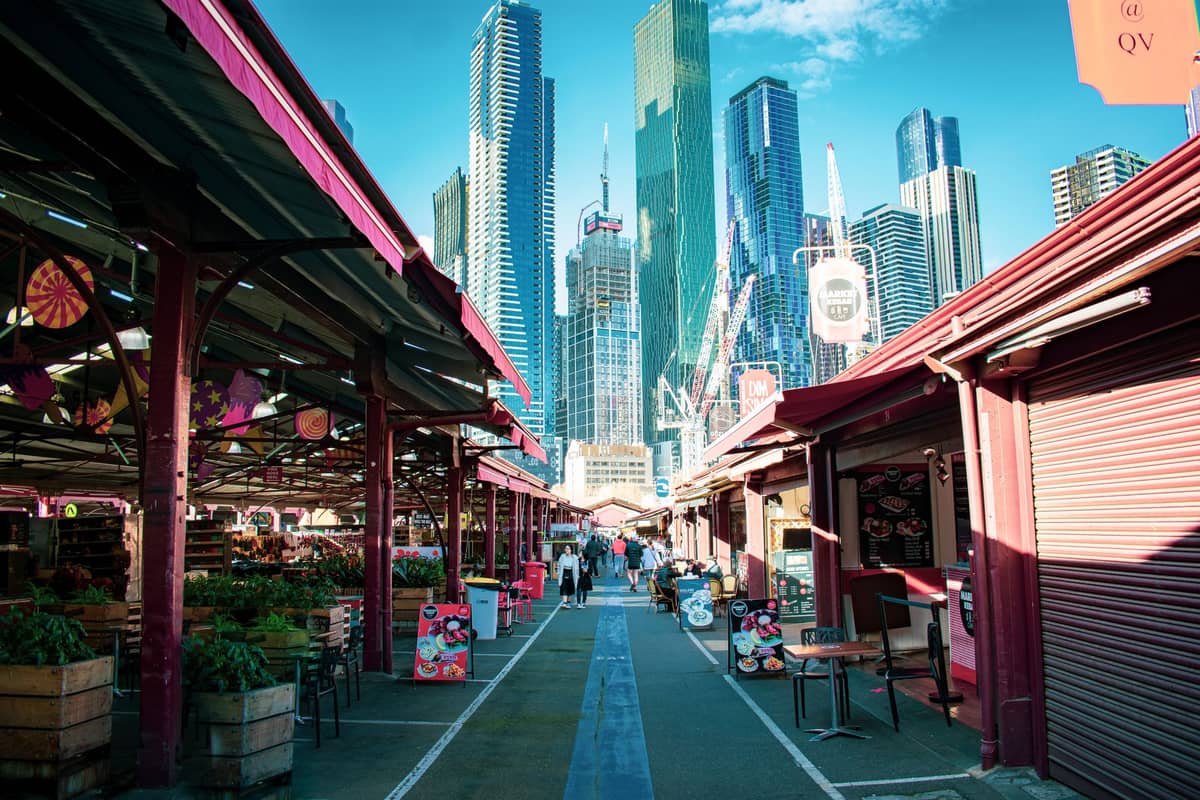
What Queen Victoria Market Actually Is
Queen Victoria Market is Melbourne's oldest continually operating market, opened on 20 March 1878 on the northern edge of the city grid. It occupies a full city block, bounded by Elizabeth, Victoria, Franklin and Peel Streets, making it one of the largest open-air markets in the Southern Hemisphere. Unlike many heritage markets that have drifted into tourist-only territory, QVM still functions as a genuine working market where local households shop for fruit, vegetables, meat, fish, and dairy alongside visitors who are there for the atmosphere.
The market is divided into distinct zones: the sheds and halls of the Upper Market cover fresh produce, deli goods, meat and fish, while the open-air lower section along Elizabeth Street runs general merchandise, clothing, and specialty stalls. The physical arrangement is part of the experience. Narrow lanes between stalls, the clattering of trolleys, the smell of smoked meats drifting from the deli section, and vendors calling prices in quick succession are all part of arriving here on a Tuesday morning.
💡 Local tip
Arrive before 8am on weekdays for the quietest aisles and the freshest produce selection. By 10am on weekends, crowds in the food halls become thick enough to slow your progress considerably.
Opening Hours and Days: Plan Around the Schedule
Queen Victoria Market is open Tuesday and Thursday through Friday from 6am to 3pm, Saturday from 6am to 4pm, and Sunday from 9am to 4pm. It is closed on Monday and Wednesday, which catches many visitors off guard. Specialty shopping opens at 9am every Market day, so the early hours are primarily for fresh food. The market also closes on most public holidays, so checking the official calendar at qvm.com.au before visiting on a long weekend is a practical necessity.
Sunday has a noticeably different character from weekday mornings. The fresh produce section sees lighter foot traffic from locals, while the general merchandise and specialty stalls attract a more tourist-oriented crowd. Saturday sits between the two: locals arrive early for the week's groceries, and by mid-morning the atmosphere shifts into something more leisurely. If you want to understand why Melbourne residents treat QVM as an institution rather than just an outing, a weekday morning visit will show you faster than any weekend.
Tickets & tours
Live prices and dates from our booking partner. If you book, we may earn a commission at no extra cost to you.
Great Ocean Road reverse itinerary tour from Melbourne
From 77 €Instant confirmationFree cancellationGreat Ocean Road bus tour with a forest walk
From 90 €Instant confirmationFree cancellationYarra Valley Bus Wine Tour including lunch with a glass of wine and chocolate
From 107 €Instant confirmationFree cancellationHidden bars of Melbourne guided tour
From 115 €Instant confirmationFree cancellation
The Halls and Sheds: A Physical Walkthrough
The Meat and Fish Hall is the most architecturally striking of the interior spaces. The long covered hall, with its timber frames and suspended lighting, has the practical feel of a building that has never stopped being used. Butchers work through their stock from early morning, and the fish section has the briny, sharp smell you would expect. The hall is accessible by wheelchair from both the Elizabeth and Queen Street entrances, as well as from the Dairy Produce Hall.
The Dairy Produce Hall connects through and carries a selection of cheeses, antipasto, olives, and continental-style deli goods that reflect Melbourne's long history of Southern European migration. The stalls here pack in densely, and the sample culture is real: vendors will hand you a slice of aged pecorino or a piece of Hungarian salami without any obligation. It is a slower section to walk through simply because pausing is built into the experience.
The open-air sections along Elizabeth Street carry a more eclectic mix: clothing, homewares, souvenirs, and specialty goods. The quality here is more variable. For food-focused visitors, the fresh produce sheds and deli halls are the core draw. The merchandise area is worth a pass-through but rarely the reason anyone remembers their visit.
ℹ️ Good to know
A wheelchair is available to borrow at the Information Hub in F Shed, Shop 1. Accessible parking is available in both of the market's car parks.
Historical Context: What the Site Represents
The land on which QVM stands carries significant historical weight beyond its role as a retail space. Before the market was established, the site held Melbourne's first cemetery, which received the remains of many of the city's earliest European settlers as well as members of the Wurundjeri Woi-wurrung and Bunurong peoples of the Kulin Nation, on whose lands Melbourne was founded. The cemetery was partially cleared for the market's development in the 1870s, a contested history that periodically resurfaces in local preservation debates.
The market sheds themselves are listed on the Victorian Heritage Register, and the upper market sheds date to the late nineteenth century. This physical continuity with the 1870s and 1880s is rare for a working market of this scale anywhere in Australia. The heritage protections mean the sheds have not been dramatically rebuilt or modernised, which preserves a utilitarian character that more polished food halls tend to lose.
If you are interested in the broader history and architecture of central Melbourne, the market pairs naturally with a walk toward State Library Victoria and the civic buildings of the CBD. The Melbourne architecture guide covers the layers of the city's built heritage in more detail.
Food at the Market: What to Actually Eat
The prepared food options at QVM have expanded considerably over the past decade. A cluster of food stalls near the main sheds serves breakfast and brunch items: wood-fired bagels, organic juices, spiced Turkish breads, freshly shucked oysters, and rotating hot food depending on the day and season. The options are eclectic and reflect Melbourne's range of food cultures, which is a fair representation of the city's wider food character.
For self-catering visitors or those staying in apartments nearby, the fresh produce prices are competitive and the quality is consistently strong. The fruit and vegetable section moves quickly, and vendors rotate their display throughout the morning. Come too late and the choice narrows; come early and you are selecting from a full spread. Cheese, cured meats, fresh pasta, and bread from the deli halls round out what you need for a serious picnic or a few days of cooking.
Melbourne's food scene extends well beyond the market. For context on where QVM fits in the city's eating culture, the what to eat in Melbourne guide covers the city's broader culinary range, and the multicultural food guide traces the immigrant communities whose produce and cooking traditions shaped the market's character.
Practical Details: Getting There, Timing, and Staying Comfortable
The market sits within Melbourne's Free Tram Zone, so arriving by tram costs nothing. Routes 19, 57, 58, and 59 all stop within easy walking distance. From the rail network, Melbourne Central Station is roughly a seven-minute walk south, and Flagstaff Station is a comparable walk to the east. On weekends, the walk from either station is straightforward. Car parks on site provide accessible parking, but driving into the CBD on Saturday morning means competing for space with a significant number of other visitors.
Melbourne's weather deserves a practical note. The market sheds provide substantial cover, but the merchandise section along Elizabeth Street is fully exposed. In summer, temperatures can reach the high 30s Celsius, and the open areas become uncomfortable by midday. In winter, mornings start cool with temperatures sometimes in the single digits. Dressing in layers and bringing a bag for produce are both genuinely useful adjustments. A reusable bag or small trolley is standard equipment among regular shoppers.
⚠️ What to skip
The market closes on most public holidays, including several that visitors might not anticipate, such as Melbourne Cup Day and Easter Saturday. Check the current schedule at qvm.com.au before visiting around any long weekend.
Photography is generally unobstructed in the open sections. Inside the food halls, the light is moderate and the scenes are genuinely photogenic: stacked vegetables, hanging cuts of meat, densely packed deli counters. Wide-angle lens users will get more from the hall interiors than telephoto shooters. Be considerate with vendors before photographing them directly; most are accustomed to it, but a brief acknowledgment is standard courtesy.
Is QVM Worth Your Time? An Honest Assessment
Queen Victoria Market is worth visiting once, and for many people, significantly more than once. The combination of genuine working market, accessible heritage architecture, street food, and free entry makes it a reliable morning outing with a low risk of disappointment. It is not a curated experience, and it does not try to be. The stalls are crowded together, the floors are bare concrete in many sections, and vendors are focused on moving product rather than providing a guided experience.
Those looking for a tranquil or boutique shopping experience should look elsewhere. The weekend crowds in peak season are substantial, and navigating a fully stocked shopping trolley through the deli section alongside other visitors and their own trolleys requires patience. Visitors who do not eat meat or fish will find the fresh produce and deli sections still offer considerable interest, but the Meat and Fish Hall, which is architecturally the most impressive, has limited appeal for them.
If the market appeals to you as part of a broader exploration of Melbourne's food and shopping culture, the Melbourne markets guide covers the city's other major markets including South Melbourne and Prahran, which have distinct characters worth comparing.
Insider Tips
- The best weekday window is Tuesday between 6:30am and 8:30am. The food halls are calm, vendors are attentive, and the produce is at its freshest. By 10am even on weekdays the central aisles become crowded.
- The Information Hub in F Shed (Shop 1) is the place to ask about accessible facilities, borrow a wheelchair, or find a locker. It also posts the most current closure dates, which are easier to check here than navigating the website on a phone.
- Bring cash as well as a card. Most stalls accept both, but some smaller produce vendors still prefer cash, and it speeds up transactions when vendors are busy.
- If you want a cooked breakfast at the market, arrive before 9:30am. The hot food stalls around the main sheds are genuinely good but attract queues by mid-morning on weekends, and some sell out of popular items.
- The car parks fill quickly on Saturday mornings. If you are driving, arriving before 8am almost guarantees a space; arriving at 9:30am often means circling. The tram network is a more practical option for most CBD and inner-suburb visitors.
Who Is Queen Victoria Market For?
- Food lovers who want to shop alongside Melbourne locals rather than in a tourist-oriented setting
- Self-catering travellers staying in serviced apartments who want quality produce at fair prices
- Families with children, who cope well with the sensory variety and open space between sheds
- History-minded visitors interested in nineteenth-century Melbourne and its built environment
- Early risers who want to anchor a morning walk through the northern CBD
Nearby Attractions
Other things to see while in Melbourne CBD:
- AC/DC Lane
Renamed in 2004 to honour one of Australia's most iconic rock bands, AC/DC Lane is a compact CBD laneway lined with street art, live music venues, and a raw energy that sets it apart from Melbourne's more polished laneways. Free to visit at any hour, it rewards those who show up after dark.
- Australian Centre for the Moving Image (ACMI)
The Australian Centre for the Moving Image (ACMI) sits at the heart of Federation Square and traces the full arc of screen culture, from silent cinema to interactive digital art. General entry and the permanent exhibition are free, making it one of the most rewarding stops in the Melbourne CBD regardless of your budget or the weather outside.
- Birrarung Marr
Birrarung Marr is a free, open-access riverside park on the northern bank of the Yarra River, a short walk from Flinders Street Station. Built on a former railway yard and opened in 2002, it offers terraced lawns, Indigenous cultural context, city skyline views, and a calendar of public events that transforms the space throughout the year.
- The Block Arcade
Built between 1892 and 1893, The Block Arcade is Melbourne's finest Victorian-era shopping arcade, a covered gallery of mosaic tile floors, ornate plasterwork, and a soaring glazed roof on Collins Street. Free to enter and open daily, it rewards slow exploration and offers one of the CBD's most atmospheric pauses from street-level traffic.
Planning a trip? Discover personalized activities with the Nomado app.