Polly Woodside: Melbourne's 19th-Century Iron Barque
Polly Woodside is a beautifully preserved 1885 iron sailing barque moored at South Wharf, Southbank. Open just twice a month under National Trust care, it offers a rare, hands-on encounter with the era of deep-sea cargo shipping. This guide tells you exactly when to go, what you'll see, and whether it's worth your time.
Quick Facts
- Location
- 21 South Wharf Promenade, South Wharf VIC 3006 (Southbank precinct)
- Getting There
- Tram routes and nearby stops vary; check the current PTV network map. Southern Cross Station is a 10–15 min walk
- Time Needed
- 1.5 to 2.5 hours
- Cost
- Open Day: adult A$16, child A$9.50, family A$43. Pirate Day: adult A$25, child A$15. National Trust members free.
- Best for
- Maritime history enthusiasts, families with young children, architecture and engineering buffs
- Official website
- www.nationaltrust.org.au/places/polly-woodside
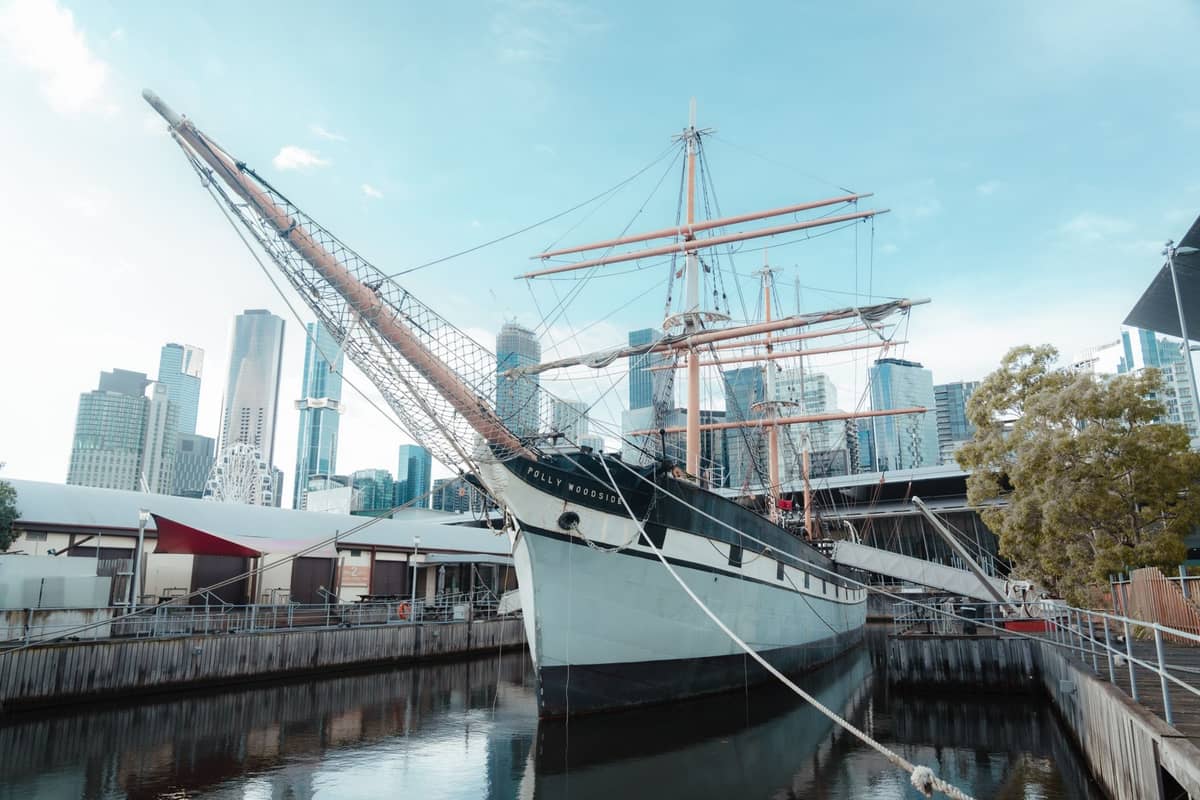
What Is Polly Woodside?
Polly Woodside is a 59-metre iron barque built in Belfast in 1885, now permanently moored at the 1875 Duke's & Orr's Dry Dock at Southbank. It is one of the few surviving examples of a working Victorian-era cargo sailing vessel in the Southern Hemisphere, and it is managed by the National Trust of Australia (Victoria). The ship opened to the public in January 1978 and has since become one of Melbourne's most distinctive heritage sites, even if it sits somewhat under the radar compared to the city's larger cultural institutions.
The vessel originally launched under the name Polly Woodside, was renamed Rona in 1904 during its working life, and was later restored to its original name when conservation efforts began. Over its operational decades it carried bulk cargoes including nitrates and coal on the demanding Cape Horn and Pacific routes. At 70 metres overall length with a 9-metre beam, it is a substantial physical object: standing at the bow and looking aft along the deck gives a genuine sense of how these ships actually worked rather than how they appear in romanticised paintings.
⚠️ What to skip
Polly Woodside is NOT open daily. It opens on the first Sunday of each month (Polly Woodside is NOT open daily. It opens on the first Sunday of each month (Open Day, 10 am–4 pm; guided tours at 10:30 am, 11:30 am, 1:30 pm and 2:30 pm) and the third Sunday (Pirate Day, 10 am–1 pm). Plan your visit carefully around these dates or you will find the gates locked.) and the third Sunday (Pirate Day, 10 am–1 pm). Plan your visit carefully around these dates or you will find the gates locked.
The Two Types of Visit: Open Day vs. Pirate Day
The National Trust runs two distinct monthly events. Open Day, held on the first Sunday of the month, is the more straightforward heritage experience. The site is open from 10 am to 4 pm, with guided tours at 10:30 am, 11:30 am, 1:30 pm and 2:30 pm, and prices at A$16 for adults, A$13 concession, A$9.50 for children aged 3–15, A$43 for a family of two adults and two children, and A$30 for a single-parent family of one adult and two children. Additional children are A$5 each. National Trust members enter free on both event days. with prices at A$16 for adults, A$13 concession, A$9.50 for children aged 3–15, A$43 for a family of two adults and two children, and A$30 for a single-parent family of one adult and two children. Additional children are A$5 each. National Trust members enter free on both event days.
Pirate Day, held on the third Sunday of each month, is a themed family event running 10 am to 1 pm. Admission is higher at A$25 for adults, A$20 concession, and A$15 per child, reflecting the added programming. Staff and volunteers dress in period costume, and the event is structured around interactive storytelling for younger visitors. If you are traveling with children under 10, Pirate Day tends to generate more engagement; if you have a genuine interest in maritime history, Open Day gives you more time and a quieter atmosphere to absorb the detail.
💡 Local tip
Arrive within the first 30 minutes of opening. The upper deck and the hold areas attract the most visitors and can feel crowded once tour groups arrive mid-morning.
Tickets & tours
Live prices and dates from our booking partner. If you book, we may earn a commission at no extra cost to you.
Great Ocean Road reverse itinerary tour from Melbourne
From 77 €Instant confirmationFree cancellationGreat Ocean Road bus tour with a forest walk
From 90 €Instant confirmationFree cancellationYarra Valley Bus Wine Tour including lunch with a glass of wine and chocolate
From 107 €Instant confirmationFree cancellationHidden bars of Melbourne guided tour
From 115 €Instant confirmationFree cancellation
What You Actually See Aboard
The experience begins before you board. The ship sits in the Duke's & Orr's Dry Dock at Southbank. Approaching along the promenade you see the full profile of the hull, riveted iron plates darkened with age, and three stripped masts rising well above the surrounding wharf sheds. The scale is the first thing visitors comment on. Even experienced travelers who assume they know what a 19th-century cargo ship looks like find the physical reality more imposing than expected.
Boarding is via a gangway, and guided tours take visitors around the vessel. The rigging, though not in a sailing configuration, gives a clear sense of the weight and complexity of managing a square-rigged barque at sea. Interpretive panels throughout the ship cover the construction process in Belfast, life for sailors on Cape Horn passages, and the cargo trade that made vessels like this commercially essential in the late 19th century. The panels are well-written and pitched at adult interest without being dry.
Below decks, the hold and crew quarters are accessible and offer the most atmospheric part of the visit. The smell of old timber, iron, and bilge water is genuinely present, which is not unpleasant but is distinctive. The crew cabin dimensions make it immediately clear how little space sailors actually had on long voyages. Interpretive exhibits in these spaces include original navigational instruments, cargo manifests, and period photographs. Volunteers are usually on hand and are knowledgeable; asking them questions tends to yield far more detail than the panels alone provide.
Historical and Cultural Context
Melbourne's position as a major port city in the late 19th century depended on exactly the kind of vessels that Polly Woodside represents. Ships of this class connected the colony of Victoria to global commodity markets, carrying wool, grain, and metals out and manufactured goods in. The South Wharf area where the ship is now moored was itself an active working port during this period. Today the precinct has been substantially redeveloped for restaurants and event spaces, and the contrast between the heritage vessel and its polished surroundings is stark. The Southbank precinct that surrounds the ship now caters primarily to dining and leisure, which is worth keeping in mind when planning your day: the waterfront restaurants along South Wharf Promenade are a practical lunch option before or after your visit.
The National Trust's conservation of Polly Woodside is considered significant in Australian heritage terms. Iron-hulled sailing vessels from the 1880s are rare survivors globally, and most have been lost to breaking yards or neglect. The decision to preserve and open this ship to the public in the late 1970s was part of a broader wave of Australian maritime heritage awareness, and the restoration work carried out over subsequent decades has maintained the vessel in a condition that allows close examination of its construction methods.
Getting There and Navigating the Precinct
The ship is located at 1–23 South Wharf Promenade, South Wharf VIC 3006. Check the current PTV network map for the nearest tram stop and route; the precinct sits just outside the Free Tram Zone boundaries. Southern Cross Station is a 10–15 minute walk along the river. If you are already spending time in, the ship is walkable from the Arts Centre end of the precinct in around 20 minutes along the riverbank. Southern Cross Station is a 10–15 minute walk along the river. If you are already spending time in Southbank, the ship is walkable from the Arts Centre end of the precinct in around 20 minutes along the riverbank.
Parking is available at nearby South Wharf facilities, but driving to this part of Melbourne on a Sunday morning is rarely necessary given public transport options. Rideshare services drop off directly at South Wharf Promenade. The surrounding streets and promenade are flat and paved, but note that boarding the ship requires using a gangway and navigating stairs once on deck. The National Trust advises that the museum and main deck are accessible, but full exploration of the ship including below-decks areas involves steps that may limit access for some visitors.
Photography, Timing, and What to Wear
Morning light on Open Day works well for exterior photography. The ship faces roughly east-west along the wharf, so the port side catches good light in the first two hours of opening. Below-decks photography requires patience with low light; a phone camera with a decent night mode will handle it, but flash tends to flatten the textures that make those spaces interesting. The rigging against an open sky gives some of the cleanest compositional opportunities on board.
Melbourne's weather is variable year-round; on the ship, exposure to wind is real and there is little shelter on the open deck. Comfortable walking shoes with non-slip soles are sensible given the metal deck surfaces and gangway. If you are visiting with children, be aware that the deck has open rail sections that require supervision of younger kids. For broader context on when Melbourne weather is most agreeable for outdoor attraction visits, the best time to visit Melbourne guide covers seasonal patterns in useful detail.
Is Polly Woodside Worth Your Time?
Honestly, this depends on your interests. Polly Woodside is not a large-scale museum with a broad range of exhibits. The entire experience is one ship, and if maritime history does not engage you, two hours on board will feel like enough after one. For travelers who find 19th-century industrial engineering, the economics of global shipping, or the physical conditions of Victorian-era seafarers genuinely interesting, it is a rewarding and specific experience that few other Melbourne attractions replicate. It also fits naturally into a day that includes the broader Southbank area, particularly if you are already visiting the Arts Centre Melbourne or the NGV International nearby.
Visitors looking for a broad survey of Melbourne's cultural offerings in a single day may find the limited opening schedule difficult to work around. The monthly-only format means you cannot simply slot it into any itinerary. But that same scarcity is part of what makes each visit feel considered rather than routine. The volunteers who staff the ship tend to be genuinely passionate about the history, which lifts the experience considerably above a typical heritage site.
Travelers on a tight budget should note that this is not a free attraction. If you are looking for cost-free ways to spend a Sunday in Melbourne, the free things to do in Melbourne guide covers a wide range of alternatives. But at under A$20 for adults on Open Day, Polly Woodside is not expensive by Melbourne attraction standards, and the National Trust membership pays for itself quickly if you plan to visit multiple heritage sites.
Insider Tips
- Check the National Trust website in the week before your planned visit to confirm the event is running — Open Days are occasionally rescheduled for public holidays or maintenance.
- If you have any interest in Australian maritime history, ask a volunteer about the Cape Horn passages. The accounts of rounding the Horn in an iron barque in the 1880s are more dramatic than any of the interpretive panels convey.
- The view from the bow looking back toward the Melbourne CBD skyline is one of the more unusual urban photography angles in Southbank and worth a few minutes regardless of your interest in the ship itself.
- National Trust membership is available for purchase on the day; if you plan to visit more than two or three National Trust sites in Victoria, the annual membership cost covers the entry savings quickly.
- Pirate Day has a shorter operating window — it closes at 1 pm rather than 4 pm. If you are traveling with young children and plan to combine it with lunch at South Wharf, account for the earlier finish when booking a table.
Who Is Polly Woodside For?
- Maritime history and 19th-century industrial engineering enthusiasts
- Families with children aged 5–12, especially on Pirate Day
- Travelers who appreciate hands-on heritage sites over conventional museum displays
- Visitors combining a Southbank arts and culture day with a distinctive outdoor attraction
- National Trust members already planning to visit multiple Victorian heritage sites
Nearby Attractions
Other things to see while in Southbank:
- Arts Centre Melbourne
Arts Centre Melbourne is the city's principal performing arts complex, anchored by the iconic 162-metre Spire rising above Southbank. From orchestral concerts in Hamer Hall to theatre, dance, and cabaret across multiple stages, the precinct offers far more than a single night out.
- Eureka Skydeck
Perched on Level 88 of Eureka Tower in Southbank, Melbourne Skydeck sits roughly 285 metres above the Yarra River. Whether you come at midday for sharp sightlines or at dusk for the city lights, the views are genuinely panoramic — but timing, weather, and crowd levels make a real difference to the experience.
- NGV International
NGV International is Australia's oldest and most visited art museum, housed in a landmark 1968 building on St Kilda Road. The permanent collection is free to enter, the architecture alone justifies the visit, and major ticketed exhibitions run throughout the year.
- Royal Botanic Gardens Victoria
Established in 1846 on the traditional lands of the Kulin Nation, Melbourne Gardens is one of Australia's most significant botanic collections. Entry is free, the grounds are open daily, and the experience shifts dramatically depending on when you arrive.
Planning a trip? Discover personalized activities with the Nomado app.